
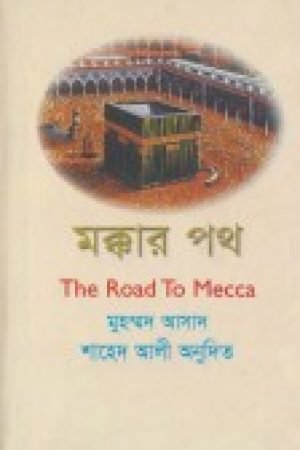
“Two Words”
‘The Road to Mecca’ is a translation of the book ‘The Road of Mecca,’ written by the renowned thinker, author, and journalist Muhammad Asad. Muhammad Asad was born a Jew. But even in his adolescence, he lost his attraction to Judaism. As he grew older, he became increasingly disillusioned with the West’s new modern way of life and its modes of living. On the one hand, the materialistic consumerism of the West, and on the other, the priests’ otherworldly, body-detached spiritual thought distanced him from the Western sphere and turned him toward the East. He became attracted to the Arab way of life and to Islam’s moderate, harmonious philosophy of life, which reconciles body and soul. In 1921, he embraced Islam and adopted the name Muhammad Asad.
‘The Road of Mecca,’ or ‘The Road to Mecca,’ is Muhammad Asad’s spiritual autobiography. While describing his varied experiences during his travels through different countries, he has presented the story of his spiritual awakening. In this book, his diverse experiences of life on the road, the way of life in the Arab world, and its comparative features in relation to Eastern and Western ways of life are narrated in the form of a story; at the same time, it portrays the moving story of the realization of truth by an unsatisfied, truth-seeking mind.
Needless to say, this book was written by one of the thoughtful sages of our age, who is not an ordinary, irrational, emotion-driven convert to Islam. He is an extraordinarily gifted person who, before embracing the faith, sought to understand it and grasp its essence in the light of all his learning and intellect.
This captivating book of exceptionally high literary quality has been translated into Bengali by the renowned fiction writer and Islamic thinker Shahed Ali, former editor of ‘Islami Foundation Patrika’ and ‘Sabuj Pata.’ There is no doubt that his magical hand, trained in the language of storytelling, has achieved remarkable success in translating this book’s descriptive literary language; any reader will enjoy its lucid and graceful style, and we can happily say that no one will grow weary during its long journey through so many pages. That is why we are publishing this book in a renewed form as a gift to readers. Rather than calling ‘The Road to Mecca’ a translation, it may be called a new creation—an original addition to Bengali literature.
We hope that, through reading this book, readers will find new food for thought in understanding Islam’s religious ideals and awaken to an even deeper faith in Islam.
—Sharif Hasan Torafdar
Publisher
Foreword
I probably first heard, while still at school, the news that a Jewish scholar named Leopold Weiss had embraced Islam; but I learned only much later that he was a writer and an exceptionally talented thinker. His Muslim name was Muhammad Asad. Although he remained vivid in my memory, I had not yet had the good fortune to read any of his writings. He was in India during the British period; after the establishment of Pakistan, he was director of the Islamic Reconstruction Organization of the Government of West Punjab, and he edited a highly distinguished English periodical called ‘Arafat.’ I knew nothing more about him.
One day, probably around 1958, Barrister A. M. Mustafa, who later became a minister in Pakistan’s central government, said in the course of conversation, ‘Brother, have you read ‘The Road of Mecca’? Of all the books I have read in my life, this is the book.’
Mustafa Bhai was not merely a famous lawyer; he was also an uncompromising, active Islamic cultural worker and a discerning reader. He kept up-to-date knowledge of where in the world the finest writers had written books on Islam. Hearing his enthusiastic praise of ‘The Road of Mecca,’ I became eager to obtain the book, and after a few days I had a copy sent by parcel from Lahore. Once I had the book in my hands, I immersed myself in it. Becoming Asad’s companion on his long and thrilling spiritual journey from childhood to his acceptance of Islam, I too traveled through various countries of Europe and Asia—along roads and across remote places, through markets and villages, cities and ports, and over the sea—and saw the world anew. Gradually, Islam’s complete form unfolded petal by petal before my eyes. I read ‘The Road of Mecca’ again and again, and as I read, I realized in my heart that a Bengali translation of this book would open a new horizon of the Islamic outlook on life for Bengali-speaking readers.
Despite my limited means and lack of time, I began translating the book and continued publishing it serially in the Islamic Academy journal edited by me. Owing to the subject matter and Asad’s extraordinary literary style, even my inadequate translation created a tremendous response among readers; many became subscribers to the Islamic Academy journal solely because of this translation, and they expressed their displeasure whenever publication of the journal became irregular.
‘The Road of Mecca,’ or The Road to Mecca, is Muhammad Asad’s spiritual autobiography. Asad has written the story of his life in a storytelling style. More delightful than a novel, this narrative, authenticated by Asad’s personal experience, has become an unprecedented analysis of Islam for people of this age. From beginning to end, the book is suffused with a new flavor and an original charm that not only gives readers pleasure but enriches them with a deeply satisfying experience. As the author’s traveling companion, the reader too finally reaches Mecca—the spiritual heart of Islam and the center of the Islamic outlook on life—and his long journey along the path of Islam is completed; in Asad’s words, this is ‘home-coming’—a return to one’s own home.
Muhammad Asad was a journalist, thinker, and unique interpreter of Islam—but essentially he was a creative genius endowed with spiritual vision; ‘The Road of Mecca’ is one of his extraordinary creations. He dedicated the book to his wife, Pola Hamida Asad. In presenting this creation through the medium of the Bengali language, I have tried, as far as possible, to convey Asad’s thrilling experiences while preserving the rhythm, flow, turns of phrase, and style of the original. But no creation can ever be translated word for word. Therefore, I do not claim to have rendered Asad’s incomparable creation fully in my own language. My consolation, however, is that from beginning to end this translation was driven by my innate love of creative writing and my lifelong affection for the Islamic way of life. By placing the translation of this book in the hands of Bengali-speaking readers, I have fulfilled a responsibility I imposed upon myself; for this, the reward belongs to Muhammad Asad, in the presence of the Most Merciful Allah. Countless eager and interested readers urged me unceasingly to complete the translation and publish it in book form; whenever we met, they raised the subject. At last, their eager wait has ended and their demand has been fulfilled; I therefore feel relieved of a burden and give thanks to Allah. Among all these countless readers, I must not fail to mention Brother Shah Abdul Hannan. Whenever my enthusiasm for the translation flagged, his earnest interest and insistence renewed my encouragement.
During the first stage of translating the book, Mohammad Azizur Islam and Sheikh Tofazzal Hossain, formerly of the Islamic Academy, recorded my oral translation for a long time. During the second stage, the poet Masud-us-Shahid carried out the entire responsibility. Masud spent a valuable part of his daily life on this work with great pleasure, while Abdul Muqit Chowdhury gladly undertook the responsibility of proofreading. Kalam Azad of Islamic Foundation Press prepared the index of the book. Each of them is dear to me; I do not wish to diminish the value of their sincere assistance by merely offering thanks.
Jnanakosha Prakashani has earned the gratitude of the entire Bengali-speaking readership by publishing the book’s third edition.
Shahed Ali
Some Words about the Dramatic Life of Allama Muhammad Asad
Professor Shahed Ali
The brightest star of wisdom and intellectual brilliance fell from the sky of the Muslim world in 1994. In the eyes of the Western world, the light of this star was fierce and dazzling; therefore, for nearly a century they pretended not to see it even while keeping it before one eye. This sage was born in the West, in a European environment. Yet he challenged the present Western civilization, advanced in knowledge and science, exposing before the world the bottomless emptiness hidden behind its external splendor. For this reason, the Western world continually tried to ignore him with irritation. News of his death received no publicity in the Western media.
A night-blind person sees neither the moon nor the stars, just as a blind person does not see the sun; likewise, the radiance of this star’s light was never fully reflected in the eyes of the Muslim world. Thus, even when the brightest star in its sky fell, the Muslim world felt no sense of emptiness—nothing about the rising or setting of the sun or stars matters to the blind. They have no media of their own either. Moreover, even in what media they do have, this death received little importance. It was said that his dying wish was to be buried in Mecca—where he had lived for a long time, discovered Islam, become its finest interpreter and representative, embraced Islam, proclaimed its superiority before the entire world, and written a book as world-stirring as ‘Road to Mecca.’ But his wish was not fulfilled. He died in Spain and was buried there.
Muhammad Asad, whose name before embracing Islam was Leopold Louis, lived for about twenty-six or twenty-seven years in Tangier, Morocco, with his wife, Pola Hamida Asad. He had entered into an agreement with Rabitat al-Alam al-Islami to translate the Holy Qur’an, together with a concise commentary. When the commentary on the first ten juz’ was published, some scholars disagreed with some of his interpretations. Asad then severed his relationship with the organization and went to Morocco; despite financial hardship, and with help only from his wife and a few friends, he decided to complete and publish the translation and tafsir on his own. After twenty long years of effort, he published his translation and tafsir. He fulfilled, for the modern world, the duty of preparing the most modern translation and commentary of the Holy Qur’an.
Leopold Louis was born in 1900 in the city of Lemberg, in present-day Poland, into a Jewish family. His grandfather was the last rabbi of a Jewish rabbinical, or priestly, family that had extended over several generations. Although his father had been educated to become a traditional Jewish rabbi, he abandoned that family tradition, studied law, became a prominent lawyer, and married into a banking family. Alongside his ordinary schooling, Louis learned to speak and read Hebrew fluently and became well acquainted with Aramaic. At that age, he became thoroughly familiar with the original text and commentaries of the Talmud. Many years later, on this subject, he wrote in his spiritual autobiography, ‘Road to Mecca’: ‘It seemed to me that the God of the Old Testament and the Talmud was occupied with the rituals by which His worshippers should worship Him. It also seemed to me that God had been astonishingly preoccupied from the beginning with the fate of one particular nation. The very structure of the Old Testament, as the history of Abraham’s descendants, seems to suggest that God is not the Creator and Sustainer of all humanity, but rather a tribal deity who continually makes the whole creation conform to the needs of a chosen nation.’
Although disappointed with Jewish doctrine, Louis did not pursue spiritual truth by any other route. After the First World War, he enrolled at the University of Vienna and, with a fair degree of arrogance, devoted himself to studying the history of art and philosophy. But this academic life failed to quench his inner thirst for discovering religious meaning. Nor did it satisfy his desire for adventure. After the First World War, Vienna was desperately engaged in trying to regain its distinctiveness and identity. The war and the collapse of the six-hundred-year-old Habsburg monarchy had shattered the foundations of old values and traditions. Even before that, they had become targets of attack by art connoisseurs and intellectuals. Influenced by a skeptical family, Louis, like many other boys of his generation, directly rejected all formal religion. His aim then was action, adventure, and excitement. Driven by this urge, he wanted to join the Austrian army under an assumed name, since he was not yet eighteen. His dream therefore failed. Four years later, when he was legally old enough to enlist in the military, his dream of military glory had already been shattered. For a revolution occurred only a few weeks later; the Austrian Empire collapsed, and the war ended as well.
But Louis had no attraction whatsoever to academic life. He felt a desire to confront life deeply—a longing to enter into life. Rather than taking refuge in the defenses that security-loving people build around themselves, Louis wanted to enter life; he wanted to find his own way toward understanding the spiritual order and discipline behind everything.
A distinctive feature of the early decades of the twentieth century was spiritual emptiness. All the values to which Europe had been accustomed for many centuries lost their own outlines and became formless and shapeless in what happened between 1914 and 1918. No new values appeared anywhere that could fill that emptiness. A sense of fragility and uncertainty, forewarnings of social and psychological upheaval, gave rise in young minds to the suspicion that nothing in human thought and endeavor was permanent. Louis and other young people like him could find no dependable support for their spiritual unrest; bewildered by questions arising from the absence of any reliable moral standard, they could find no one to give them satisfactory answers. Louis saw that ‘science says knowledge is everything, yet without a moral goal knowledge can create only chaos.’ There is no doubt that the social reformers, revolutionaries, and communists of that time wanted to build a nobler and happier world. But Louis’s sharp vision saw that they were all thinking only in the light of external social and economic conditions and, in seeking to correct defects in these areas, had elevated the materialist concept into a new anti-metaphysical metaphysics. They saw that many things happening around them in the world were profoundly inconsistent with the imagined divine attributes. The forces controlling human destiny seemed clearly distinct and separate from the qualities attributed to Allah. From this they concluded that there was no such thing as God. The self-righteous guardians of religion had dressed Allah in their own garments and severed Him from human destiny, making Him unrelated to it. But this did not solve the problem; in personal life, this uncertainty and instability about what one ought to do could lead to terrible disorder and create contempt for human education, culture, and sense of beauty. Because of this innate realization, Louis did not stop there. For him, the desire to build a noble life became an aid in seeking a creative path of hope. Driven by this urge, he enrolled at the University of Vienna and chose the history of art as his principal subject. But the subject did not satisfy Louis. He saw that his teachers—including the distinguished scholars Strzygowski and Dvořák—were excessively occupied with discovering the aesthetic rules by which artistic creation is governed; they had made very little effort to uncover the spiritual vibrations at its core. In other words, in Louis’s view, their approach to art was narrowly confined to the forms and styles through which art finds expression.
During the days of his youthful confusion, Louis became acquainted with the conclusions of the new psychoanalytic science that had captivated Europe, but he was not satisfied by them—and found no answer to his questions—even though psychoanalytic theory had appeared as a first-class revolution. His belief that the discovery of the role of unconscious desires in shaping human personality had unquestionably opened a path to deeper self-understanding did not last long. To him, the excitement of Freudian thought was as intense as the intoxication of wine. In Vienna’s cafés, he listened absorbedly to heated debates among some of the early pioneers of psychoanalysis—scholars such as Alfred Adler, Hermann Stickel, and Otto Gross—but Louis was disturbed by the intellectual arrogance of this new science. In his view, ‘This science seeks to reduce all the mysteries of the human soul to a number of nervous actions and reactions.’ He realized that the conclusions of this new discipline lacked even the capacity to bring one close to ultimate truths. Nor did he find in it any direction toward a new path to a noble and elevated life. After the Great War, the widespread collapse of generally accepted values began; in its course, many restrictions governing relations between men and women also loosened. It was a plunge from one condition into its complete opposite, where everything had become a subject of dispute. In other words, people were cast from their faith in humanity’s uninterrupted upward progress to Spengler’s bitter pessimism, Nietzsche’s moral relativism, and the spiritual emptiness created by psychoanalysis. Among young men and women driven by bodily desire, sexual relations became indiscriminate, casual, and free. Leopold Louis felt that this was nothing more than a revolt against empty convention. He thought that perhaps the terrible loneliness separating one person from another might be dispelled through the union of man and woman. Amid this mental agitation and restlessness, he could no longer continue his university studies. His father wanted to make him a scholar with a PhD. But abandoning that path, and against his father’s wishes, he chose a journalistic life—he would become a writer, and writing would be his profession. From Vienna he reached Prague, where, at an old café called the Westend, he became acquainted with a magical circle of artists and writers. After some time, his father learned of this and wrote to him: ‘I can now see clearly that you will die as a wandering vagabond, lying beside a gutter in the street.’ The fiercely self-confident, stubborn young Louis replied, ‘No.’ He had realized that he wanted to be a writer; he had come to believe that the world of writers was eagerly waiting for him, its generous arms extended wide.
But in those days, gaining access to any famous newspaper was difficult. Day after day he walked the streets of Berlin because he had no money for the subway or a taxi. For many weeks he lived on nothing but tea and the two pieces of bread his landlady gave him in the morning. In those days, his lot was utter fasting. And his nightly dreams were packed with fresh, thick slices of bread spread with butter.
In the midst of this extreme poverty, he spent some time working as an assistant to a film producer, then earned some money by writing a film scenario for his Viennese friend Eston Kueh and later writing another scenario. After that, he spent another year doing various temporary jobs in different cities of Central Europe, and finally entered the world of newspapers in 1921. Dr. Demart, a wealthy member of the German Catholic Center Party and a prominent figure in German politics, was preparing, with the cooperation of United Press of America, to launch a news agency called United Telegraph. Applying for a position as an assistant in his organization, Louis obtained work as a telephone operator. For his ambition, this was an extremely disappointing job. But he had no choice but to accept it. After working there for a month, he secretly arranged an interview in Berlin with Madame Maxim Gorky, who had come there during the terrible famine in Russia in 1921 to build public opinion for effective relief and assistance in the capitals of Central Europe. Through that interview, Leopold Louis, the telephone operator, became a reporter. He became a journalist.
Leopold Louis was then a twenty-two-year-old, exuberant young man. Louis and other young people his age were restless with the desire to change society and rebuild it anew. How should society be structured so that people could live truly full lives? How should their relationships be arranged so that everyone could break out of the loneliness and isolation surrounding each person and spend life in genuine mutual friendship and cooperation? What is good, what is evil, what is destiny—or, put differently, what should a person do so that, in the truest sense, he may be one and identical not merely in words but with his life, and say: I and my destiny are not separate—they are one!
The prevailing atmosphere of moral and social uncertainty everywhere gave birth to reckless optimism. Its expression appeared, on the one hand, in the daring experimentation of the music, painting, and theatre of that period, and, on the other, in an often revolutionary search, groping blindly for the structure and outlines of culture. Yet alongside this optimism, artificially kept alive, there was also a spiritual void. An indistinct, arrogant relativism was born within a growing pessimism. Nothing was proceeding as naturally and orderly as before in the emotionally overwrought, oppressed, dissatisfied, and agitated European world after the Second World War. Lewis came to see that the real deity of the Western world was no longer anything spiritual. Its sole object of worship was comfort. For the average European—whether democrat, communist, labourer, or intellectual—meaningful faith lay in the worship of material progress, because there could be no other purpose in life than to make life continually easier. In the language of the time, the sole purpose of life was to liberate human beings from nature’s grip. The temples of this new religion were vast factories, cinemas, chemical laboratories, dance halls, and zoological institutions. And the priests of such temples were bankers, engineers, politicians, film stars, statisticians, education directors, record-makers, aviators, and commissars. Amid universal disagreement over the concepts of good and evil, and the resort to expediency in all social and economic matters, a moral failure was revealed—the same expediency that may be compared to a street prostitute, who gives her body whenever and to whomever she is desired. At that age Lewis saw that an insatiable lust for power and pleasure had inevitably divided the Western world into mutually opposed groups. Each of these groups was armed with deadly weapons, and whenever their mutual interests were threatened, they became desperate to destroy one another. The highest standard of right and wrong then was practical utility—worldly success. Describing Lewis’s condition at that time, Lewis himself said: “I saw how unhappy and confused life had become. How slight the bond between one person and another. Although society and nation were being exalted with deafening, frenzied shouting. How far we had moved from the world of our instinctive feelings. And how narrow and dim our souls had become. At that time, Europe was the beginning and end of all our thoughts.”
Lewis says: “But my inability to share in the divergent social, economic, and political hopes and aspirations of those around me, or of any group among them, gradually took the form within me of the vague idea that I was not really one of them, that I had no connection with them; and together with it arose the desire that I must belong to someone— but whom? I must be part of something—but what?” With this longing and restlessness filling his heart, in 1922, at the age of twenty-two, he travelled to Jerusalem in the Arab country, responding to the call of the Qur’an. Through long association with the Arabs, he found the answer—whose member he would become, and of what he would be a part. As a correspondent of the world-famous Frankfurter Zeitung, he came to Jerusalem and, a few years later, travelled through Palestine, Transjordan, Iraq, Persia, and Afghanistan. During his stay in Jerusalem, he first came into contact with Islam and became attracted to the Arabs’ way of life. After close association with the Arabs, he discovered that traditional Muslim society possessed an innate harmony between mind and senses—something Europe had lost. Among them he discovered certainty of heart and freedom from self-doubt, a freedom beyond the dreams of Europeans. At last Leopold Lewis found the answer to what he would belong to, and in 1926, on returning to Europe, he and his wife embraced Islam. His Muslim name became Muhammad Asad. Asad’s autobiography, The Road to Mecca, calls his acceptance of Islam a “return to his own home.” After embracing Islam, Asad lived in Arabia for nearly six years, gaining a deep familiarity with Arab life and language. He became close to King Ibn Saud. He then left Arabia for India, where he met the great Muslim poet and philosopher, Allama Iqbal. On Iqbal’s advice, Asad abandoned his plans to visit East Turkestan, China, and Indonesia and remained in India to interpret and analyse the intellectual foundations of the Islamic state. At that time, the Islamic state existed only as the dream of a visionary poet’s dream-filled mind. In Muhammad Asad’s words: “For me, as for Iqbal, it was a dream—the symbol of a way, indeed the only way, to revive all the slumbering souls of Islam: the creation of a people’s political entity whose cohesion would be based not on common flesh and blood, but on common allegiance to an ideal. For many years I devoted myself to this goal through study, writing, and lecturing, and in time acquired some renown as an interpreter of Islamic law.” But this was not merely some renown; it was, in fact, worldwide fame.
When Pakistan was established in 1947, its government invited Muhammad Asad to establish and direct an institution called the Department of Islamic Reconstruction. Its aim was to present in detail the ideal Islamic concepts concerning the state and society, upon which the newly born political organisation could rely for its ideological guidance. After carrying on this highly stimulating work for two years, Muhammad Asad joined the Pakistan Foreign Service. In Pakistan’s Foreign Office, he became head of the Middle East Division. Muhammad Asad supplied all the historical facts and documentary evidence supporting the successful campaign of arguments and information that Pakistan conducted at the United Nations on behalf of the Palestinians against Zionism. In the Foreign Office, he devoted himself to strengthening relations between Pakistan and the Muslim world. During this period, Muhammad Asad was appointed Minister Plenipotentiary to Pakistan’s mission at the United Nations. Later, toward the end of 1952, he resigned from this post and devoted himself to writing his immortal work, The Road to Mecca.
The Story of the Story
The story I am about to tell in this book is not the autobiography of a notable person because of his role in public affairs; nor is it a narrative of adventurous exploits—for although many remarkable adventures occurred in my life, they were merely incidental to what was taking place within me, and never more than that. Nor is it the story of a conscious effort to search for religious faith—for that faith entered my life over many years, without any effort on my part to attain it. My story is simply that of a European’s discovery of Islam and his gradual merging into Muslim society.
I had never thought of writing this book, for it had never occurred to me that my life could be of any particular interest to anyone but myself. But when, after spending twenty-five years outside the Western world, I came to Paris and from there to New York at the beginning of 1952, I was compelled to change my opinion. Since I was then serving as Pakistan’s Minister Plenipotentiary at the United Nations, everyone naturally had their eyes on me; among my European and American friends and acquaintances I became an object of immense curiosity. At first they imagined that my work was that of a European “expert” whom a government of the East had employed for a specific purpose, and that I had adapted myself, for my own convenience, to the customs of the nation I served. But when my activities at the United Nations became clear, they were somewhat astonished to realise that I had identified myself not only in practical matters but also emotionally and intellectually with the political and civilisational aims of the Muslim world in general. As the days passed, more and more people began to ask about my past. They learned that I had begun my career very early as a foreign correspondent for Continental newspapers and, after travelling extensively throughout the Middle East for several years, had become a Muslim in 1926; that after embracing Islam I had lived in Arabia for nearly six years and had succeeded in gaining the friendship of King Ibn Saud; that I had then left Arabia for India, where I met the spiritual father of the idea of Pakistan—and the great Muslim poet-philosopher Muhammad Iqbal. It was he who, within a short time, persuaded me to abandon my plans to travel through East Turkestan, China, and Indonesia, and to remain in India to interpret and analyse the intellectual foundations of the future Islamic state, which at that time was no more than a dream in Iqbal’s visionary mind. For me, as for Iqbal, this dream symbolised a way—indeed, the only way—of reviving all the slumbering hopes of Islam: the creation of a people’s political entity whose cohesion would rest not on common blood and ancestry, but on common allegiance to an ideal. For many years I devoted myself to this goal through study, writing, and lecturing, and in time acquired considerable renown as an interpreter of Islamic law and civilisation. When Pakistan was established in 1947, its government invited me to establish and direct a department called the “Department of Islamic Reconstruction”; its purpose was to set out in detail the ideal Islamic concepts of state and society on which the newly born political organisation could rely for ideological guidance. After carrying on this highly stimulating work for two years, I joined the Pakistan Foreign Service. In Pakistan’s Foreign Office I was appointed head of the Middle East Division. There I devoted myself to strengthening the bonds and relations between Pakistan and the rest of the Muslim world; and during this period I was eventually appointed to Pakistan’s mission at the United Nations in New York.
All this points to something far deeper than a European’s merely adapting outwardly to life in a Muslim society: it signifies the conscious and wholehearted withdrawal of allegiance from one cultural family and the declaration of allegiance to an entirely different cultural environment. To many of my Western friends this seemed utterly astonishing. They could not picture how a man born, raised, and educated in the Western world could so completely and openly, without suppressing anything within himself, identify with the Muslim world; how he could replace his Western cultural inheritance with an Islamic one; or what could have compelled him to adopt a religious and social ideal which they had taken for granted as vastly inferior to all European ideas.
But why, I began asking myself, did my Western friends take this matter for granted? Had they ever truly felt the need to approach the essence of Islam directly? Or were their opinions based on distorted ideas inherited from previous generations and on a few conventional phrases? Could it be that the ancient Greek and Roman way of thinking—which divided the world into Greeks and Romans on the one hand and barbarians, or barbarian peoples, on the other—was still so deeply embedded in the Western mind that it was theoretically incapable of acknowledging any clear and definite value in anything lying outside its own cultural orbit?
From the time of the Greeks and Romans, European thinkers and historians have been inclined and willing to understand the history of the world only through the light and meaning of European history and Western cultural experience. In this picture, non-Western civilisations enter only when their existence, or particular movements arising within them, have had or are having a direct influence on the fate of Western humanity; and for this reason, in the Western view, world history and its various cultures are ultimately no more than an expanded history of the West!
Naturally, such a narrow perspective gives rise to a distorted view. Since Western people are familiar in detail and vivid colour with writings that portray their own culture or discuss the problems of their own civilisation, while doing little more than occasionally turning their heads to glance here and there at the rest of the world, the average European or American easily falls prey to the mistaken notion that the Western cultural experience is not only superior to that of the rest of the world, but so vast in scale that no comparison between the two is possible; and therefore that the Western way of life is the only acceptable standard by which other ways of life can be judged. This naturally implies that any intellectual idea, social institution, or moral evaluation that does not conform to this Western ideal or model is essentially an element of an inferior way of life. Following in the footsteps of the Greeks and Romans, the Western world likes to think that all those different civilisations, past or present, are merely experiments obstructing the path of progress that the West is infallibly following; or, at most, they are—as in the case of civilisations that developed directly before modern Western civilisation along the same line—several successive chapters of the same book, with civilisation, of course, being its final chapter.
When I expressed this view to an American friend of mine—someone of considerable intellectual ability, whom one might call a scholar by temperament—he initially expressed some doubt.
“Granted,” he said, “the ancient Greeks and Romans displayed a limited outlook when judging foreign civilisations; but was this limitation not the inevitable result of the difficulty of communication between them and the rest of the world? And has not this difficulty been largely overcome in modern times? In any event, we Westerners nowadays certainly keep ourselves informed about what is happening beyond our own cultural orbit. Are you not forgetting the large number of books published in Europe and America during the last quarter-century about Eastern art and philosophy, and about the political ideas shaping the minds of the various peoples of the East? Surely it would be unfair to disregard the Western desire to understand what other cultures may have to offer!”
“Perhaps there is some truth in what you say,” I replied. “There is no doubt that the original Greek-Roman outlook is no longer fully active today. It has lost much of its rigidity and edge, not for any other reason but because the more mature thinkers among Western intellectuals have become disappointed and doubtful about many aspects of their own civilisation. In some of them, the realisation is beginning to dawn that human progress may not have a single book and a single story, but may consist of many books and many stories; and this simply because, historically speaking, humanity is not a homogeneous entity but a diverse association of different groups, possessing widely divergent ideas about the meaning and purpose of human life. Yet I do not think that the Western world has truly begun to display a more benevolent, patronising attitude toward foreign cultures than did the Greeks and Romans; it may be said only that the West has become more tolerant. But remember—this tolerance is not toward Islam, but only toward certain specific Eastern cultures that offer a kind of spiritual attraction to Western people afflicted by spiritual hunger, while at the same time remaining so remote from the Western worldview that they are not regarded as presenting any real challenge to its values.”
“What do you mean by that?”
“Look,” I replied, “when a Westerner discusses, say, Hinduism or Buddhism, he is invariably conscious of the fundamental difference between these doctrines and his own. He may admire this or that feature of them, but naturally he will never agree to consider replacing his own ideas with them. Since he acknowledges this impossibility from the outset, he can think about these alien cultures with mental poise and often with sympathetic understanding. But when Islam is concerned—which is not nearly as opposed to Western values as Hindu or Buddhist philosophy is—this Western poise is almost always and inevitably disturbed by emotional prejudice. Could it be, I sometimes wonder with astonishment, that Islamic values constitute a particularly veiled challenge to many Western ideas of spiritual and social life precisely because they are so close to Western values?”
And I began to tell him of a theory that had occurred to me several years earlier—a theory which, in my view, might also help to explain more clearly the deep-rooted hostility toward Islam so often found in Western literature and contemporary thought.
“To find a truly convincing explanation for this hostility,” I said, “you must look far back into history and try to understand the psychological background of the early relations between the West and the Muslim world. The roots of what Western people today think and feel about Islam lie in the pressure of deep influences and the imprint of memories born during the Crusades.”
“The Crusades!” my friend exclaimed in astonishment. “You surely do not mean that what happened nearly a thousand years ago can still influence people of the twentieth century?”
“But it certainly does. I know it will sound incredible. But do you not remember how incredulously the early discoveries of the psychoanalysts were received, when they tried to prove that much of an adult’s emotional life—and almost all the apparently meaningless tendencies, tastes, and idiosyncrasies contained in the phrase ‘individual temperament’—could be traced to various experiences of early childhood, the most formative period of his life? Well, are nations and civilisations anything other than collective individuals? Their development too is inseparably connected with their early childhood experiences. As with children, these childhood experiences may have been pleasurable or painful; they may have been entirely rational or, conversely, the result of a childishly simple misinterpretation of an event. The power of each such experience to alter the mind depends chiefly on the intensity with which it began. The century immediately preceding the Crusades—that is, the period marking the end of the first thousand years of the Christian era—can easily be described as the early childhood of Western civilisation…”
I reminded my friend—who was himself a historian—that this was the age in which, after the dark centuries following the collapse of the Roman Empire, Europe had for the first time begun to discern its own cultural path. At that very moment, new literature began to be created in the various mother tongues of the European peoples, with little connection to the nearly forgotten Roman tradition; the arts gradually came alive under the inspiration of Western Christianity’s religious experience, recovering from the mental exhaustion caused by the warlike migrations of Goths, Huns, and Avars. A new cultural world was being born from the immature condition of the early Middle Ages. At precisely that turning point, at the most fragile and sensitive moment of its self-development, the Crusades inflicted on it the greatest shock of its life—a “trauma,” in modern language, an emotional wound capable of becoming the cause of mental illness……
The Crusades were an immense collective pressure upon a civilisation that had only just begun to become self-conscious. Historically speaking, the Crusades were Europe’s first and wholly successful attempt to see itself in the light of cultural unity. Before or after the enthusiasm and excitement generated by the First Crusade, Europe never underwent any experience comparable to it. A powerful wave of madness swept across the continent—an exhilaration that, for the first time, broke through all barriers between different states, tribes, and classes. Before this there had been the Franks, Saxons, Germans, Burgundians, Sicilians, Normans, and Lombards—a jumble of different tribes and peoples with almost nothing in common except this: nearly all their feudal kingdoms and provinces were remnants of the Roman Empire, and they were all Christians. But in the Crusades, and through them, this religious bond was raised to a new level: the political-religious idea of a “Christian kingdom,” a common aim of all Europeans. In the end, this gave birth to a Europe-based cultural consciousness. When, in November 1095, Pope Urban II, in his famous speech at Clermont, urged the Christians to wage war against the “heathen nations” occupying the Holy Land, he perhaps unknowingly proclaimed the charter of Western civilisation.
The experience of intense emotional trauma resulting from the Crusades gave Europe its cultural consciousness and its unity; but ultimately this same experience began to apply the false coating of colour through which Islam subsequently appeared to Western eyes—not merely because the Crusades meant war and bloodshed. How many wars have taken place among different nations, only to be completely forgotten by those nations later—and how many hostilities and enmities that had seemed to them indelible were later transformed into friendship! The harm caused by the various Crusades was not confined to the clash of weapons. First and foremost, it was psychological harm: the poisoning of the Western mind against the Muslim world through a deliberate misrepresentation of Islam’s teachings and ideals. For the justification of the Crusading call to be maintained, the Prophet of the Muslims had necessarily to be identified as the Antichrist, and his religion portrayed in the vilest terms as a source of licentiousness and perverse taste. The ridiculous notion that Islam was a religion of crude sensuality and savage conflict, not of purification of the mind, a religion of ritual observance, entered the Western mind during the Crusades and has remained there ever since. At that time, Europeans transformed the name of the Prophet Muhammad—the same Muhammad who instructed his community to honour the prophets of other religions—with hatred and contempt into “Mahound.” The age of free inquiry in Europe was still far in the future. It was therefore easy for the forces then in existence to sow the black seeds of hatred and hostility against a religion and civilisation entirely different from Western religion and civilisation. Thus it is no accident that the fiery Chanson de Roland—in which the imaginary victory of the Christian kingdom over the Muslim infidels of southern France is narrated—was not composed while these wars were being fought, but three centuries later, that is, shortly before the First Crusade; and it immediately became Europe’s “national anthem.” Nor is it accidental that the epic poetry composed about these wars marks the beginning of a “European” literature, clearly distinct from the earlier regional literature: the childhood of European civilisation rests upon an intense hatred of Islam.
It seems an irony of this very history that the hostility toward Islam nurtured in the West for centuries, religious in origin, still survives in its subconscious even at a time when religion has almost entirely lost its authority over the imagination of Western man. Of course, this is not really surprising. We know that the religious beliefs instilled in a person during childhood remain with him throughout life—‘And this,’ I conclude my argument, ‘is exactly what happened in the collective personality of Western civilization. The shadow of the Crusades still stretches over Western civilization; and in all its reactions toward Islam and the Muslim world there are unmistakable traces of that deathless ghost…’
My friend remains silent for a few moments. I can still see that tall, slender man pacing about the room. His hands are in his coat pockets; he shakes his head as though somewhat bewildered, and at last he says:
‘There may be something substantial in what you say—there really may be—although I am not in a position to examine your theory just now; I cannot judge it at the moment. In any case, your life, which seems to you very simple and free of complications, must certainly appear utterly astonishing and unusual to Western people. Why do you not write your autobiography? I am sure it would be a very absorbing and interesting book.’
Laughing aloud, I replied: ‘Yes, in order to write such a book I might perhaps accustom myself to leaving the Foreign Service. After all, writing is my real profession…’
The joking reply I had given gradually faded from my mind, without my realizing it, over the following weeks and months. I began to think deeply about recording the story of my life and thereby helping, however modestly, to remove the thick veil that has hidden Islam and its culture from the Western mind. My entry into Islam was in many ways a unique and unparalleled event: I did not become a Muslim because I had lived among Muslims for a long time; rather, I decided to live among them because I had embraced Islam. Could I not, by making Western readers acquainted with my own personal experience, contribute more to mutual understanding between the Islamic and Western worlds than I could in the diplomatic post I held—a post that could be filled just as effectively by others from our country? In short, any intelligent person could become Pakistan’s representative at the United Nations—but how many people are able to speak to Westerners about Islam as I can? I am a Muslim, but it is also true that I was born in the Western world; therefore I can speak in the language of the educated of both Islam and the Western world…
And for this reason, toward the end of 1952, I resigned from the Pakistan Foreign Service and began writing this book. I cannot say whether it has become the kind of ‘absorbing book’ my American friend had hoped for. With the help only of a few old notes, scattered diaries, and some of the articles I had written for newspapers at the time, I had no choice but to journey back into the past through the intricate lines of a development and evolution that had unfolded over many years and across a vast geographical expanse.
And this is the story—not the story of my entire life, but only of those years before I left Arabia on the road to India: those exciting years I spent traveling through almost all the countries between the Libyan Desert and the snow-covered peaks of the Pamir Plateau, and between the Bosphorus and the Arabian Sea. This story is told against a particular background—and it must be remembered that it is set against my last journey through the desert, from the interior of Arabia to Mecca, toward the end of the summer of 1932; for during those twenty-three days, the pattern of my life became completely clear to me.
The Arabia described in the following pages no longer exists. Its solitude and cohesion collapsed suddenly under the tremendous impact of oil thrust violently upward and under the weight of the gold that oil brought with it. Its noble simplicity has vanished, and with it has vanished the uniquely human quality it possessed. When one feels sorrow for something precious that has now been lost forever and can never be recovered, I remember, with that sorrow, the last long journey across the desert—when the two of us rode on, and rode, each upon a camel, through the swimming light…
Thirst
One
The two of us are riding two camels, moving on and on; the sun blazes overhead, light glitters and scorches everywhere—a solitude and sun-scorched silence—and through it we two men ride upon our two camels, swaying in the rhythm and motion of travel that lulls a person to sleep and makes him forget the day, the sun, the hot wind, and the long road. Here and there, clumps of yellow grass crown the dunes, and in places bushes of tangled hamd-vine lie coiled upon the sand like enormous pythons. The senses seem to have fallen asleep. I sway in the saddle. I hear nothing—the sound of sand being crushed beneath the camel’s feet, or the rubbing of the wooden saddle peg against the inside of my knees. I have covered my face with the folds of my turban to protect it from the sun and wind. It seemed to me that I was passing through my own solitude as if it were a tangible object, a substance that could be held and touched—yes, passing through it toward the wells of Tayma… toward those deep wells of Tayma that give water to the thirsty… Straight through the Nufud toward Tayma, I heard a voice. I do not know whether it was a voice heard in a dream or the voice of my companion:
—‘Were you saying something, Zayd?’
—‘I was saying,’ my companion replied, ‘that not many people would dare cross the Nufud straight across merely to see the wells of Tayma.’
Zayd and I had gone to Qasr Asaymin, on the Najd–Iraq frontier, at the request of King Ibn Saud. We were returning from there. Once my work was finished, I had plenty of free time, so I decided to visit the distant and ancient oasis of Tayma, situated about two hundred miles to the southwest. It was the ‘Tema’ of the Old Testament, concerning which Isaiah said, ‘The inhabitants of Tema bring water to the thirsty.’ Tayma’s abundant water and its great wells have no equal anywhere in Arabia. Because of this water and these wells, Tayma had, in pre-Islamic times, become a major center of caravan trade and a shrine of ancient Arab civilization. I had long wished to see the place. So instead of taking the roundabout routes used by desert caravans, we plunged straight into the vast Nufud from Qasr Asaymin. Between the uplands of central Arabia and the Syrian Desert stretches the red-sand desert of the Nufud, immense in extent. In this terrifyingly desolate region there is no footprint, no road. The wind seems to have taken responsibility for ensuring that no human or animal step can leave a lasting mark in the soft, yielding, shifting sand, and that no feature of the land remains long enough to guide a traveler. Under the wind’s pressure, the outlines of the dunes are constantly changing, flowing in a slow, imperceptibly gentle movement and taking shape after shape. Mountains are transformed into valleys, valleys into valleys, and valleys assume new forms, making a soft murmuring sound. Even to a camel’s mouth that grass tastes like bitter ash!
I have crossed this desert in many directions. Even so, I would not have the courage to find my own way through it without assistance. So I was immensely happy to have Zayd with me. Zayd was a man of this part of the country. His tribe was the Shammar, whose settlements lay along the southern and eastern borders of the Nufud. When the dunes suddenly turn into dense green fields after the winter rains, they graze their camels in the midst of the Nufud for several months of the year. Zayd’s bond with the desert’s changing moods was a bond of blood; his heart beat in tune with it.
Of all the people I have met to this day, Zayd seems the finest. He had a broad forehead, a slender body of medium height, a handsome build, tremendous strength, a well-formed, powerful jaw, and a narrow, wheat-colored face, at once stern and sensual. It possessed the expected gravity that is a special characteristic of the desert Arabs—a self-contained dignity tempered by sincere warmth. He was a fine combination of pure Bedouin blood and life in a Najdi town; though free from the defects of Bedouin extravagance, he retained the Bedouin’s instinctive certainty, and though he had escaped the material artificiality of townspeople, he had acquired their worldly wisdom. Like me, he had lived an adventurous life full of incident and excitement. During the Great War, the Turkish government formed an irregular camel corps for an expedition into the Sinai Peninsula, and as a boy Zayd had been one of its soldiers. He had also fought to defend the settlements of his Shammar tribe from Ibn Saud’s attacks. For a while he smuggled arms in the Persian Gulf. In many parts of the Arab world he had passionately loved many women. Of course, at some time or other he had legally married each of them, and then divorced them according to the law. He had traded in horses for a while in Egypt. In Iraq he had been a soldier of fortune; finally, for nearly five years, he had been my companion in Arabia. And now, toward the end of the summer of 1932, the two of us were once again riding camels, as we had done so many times before, wandering along lonely paths among the dunes; we stopped beside wells with broad courtyards and rested at night beneath the glittering sky. The camels’ feet made a swishing sound over the hot sand; from time to time, in step with the camels’ footfalls, Zayd would sing in a monotonous voice. At night we pitched our tent, made coffee, cooked rice, and sometimes prepared the meat of wild animals we had hunted. As we lay upon the sand at night, the wind brushed us with a cool touch. The sun rose over the dunes; the reddish sun shattered in a tremendous explosion like fireworks, and sometimes, as today, we saw the miraculous manifestation of life among the grasses and plants after water had suddenly appeared.
We have stopped for the noon Salat, and I am washing my hands, face, and feet with water from a waterskin. A few drops trickle down onto a dry clump of grass near my feet—a helpless little tuft, yellowed by the sun’s merciless heat, drooping lifelessly upon the sand. But as soon as a few drops fall upon it, a wondrous shiver runs through its curled leaves; I can clearly see them unfolding before my eyes. A few more drops… The little leaves move, curl up, and then slowly, as though shyly trembling, straighten themselves. Holding my breath, I pour a little more water over the tuft. The grass moves more quickly and more violently, as though some invisible force were jolting it awake from the sleep of death. And its leaves—what a joyful sight! They begin to contract and expand like the arms of a fish, as though overcome by a shy yet irresistible excitement, in a genuine momentary explosion of sensual delight. What had seemed dead only moments earlier thus finds life returning within it—openly, powerfully, a life before which death is vanquished, whose richness lies beyond the grasp of human understanding.
In the desert, you always feel life in its royal form. Because sustaining life is so difficult, so arduous, life in the desert always seems a blessing, a treasure, a wonder. And the desert is always full of surprises. Even after knowing the desert for many years, there is always room for astonishment. Sometimes, when the desert seems to lie before our eyes in all its harshness and emptiness, it appears to awaken from a dream and begin to breathe again; where yesterday there was nothing but sand and bits of stone, we suddenly see tender, pale-green grass springing up. The desert begins to breathe once more, and a flock of small birds starts flying through the air with the sound of beating wings. From where have these slender, long-winged emerald-green birds come, and where will they go? Or perhaps a swarm of locusts suddenly rises into the sky with fierce speed and a humming roar, gray and hungry, savage and boundless like an army of warriors…
The manifestation of life in its royal form: because life is rare in the desert, its royal form is always wondrous, always astonishing, and here lies the whole nameless fragrance of Arabia’s sandy deserts and its many other changing landscapes!
Sometimes the road passes over lava soil—black and uneven; sometimes over endless dunes. A thorn-covered wadi or valley lies between two rocky hills, and now and then a startled, frightened rabbit leaps from the bushes across our path. At times we find loose sand marked by the tracks of gazelles and two or three stones blackened by fire, upon which travelers long ago, lost in the womb of oblivion, cooked their food on some forgotten day. Sometimes we glimpse a village shaded by a line of palms, while wooden wheels turn above a well and create a kind of music—and travelers listen to that unbroken music. Sometimes we come upon a well in the middle of a desert valley, surrounded by Bedouin herders crowding around to water their thirsty sheep and camels. Singing in chorus, they draw up water in large leather bags, and as it pours with a splash into leather vessels, the animals’ excitement reaches its height. Above all this lies the solitude of the steppe, overwhelmed by the relentless sun; here and there, yellow grass and thick-leaved bushes spreading branches like snakes and creeping over the ground make certain places inviting pasture for camels. A solitary acacia-like tree may stand with its branches spread against the steel-blue sky. Golden lizards emerge from among mounds of earth and stones, darting their gaze right and left, then vanish again like a shadow, like something spectral. People believe that these golden lizards never drink water. In a sunken hollow stand black tents made of striped wool. Toward afternoon, a herd of camels may be driven home, with herders riding the bare backs of young camels. When they call their animals, the desert silence seems to sip and swallow their voices; without stirring an echo, the voices disappear into the silence.
Sometimes, on the distant horizon, faintly bright shadows appear—are they clouds? They drift low. Their color and position change constantly. At one moment they may look like gray-brown mountains—though somewhat above the empty horizon—and the next they take on the appearance of a shadowy avenue of rocky cedars, but suspended in emptiness. Then, as they slowly descend and turn into lakes and flowing rivers, and the reflections of mountains and trees tremble in their beckoning waters, you suddenly recognize what they are! They are the beckoning of the jinn—the mirage that has repeatedly raised false hopes in travelers and thereby brought about their ruin, while, unwittingly, a traveler’s hand reaches toward the waterskin on his saddle…
Some nights are filled with a different kind of danger. There is then the excitement and turmoil of war among the various tribes; a traveler pitches his tent but does not light a fire, lest anyone see him from a distance. With rifles between their knees, they remain awake for hours on end. And then there are those peaceful days when, wandering along a lonely road, a traveler encounters a caravan and at dusk listens to the sun-baked, grave men seated around the tent fire. They talk about the simple and immense matters of life and death, hunger and satisfaction, pride, love and hatred, bodily desire and its gratification, war, and the palm groves around distant village homes—and you will never hear them talking nonsense, because no one can talk nonsense in the desert…
You will learn the demands of life in those days of thirst, when your tongue clings to your palate like a dry piece of wood and no message of deliverance comes from the horizon; instead there comes the blazing desert simoom and whirling sandstorms. On other, very different days, you may be a guest in a Bedouin tent, and the men will bring you bowls full of milk—the rich milk of camels fattened at the beginning of spring, when the steppe and dunes turn green like gardens after the rains and the animals’ udders become round and heavy. From one side of the tent you will hear the women cooking mutton over an open fire in your honor and laughing loudly.
The sun, like red-hot metal, disappears behind the mountains. Here the stars glittering at night are higher than anywhere else on earth, and beneath them your sleep is deep and dreamless. The mornings are pale gray and mildly cool, while on cold winter nights an icy wind lashes the tent fire around which you and your companions sit pressed close together for a little warmth. And summer days are ablaze, when you sit upon your swaying camel and travel for hour after hour, as though for eternity; high above you, a bird of prey circles and wheels to escape the scorching wind…
Two
Slowly afternoon passes over the dunes, with their silence and solitude. After a while, a group of Bedouins breaks the solitude. They are four or five men and two women, all riding camels. On the back of a pack animal are their folded black tent, cooking utensils, and all the other equipment of Bedouin life. Two children sit atop the pile of belongings. The group was crossing our path. When they came very close to us, they pulled on their animals’ reins and said:
—‘Peace be upon you.’ We replied, ‘And upon you be peace, and His blessings.’
—‘Where are you going, travelers?’
—‘Insha’Allah, Tayma.’
—‘Where have you come from?’
—‘From Qasr Asaymin,’ I replied. Then all was silent. One of them was an old man, thin, with a sharp, pointed face and a black, pointed beard. There was no doubt that he was their leader. His gaze grew sharper and more penetrating as it moved from Zayd and fixed suspiciously upon me—I was a fair-skinned foreigner. I had suddenly appeared out of nowhere in this roadless, barren expanse, unexpectedly; I was coming from the direction of British-occupied Iraq. Perhaps I was a… The sharp-faced man’s hand seemed to fumble in bewilderment with the front of his saddle, while his companions waited around us at intervals. As leader of the group, he would be the one to speak. After a few moments, it seemed that he could no longer bear the silence, and he asked me:
—‘Which Arabs are you from?’—that is, he wanted to know what tribe or region I belonged to. But before I could answer, he recognized me, and his eyes and face suddenly brightened with laughter.
—‘Oh, now I recognize you. I saw you with Abd al-Aziz. But that was a long time ago—the whole four years ago, wasn’t it?’
He extended a friendly hand toward me. Then he spoke of the time when I was living in the royal fortress at Riyadh, and he had come with a delegation of Shammar leaders to pay their respects to Ibn Saud’s tribe. The Bedouins always call Ibn Saud by his first name, ‘Abd al-Aziz.’ They add no formal honorific to his name, because the Bedouins are free men. They regard the King simply as a man—certainly worthy of respect, but no more than a human being deserves. Thus, for a while, we brought those vanished days to life through memory, speaking of this and that. He told one story about Riyadh, and I told another—Riyadh, where a thousand guests lived daily, inside and outside the city, at the King’s expense, and when they departed they received gifts according to each person’s honor: from a handful of silver coins or an abaya to a bag filled with gold coins, a horse, or a camel, which the King often gave to tribal leaders.
But the King’s generosity was far more a matter of the heart than of money. Perhaps it is above all because of the warmth of his feelings that everyone around him loves him—and so do I.
During the years I spent in Arabia, Ibn Saud’s friendship always spread over my life like the radiance of a warm light. He calls me his friend, although he is a king and I am merely a journalist. It is not simply because I received his friendship so abundantly during the years I spent in his kingdom that I love him. He gives his friendship to many people. I call him my friend because, just as he opens his purse to many people, he sometimes opens his heart to me. I like to call him my friend because, despite all his faults—and who is without faults?—he is a truly great man; not exactly ‘kind,’ for kindness can sometimes become a cheap thing in itself. When you see an old Damascus sword, you say with admiring wonder, ‘Yes, this is an excellent weapon,’ because it possesses everything you could want in such a weapon. In the same way, I consider Ibn Saud a great man. He is self-contained and always follows his own path, and if he often makes mistakes in his actions, it is because he never wishes to be anything other than what he is.
I first met King Abd al-Aziz in Mecca, at the beginning of 1927, only a few months after I embraced Islam.
My wife—who had accompanied me on my first pilgrimage to Mecca—had recently died suddenly, leaving me melancholy; I had become antisocial. I was trying desperately to free myself from darkness, from utter despair. I spent most of my time in my room. During this period I was in contact with only a handful of people, and for several weeks I even avoided the customary courtesy visits to the King. Then, one day, while going to meet one of King Ibn Saud’s foreign guests—Haji Agus Salim of Indonesia—I learned that, by the King’s order, my name too had been added to his list of guests. It seems he had learned the reason for my silence and had accepted it with quiet sympathy. Thus, as a guest—a guest who had not yet once had the good fortune to see his host’s face—I arrived at a beautiful house on the southern edge of Mecca, near a rocky mountain pass. The road to Yemen ran through this pass. From the courtyard I could see a large part of the city—the minarets of the Great Mosque, rows of thousands of houses with brightly tiled roofs, and the lifeless desert mountains, above which the sky hung like a dome, a sky blazing like molten metal.
Even so, I might have continued postponing my meeting with the King had I not happened to meet his second son, Prince Faisal, in a book room on the veranda of the Great Mosque. Sitting in that long, narrow room, surrounded by old Arabic, Persian, and Turkish books and manuscripts, was a delightful experience; the room’s stillness and darkness filled me with an extraordinary peace. Of course, one day this natural silence was broken by the noisy arrival of a group of people. Armed bodyguards led the way. Prince Faisal was passing through the book room with his retinue. He was tall and thin, and far more dignified than his age and beardless face would suggest. Despite his youth, his father had entrusted him with the serious responsibility of representing the King in the Hijaz immediately after conquering the Hijaz two years earlier (the King’s representative in Najd was Faisal’s elder brother, Prince Saud—although the King himself spent half the year in Mecca, the capital of the Hijaz, and the rest in Riyadh, the capital of Najd).
The director of the book room was a young Meccan scholar. I had been his friend for some time. He introduced me to the Prince.
Faisal shook hands with me, and when I bowed my head toward him, he gently pushed my head back with his fingertips; his face lit up with a warm, friendly smile.
He said, “We people of Najd do not believe that one man should bow his head before another! He should bow his head only before Allah for the purpose of offering salat.
The Prince seemed kind, dreamy, and somewhat solemn and shy. This impression of him grew firmer during the final years of our acquaintance. The nobility of his bearing was not artificial; it seemed to shine and radiate from within him. That day, as the two of us talked, I suddenly felt an intense desire to meet the father of this son.
“The King will be pleased to see you,” Prince Faisal said. “Why are you avoiding him?”
The next day the Prince’s secretary took me by motorcar to the King’s palace. We went along the road through the Al-Ma’ala market, moving slowly through the crowds and the din of camels, Bedouins, and auctioneers. The auctioneers were selling everything the Bedouins needed—camel saddles, abayas, carpets, silver-worked swords, tents, and brass coffee pots. Leaving them behind, we emerged onto a broader, quieter, more open road, and at last reached the vast palace where the King lived. The open space in front of the palace was teeming with saddled camels, and several armed men stood in an arched room whose floor was covered with inexpensive carpets; along the walls were long divans covered in khaki cloth, and through the gaps in the windows green leaves could be seen: this was the beginning of a garden being cultivated with great difficulty in Mecca’s soil.
A black servant came and announced, “The King has invited you.”
I entered a room like the one I had just left. The difference was that this room was smaller and lighter, though one side was completely open toward the garden. The floor was covered with costly Persian carpets; the King sat cross-legged on a divan beside a lattice window opening onto the garden. His secretary sat on the floor at his feet, taking down his dictation. When I entered, the King rose, then extended both hands and said, “Ahlan wa sahlan”—“This is your own home; make yourself comfortable.”
This greeting means, “You have now entered your own family; may you place your seat on a comfortable spot”: this expression of welcome is the oldest and most beautiful Arab custom.
For a moment I gazed in amazement at the enormous height of King Ibn Saud. When I gently kissed the tip of his nose and his forehead—as by then I had become familiar with the Najdi custom—I had to stand on tiptoe despite being six feet tall, while the King had to bend his head down toward me. Then, after casting an apologetic glance at his secretary, he sat down on the divan and seated me beside him:
“One minute, I am just finishing this letter.”
While he continued dictating calmly, he also began conversing with me—yet not once did the two activities become confused. After a few formal sentences, I handed him a letter of introduction. He read it—in other words, he was carrying out three tasks at once—and then, without stopping his dictation or ceasing to inquire after my welfare, he ordered coffee.
Meanwhile I had an opportunity to observe him more closely. His body was so well formed and the proportions of his limbs so balanced that the sheer size of his frame—he must have been at least six and a half feet tall—became apparent only when he stood. His face, framed by the customary blue-and-white checked kufiya and crowned with a gold-braided igal, was intensely masculine. In accordance with Najdi fashion, he kept his beard and moustache trimmed short. His forehead was broad, his nose strong and prominent, like an eagle’s beak; his full face, though not soft, sometimes seemed almost feminine in its sensuous shyness. When he spoke, his face came alive with the extraordinary mobility of its muscles, but when he was silent it seemed somehow sorrowful—as if he had returned to the solitude within his heart. The deep-set position of the King’s eyes may have contributed to this. The blurred sight in his left eye somewhat marred the perfect beauty of his face. A film seemed to cover the King’s eye. Later I learned the story of this affliction, although most people, not knowing the truth, said that the King’s left eye had simply become that way on its own; in fact, it had happened under tragic circumstances.
Several years earlier, one of his wives, openly intending to kill the King, had put poison into a perfume vessel at the instigation of the family of Ibn al-Rashid, the King’s rival. Brass perfume vessels of this kind were used at formal gatherings in Najd. According to custom, before the vessel was placed before the King’s guests, it was first offered to the King himself. Ibn Saud detected something strange in the scent at the very first sniff and immediately threw the vessel onto the floor. His vigilance saved his life, but before that happened his left eye had been injured and partially blinded. In his position, many kings would certainly have taken revenge; but Ibn Saud forgave the treacherous woman instead of taking revenge on her—for he was firmly convinced that she had done it under the irresistible influence of her own family, since her family was related to the family of al-Rashid. He merely divorced her, then sent her back to Hail, to her own home, with abundant gold, silver, and gifts.
After that first meeting, the King began summoning me almost every day. One morning I went to him with a request. I did not hope very much that it would be granted, because I had asked permission to travel within the country, whereas the King did not permit ordinary foreigners to visit Najd. In any case, as I was cautiously raising the proposal, the King suddenly cast a brief but intense glance at me; it was a glance that seemed to penetrate to the very core of my unspoken thoughts. The King smiled, then said, “O Muhammad, will you not come with me to Najd and stay in Riyadh for a few months?”
I was utterly astonished, and the other people present seemed just as astonished as I was. Such a spontaneous invitation to a foreigner was almost unheard of.
He continued, “I want you to travel with me by motorcar next month.
I drew a deep breath and then said, “O Imam, may Allah grant you a long life. But what good will it do me to travel by motorcar? What will I gain by rushing from Mecca to Riyadh in five or six days if I see nothing of your country except the desert, a few dunes, and here and there some people, people like shadows on the horizon? May Allah grant you a long life, but a camel will be more useful to me than all your motorcars!”
Ibn Saud laughed. “So you are eager to look my Bedouins in the eye? I warn you beforehand: they are very backward. And my Najd is desert, with no attractions at all; on this journey the camel saddle will feel hard and food will be scarce; apart from rice, dates, and occasionally meat, you will get nothing. But, be that as it may, if you insist on traveling by camel, so be it—and in the end it may be that, after getting to know my people, you will not regret it: they are poor, they know nothing, they are nothing, but their hearts are full of simple faith.”
And a few weeks later I set out for Riyadh by a roundabout route; for the journey the King gave me a camel, provisions, a tent, and a hadi, or guide. It took me more than two months to reach Riyadh. This was my first journey into the interior of Arabia—the first of my many journeys. For the few months the King had mentioned stretched into several years, and how easily those few months became years—years in which I traveled not only through Riyadh but through almost every region of Arabia, and the camel saddle no longer felt hard!
“May Allah grant Abd al-Aziz a long life,” said the sharp-faced man. “He loves the Bedouins, and the Bedouins love him!” And why would they not love him? I asked myself. The King is open-handed toward the Bedouins of Najd, and this generosity is a permanent feature of his rule. Perhaps not a very praiseworthy feature, because the money and gifts that the King regularly distributes among the chiefs of various tribes and their followers have made them so dependent on the King’s rewards that they have lost the desire to improve their own circumstances through their own efforts; gradually they have become charity-eating, ignorant people, happy to remain idle.
Throughout my conversation with the sharp-faced man, I noticed that Zayd seemed to be growing somewhat impatient. While he was speaking with one of them, he kept glancing at me frequently, as though his look were reminding me that a long road still lay ahead of us, and that brooding over old memories and the past did not quicken a camel’s pace. We took our leave. The Shammar Bedouins urged their camels eastward and soon disappeared behind the dunes. From where we stood, we could still hear one of them begin a nomadic tune—a song sung to urge a camel to increase its rider’s speed and to dispel the monotony of riding. Then Zayd and I again took our westward route toward distant Tayma, and the tune gradually faded behind us as silence returned.
Three
“Look, look,” Zayd’s voice broke the silence. “A rabbit!”
I looked toward the bundle of gray fur that had just leaped from a bush, while Zayd slipped down from his saddle and removed the wooden stick hanging from its front. He leaped after the rabbit, and just as he was about to throw it, his foot caught in the root of a hamd bush. He stumbled and fell flat on his face—and the rabbit vanished from sight.
“We have lost an excellent meal,” I said, smiling at Zayd. Zayd gathered himself and stood up, looking ruefully at the stick in his own hand.
“But do not be sorry, Zayd; the rabbit was certainly not in our kismet…”
“No, it was not in our kismet,” he replied somewhat absently. Then I noticed that he was walking with a slight limp.
“Are you hurt, Zayd?”
“Oh, it’s nothing. I have only sprained my ankle. It will be better in a little while.”
But in truth he did not get better. After we had continued for another hour, sitting on our saddles, I noticed some sweat on Zayd’s face, and when I looked once at his foot, I saw that his ankle was badly sprained and terribly swollen.
“There is no point in going on like this, Zayd. Come, let us pitch the tent here today. One night’s rest will make you well.”
Zayd tossed and turned in pain throughout the night. He got up long before dawn, and his sudden movement woke me from my uneasy sleep.
“I can see only one camel,” he said. Then, looking around, we discovered that one of the two animals—Zayd’s camel—had disappeared. Zayd wanted to ride my camel in search of his, but because of his injured foot he could barely stand; walking, mounting a camel, and dismounting were out of the question.
“You had better rest, Zayd. I will go in your place; it will not be difficult for me to return by the route I take.”
And at sunrise I set out on my camel, following the tracks of the missing animal. The footprints wound through the sandy valley, then disappeared behind the dunes.
I traveled for an hour, then another, and then another still; but the tracks of the lost animal stretched far ahead when I dismounted for a while to eat a few dates and drink some water from the waterskin tied to the camel. The sun was high. But for some reason its dazzling brilliance was gone. Tawny clouds, unusual at this time of year, floated motionless beneath the sky; an astonishingly thick and heavy air pressed down upon the desert, and it had softened the outlines of the dunes far more than they normally were.
A strange movement on the crest of a high sand hill ahead of me caught my attention—is it an animal? Perhaps the lost camel! But when I looked more carefully, I saw that the movement was not on the crest but within the crest itself. The crest began to move very slowly, gliding lightly without pause, advancing in indistinct, rippling waves; then it seemed to roll down the slope toward me, like the crest of a wave rolling slowly forward. From beyond the dune, a deep crimson glow crept upward into the sky. Beneath this redness, the lines of the dunes lost their sharpness and became blurred—as though a curtain had suddenly been drawn across them; a pale reddish dawn-glow spread rapidly over the desert. Sand clouds began swirling around my face and all around me, and suddenly the wind struck the valley with tremendous force, cutting through it and tearing it apart, while a roar began from every side. Like the crest of the first hill, the crests of all the sand hills within my sight began crumbling grain by grain and rolling away. Within minutes the sky took on a deep rust-colored hue, and the air filled with whirling grains of sand that, like a dense reddish fog, covered both the sun and the day. There could be no doubt: it was a dust storm!
The camel, crouching on the ground, tried to rise in terror. By then the wind had become a storm. I struggled to keep myself upright in the wind and made the camel sit down by tying a rope around its neck; I tied its two front legs with a cord, and, for greater security, one of its hind legs as well. Then I lay flat on the ground and pulled my abaya over my head. To keep from choking on the blowing sand, I pressed my face into the camel’s armpit. I realized that the animal too had pressed its face against my shoulder, no doubt; for that reason I felt the sand piling up over me on the side where I had no shelter from the camel’s body. To avoid being completely buried beneath the sand, I was forced to change position from time to time.
My anxiety was not needless, for this was not my first sudden encounter with a sandstorm in the desert. I wrapped myself tightly in my own abaya and lay flat on the ground.
I waited for the storm to stop. There was nothing for me to do but listen to the roar of the wind and the flapping of my clothes—the flapping of a sail let loose from its ropes, or the sound of a flag in the wind, like the flapping of the tribal flags at the ends of long poles carried by a marching Bedouin army, as the flags had danced and snapped nearly five years earlier above the Najdi Bedouin riders; there were several thousand of them, and I had been among them. After performing Hajj, we were returning from Arafat to Mecca! This was my second pilgrimage. After spending a year in the interior of the Arabian Peninsula, I had barely managed to return to Mecca in time to join the pilgrims gathered on the plain of Arafat east of the Holy City. On the way back from Arafat I saw myself among a vast multitude of white-robed Najdi Bedouins—camels being driven at a brisk pace across the dusty plain, a sea of white-clad men; thousands of camels, some with honey-colored coats, advancing in a deafening, earth-shaking dance, like an irresistible wave surging forward. Tribal banners roared in the wind, and tribal cries—by which they proclaimed the heroic deeds of their different tribes and ancestors—rose from every group in waves of exultation. Indeed, for the people of Najd, the inhabitants of the highlands of central Arabia, war and Hajj spring from the same source… And the countless pilgrims from other countries—Egypt, the Indian subcontinent, North Africa, and Java—who were unaccustomed to such frenzy scattered in terror from before us, for no one could survive by standing near the path of that roaring host, just as death was inevitable for any rider who fell from his camel among thousands of racing camels.
However frenzied that day’s movement on camelback was, I shared in the frenzy, and with a wild joy in my heart, amid the humming and whistling, I surrendered myself to that special moment, to speed and tumult—and the wind rushing across my face seemed to sing, “You will never again be a foreigner—you will never again be counted as an outsider among my people.”
As we lay on the sand beneath the flapping abaya, I heard an echo rising even from the roar of the dust storm: “You will never again be a foreigner.”
I am not a foreigner. Arabia has become my homeland. My Western past seems like a dream seen long ago—not so unreal that I can forget it, and not so real that it can become part of my present. It is not that I have become an idle dreamer; rather, whenever I stay in a city for several months—as in Medina, where I have an Arab wife and a little son, and a library filled with books on the early history of Islam—I become restless and yearn for action and movement, for the desert’s stark vitality, for the smell of camels and the touch of a camel saddle. The astonishing thing is that, during most of my life—I am now a little over thirty-two—the urge to wander that has made me so restless and repeatedly tempted me to face every kind of risk and danger has arisen less from a thirst for adventure than from the desire to find a place of comfort for myself in the world, to reach a point where I could be in harmony with all that I think, feel, and desire. And if I understand correctly, during these years this desire for inner discovery has driven me from everything that my European birth and upbringing in a European environment seemed to have destined for me, into an entirely new world, wholly different in thought and outward form.
When the storm finally stopped, I shook myself free of the piles of sand that had accumulated around me. My camel too was half buried in sand, but the experience had not been particularly bad for it, since it had certainly undergone such experiences many times before. At first it seemed that, apart from filling my mouth, ears, and nose with sand and blowing the sheepskin from my saddle, the storm had done us no great harm. But I soon realized my mistake.
All the outlines of the dunes around me had completely changed. The storm had erased the tracks of the missing camel and my own footprints. I was standing on entirely new ground. Now there was nothing to do but return to the tent, or at least try to return; my only aids were the sun and a general sense of direction, an almost instinctive feeling possessed by anyone accustomed to traveling in the desert. But in this case even these two aids were not wholly reliable, because the dunes prevent you from proceeding along a straight path—you cannot advance in the direction you wish to follow.
The storm has made me terribly thirsty, but trusting that I would not have to remain away from the tent for more than a few hours, I had already drunk the last sip of water from my little waterskin long ago. In any case, I am certain that I have not strayed far from the tent, and although my camel has not drunk water since we last stopped beside the well two days ago, it is an experienced traveler and there is no doubt that it can carry me back to the tent. I turned my camel’s head in the direction where I thought the tent lay, and then set off at a brisk pace.
An hour passed, then another hour, then another, but there was no sign of Zayed or of the place where our tent stood. None of the orange-colored hills retained a familiar appearance. Even without the storm, it would have been extremely difficult to find anything familiar among these mountains.
Toward late afternoon I reached some granite rocks jutting out of the sand; such rocks are rarely encountered amid these expanses of sand. I recognized them the moment I saw them. Zayed and I had passed beside them only yesterday afternoon, not long before pitching our tent for the night. I breathed a great sigh of relief, for there was no doubt that I had come a long way from where I had expected to find Zayed; all I had to do was proceed straight southwest, as I had the day before, and I would not have much difficulty finding him.
I remembered that these rocks had been a three-hour journey from our tent for the night; but now, after driving the camel for another three hours without finding either the tent or any trace of Zayed, had I lost him again? I kept moving, kept moving, again and again toward the southwest, carefully watching the sun’s course in the sky. When night fell, I decided that it was utterly pointless to go on. Better to rest a little and wait for the light of dawn! I dismounted, tied up the camel, and tried to chew a few dates, but, to tell the truth, I was terribly thirsty, so I placed the dates before the camel, rested my head against its body, and lay down.
From time to time I drifted into a drowsiness—not quite sleep, not quite wakefulness, but a succession of dreamlike states rooted in exhaustion. Again and again that drowsiness was broken by thirst, which was becoming increasingly agonizing. Besides, somewhere in the deepest recesses of the heart, where a person does not wish to reveal anything even to himself, lay the stark honesty of fear, twisting like a mollusk: what would become of me if I could no longer find my way back to Zayed and our waterskins? For wherever I set out from here, even if I traveled for many days, I would find neither settlement nor water.
We set out again at dawn. During the night I had thought it over and concluded that I must have come a long way south. Therefore, Zayed’s tent, where I had spent the night, ought to lie somewhere north or northeast of here. So we traveled north and northeast, crossing the waves of sand from one valley to another, circling sometimes around the sand hills on the right, sometimes around those on the left. At noon we rested. My tongue was stuck to the roof of my mouth and felt like old, cracked, thick leather. My throat had become sore and my eyes burned. Pulling my abaya over my head, I tried to sleep for a while pressed against the camel’s belly, but sleep would not come. In the afternoon we set out again, this time farther east, because by then I understood that we had come a long way westward; but, strangely, there was still no trace of Zayed or the tent.
So another night came. Thirst became torture, and the craving for water became the mind’s only irresistible thought—a mind no longer capable even of thinking coherently. But as the dawn sun spread its even light, I sat up again on my camel’s back; morning passed, noon passed, and another day’s afternoon arrived, while I continued driving the camel onward. Nothing but dunes, without end. Or was this the end—the end of all my roads, the end of all I had sought and found? Was this my end, among people among whom I would never again be regarded as a foreigner? “O Allah,” I broke down in prayer, “do not let me perish like this…”
In the afternoon I climbed a high dune, hoping to see the surrounding terrain a little better. When I saw what looked like a black dot far to the east, I wanted to cry out with joy, but I did not even have the strength to shout. I had no doubt that this black spot was none other than Zayed’s tent and the two waterskins—two huge waterskins full of water! As I mounted the camel again, both my knees began to tremble. Slowly and cautiously we moved toward the black spot—it could not possibly be anything but Zayed’s tent. This time I took every precaution not to lose my direction again. I proceeded in a straight line, sometimes climbing a sand hill and sometimes descending into a sandy valley, doubling and tripling our hardship in the process. The only thing that encouraged me was the hope that within a little while, at most an hour or two, I would reach my destination. At last, after crossing the crest of the final dune, my destination came clearly into view; I pulled on the camel’s reins and looked toward the black spot half a mile away. It seemed that my heart had stopped beating, for what I saw before me was nothing but the black granite rocks protruding from the sand—the same rocks I had passed with Zayed three days earlier and alone again two days ago…
I had been going around in circles for two days.
Four
When I dismounted, I was utterly exhausted, without a shred of strength. I did not even think to tie the camel’s legs. Indeed, the animal too had become so exhausted that it had no desire to run away. I felt like crying, but not a single tear came from my dry, swollen eyes.
How much time passed after I cried!… But, whatever the case, was it not all a matter of the distant past? Everything belonged to the past, and there was no such thing as the present! There was only thirst… and heat… and pain.
It had been nearly three days since I had drunk water. My camel had last drunk five days earlier. It might perhaps continue like this for another day, at most two. But I knew that I could not go on that long. Perhaps I would go mad before I died, for the fear in my mind was intertwined with the pain in my body; one gave birth to the other—burning, agonizing, rending!…
I wanted to rest, to relax, but at the same time I knew that if I rested now, I would never be able to get up again. Somehow I dragged myself up and mounted the saddle once more, then struck and kicked the camel until I forced it to stand. I nearly fell from the saddle when the camel, rising onto its hind legs, leaned forward—and then, as it straightened its forelegs, toppled backward. We began moving slowly, in agony, toward the west. The west—what an irony! But I wanted to live, and that was why we moved, why we continued onward.
With whatever strength remained to us, we trudged onward through the whole night. When I fell from the saddle, it must already have been dawn. I did not fall onto anything hard; the sand was very soft and comfortable, as though it were embracing us tenderly. For a while the camel stood motionless. Then, with a long sigh, it let its body sink first onto its knees and then onto its hind legs, stretched its neck out on the sand, and curled up beside me.
I too lay down on the sand in the narrow shadow of my camel. I wrapped myself in my abaya to protect myself from the desert’s heat outside me and from the pain, thirst, and fear within. I no longer had the strength to think. I could not close my eyes. Whenever my eyelids moved even slightly, it felt as though heated metal were moving across my eyeballs. Thirst and heat… thirst and murderous silence—a warm, dry silence that shrouded me in the burial cloth of its desolation and despondency; the sound of blood in my ears made the camel’s occasional sigh terrifying—as though these were the last sounds on earth, and the two of us—a man and an animal—were the last wretched living creatures on the face of the earth, doomed to destruction!
Far above us, a vulture circled in the liquid heat, never stopping, like the head of a pin flying freely against the faded sky, over every horizon…
My throat had swollen; my windpipe was dry and nearly blocked, and every breath seemed to drive a thousand needles into the base of my tongue—that great, magnificent tongue which ought not to move, yet could not stop moving even for a moment. Everything inside me was burning; everything had become an unceasing torment. For a few seconds, the steel-like sky brightened before my wide-open eyes!
My hand seemed to stretch out of its own accord and touch the hard stock of the little gun hanging from the saddle peg. At once my hand remained there, and with sudden clarity my mind saw the five fresh cartridges in the cartridge case and what could happen swiftly with the slightest pressure on the trigger—something inside me whispered: Hurry, take the gun before you become unable to move again.
And at that moment I felt my lips moving, giving form to the soundless words rising from the deepest cave of my mind: “I will test you… surely I will test you,” and the vague, indistinct words gradually took shape, becoming like a verse of the Qur’an: “We shall certainly test you with something of fear and hunger and loss of wealth, life, and fruits; but give glad tidings to those who are patient, who, when calamity befalls them, say: We belong to Allah, and to Him is our return.”
Everything was hot and melancholy. Amid that burning melancholy, I felt a life-giving breath in the air and heard its soft whisper, as though the wind were murmuring through the trees—over water, and that water was a slender stream flowing slowly between two banks covered in green grass, near my childhood home. I was lying beside the river—a little boy of nine or ten, chewing a blade of grass and looking at the white cows, grazing nearby with their large, dull eyes open in the simple contentment of satisfaction. Far away, peasant women were working in the fields. One wore a red scarf and a blue skirt with broad red stripes. White ducks splashed the water with their feet. And the gentle breeze moved across my face with a sound like an animal breathing. Yes, that was it—the sound of an animal breathing. The great white cow, whose legs were dotted with copper-colored spots amid the white, had come very close and was now nudging me while breathing heavily through its nostrils; right beside me, I felt the movement of the cow’s legs.
I opened my eyes; I heard my camel snort and felt its legs moving beside me. The camel was half-standing on its hind legs, its neck and head raised, its nostrils flared—as though it had suddenly caught the hint of a good, sweet scent in the midday air. Again I felt it snorting loudly through its nose—its excitement seemed to flow down its throat in waves, over its shoulders, and roll toward its enormous, half-upright body. I had seen this before: after a long journey through the desert, a camel snorts and makes these sounds when it smells water. But here… there was no water here… was there? I raised my head and looked with both eyes in the direction the camel had turned. It was facing the nearest dune—a low crest against the steel-like emptiness of the sky. Nothing moved there and no sound could be heard—only an indistinct note, like the vibration of an old lute string, very soft and fragile, yet sharp. It was the high, sharp, fragile voice of a Bedouin, driving his camel onward in rhythm with its footsteps, just beyond the crest of the sand hill, very near in terms of distance; but within a fraction of a moment I knew that the place was far beyond my reach, that my voice could never carry there. Surely there were people there, but I had no strength at all to reach them. I was so weak that I could not even stand. I tried to shout, but only a hoarse groan came from my throat. Then, by itself, my hand fell upon the hard stock of my little gun hanging from the saddle… and in my mind’s eye I saw five fresh cartridges in the cartridge case!
With one final effort I managed to unfasten the gun from the saddle peg. Loading the gun from its belt felt as heavy as lifting a mountain above my head, yet at last I succeeded. Then I stood the gun on its stock, pointed the barrel straight toward the sky, and pulled the trigger. The bullet whistled away into the void and disappeared pitifully, making only the faintest sound. I broke open the barrel again, loaded it, fired, and listened. The song like the sound of a lute had stopped. For a moment there was only silence, nothing else. Suddenly something appeared above the crest of the dune: a man’s head, then his shoulders, and another man beside him. They looked down for a few moments, then turned and shouted something to their unseen companions; after that they crawled over the crest of the dune and came rushing toward me, half running and half sliding down the slope.
Two or three men gathered around me—in this lonely wilderness, what a vast crowd! They were trying to lift me; their movements, the random motion of their hands and feet, formed a bewildering spectacle. I seemed to feel burning cold ice and fire upon my lips, and saw the face of a bearded Bedouin leaning over me, his hand pushing a dirty wet cloth into my mouth. His other hand held an open waterskin. I instinctively reached toward the waterskin, but the Bedouin pushed my hand away; he dipped the cloth in water, then squeezed a few drops from it between my lips. I clenched my teeth so that the water would not flood my mouth and burn my throat. But the Bedouin parted my teeth and put a few more drops into my mouth. This was not water; it was like molten lead. Why were they treating me this way? I wanted to escape and save myself from their cruelty, but they held me down. Damn them all! My skin was burning; my whole body was on fire. Did they want to kill me? If only I had the strength to seize the gun and defend myself! But they forced my mouth open and gave me a few drops of water; I had no choice but to swallow it. Strangely, the water did not burn so fiercely as it had a little earlier; the wet cloth on my head felt good, and when they poured water over my body, the touch of the wet cloth brought a shiver of delight…
Then everything turned black; I was descending into a deep well—descending so rapidly that the air rushed past my ears with a whoosh, hissing and whistling, and that hissing sound changed into a roar—into roaring darkness… Black—black…
Five
Black… black… soft, gentle blackness, without a sound—a great, benevolent darkness that embraced me like a warm blanket and awakened the wish that I might remain this way forever, so wonderfully exhausted, drowsy, and lazy. I had no need to open my eyes or move my arms; yet I moved my arms and opened my eyes merely to see the darkness above my head—the woolly darkness of a Bedouin tent made of black goats’ hair, with a narrow opening at the front, through which I could see a piece of the star-sparkled night sky and, below in the starlight, the gentle curve of a gleaming dune… Then—the opening of the tent grew dark, and a man’s figure stood within it, the pattern of his hanging robe etched against the sky. I heard Zayed shout, “He is awake! He is awake!” Then his stern, restrained face bent almost over mine; Zayed held my shoulder. Another man entered the tent. I could not see him clearly. But when he began speaking in a slow, deep voice, I immediately understood that he was a Bedouin of the Shammar tribe.
Again I felt a burning, desperate thirst, and I gripped hard the bowl of milk Zayed held out to me. But when I swallowed it, the pain disappeared. As I drank the milk, Zayed went on describing how this small group of Bedouins had come to pitch their tent nearby when the sandstorm began, how worried he had become when the lost camel returned by itself during the night, and how everyone had joined together to search for me; how, nearly three days later, when they had almost abandoned all hope, they had heard the sound of my gun from behind the dunes…
After that, they pitched a tent over me and ordered me to remain inside it tonight and tomorrow. Our Bedouin friends were in no hurry; their waterskins were full, and they even gave my camel three entire buckets of water, because they knew that after a day’s journey south, they and we would reach an oasis where there was plenty of food—hamd shrubs.
After a while Zayed led me out of the tent and spread a blanket on the sand. I lay beneath the star-filled sky.
A few hours later I awoke to the clinking of Zayed’s coffee pot—the smell of fresh coffee like a woman’s warm embrace!
“Zayed!” I cried out. With surprise I noticed that although my voice was still tired, it was no longer hoarse. “Will you give me some coffee?”
“By Allah, uncle, of course I will,” Zayed replied according to the old Arab custom. Arabs address in this way anyone whom they wish to honor, whether that person is older or younger than the speaker (as in our case—I was a few years younger than Zayed). “You will have as much coffee as your heart desires.”
I drank coffee and grinned at Zayed’s cheerful face. “Well, brother, tell me—why do people like us throw ourselves into such dangers instead of staying at home like sensible men?”
“Because,” Zayed replied, grinning at me, “people like you and me cannot sit at home until our hands and feet have grown stiff and we have become feeble! Besides, do people not die in their own homes? Does a person not carry his destiny on his shoulders wherever he may be?”
Zayed used the word ‘qisma’ to mean ‘destiny’—qism means ‘that which has been decreed by fate.’ Its Turkish form, ‘kismet,’ is well known in the West. As I drank another cup of coffee, it occurred to me that this Arabic word also has a deeper meaning: “That in which a person has a share—that is kismet.”
That in which a person has a share—that alone…
The words stirred a faint, fading sound in my memory, and at once a scene of a strained smile floated before me… Whose smile? A cloud of smoke, pungent smoke, like hashish smoke, and behind it a strained smile. Yes, it had been hashish smoke, and the smile belonged to the strangest person among all those I had met in my life. I had met him after a strange experience in my life! A danger… which had seemed… yes, had merely seemed imminent; fleeing from it without knowing what I was doing, I had rushed toward another danger, and that danger was far more real, far more imminent than the one I had tried to avoid… These two dangers, the unreal and the real, together pushed me toward a newer kind of freedom.
It had happened eight years earlier. I was traveling on horseback with my Tatar servant Ibrahim, from Shivaj toward Kerman, a sparsely settled, roadless region near Lake Nayris in southern Iran. It was winter, and during that season the region had become a sticky, muddy steppe; there were no villages nearby, and to the south the marsh, enclosed by Kuh-i-Gushnegan, or “the Mountains of the Hungry,” reached the edge of the lake. In the afternoon, as we were circling an inconspicuous hill, the lake suddenly came into view—a silent green plain without movement, sound, or life, because its water was so salty that no fish could survive in it. Apart from a few stunted plants and some desert grass, nothing grew in the salty soil along its shore. The ground was covered with a thin layer of snow mixed with mud, and upstream a narrow, faint track ran nearly two hundred yards from the shore.
Evening had come; we still had no sign of Khan-i-Khet, our destination for the night—the inn. But at any cost we had to reach it. There was no other settlement for a great distance, and because the marsh was nearby, proceeding in the darkness had become very dangerous. Indeed, we had been warned that morning not to go there alone, because a single wrong step could bring an easy and sudden death. Besides, after a long day traveling over wet, sticky ground, our horses had become extremely tired—they too now needed rest and food.
As night fell, torrential rain began. We traveled soaked, gloomy, and silent, relying more on the horses’ instinct than on our own useless eyes. Hour after hour passed… but where was the inn? There was no sign of it! Perhaps we had passed it in the darkness without realizing it; perhaps we would have to spend the night in the open, beneath the rain, which was growing steadily heavier and more violent. Our horses’ hooves struck the water and sent it splashing; our wet clothes clung to our bodies like heavy burdens. The black, impenetrable night hung around us behind a curtain of surging water. We were shivering to the bone, but the knowledge that the marsh lay close by made us even more frightened. If the horses should make even one mistake and step off the hard ground, may Allah have mercy on us! We had been warned that morning.
I was riding ahead, with Ibrahim behind me, perhaps ten paces away. Again and again that terrible question assailed my mind—had we passed Khan-i-Khet in the darkness? Spending the night beneath the cold rain—what a sinister prospect! But if we had already gone a long way, where had the marsh gone?
Suddenly I heard a soft, muffled squelching sound beneath my horse’s hooves. I realized that the animal was sinking into the mud—sinking a little, partly submerged, then desperately lifting one leg and sinking again. All at once the thought pierced my mind: had we stepped into a swamp? I pulled hard on the reins and began kicking violently with both feet at the horse’s sides. The horse raised its head and began thrashing terribly. Cold sweat burst through my skin. The night was so black that I could not even see my own hands; but from the way the horse’s body swelled and contracted with its breathing, I could feel how desperately it was struggling to escape the mud’s embrace. Almost without thinking, I seized the riding whip that normally hung unused from my wrist and, with all my strength, struck the horse across its rump. My aim was to spur it to expend whatever strength it had left, because if it stood motionless at that moment, it would sink, and I would sink with it into the mud, deeper and deeper. Unaccustomed to such blows, the wretched animal—the Kashgai pony, possessed of extraordinary speed and strength—reared up on its hind legs, then began striking the ground again with all four feet. Desperately gasping at frequent intervals to escape the mud, it tried to jump, flung itself forward, slipped and fell again—and without pause, the horse’s hooves continued beating the soft mud again and again.
A mysterious object passed over my head with a whistling sound. I raised my head at once, and then a hard, incomprehensible blow fell upon me—but from where? Time and thought tumbled over one another and became hopelessly confused.
For a moment that seemed to last for hours, amid the splashes of rain and the horse’s panting, I thought I could hear the sound of it sucking up and drinking the mud. Our final moment must surely be near. I relaxed both my feet in the stirrups, then prepared to leap from the saddle and test my fate alone… perhaps I might save myself by lying flat on the mud. As I was in this state of mind, my horse suddenly, unbelievably, struck very hard ground once… twice… and I, sobbing with the joy of deliverance, seized the reins and stopped the trembling animal. We had survived.
At that moment I suddenly remembered my companion, and, overcome with fear, cried out… “Ibrahim!” But there was no answer. My heart froze.
“Ibrahim!” But I was surrounded only by the dark night and the rain. Had he been unable to save himself? In a hoarse voice I called out again, “Ibrahim.”
And then, almost unbelievably, a cry floated indistinctly from far away: “Here… I am here.”
Now it was my turn to be stunned! How had we become separated from each other by such an immense distance?
—“Ibrahim!”
—“Here… here.”
Following the sound, I held the horse’s reins and led it forward, testing every inch of ground with my feet, walking very slowly and with the utmost caution toward the distant voice: Ibrahim… Ibrahim was sitting calmly on his horse’s saddle.
—“What happened to you, Ibrahim? Did you also accidentally enter the swamp?”
—“Swamp? No. I don’t know why, but when you suddenly spurred your horse and disappeared, I—without moving an inch—stopped exactly where I was.”
—“Spurred your horse and disappeared!” At last the mystery was solved! My attempt to escape from the swamp had been the product of my imagination. Surely my horse had entered a muddy road, and I had imagined that the horse and I were sinking into a swamp; so I had whipped it and driven it on like a madman! Deceived by the darkness, I had mistaken the horse’s forward movement, its rushing ahead, for a desperate effort to escape the swamp’s grasp, and had galloped through the night, unaware that many tangled shrubs were scattered here and there across the plain. It was not the swamp but these trees that had been the imminent and genuine danger: the branch that struck my arm might instead have been a larger one, capable of crushing my skull and thus bringing my journey through southern Iran to a marked and final end.
I was furious with myself—and furious also because we had lost all sense of direction and it was no longer possible to find any sign of the road. We would never find the caravanserai again.
But once again I was mistaken.
Ibrahim stopped his horse and dismounted to feel the condition of the ground with his hands and perhaps thereby find the road anew. As he crawled along in this way, his head suddenly struck a wall—the black wall of the Khan-i-Ket caravanserai!
If I had not made the imaginary mistake of thinking that we had entered a swamp, we might have continued onward, perhaps passed far beyond the caravanserai, and then perhaps truly become lost in that swamp, for we later learned that it began less than two hundred yards ahead.
This caravanserai is one of the many ruins dating from the time of the great Shah Abbas. Beneath the arches of rows of sturdy buildings ran passageways, with gaping doorways and collapsed ovens. Here and there, on lintels and cracked majolica tiles, I saw traces of old carvings. Old straw and horse dung lay scattered through the few uninhabitable rooms. Ibrahim and I entered the main hall and found the caravanserai’s overseer sitting beside an open fire on the bare floor, with another man standing beside him—barefoot, dwarf-sized, and dressed in torn clothes. As soon as we entered, both men stood up. The dwarf bowed solemnly in greeting, with an almost perfectly theatrical gesture, placing his right hand over his chest. His worn jacket was covered with countless patches of many colors; the man was dirty, utterly untidy and disheveled, yet his eyes shone brightly and his face was calm and gentle.
The overseer left the room once to tend to our horses. I threw off my wet clothes, while Ibrahim promptly set water for tea over the open fire. With the graceful manner of a noble lord who remains courteous toward those beneath him without losing his dignity, the dwarf accepted the cup of tea that Ibrahim held out to him.
Showing not the slightest unusual curiosity, and as though merely beginning a polite conversation, he looked at me. “Janab-i Ali, are you English?”
—“No, I am Austrian.”
—“Would it be improper if I asked whether you have come here for trade?”
—“I am a newspaper writer,” I replied. “I am traveling through your country to tell my people about it. My people like to know how others live.”
He nodded with an agreeable smile, then fell silent. After a while he took a clay hookah and a bamboo stem from the folds of his garment; he fitted the stem to the clay vessel, then began rubbing between his palms something that looked like tobacco. Carefully, as though it were more precious than gold, he placed the substance in the bowl and covered it with glowing embers. He put the bamboo tube to his mouth and drew in the smoke quite forcefully, then began coughing violently as he inhaled and cleared his throat in this way. The water inside the clay hookah bubbled, and a pungent smell gradually filled the room. Now I understood—this was Indian hemp, “hashish.” At last the meaning of his strange manners and gestures became clear: he was a hashshashi, a hashish addict! Unlike opium smokers, his eyes were not veiled; they shone with a detached, impersonal depth. His gaze was far away, so immeasurably distant from the real world around him.
I sat silently watching him. When he finished smoking, he asked me, “Would you like to try some?”
I declined the offer with thanks. I had tried opium once or twice in my life (though I had found no pleasure in it), but attempting to smoke this hashish seemed to me exceedingly difficult, even distasteful. The hashshashi smiled silently, sweeping me with his slanting eyes in a friendly, teasing way:
—“I know, honored friend, what you are thinking. You think that eating hashish is the work of Satan and that you are afraid of it. Utter nonsense. Hashish is a gift, a mercy from Allah. Excellent… especially for the mind. Sir, observe; let me explain. Opium is bad—there is no doubt about that—because opium awakens in people a desire for things that cannot be obtained. It makes their dreams greedy, like the desires of animals. But hashish calms everyone and makes people indifferent to everything in the world. Yes, that is so. Hashish gives a person contentment. You could place a maund of gold before a hashshashi—not only while he was smoking hashish, but at any time—and he would not extend even one finger toward that gold. Opium makes a person weak and cowardly, but hashish… hashish banishes all fear and makes a person brave as a lion. If you told a hashshashi to plunge into an icy current in the middle of winter, he would leap straight into it and laugh… because he has learned that whoever has no greed has no fear—and if a person can conquer fear, he conquers danger, because he knows that whatever has happened in his life is part of him, part of everything that is happening in creation…”
Again he laughed—that brief, rippling, silent laugh that could not be called mocking, nor could it be called benevolent: something midway between the two. Then his laughter ceased; only his teeth gleamed behind the coiling smoke, and his bright gaze fixed itself upon a steady, immovable distance.
“Part of everything that is happening…” Lying beneath the stars of the friendly Arabian sky, I thought to myself: I… this bundle of bone and flesh, sensation and perception—I have been placed in the chamber of the Ruler of the Universe, and I am part of everything that is happening. “Danger” is merely an unreal notion—it can never overcome me—for whatever is happening in my life is part of that all-pervading current, of which I myself am a part. It may be that danger and safety, death and joy, destiny and fulfillment are all merely different aspects of this small yet dignified bundle—that is, me. What boundless freedom, O Allah, You have granted humanity!”
The painful joy of this thought was so intense and piercing that I was forced to close my eyes, and the faint breeze passing over my face seemed, from far away, to brush me silently with the wings of liberation.
Six
By now I felt strong enough to sit up. Zayd brought me one of the saddles from our camels so that I could sit propped against it.
—“Uncle, rest; thinking you were dead, I mourned you. How happy I am today to find you alive and well!”
—“I have always found you to be a true friend! If you had not heard my call and hurried to me, tell me, how would I have carried on through the years without you?”
—“Uncle, I have never regretted the years I spent with you. I still remember the day, five years ago, when I received your letter. In it you had summoned me to Mecca. The thought of seeing you again was dear to me. There was also a special reason: by then you had been blessed with the grace of Islam. At that very time I had married a young virgin girl from the Muntafiq; in her love my happiness knew no bounds. The waists of those Iraqi girls are very slender, and their breasts firm and hard, just like this”—remembering the scene, he smiled faintly and pressed his forefinger against the hard pommel of the saddle against which I was leaning—“and it is very difficult to break free from their embraces.” So I said to myself, ‘I will go, but not just now. I must wait a few weeks.’ But week after week passed… month after month went by, and although within a few days I had divorced that woman—that son of a bitch—because she was looking at her cousin with eyes of flirtation, I still could not leave my Iraqi agayl, could not leave my job, my friends, or the pleasures and gaiety of Baghdad and Basra. I kept telling myself, ‘Not right now; a little later.’ But one day, when I was riding away from our camp on a camel with my wages and wondering which friend’s house I would spend the night in, I suddenly remembered you. I remembered that in your letter you had written of the death of your beloved wife—your companion—may Allah have mercy on her. I thought how lonely you must feel after losing her, and at once I understood that I could not wait any longer—I had to hurry to you, there and then. I tore the tassel from my Iraqi egal and threw it away; then I did not even go home to collect my clothes. I turned my camel toward the Nufud… toward Najd, and set off. I stopped only once, at the next village, to buy a waterskin and some food… then I drove the camel onward day after day until I met you in Mecca, four weeks later…”
—“And do you remember, Zayd, our very first journey together into the interior, southward, toward the date groves and the wheat fields of Wadi Bishah, and from there toward the sands of Ranyah, which no non-Arab had crossed before?”
—“How vividly I remember it, Uncle. How eager you were to see that empty region 1Rub al-Khali—the vast, uninhabited, sandy desert that covers– the Arabian Peninsula by one– quarter—।]where, under the sun, the sands sing under the influence of the jinn. And what of the Bedu who live on the edge of that region? They had never seen spectacles in their lives and thought yours were made of frozen water. They themselves are like jinn; just as other people read books, they read the tracks of roads in the sand, and they read from the sky and the wind that a dust storm is coming—many hours before it arrives. And Uncle, do you remember the guide we hired at Ranyah—that devil of a Bedouin, whom you wanted to shoot because he tried to abandon us in the middle of the desert? How furious he became at the device with which you took photographs!”
We both laughed at that adventure we had left far behind us. But at the time we had been in no mood for laughter. We were six or seven days’ journey south of Riyadh when that guide, a rough Bedouin from the Ikhwan settlement of Rayn, exploded in anger after I explained the purpose of the camera to him. He was ready to abandon us then and there, because taking such heathen photographs endangered his soul. I would not have minded being rid of him if I had not feared that we had reached a region unfamiliar to either Zayd or me—where, left alone, we would certainly lose our way. At first I tried to convince our “Bedouin devil” by reason. But it did no good. He would not understand. Instead, he turned his camel back toward Ranyah. I then made it clear to him that if he persisted and left us to an almost certain death from thirst, he would never escape with his life. Despite this warning, when he began to drive his camel away, I aimed my rifle at him and prepared to shoot—I fully intended to do so; and it seemed that this finally suppressed all our friend’s worries about his soul. After muttering for a while, he agreed to guide us to the next settlement, three days’ journey away, where we could place our disputed matter before the qadi for judgment. Zayd and I took away his weapon, then guarded him by turns so that he could not slip away. A few days later, when we appealed for judgment to the qadi of Kubaiya, he initially ruled in favor of our guide. “For,” he said, relying on a mistaken interpretation of a hadith of the Messenger, “making pictures of living creatures is reprehensible.” Yet, despite the widespread belief among many Muslims even today that making pictures of living creatures is forbidden, Islamic law contains no ruling to that effect. I then spread before the qadi the King’s open letter, written “to all the amirs of the country and to anyone who reads this.” As he read, the qadi’s face grew longer and longer: “Muhammad Asad is my guest, my friend, and my beloved; whoever treats him as a friend treats me as a friend, and whoever is hostile to him is my enemy…” Ibn Saud’s words and seal worked like magic upon the stern qadi. In the end he ruled that photography might be permitted “under certain circumstances.” After this ruling we released our guide and hired a new one to take us toward Riyadh.
—“Uncle, do you remember those days in Riyadh, when we were the King’s guests, and how saddened you were to see the old royal stables filled with gleaming motorcars!.. And do you remember the King’s kindness toward you?”
—“And do you remember, Zayd, how the King sent us to uncover the mystery of the Bedouin rebellion, and how, traveling night after night, we secretly entered Kuwait, only to discover the real secret behind the gleaming new riyals and the weapons arriving across the sea for the rebels…?”
—“And Uncle, what about that mission of ours when Sayyid Ahmad—may Allah prolong his life—sent us to Cyrenaica, and how we secretly crossed the sea in a dhow and entered Egypt, and how, evading the eyes of those Italians—may Allah’s curse be upon them—we entered Jabal Akhdar and joined the mujahidin under the leadership of Umar al-Mukhtar? How thrilling it was!”
In the silence of a desert night lit by starlight, when a delicate, mildly warm breeze raises little ripples in the sand, images of past and present repeatedly intertwine, then fall apart again, and with a wondrous sound that revives memory, call to one another backward across the passing years: the beginning of my Arabian years, my first pilgrimage to Mecca, and the darkness that had shrouded those early days; in contrast, the death of the woman I loved as I never loved another afterward, who now lies beneath the soil of Mecca, a simple uninscribed stone at her head marking the end of her path and the beginning of a new path for me—a conclusion and a beginning, a call and an echo in Mecca’s rocky valleys, wondrously entwined with each other’s dreams!
—“Zayd, will there be some more coffee?”
“Awaiting your orders, uncle!” Zayd replies. He rises without haste, holding a long, slender coffee pot in his left hand. Then, a minute or two later, two handleless cups give a light chinking sound in his right hand—one for me and one for himself. He pours a little coffee into the first cup and hands it to me. From beneath the shade of the red-and-white checked kufiyya, his eyes study me with deep concentration, as though this display of respect were far more important than the little cup of coffee! Those two large, white, eager eyes, adorned with long lashes, at once sorrowful and glowing with quiet joy, speak of the lives of a hundred generations lived in freedom on the steppe: they are the eyes of a man whose forefathers were never exploited and never exploited anyone else. But most beautiful of all are the movements of his body—calm, aware of the individual rhythm of every gesture, never hurried and never hesitant; so perfect and free of excess that they remind you of the interplay of instruments within the unison of a well-coordinated orchestra. Among the Bedouins one often sees this kind of movement, reflecting the spareness of the desert in them. For, apart from a few towns and villages, human life in Arabia has been shaped so little by human hands that nature’s harsh laws have compelled people to reject every kind of irregularity in their conduct and to transform all actions undertaken by their own will or necessity into a small number of highly specific, basic forms—forms that have remained unchanged for countless generations and have acquired, over time, the smooth, lucid clarity of crystal. It is this inherited simplicity that we now see both in the gestures of the true Arab and in his attitude toward life.
“Zayd, tell me where we are going tomorrow!”
Zayd looks at me with a faint smile. “Why, uncle, we are going toward Tayma, aren’t we?”
“No, brother, I did want to go to Tayma! But now I no longer want that. We are going to Mecca…”
The Beginning of the Journey
One
A few days after falling prey to thirst, toward evening, Zayd and I reached a small, abandoned oasis and decided to spend the night there. Beneath the rays of the setting sun, the eastern sand hills glittered like heaps of rainbow-colored agate, in a continuously changing procession of colored chalk-like shadows and softened reflections of light; and the change in color was so delicate that the eye seemed almost to do violence to a barely perceptible stream of shadow advancing toward the deepening grayness of twilight. You could still clearly see the tops of the date palms, like feathered crowns, and behind them, half-hidden, the low mud houses and the walls of the gardens! The wooden wheels over the well were still singing.
Some distance from the village, we made our camels kneel beneath the date grove. Then we unloaded their heavy bags and removed the saddles from their hot backs. Seeing us as strangers, several lively children gathered around us, and one of them, a big-eyed boy dressed in torn clothes, told Zayd that he would show him where firewood could be found. While the two of them set off in search of wood, I took the camels to the talab. I lowered my leather bucket and was lifting it after filling it with water when several girls from the village came to draw water, carrying copper vessels and earthen jars. They carried the vessels easily on their heads, letting both arms hang at their sides, leaning slightly forward to keep time with the load, and lifting the hanging folds of their burqas with both hands like fluttering fans.
“As-salamu alaykum—peace be upon you, O traveler.”
And I replied, “And peace and God’s mercy be upon you.”
Their clothing was black and their faces uncovered, as is true of almost every village woman and Bedouin woman in this part of Arabia, so that you could easily see their great dark eyes. Although they had been settled in an oasis for many generations, they had not lost the intimate bearing of their ancestors’ nomadic life. Their movements were clear and precise; their speech was entirely free of shyness or embarrassment. As I watched them silently take the bucket rope from my hand and draw water for my camels, I thought of exactly what that woman had done for Abraham’s servant beside a talab four thousand years earlier, when he had come from Canaan to Padan Aram, to their kinsmen, to find a bride for his master’s son Isaac.
“In the evening he made his camels kneel outside the city, beside a talab.
And he said, ‘O my master, God of Abraham, I pray to You, grant me success today and show mercy to my master Abraham. Look, here I am standing beside a water talab, and the daughters of the townspeople are coming to draw water. Let it happen that when I say to a young woman, “I pray you, lower your jar so that I may have water,” she says, “Drink, and I will water your camels”—let her be the girl whom You have appointed for Your servant Isaac; then I will know that You have shown mercy to my master.’
And behold, before he had finished speaking, Rebecca appeared, with her jar upon her shoulder. The young woman was very beautiful and a virgin, untouched by any man. She went down into the well, filled her jar, and came back up.
The servant ran up to her and said, ‘Please, let me drink from your jar.’ She said, ‘Drink, my lord.’ And she quickly lowered the jar into his hands and let him drink. After he had drunk, the young woman said, ‘I will also draw water for the camels until they have had enough.’ Without delay, she emptied her jar into the trough from which the camels would drink, then ran back to the well and continued drawing water for all the camels…”
I was standing beside a well in a small oasis amid the vast sands of the Nufud, with my two camels, looking at the girl who was taking the bucket rope from my hand into her own and drawing water for my animals—and the biblical story was then floating through my mind. The land called Padan Aram and the age of Abraham were very far away, but the memory awakened by these women’s dignified movements had erased every distance of place, and in terms of time, four long thousand years seemed like nothing at all!
“Dear sisters, may God bless your hands and keep them safe.”
“And, O traveler, may you too remain in God’s protection,” they replied. Then they turned their attention to their bowls and jars, filling them so they could carry water home.
Returning to our tent site, I made my camels kneel and hobbled their front legs so that they could not wander off during the night. Zayd had already lit the fire and begun making coffee. A long, curved-spouted pot was boiling; another small coffee pot of the same shape stood ready beside Zayd’s elbow. In his left hand he held a huge, flat iron spoon with a two-foot handle; with it he roasted a handful of coffee beans over the low fire, because in Arabia coffee is roasted fresh for every pot. As soon as the beans became somewhat copper-colored, Zayd placed them in a brass mortar and ground them. Then he poured some boiling water from the large pot into the smaller one, tipped the ground coffee into it, and set the pot near the fire so that the water could boil slowly. When the drink was nearly ready, Zayd dropped in some cardamom seeds to make it stronger, for in Arabia they say that if coffee is to be good, it must be as bitter as death and as hot and spicy as love.”
But I was not yet ready to enjoy my coffee in comfort. After long, exhausting hours sitting in the saddle in the heat, my sweat-soaked clothes clung heavily to my skin; naturally, my whole being yearned for a bath, so I slowly made my way back to the well beneath the date grove.
By now darkness had thickened. Everyone had gone home from the date grove. Only a dog was barking in the distance, where the houses stood. I took off my clothes and climbed down into the well, placing my hands and feet on the ledges and crevices in its wall and using several ropes from which the water skins hung. I descended to the dark water and then into it. The water was very cold, and it reached my chest. In the darkness, the water-drawing ropes stood beside me, pulled straight by the weight of the huge skins now submerged in the water. During the day these skins were used to irrigate the fields. Beneath my feet I felt a thin, faint stream of water seeping upward from an underground spring, keeping the well fresh with a slow, ever-renewing flow.
Above me, the wind howled over the mouth of the well and created a faint echo inside it, like the sound within a seashell held against the ear—a great, hissing shell that I loved to press to my ear and listen to at my father’s house, many years earlier, when I was a child barely tall enough to see over the table. I would hold the shell to my ear and wonder whether that sound was always rising within it, or whether it began only when I held it there. Did it have any connection with me? Was the music playing of its own accord, or did it begin only when I wanted to hear it? Many times I tried to outwit the shell by leaving it far from me so that the hissing would stop—then suddenly I pressed it to my ear again. There was the music again, the sound! I never solved the question: whether the music continued to play inside the shell even when I was not trying to hear it.
Of course, I did not understand then that my mind was becoming entangled in a question that had bewildered far wiser people than I for countless ages: whether there is such a thing as ‘truth’ or ‘reality’ independent of our minds, or whether our direct perception creates it. But looking back on those days, I feel that this problem did not pursue me only in childhood; it pursued me later as well—as it pursues every thoughtful person at some time, knowingly or unknowingly. For whatever objective truth may be, the world reveals itself to us in the form and to the extent that it is reflected in our minds. Thus each of us can apprehend ‘truth’ only through the connection of our own experience. Here perhaps lies a rational explanation for the first beginnings of human consciousness and for humanity’s perennial belief in survival after death; and this belief is so deep and so widespread among all peoples and in all ages that it cannot simply be dismissed as a fanciful notion. It would not be an exaggeration to say that this belief has become inevitable, necessarily, because of the particular structure of the human mind. In the abstract, theoretical sense, it may not be difficult for a person to think of his own death as final extinction, but it is impossible to visualize that extinction. For that would mean being able to witness the extinction of every material thing in reality. In other words, one would have to conceive of nothingness—a conception that no human mind is capable of forming.
Philosophers and prophets did not newly teach us to believe in the existence of life after death; they merely gave form and spiritual significance to an innate idea as ancient as humanity’s appearance on earth.
I cannot help smiling inwardly at the incongruity between thinking about such profound problems and the utterly mundane act of washing away the dust and sweat of a day’s journey. Is there any visible or intelligible boundary between the mundane and the profound aspects of life? What could be more mundane, for example, than setting out to search for a lost camel? And what could be more profound and incomprehensible than coming close to death from thirst?
Perhaps the shock of that experience sharpened my senses and made the need for some explanation to myself unavoidable. That need was the need to understand the course of my own life more fully than I had understood it before. But then I remind myself: while a person is alive, can he truly understand the meaning of his own life?
Perhaps the shock of that experience sharpened my senses and made the need for some explanation to myself unavoidable. That need was the need to understand the course of my own life more fully than I had understood it before. But then I remind myself: while a person is alive, can he truly understand the meaning of his own life? We sometimes know what has happened in our lives at this moment or at some particular time, but our purpose, our destiny, is not so easily understood or seen. For destiny is the sum total of the past and the present—all that has happened within us and driven us—and all that will happen within us and drive us in the future; and for that reason, its complete form can appear only at the very end of our journey. As long as we are traveling, we will always misunderstand it or understand only half of it.
How can I, at thirty-two years of age, say what my destiny was, or what it is?
When I look back at my life so far, I sometimes feel as though I am seeing the lives of two different people. But whenever I reflect on this, I wonder: were these two parts of my life really so different from each other—or, beneath all the outward differences of form and method, was there always a unity of feeling and the same purpose in both parts of my life?
I raise my head and, above the circular rim of the well, see a circular fragment of sky and the stars. I stand motionless for a long time, and it seems to me that I can see them slowly moving through space so that they may complete the cycle of millions upon millions of years that will never end. And then, whether I want to or not, I have to think of the few stretches of those years that I have passed through—the indistinct years I spent in the warm security of my childhood home, in a city whose every lane was familiar to me… Then the days spent in great cities, cities full of excitement and hope, which only an adolescent can feel… Then in a new world, where people’s faces at first seemed foreign, but which in time brought a new intimacy and a new feeling of returning home. Then… unfamiliar, still more unfamiliar settings; days spent in cities as old as the human mind, on endless steppes and in mountains whose primeval nature reminded one of the wild antiquity of the human heart… And in the lonely, burning isolation of the desert, days rolled on, slowly giving birth to new truths—truths that were new to me. And then, after a long conversation amid the snows of the Hindu Kush, an Afghan friend had exclaimed in amazement, ‘But you are a Muslim; you simply do not know it.’ … And another day, several months later, when I myself had come to know it. Then my first Hajj in Mecca, my wife’s death and the despair that followed; and from then on all these moments spent among the Arabs—endless moments—and year after year traveling through the desert and steppe, risking danger amid the wars of the wandering Arab Bedouins; taking part in Libya’s struggle for independence; and spending a long time in Medina, where I tried to complete my knowledge of Islam in the Prophet’s Mosque; then Hajj again and again; marrying Bedouin girls and later divorcing them; warm relationships with people and barren days of solitude… Scholarly discussions with learned Muslims from every part of the world; journeys through unknown, unexplored regions: these years of immersion in worlds far removed from the ideas and aims of Western life.
What a long procession of years upon years! At this moment all those submerged years have risen to the surface and, lifting the veils from their faces, have begun calling to me in many voices; and suddenly, with a quick shock to my heart, I saw how long, how endless, my journey had been! “You have always done nothing but travel, and travel,” I tell myself. “You have still been unable to give your own life any form that a person can grasp with his hands, and you have never been able to answer the question ‘Where?’ … You have done nothing but travel and travel… as a traveler, through many countries, a guest in many homes; but the longing of your journey is not yet over, and although you are no stranger, you have still been unable to put down roots.”
I have found my place among a human community—so that they believe I have embraced all the things they believe in—yet I have still been unable to put down roots. Why?
Two years ago, when I took an Arab wife in Medina, I had hoped that she would give me the gift of a son. Through her son Talal, who was born into our home only a few months ago, I have begun to feel that the Arabs are at once my relatives and my ideological brothers. I want Talal to sink his roots deep into this country and grow up conscious of the noble inheritance of blood and civilization that is his. It seemed to me that this should be enough to make anyone long to settle permanently somewhere and establish a lasting home for his family. Then why has my wandering still not ended? Why must I continue along my road? Why can the life I myself have chosen still not make me completely happy? What is the thing I am not finding in this environment? It is certainly not Europe’s intellectual curiosity. I left all that behind. Not that I have suffered much loss by it. Indeed, I have moved so far away from those things that even preparing articles for the European papers that provide my livelihood has grown increasingly difficult. Whenever I send off an article, I feel as though I am throwing a stone into a bottomless well: the stone disappears into the dark emptiness, and not even the faintest echo comes back to tell me that it has reached its destination.
As I was thinking in this way, restless and bewildered, half-submerged in the dark water of a well in an Arabian oasis, I suddenly heard a voice rising from the background of my memory… the voice of an old Kurdish nomad: “When water loses its movement in a stagnant pool, it becomes stale, worn-out, and dirty; but when it is moving and flowing, it becomes clear and pure. The same is true of people who are constantly traveling and in motion.” Then it seemed as though all my agitation had been dispelled by a magic spell. I began to look at my life with my eyes opened wide, as I look at a page of a book in order to read a story from it, and I began to understand that the course of my life could not have been different; for when I asked myself, “What is the sum of my life?” something within me answered: “You have set out from one world in order to find another—from an old world to gain a new one, a world of which, in truth, you had never been the possessor.” And with sudden clarity I understood that such an endeavor might in fact require an entire lifetime.
I climbed out of the well, put on the clean, long kurta I had brought with me, and returned to Zayd beside the fire and the camels. I drank the strong coffee Zayd gave me, then lay down flat on the ground near the fire, refreshed and invigorated.
Two
My hands lay crosswise beneath my neck, and I gazed up at this Arabian night, a dark, star-filled night arched above me like a bow. A meteor shot across the sky like an electric arc, and then another, and another: arcs of light tearing through the breast of darkness! Were they merely fragments of shattered planets, the remains of some cosmic catastrophe, now hurtling aimlessly through the infinite expanse of the universe? Ah, no. If you asked Zayd, he would tell you that they were spears of fire with which the angels drive away Satan, who on certain nights secretly climbs into the heavens to steal knowledge of God’s mysteries… Was it then Satan’s king, Iblis himself, upon whom a fiery dart had just been hurled with tremendous force in the eastern sky…?
The legends associated with this sky and its stars were more familiar to me, from my childhood home…
How could it have been otherwise? From the moment I entered Arabia, I had lived like an Arab; I wore only Arab clothes, spoke only in Arabic, and even dreamed in Arabic. The customs and imagery of Arabia had almost imperceptibly shaped my thoughts. However skilled a foreigner may be in a country’s customs and language, I was never hindered by the mental limitation that generally prevents him from finding the true path to understanding the emotions of people from another country and makes it impossible for him to make their world his own.
Suddenly I burst into laughter, laughing with happiness and liberation—so loudly that Zayd looked at me with astonished eyes, and my camel slowly turned its head toward me in an indistinct, disdainful gesture. For at that moment I saw my path: despite its great length, how simple and straightforward it was—the road from a world that had not been mine to the world that was entirely my own.
My coming to this country—is it not truly a return to my own home? A heart’s return to its own home, after turning through thousands of years in search of that home and now recognizing this sky—my sky—with a painful exultation? For the sky of Arabia is so deep, so high, and far more festive with stars than the sky of any other country; this very sky was like a canopy over the path of my forefathers, those wandering pastoral warriors who, thousands of years ago, at the very dawn of their power, blinded by the lure of land and plunder, set out toward the fertile regions of Chaldea and an unknown future: that small Bedouin tribe of the Jews—the forefather of those people who was later born in the place called ‘Ur’ of the ‘Chaldeans.’
That man, whose name was Abraham, was not a resident of the region of ‘Ur.’ His tribe was one among the many tribes of Arabia. At one time or another, these Arab tribes had wound their way from the peninsula’s hungry deserts toward the dreamland of the north, which they believed was overflowing with milk and honey. Those regions were the cultivated lands of the Fertile Crescent—Syria and Mesopotamia. Sometimes these tribes defeated the inhabitants there and established themselves in their place as rulers; gradually they mingled with the conquered peoples and, together with them, emerged as new nations, like the Assyrians and Babylonians, who built their kingdoms upon the ruins of the earlier Sumerian civilization; or like the Chaldeans, who grew powerful in Babylon; or like the Amorites, who later became known as Canaanites in Palestine and Phoenicians along the Syrian coast. At other times, the invading pastoral nomads were so weak that they lacked the strength to defeat those who had come before them; consequently, they disappeared among the earlier peoples, or the settled inhabitants drove them back toward the desert, thereby forcing them to seek new pastures and perhaps conquer a different region. According to the Torah, Abraham’s original name was ‘Ab-Ram,’ which in ancient Arabic means ‘the ambitious one.’ Evidently, Abraham’s tribe was one of the weaker tribes. The biblical account of their settlement in the barren region on the edge of the desert describes the time when they realized that they had failed to find a new home for themselves in the Tigris region and were preparing to set out northwestward along the banks of the Euphrates toward Harran and from there toward Syria.
‘The ambitious one’—that primal ancestor of mine whom Allah pushed toward all manner of unknown lands, so that he might discover his own being—must surely have understood, understood very well, why I had come here; for he too had had to race through many lands and wander through many countries before he could give his life a form that one could grasp and touch with one’s hands; before putting down roots in a particular place, he too had been a guest in many homes. Beside that experience of his, at once awe-inspiring and fearsome, my own trivial bewilderment would have seemed no problem at all. He understood, as I now understand, that the meaning of my wandering lay in a hidden desire to become acquainted with myself by becoming acquainted with a world that led toward life’s deepest questions and toward the nature of truth, a world entirely different from everything I had known and grown accustomed to in childhood and youth.
Three
What a long road from my childhood and youth in Central Europe to my present life in Arabia! Yet how delightful it is to recall those days left behind in life.
Those first days of childhood—spent in a house in Lwów, Poland, still under Austria—which was as quiet and dignified as the street beside which it stood. A long street, somewhat dust-gray yet clean, lined on both sides with rows of chestnut trees, its surface paved with thick wooden planks; in the languid afternoons it muffled the sound of horses’ hooves and transformed every moment of the day. I loved that beautiful street with a strange awareness, as I loved the cities of my childhood—not merely because it was my street, but, I think, because with an air of majestic tranquility it flowed from the lively center of the cheerful, bustling city toward the silence of the woods at its edge and the vast cemetery hidden within them. Sometimes beautiful carriages seemed to fly along on their silent wheels, keeping time with the rapid clip-clop of the running horses’ hooves; and if it was winter, and the street lay buried beneath a foot of snow, then sleighs glided over it, steam rose from the horses’ nostrils, and their bells tinkled in the fog-laden air. And if you yourself were sitting inside a sleigh and felt the fog rushing past you and its icy touch against your face, your childish heart would understand that the racing horses were carrying you toward a happiness with neither beginning nor end.
Then there were those summer months in the countryside, where a wealthy banker uncle of mine had set up a large estate for the pleasure of his extended family. A small, slow-moving river flowed by, lined on both banks with willows; then there were the quiet barns filled with cattle—and a half-light mysteriously saturated with the smell of animals and hay, and the laughter of Ruthenian peasant girls busy milking the cows in the evening. You could drink warm, foaming milk straight from the pail, not merely because you were thirsty, but because there was something exciting about drinking something still so close to its animal source. Those August days I spent in the fields with the laborers who were cutting the wheat, and with the girls who gathered it and tied it into sheaves: young women, handsome and heavily built, with full breasts and strong, vigorous arms, whose strength I felt when, at midday, they playfully rolled me over the stacks of wheat; naturally, I was so young then that I could attach no meaning beyond that to their laughing embraces.
And there were my journeys with my father and mother to Vienna and Berlin, the Alps and the forests of Bohemia, the North Sea and the Baltic; the places were so far apart that each seemed like a new world. Whenever I set out on such a journey, my heartbeat seemed to stop at the thought of the new wonders about to reveal themselves to us with the train engine’s first whistle and the first jolt of its wheels!
Besides, there were many playmates—boys and girls, a brother and a sister, and numerous cousins—and, after the dreary days of school during the week—which were not particularly painful—those bright, free Sundays; running about the countryside, my first secret meetings with pretty girls my own age, and the strange excitement that made me blush and took me hours and hours to overcome…
This childhood was happy—though past, it was fulfilling. My father and mother led comfortable lives; one might say they lived for their children. The ease with which I later adapted myself to unfamiliar and sometimes adverse circumstances may have been rooted in some influence of my mother’s serenity and steadfast silence; on the other hand, my father’s mental restlessness may have been reflected in my own restless nature…
If I had to describe my father, I would say that this handsome, slender, medium-sized, dark-complexioned man—with black, eager eyes—did not fit very well into his surroundings. In the early years of his youth, he dreamed of studying science, devoting himself especially to physics. But this dream did not succeed in his life. He was obliged to be content with becoming a barrister. He had in fact been fairly successful in that profession, because for his keen, eager mind it may have been something of a challenge. Even so, Father could never accept that profession with his heart and soul. The sense of loneliness that settled around him may have arisen from the ever-present awareness that his true vocation had betrayed him.
My father’s father was a strict rabbi, or Jewish cleric, in Czernowitz, the capital of Bukovina, then an Austrian province. I still remember him—the old man was very handsome; his hands were soft, smooth, and long, and his eager, sensitive face was framed by a long white beard. Throughout his life, in his spare time, he studied mathematics and astronomy; he had a deep passion for both disciplines. He was also the finest chess player in the area—and this may have been the foundation of his long friendship with the strict Greek archbishop, for the archbishop too was a celebrated chess player. Evening after evening, the two old men sat over a chessboard, and their gatherings ended with discussions of the sublime affirmations of their respective religions. Some might think that, with such intellectual inclinations, it would have been natural for my grandfather to welcome my father’s bent toward science. But from the beginning he privately decided that his first son would follow the tradition of the Jewish rabbinate, an old tradition in their family for several generations. He was unwilling even to consider any other profession for my father. His resolve may have been strengthened by a shameful skeleton kept in the family cupboard: the memory of an uncle of his—that is, a brother of my great-grandfather—who had broken with the family tradition in a most unusual way and had even renounced the religion of his forefathers.
It seems that this almost legendary brother of my great-grandfather—whose name was never spoken aloud in the family—had been raised within the same family tradition. At a very young age he became a full-fledged rabbi, and at that same age he was married to a woman whom he does not seem to have loved. In those days a rabbi’s salary was not very high. So he dealt in furs to increase his income, and for that reason he had to travel every year to Leipzig, the central fur market of Europe. When he was about twenty-five, he set out on one of these long journeys by horse-drawn carriage. It was the first half of the nineteenth century; that time too he went to Leipzig and sold his furs, but instead of returning home he sold both his carriage and his horses. Then, having shaved off his beard and sidelocks, he forgot the wife he did not love and went to England. For some time he supported himself by manual labor, studying astronomy and mathematics in the evenings. It seems that one of his patrons learned of his identity and arranged for him to continue his studies at Oxford! Several years later, my great-grandfather’s brother emerged from Oxford as a promising scholar and a convert to Christianity. Shortly after sending a bill of divorce to his Jewish wife, he married a non-Jewish girl. Little was known in our family about his later life—only that he achieved considerable fame as an astronomer and died a knight.
It seems that this terrible example made my grandfather’s attitude toward my father’s interest in studying the sciences so inflexible. He must become a rabbi—and that was final! Of course, my father was not prepared to give up so easily. During the day he studied the Talmud, but at night, secretly and without any teacher’s help, he studied a humanistic secondary-school curriculum. Later he disclosed this to his mother. She may have been distressed by her son’s secret studies, yet, owing to her noble nature, she understood that it would be cruel to deprive him of the opportunity to follow his heart’s desire. At the age of twenty-two, having completed the eight-year secondary course in four years, my father prepared for the B.A. examination and passed it with distinction. With this degree, he and his mother gathered the courage to reveal the terrible news to my grandfather. I can imagine the dramatic scene that followed. But the result was that my grandfather finally softened and agreed that my father would no longer study to become a rabbi, but would instead attend the university. Naturally, the family’s financial circumstances did not allow him to study his favorite subject, physics. For that reason he took up a more lucrative profession—that of a lawyer—and in due course emerged as a barrister. A few years later he settled in Lwów, in eastern Galicia, and there he married my mother, one of the four daughters of a wealthy local banker. There, in the summer of 1900, I was born as the second of their three children.
My father’s frustrated desire found expression in his extensive study of scientific subjects and perhaps in his strange yet deeply suppressed favoritism toward his second son—that is, toward me. It seems that I too was more attracted to subjects that had no connection with immediate money-making or a successful career. Nevertheless, there was no possibility that his dream of making me a scientist would be fulfilled. Though I was not stupid, as a student I was extremely indifferent by nature. Mathematics and the natural sciences bored me. I took boundless pleasure in reading Sienkiewicz’s thrilling historical romances, the fantastic stories of Jules Verne, the tales of James Fenimore Cooper and Karl May about Red Indians, and later Rilke’s poetry and Thus Spoke Zarathustra, written in profound, elevated rhythms. The mysteries of gravity and electricity excited me no more than Latin and Greek grammar. As a result, I was promoted each time only after repeatedly failing my examinations. Surely this was a source of acute disappointment to my father. But he may well have found consolation in the fact that my teachers were very pleased by my inclination toward Polish and German literature and history.
Following my family tradition, I acquired a thorough knowledge of Hebrew religion at home from a tutor. This was not because of my parents’ outward piety. They belonged to an age in which people merely professed verbal allegiance to one or another of the religious beliefs by which their ancestors’ lives had been shaped; no one made the slightest effort to form his practical, or even moral, thinking according to that religion’s teachings. Either in the dull, lifeless formalism of people who clung to their religious inheritance merely out of habit—merely out of habit—or in the haughty indifference of the ‘emancipated,’ who regarded religion as an obsolete superstition with which one might occasionally conform outwardly, but about which one was inwardly ashamed because it could not be supported by reason—in every respect, my father and mother belonged to the former group. Yet at times a faint suspicion arises in me that my father, at least, leaned toward the second group. Nevertheless, to please his father and father-in-law, he insisted that I spend long hours studying the religious books. Thus, by the age of twelve or thirteen, I had not only learned to read Hebrew very quickly but had also acquired the ability to speak it fluently. I also gained a fair acquaintance with Aramaic. Perhaps this acquaintance later enabled me to master Arabic so easily. I read the Old Testament in its original language. In this way I also became acquainted with the Mishnah and Gemara—that is, the main text of the Talmud and its commentary. With some confidence I could discuss the differences between the Talmuds of Jerusalem and Babylon. I became so lost in the complexities of the Targum, that is, the biblical commentaries, that the life of a rabbi seemed destined for me!
Despite all this new religious knowledge, or perhaps because of it, I soon began to adopt a superior attitude toward many of the principles of Judaism. It is true that I did not disagree with the emphasis placed throughout Jewish scripture on moral goodness, nor with the great divine consciousness of the Jewish prophets. But it seemed to me that the ‘Allah’ of the Old Testament and the Talmud was unnecessarily preoccupied with the rituals by which His worshippers were to worship Him. It also seemed to me that Allah had been astonishingly preoccupied from the beginning with the fate of one particular people, the Jews. The very structure of the Old Testament as a history of Abraham’s descendants makes it seem that Allah is not the Creator and Sustainer of all humanity, but rather a tribal deity who regulates the needs of a chosen people within the whole of creation: rewarding them with conquest when they do good and, whenever they stray from the path prescribed for them, forcing them to suffer humiliation and misery at the hands of unbelievers. When viewed in the light of these fundamental defects, it seems that even the moral fervor of later prophets such as Isaiah and Jeremiah contains no universal message.
But the result of my early studies, though contrary to what had been hoped—for instead of drawing me toward the religion of my forefathers, they pushed me away from it—later helped me understand, I sometimes think, the fundamental purpose of religion as such, whatever its form. Although Judaism disappointed me, at that time I made no attempt to seek spiritual truth elsewhere. Under the influence of a skeptical environment, like many other boys my age I simply rejected all formal religion. Since religion had never seemed to me more than a vast system of restrictive laws, I had no real connection with it once I turned away from it. What I wanted was not very different from what nearly all boys want—I wanted action, I wanted adventure and excitement!
Around 1914, when the Great War had begun, it seemed that the first great opportunity to fulfill my childish dreams had come within reach. At fourteen, I ran away from school and joined the Austrian army under a false name. I was much taller than my age suggested, so I easily passed for eighteen, which was the minimum age for enlistment. But clearly I possessed none of the qualities of a soldier. After about a week, my father found me with the help of the police. I was then brought back to Vienna in disgrace, where my family had begun living some time earlier. Nearly four years later I was formally and legally admitted into the Austrian army, but by then my dream of military glory had ended, and I was searching elsewhere for fulfillment. In any case, only a few weeks after my enlistment, revolution broke out, the Austrian Empire collapsed, and the war ended.
For nearly two years after the First World War, I studied the history of art and philosophy at the University of Vienna in a rather haphazard way. My heart was not in these studies. The quiet academic life held no attraction for me. I felt a longing to confront life more deeply, a desire to enter into life. I wanted to enter life without taking shelter in the artificial defenses that security-loving people build around themselves; I wanted to find my own way toward understanding the spiritual order underlying everything—an order that I knew must exist, yet which I could not then see clearly.
It is not at all easy to express in words what I understood by spiritual order in those days. Certainly I did not think about the question in the ordinary religious sense; indeed, one might say, not in any definite sense at all. To be fair to myself, I must say that this vagueness, this indefiniteness, was not of my own making—it was, in fact, the vagueness and indefiniteness of an entire age.
One characteristic of the opening decades of the twentieth century was spiritual emptiness. All the moral values to which Europe had been accustomed for many centuries lost their definite outlines and became formless under the terrible pressure of what happened between 1914 and 1918. And no new set of values had yet appeared anywhere in their place. Everyone felt a sense of transience and uncertainty, a foreboding of social and psychological upheaval—which led people to doubt whether anything could ever again possess permanence in human thought and endeavor. Everything seemed to be drifting in a shapeless, formless flood. And the spiritual restlessness of the young could find no support anywhere. Since there was no reliable standard of morality, no one could give us young people satisfactory answers to the questions that had left us bewildered. Science meant that ‘knowledge is everything’—and it had forgotten that knowledge without a moral purpose can create only chaos. Social reformers, revolutionaries, and communists—there is no doubt that all of them wanted to build a better and happier world—but each of them thought only in terms of external social and economic conditions, and in order to correct their flaws they elevated their materialist conception of history into a new metaphysics, an anti-metaphysics. Meanwhile, ordinary religious people knew no better than to attribute to Allah the qualities derived from their own ways of thinking, qualities that had long since become rigid and meaningless. And when we young people saw that what was happening in the world around us was often violently inconsistent with the imagined divine qualities, we said to ourselves: ‘The qualities attributed to Allah are plainly separate and distinct from the forces governing human destiny. Therefore, there is no such thing as Allah.’ Very few of us thought that the cause of all this confusion might lie in the capricious moods of religion’s self-important guardians, who claimed the right to ‘identify Allah’ and thus, clothing Allah in their own garments, separated Him from humanity and its fate.
This uncertainty and instability concerning one’s responsibilities in personal life can lead to profound moral chaos and contempt for human art, beauty, and culture; on the other hand, it can also help one search for a creative personal path toward what makes a great life.
Indirectly, this instinctive insight may have been the reason I chose the history of art as my principal subject at the university. It seemed to me that the true task of art was to present a pattern of bringing into harmony the multiplicity in our minds—a pattern that surely lies beneath the fragmented images of events that our consciousness reveals to us, and that can be fully expressed only through imaginative thought. Needless to say, my course of study could not satisfy me. It seemed that my professors—some of whom, such as Strzygowski and Dvořák, were distinguished in their respective fields—were far too occupied with discovering the aesthetic rules by which the creation of art is governed; they made very little attempt to uncover the spiritual vibrations at its core. In other words, in my view their approach to art was narrowly confined to the forms and styles through which art finds expression.
Even in those days of youthful, radiant confusion, I remained similarly dissatisfied—perhaps for somewhat different reasons—with the conclusions of psychoanalysis that I encountered. There is no doubt that, at the time, psychoanalytic theory appeared as a first-rate psychological revolution. I felt it to the very depths of my being: by opening in this way the long-sealed yet new doors of knowledge and understanding, it would profoundly influence, perhaps completely transform, the way people thought about themselves and society; the discovery of the role played by the desires and appetites of the unconscious mind in shaping personality had unquestionably opened the way to a deeper self-understanding, something earlier psychological theories had been unable to give us. I was ready to accept all this—or rather, the excitement of Freudian thought was as intense for me as the intoxication of wine. On many evenings I listened in Vienna’s cafés to heated discussions among some of the pioneers of psychoanalytic theory, such as Alfred Adler, Hermann Stickel, and Otto Gross. Yet I was disturbed by the principles underlying its analysis, because this science sought to reduce all the mysteries of the human soul to a number of nervous processes and reactions. The philosophical conclusions reached by the founder of this doctrine and his followers seemed to me somehow far too subtle, far too certain, and far too simplified; consequently, I felt that these conclusions lacked even the power to bring us close to ultimate truths. Nor, surely, did they point toward any new path to a higher life.
Although these problems often occupied my mind, I did not find them particularly troublesome. I had never been greatly interested in contemplating anything beyond the senses, or in consciously investigating truths that existed merely as ideas. My attraction was toward everything that could be seen and felt—the population, its activities, and its various relationships. And it was precisely at this time that I began to discover my relationship with women.
Immediately after the Great War, the widespread breakdown of generally accepted values began, and in its wake many of the restrictions governing relations between men and women also began to loosen. In my view, this was less a revolt against the narrow bigotry of the nineteenth century than an involuntary plunge from one condition into its complete opposite—from a condition in which certain moral principles were regarded as eternal and beyond dispute into one in which everything had become a matter for debate. It was the pendulum’s return from humanity’s until-then faith in its uninterrupted upward progress toward Spengler’s bitter pessimism, Nietzsche’s moral relativism, and the spiritual emptiness created by psychoanalysis. Looking back at those early postwar years, it seems to me that the young men and women who spoke and wrote so enthusiastically about the “liberation of the body” were far removed from the intensely exciting inspiration of the god Pan, to whom they so readily turned. Their sensibility was too languid for them to be revolutionaries. Sexual relations among them were generally sudden and unpremeditated, arising in a kind of dull, expressionless indifference that often ended in promiscuous intercourse.
Even if I felt myself bound by whatever remained of traditional morality, it would still have been very difficult to protect myself from the atmosphere that had grown so widespread and powerful. Rather, like many others of my generation, I took pride in what was considered rebellion against the prevailing order. Playing at love easily turned into love, and some love affairs took the form of sexual passion. I certainly do not think that I was promiscuous, because even in those youthful loves of mine, however trivial and short-lived, there was almost always the indistinct yet insistent murmur of a hope: that perhaps the terrible loneliness which so clearly separates one man from another might be broken through the union of a man and a woman.
… … . .. .. …………. … . … … … . ..
My restlessness continued to grow. As a result, it became increasingly difficult for me to continue my university studies. At last I decided to abandon my studies altogether and try my hand at journalism. But my father strongly opposed me. He objected with arguments more compelling than I was then willing to acknowledge. He said that before choosing writing as a profession, I had to prove, at least to myself, that I could write. After a heated discussion, he concluded by saying, “In any case, no one has ever been known to say that a Ph.D. was an obstacle to becoming a successful writer.” His argument was flawless and irrefutable. But I was very young, intensely optimistic, and exceedingly restless. When I realized that he would not change his mind, I had no choice but to begin life on my own terms. Without telling anyone what was in my mind, one summer day in 1920 I took leave of Vienna and boarded a passenger train bound for Prague.
Apart from my personal belongings, I possessed nothing except a diamond ring. I had received the ring from my mother. She had entered Paradise a year earlier. In Prague, a café was the principal meeting place of literary people; with the help of a waiter there, I sold the ring. I was probably cheated badly, but the money I received seemed to me a fortune fit for seven kings. With this wealth in my pocket, I arrived in Berlin. There, several Viennese friends introduced me to a magical circle of artists and writers at the old Café des Westens.
I realized that from then on I would have to make my own way without anyone’s help. I would neither expect nor accept financial assistance from my family ever again. A few weeks later, when my father’s anger had somewhat subsided, he wrote to me: “I can see it clearly now: one day you will die like a wandering tramp, lying beside the road in a gutter.” I replied at once: “No, there is no roadside gutter in store for me—you will see me rise straight to the summit.” How I would reach the summit was not at all clear to me then; but I knew that I wanted to write, that I wanted to become a writer—and I had also come to believe that the literary world was eagerly waiting for me, its generous arms outstretched.
A few months later my cash ran out, and I began urgently looking for work. For a young man ambitious to become a journalist, the obvious choice is to obtain a position at one of the famous daily newspapers. But I discovered that they did not like me—though I did not realize this all at once. It took weeks of pacing the pavements of Berlin for me to understand it, and pacing those pavements was painful, because even finding the fare for the subway or a taxi had become a problem. After countless humiliating interviews with chief editors, news editors, and associate editors, I reached the same conclusion: unless a miracle occurred, no young man who had not written even a single line, not a drop at all—
No miracle occurred for me. Instead, I became acquainted with hunger, and for many weeks I lived on the two pieces of bread my landlady gave me each morning. The literary friends I had made at the Café des Westens were unable to do much for an inexperienced aspiring writer like me. Day after day we lingered there on the very brink of emptiness, struggling merely to keep our chins above water. Occasionally, if someone happened to sell a good piece of writing or a painting, we encountered a sudden spell of affluence; then one of them would give a beer-and-Frankfurter party and invite me to share in this unexpected good fortune. Sometimes an insecure parvenu would invite us strange intellectual nomads to his flat and stare at us in awe tinged with fear as we filled our empty stomachs with caviar, canapés, and champagne, repaying our host’s kindness with “our insight into Bohemian life.” But such occasions were exceptional. The general rule in those days was absolute fasting, and my nightly dreams were packed with fresh, thick slices of bread spread with butter. Several times I felt like writing to my father and asking for help. He surely would not have refused. But each time my pride stopped me; instead of asking for help, I wrote to him that I had secured a splendid job and was earning a handsome salary.
At last, by a stroke of good fortune, a change came. I met F. W. Murnau. He had only just entered the arena of fame as a rising film producer. (I met him a few years before he went to Hollywood. There he achieved still greater fame and eventually died tragically before his time.) Murnau had a whimsical, reckless quality, and for that reason he was dearly loved by all his friends. As soon as he saw me, he was drawn to this young man who, despite so much adversity, was intensely optimistic and eager about the future. He asked whether I would be willing to work as his assistant on the new film he was about to begin. Although the job was very temporary, I felt that the gates of Paradise were opening before me when I stammered, “Yes—I would.”
Two brilliant months—free from worry about money! Completely absorbed in wonderful and unusual experiences of a kind I had never encountered in life, I worked as Murnau’s assistant. My self-confidence rose enormously; and it certainly was not diminished by the fact that the film’s leading lady—a famous and beautiful actress—did not feel threatened by the young assistant director’s amorous advances. When the film was completed and Murnau prepared to go abroad for a new assignment, I left his employ believing that the worst days of my life were over.
A short time later, a Viennese journalist friend of mine, who had by then made quite a name for himself in Berlin as a drama critic—his name was Anton Kuh—asked me to help him write the scenario for a film. I was given responsibility for writing the scenario itself. I agreed with tremendous enthusiasm. I believe I worked terribly hard on it. In any case, the director was pleased and paid us the promised sum; Anton and I divided the money equally between us. To commemorate our entry into the world of cinema, we gave a party at Berlin’s most fashionable restaurant. When we received the bill, we discovered that all our money had to be spent on lobster, salted fish roe, and French wine. But fortune rescued us. We immediately set to work on another scenario, this one centered on Balzac—a completely fictional picture based on a strange imaginary experience of his! Not only that: on the very day we finished the script, we found a buyer for it. This time we did not organize a “feast” to celebrate our success. Instead, we set off for several weeks of leisure in Bavaria.
Then came another year—a year filled with audacious successes and failures. After doing various temporary jobs in different cities of Central Europe, I succeeded in entering the world of newspapers.
This breach of the fortress occurred in the autumn of 1921, after yet another period of financial hardship. One day I was sitting at the Café des Westens, tired and dispirited. At that moment a friend came and sat down at my table. When I told him about my difficulties, he offered me some advice:
“There may be an opportunity for you. Darmart himself is about to start a news agency with the cooperation of United Press of America. The agency will be called United Telegraph. I believe he will need many sub-editors. If you like, I can introduce you to him.”
Around the 1920s, Dr. Darmart was a well-known figure in German political circles. Among the members of the Catholic Centre Party, he was truly outstanding. The idea that I might work as his assistant seemed attractive to me.
The next day my friend took me to Dr. Darmart’s office. The charming, middle-aged man invited us to sit down in a polite and friendly manner.
“Mr. Fingal. (That was my friend’s name) has told me about you; have you ever worked as a journalist before?”
“No,” I replied, “but I have plenty of other experience. You might say that I am an expert on Eastern European countries, and I know many languages.” (In fact, I could speak only one Eastern European language, Polish, and I had only the vaguest idea of what was happening in that region at the time. Nevertheless, I was determined. I would not let unnecessary modesty ruin my opportunity.)
“Indeed? How splendid,” Dr. Darmart remarked with a broad smile. “I am very fond of experts. But unfortunately, at this moment I cannot use you for anything concerning Eastern Europe.”
He must have detected the shadow of disappointment on my face, for he quickly added, “Still, I do have a job for you—though it may not be quite worthy of your dignity.”
“What kind of job, sir?” I asked, remembering that I still had not been able to pay my rent.
“Look, I need a few more telephonists—no, no, don’t worry, not operators. I need telephonists who will send news over the telephone to the provincial newspapers…”
The proposal was humiliating for my ambitions. I looked at Dr. Darmart, and he looked back at me. When I saw the playful, humorous lines around his eyes drawing together, I realized that my vainglorious game had failed.
“I will do it, sir,” I replied with a sigh and a smile.
The following week I began my new job. It was extremely monotonous and tiring. It had little connection with the journalistic life I had dreamed of. My work consisted of sending brief messages several times a day by telephone to the newspapers of our news agency in various parts of the country. But I was an excellent telephonist, and my salary was excellent too!
I worked that way for a month. The job was extremely monotonous and tiring. It had little connection with the journalistic life I had dreamed of. My work consisted of sending brief messages several times a day by telephone to the newspapers of our news agency in various parts of the country. But I was an excellent telephonist, and my salary was excellent too!
I worked that way for a month. At the end of the month, an unprecedented opportunity came my way.
In 1921 Russia suffered a famine of unprecedented horror. Millions upon millions were starving, and hundreds of thousands were dying. Newspapers throughout Europe were engrossed in horrifying accounts of the situation. Several plans were being made to send foreign relief; one of them was organized by Herbert Hoover, who had provided extensive assistance to Central Europe after the Great War. Inside Russia, Maxim Gorky led a large-scale relief effort. His dramatic appeals for aid moved the entire world, and there was much whispered talk that his wife would soon visit the capitals of Central Europe to build public support for more effective relief.
I was merely a telephonist. Thus I had no direct part in transmitting reports about these exciting events, but eventually I became involved quite by chance through a remark made by a friend I had suddenly got to know. (I had many such sudden friends, in the most unlikely places.) In this case, the acquaintance was the night doorman at the Hotel Esplanade, one of the cleverest men in Berlin. He said, “You know, Madame Gorky—she’s a wonderful woman. No one could ever imagine that she is a Bolshevik!”
“Madame Gorky? Where have you seen her?”
The doorman lowered his voice and whispered, “She is staying at our hotel. She arrived only yesterday, but she registered under another name. Only the manager knows who she is. She does not want reporters swarming around her.”
“But how did you find that out?”
“We doormen know everything that happens in a hotel,” he said with a toothy grin. “Do you think our jobs would last long if we didn’t know even that?”
What a wonderful thing it would be to obtain a personal interview with Madame Gorky! Especially since not a single word had appeared in the newspapers about her being in Berlin. My imagination caught fire at once.
“Can you somehow arrange for me to meet her?” I asked my friend.
“I don’t know whether I can—Madame Gorky is extremely unwilling to let anyone know who she is. But there is something I may be able to do. If you sit in the lobby this evening, I may be able to point her out to you discreetly.”
That was enough for me. I rushed to my office at United Telegraph. Almost everyone had left by then, but fortunately the news editor was still working at his desk. I pressed him: “If I promise to obtain a sensational story for you, will you give me a press card?”
“What kind of story?” he asked suspiciously.
“Give me the press card and I’ll give you the story. If I don’t, you can have the card back at any time.”
At last the old news fanatic agreed to my proposal. I left the office with a card, proudly possessing a card that now identified me as a representative of United Telegraph.
I spent the next few hours in the Esplanade’s lobby. At nine o’clock my friend came on duty. Standing in the doorway, he signaled to me with his eyes; then he disappeared behind the reception desk and returned a few minutes later to say that Madame Gorky was not in her room—she had gone out.
“If you sit patiently here for a long time, you will certainly see her when she returns.”
At about eleven I received a signal from my friend. He was discreetly indicating a woman who had just entered through the revolving door: a beautiful woman of about forty or forty-five, small in stature, wearing a superbly cut black gown and a loose sleeveless garment that trailed along the floor behind her as she walked. Her bearing was so genuinely aristocratic that it was difficult to imagine her as the wife of the “poet of the coolies and laborers,” and even more difficult to imagine her as a citizen of the Soviet Union. I blocked her path and bowed, then prepared to address her in the most captivating voice I could manage: “Madame Gorky…”
For a moment she stood stunned in startled astonishment. Slowly, her beautiful dark eyes brightened with a faint smile. Then she replied in German so flawless that there was scarcely a trace of a Slavic accent: “I am not Madame Gorky—you are mistaken. My name is So-and-so.” (She gave a name that sounded Russian, but which I have forgotten.)
“No, Madame Gorky,” I insisted. “I know I am not mistaken. I also know that you do not want to be troubled by reporters—but if you would give me a few minutes to speak with you, that would be enough for me—yes, it would be enough. This is the first opportunity of my life, my chance to establish myself. I am sure you will not let this opportunity of mine be wasted.” Then I showed her my press card. “I received it only today—and if I cannot submit a report of my interview with Madame Gorky, I shall have to return this card.”
The aristocratic lady still wore the same faint smile. “But if I swear that I am not Madame Gorky, will you believe me?”
“I will believe whatever you say under oath.”
The woman burst out laughing. “You are a very remarkable young man.” (It was doubtful whether her lovely head reached as high as my shoulder.) “I will not tell you a lie. You have won. But we cannot spend the rest of the evening in the lobby. Would you be willing to have tea with me in my room and give me some company?”
In this way I was honored by sitting in Madame Gorky’s room and drinking tea. For nearly an hour she described the horrors of the famine in detail. Then, when I took my leave of her at midnight, I carried away many pages of notes.
The sub-editors on night duty at the United Telegraph office stared in astonishment when they saw me there at that unusual hour. But I felt no need to offer an explanation. I had urgent work in hand. I wrote my interview report as quickly as possible and, without waiting for the editor, booked an urgent press call for each of our client newspapers.
The bomb exploded the very next morning. Not a single letter had appeared in any of Berlin’s famous dailies about Madame Gorky’s presence, yet every provincial newspaper served by our news agency printed on its front page an exclusive account of the interview between Madame Gorky and the special representative of United Telegraph. The telephonist had produced a first-class report!
That afternoon a meeting of the editors was held at Dr. Darmart’s office. I was summoned there, and then lectured on the fact that important news must never be distributed without the news editor’s permission. After this preliminary lecture, I was informed that I had been promoted to reporter.
At last I became a journalist.
Four
Soft, gentle footsteps sound on the sand: Zayed is returning from the well with water-filled waterskins. With a thud he drops the waterskin on the ground, then busies himself again with preparing our midday meal: rice and a small piece of mutton that he had bought in the village the previous evening. He stirs it several times with the ladle for the last time, then, after the dish begins to bubble, he turns to me:
—“Will you eat now, uncle?” And without waiting for my answer—for he knows that my answer can be nothing but yes—he heaps the food from the pot onto a large platter, places it before me, and fills a brass jug with water and holds it out for me to wash my hands:
—“In the name of God; may Allah grant us long lives.” Then we sit cross-legged facing each other and fall to eating with the fingers of our right hands.
We eat in silence. Neither of us is very good at talking, and besides, in any case, my mind has by then entered the realm of old memories. I was thinking of my earlier days in Arabia, before I had even met Zayed. So I cannot speak plainly; I merely continue speaking to myself within my own mind, mingling the tastes and scents of past moods with my present state of mind.
After the meal, when I sat leaning against my camel’s saddle, my fingers playing with the sand, I gazed at the constellations of the silent, still Arabian sky. It occurred to me how wonderful it would be if I had someone beside me to whom I could open my heart and tell everything that had happened in my life during those far-off years! But beside me there was no one except Zayed. Zayed was a wonderful and trustworthy man—I had found him as my companion through many lonely moments of my life. Zayed was exceedingly perceptive; he could grasp even the most subtle matters, and his knowledge of human character was profound. But when I glanced sideways at his face, turning my neck, his well-shaped, clean face framed by long locks bent at that moment over the coffee cup, forgetting everything, and then, the very next moment, Zayed turned his head to look at the camels sitting nearby on the ground, peacefully chewing their cud—I understood that I wanted an entirely different listener; someone whose connection was not merely with that distant past of mine, but who would also stand far removed from the sights, sounds, and smells of my present days and nights, before whom I could loosen the knots of my memories one by one—so that his eyes could see them, and afterward my own eyes could see them again, and in this way he would help me capture my own past life in the net of my words.
But here there was no one except Zayed. And Zayed himself was the very embodiment of the present.
The Wind
One
We kept going and going—two men on two camels—and morning rolled past and left us behind.
—“It is a very strange matter—a very astonishing matter,” Zayed’s voice rang out in the silence.
—“What is strange, Zayed?”
—“Is this not a strange matter, uncle? Only a few days ago we were heading toward Tayma, but now our camels are facing Mecca. I believe that before that night you yourself did not know it either. You are a wanderer like a Bedouin… exactly as I am! Uncle, is it some jinn who, four years ago, suddenly awakened in me the desire to meet you in Mecca and has now given birth in your mind to the decision to go to Mecca? Are we drifting along on the wind like this because we do not know what we want?”
—“No, Zayed, you and I—we are willingly drifting on the wind, because we know what we want; our hearts know it, although our thoughts sometimes take a long time to grasp it. But in the end our thoughts move in step with our hearts, and then we imagine that we have reached a decision…!”
.. . .. . … .. . .. . …
Perhaps ten years earlier, my heart had not known it then either, when I stood on the deck of a ship. The ship was carrying me toward the Near East on my first journey there, southward, through the Black Sea, through the gray, boundless obscurity of a foggy night, past a fog-shrouded dawn, toward the Bosporus. The sea seemed like lead; now and then foam splashed onto the deck, and the blows of the engine were like the beating of a heart!
I stood holding the railing, my gaze fixed on the pale shadows. If someone had asked me then what exactly I was thinking at that moment, or what precisely I expected from this first expedition to the East, it would have been very difficult for me to give a clear answer. Curiosity, perhaps—but it was not an intense curiosity, and it seems to have been directed toward something of no particular importance. The fog of my unease, which seemed somehow connected with the fog gathering over the sea, was not directed toward foreign lands or the people of the coming days, the images of the near future, the strange cities and ports and faces, the foreign clothes and customs that soon began to cast their shadows before my eyes; they occupied very little place in my thoughts. The journey seemed somewhat accidental to me. I accepted it as a pleasant, though not especially important, interval in my long journey. At that time my mind was restless and scattered among thoughts of the past!
The past? Did I really have a past? I was twenty-two then. But people of my age—those born at the beginning of this century—had perhaps grown up much more quickly than people of any earlier age; within a short time they had acquired the experience of much longer lives. And I felt as though I were looking back, my eyes fixed upon the vast expanse of time behind me. All the obstacles and adventures of those years—the hopes and aspirations, the efforts and failures, and all those women and my first sudden assaults upon life—all of it began to come alive before my eyes. Those endless nights beneath glittering skies, when I did not quite know what I wanted and walked through deserted streets with a friend, talking about spiritual matters—utterly forgetting how empty my pockets were and how uncertain the morrow would be for me—a pleasurable discontent that only a young man can feel, together with the desire to change the world and build it anew: how society ought to be arranged, how people should relate to one another, so that everyone might break out of the loneliness surrounding them and live in genuine mutual cooperation and friendship. What was good and what was evil, what was fate—or, to put it differently, what should a person do so that he could truly, and not merely in words, become one with his life and say, ‘My destiny and I are not separate; we are one’—these were discussions that never seemed to end. The literary cafés of Vienna and Berlin, where endless debates raged about ‘form’ and ‘style’ and ‘expression,’ about the meaning of political freedom, about the relations between women and men… a hunger for knowledge and, sometimes, hunger of the stomach too… and nights spent amid unrestrained sensual passions: at dawn the bed would lie dirty and disordered, as the excitement of the night ebbed away and gradually became gray, hard, and joyless. But when morning came, I forgot the barren remains of dawn and began walking again, swaying as I went, and felt the earth beneath my feet trembling with joy… the excitement of seeing a new face or taking up a new book… searching for answers to questions and finding half-answers—and in those exceedingly rare moments when it seemed that the world had suddenly fallen silent for a few seconds, illumined by a flash of insight—an insight that hinted at the discovery of something no one had ever reached before: one answer to all questions…
Those years at the beginning of the twentieth century were astonishingly strange. The atmosphere of social and moral uncertainty prevailing everywhere gave birth to reckless optimism, expressed on the one hand in daring experiments in music, painting, and drama, and on the other in groping in the dark over the outlines and structures of culture, often in revolutionary investigations. But alongside this artificially sustained optimism there also prevailed a spiritual emptiness, a vague, haughty relativism born of a growing despair concerning humanity’s destiny.
Despite my youth, it was no secret to me that, after the devastation of the Great War, nothing was functioning as before in the fear-stricken, discontented, emotionally tormented, overwrought, high-strung European world. I saw that its true object of worship was no longer anything spiritual; its sole deity was ‘comfort,’ ease and luxury. There is no doubt that even then there were many people whose feelings and thoughts were governed by religious meaning, who were desperately striving to reconcile their moral beliefs with the essence of their civilization. But they were rare exceptions.
The average European—whether a democrat or a communist, a worker or an intellectual—seemed to possess only one meaningful faith: the worship of material progress, the belief that life could have no purpose other than making itself continually easier, or, in the language of the day, that ‘liberating life from the grip of nature’ was its sole purpose. The temples of this religion were the vast factories, cinemas, chemical and research laboratories, dance halls, and water-and-power companies; and the priests of such temples were bankers, engineers, politicians, film stars, statisticians, education administrators, record-setting aviators, and commissars! The general disagreement over the notions of good and evil, and the resort to opportunism in all social and economic matters, expressed a moral failure—the kind of opportunism comparable to that of a painted street prostitute who gives herself to anyone, at any time, whenever desired. The insatiable lust for power and pleasure inevitably divided Western society into mutually hostile groups, each armed with every kind of weapon and determined to destroy the others whenever and wherever their interests clashed. In civilization, the result was the creation of a type of human being for whom practical utility seemed the sole standard of morality, and worldly success the highest measure of right and wrong.
I saw how unhappy and confused our lives had become, how little genuine connection there was between one person and another, although society and the nation were being invoked with ear-splitting, almost frenzied cries. We had moved so far from the world of our instinctive feelings, and our souls had become so narrow and agitated. I saw all this. But for whatever reason, it never occurred to me deeply that a partial solution might lie somewhere beyond Europe’s own cultural experience. Europe was the beginning and end of all our thinking. And even discovering Lao-tse at the age of seventeen or thereabouts did not change my attitude in this respect.
. .. … …
This was a genuine discovery. I had never even heard the name Lao-tse before, nor had I the slightest notion of his philosophy. Then one day I suddenly found a German translation of the Tao Te Ching on the counter of a bookshop in Vienna. The book’s strange title aroused some curiosity in me. As I leafed through it at random, my eye suddenly fell upon one of its short, significant chapters, and I felt a sudden romance, like a stab of happiness, an unexpected shiver. I completely forgot my surroundings and remained standing motionless, as if spellbound, where I was, the book in my hand; for in it I saw life in its perfect, gentle purity, within that calm, humble joy which rises upward and which is always available in the human heart whenever a person takes care to make proper use of his own freedom. I knew that this was true: it was a truth that had always been true, although we had forgotten it, and at that moment I witnessed it with the joy with which a person returns to a long-lost home…
For several years thereafter, Lao-tse was a kind of window for me, through whose opening I looked toward the glass-clear regions of life—a life far removed from all narrowness and from the fears human beings create for themselves, free from the childish obsession that had compelled us, from moment to moment, always and at any cost, to secure our existence anew through material progress. It was not that ‘material progress’ seemed wrong or unnecessary to me; even then I considered it beneficial and necessary. But at the same time I came to believe that ‘material progress’ could never achieve its true aim, which was to increase the overall happiness of humanity, unless it were accompanied by a new shaping of our spiritual outlook and a new, independent faith in ultimate values. But how this new shaping could be achieved, and what form this new valuation would take, was not at all clear to me.
Instead of clutching life and tyrannizing over it, a person ought to surrender himself to life’s hands—yet to expect that people would change their aim in life, and thus alter the direction of their efforts, merely because someone began preaching this particular teaching of Lao-tse would have been nothing but idle fantasy. Mere preaching, mere intellectual understanding, was wholly incapable of changing the spiritual outlook of European society. What was needed was a new faith of the heart, a new religion—the surrender, fired by the flame of faith, to those values in which there is no room for ‘if’ or ‘but.’ But where could that religion be found…?
For whatever reason, it did not occur to me that Lao-tse had raised his strongest objection against the intellectual attitude itself, which is transient and therefore changeable. Rather, his challenge was directed against the fundamental idea from which that attitude arose. Had I known this, I would have been forced to conclude that Europe could not attain the unburdened serenity of the spirit of which Lao-tse spoke unless it found the courage to question its own spiritual and moral foundations. Of course, I was far too young then to reach such a conclusion consciously. I was not yet old enough to understand the full significance or the total richness of the Chinese sage’s protest. It is true that his words had seized and shaken my innermost being; they revealed to me a form of life in which a person could feel united with his destiny and thus with himself. But I could not see how such a philosophy could cross the boundaries of purely mental contemplation and be realized in the setting of European life. Gradually, therefore, I began to doubt whether its realization was possible at all. I had not yet reached the point at which I could ask myself: if European life were judged in the light of its principles, was that way of life really the only possible one? In other words, like everyone around me, I was completely enmeshed in Europe’s self-absorbed cultural outlook.
Thus, although Lao-tse’s voice never fell entirely silent, it gradually receded into the background of contemplative imagination, and in time became nothing more than a vehicle for beautiful poetry. I still read it from time to time and was wounded by a pleasurable stab of expectation. Yet each time I put the book aside with the sincere regret that it was nothing more than a dream calling toward an ivory tower; and although I could not move in step with the discordant, bitter, and greed-blinded world of which I was a part, I had no desire to live in an ivory tower.
Yet I felt no enthusiasm at all for the aims and efforts that were then moving ceaselessly through Europe’s intellectual atmosphere and filling European literature, art, and politics with the hum of lively debate—for however opposed most of these aims and efforts were to one another, they all had one thing in common: the simple notion that it was truly possible to pull life out of its present confusion and ‘improve’ it, provided only that external economic and political conditions were improved. I had already felt very deeply that material progress alone was no solution, and although I did not know for certain where the solution might be found, I never discovered within myself the unmistakable enthusiasm and excitement that my contemporaries felt in the name of ‘progress.’
It is not true that I was unhappy. I had never been introverted. And at that very time I was enjoying almost extraordinary success in my practical life. Although I was scarcely inclined to attach much importance to my profession, my work at United Telegraph seemed to open many roads into the wider world—for because I knew several languages, I had by then been promoted to associate editor and entrusted with supplying news to Scandinavian newspapers and periodicals. Café de l’Occident and its spiritual heir, Café Romanisches—these two places were almost my mind’s and spirit’s own homes; nearly all the famous writers, artists, journalists, actors, and film directors of the day gathered there. My relations with these celebrated people were friendly and sometimes intimate, and I considered myself one of them, if not in fame, then at least in outlook. I enjoyed both deep friendships and brief loves. Life seemed exciting to me, full of promise and expectation, rich in fragmented sensations; for I did not know what I truly wanted, though alongside the ridiculous arrogance of youth there had also arisen the conviction that one day I would certainly know. Thus I swung between the satisfaction and dissatisfaction of my heart just as many young people swung in those astonishing years—for none of us was truly unhappy, just as it was also true that very few of us seemed consciously happy.
I was not unhappy, but my inability to participate in the varied social, economic, and political hopes and aspirations of those around me, or of any group among them, gradually took the form of a vague feeling that I was not really one of them, that I had no connection with them; and at the same time there arose within me the equally vague desire that I must belong to someone or something—yet to whom? I must be part of something—but what?
… … … …
Then one day, in the spring of 1922, I received a letter from my uncle Dorian.
Dorian was my mother’s youngest brother. The relationship between us was not that of uncle and nephew so much as one of friendship. He was a psychoanalyst, one of Freud’s early disciples; at that time he was the head of a mental hospital in Jerusalem. Since he was not himself a Zionist and had little sympathy for Zionism, he was instead drawn to the Arabs, who had nothing else to offer him. My uncle was unmarried, and so this young nephew might become his companion in his loneliness. In his letter he recalled those exciting days in Vienna when he had guided me into the new world of psychoanalysis, and ended by saying: Come here and stay with me for a few months. I will pay your travel expenses. You can return to Berlin whenever you wish. Here you will stay in a delightful old Arab stone house, slightly cool in summer (and terribly cold in winter). The two of us will spend time together. I have a great many books; when you have had enough of the strange and beautiful scenes around you, you can read as much as you like…
I made up my mind promptly. Indeed, this promptness had always been a feature of the major decisions of my life. The very next morning I informed Dr. Damart at the United Telegraph office that an urgent matter required me to go to the Near East, and that I would therefore be leaving the agency within a week—
If someone had told me then that my first contact with the Islamic world would not remain limited to a holiday experience, but would have far-reaching consequences and turn my life in a new direction, I would have laughed and dismissed the idea as utterly unrealistic and absurd. Nor is it true that I was free from the enchantment of those lands with which my imagination had become involved amid the romantic atmosphere of the Arabian Nights, like that of most Europeans. I did expect a profusion of colors, exuberant customs, and strange encounters. But it never occurred to me that I might also expect new adventures in the world of the spirit. This new journey seemed to hold no particular personal promise for me. I had easily reconciled whatever notions I had previously acquired in life with the Western view of the world, and I hoped that this would enable me to reach, within the only cultural environment I knew, a broader field of feelings and ideas. And if you think about it, how could any different understanding have been possible for me? I was a very, very young European, and I had grown up believing that Islam and everything Islam stood for were nothing more than a romantic byway in human history; therefore, mentioning it alongside Christianity and Judaism—the only two religions that the European West considered worthy of serious consideration—was improper, let alone comparing it with them.
With this vague European aversion to Islamic substance—though not to the romanticized outward aspect of Muslim life—I began my journey in the summer of 1922. To be fair to myself, I cannot say that I was immersed in any personal significance; nevertheless, I was unconsciously and deeply entangled in that self-absorbed, culturally self-centered mentality which has always been a characteristic of the West.
… … …
And now I am on the road to the East, standing on the deck of a ship. A slow journey has brought me to Constanța, and from there into this misty realm.
From behind the curtain of fog, a red ball rose before my eyes, then sank and slipped past very close to the ship. Seeing the ball, I understood that the fog was clearing and the sun was about to rise. A few pale shapes appeared, seeming almost to possess the hardness of metal. Under their pressure, the milky-white, compact fog slowly spread itself over the water; then the shapes bent apart into circles, and at last, on either side of the sun’s rays, they began to rise upward like broad, floating wings of blood.
“Good morning.” A deep, full voice was heard. I turned and recognized the black cloak of my companion from the previous evening. I also recognized the friendly, slightly crooked smile on his face, which I had come to love during our few hours of acquaintance. The Jesuit priest was half Polish and half French; he taught at a college in Alexandria. After his leave, he was returning to his post. After boarding the ship, we had spent the evening in intimate conversation. Although I soon realized that we differed widely on many matters, we also agreed on many others; and I was old enough by then to recognize that before me stood a man possessed of a wonderful, serious yet humorous mind…
—“Good morning, Father Felix. Look out at the sea.”
With the sunrise came daylight and the appearance of color. We stood at the bow of the ship, facing the morning breeze. Intoxicated by the impossible, I tried to determine the movement of color amid the rise and fall of the waves. Blue? Green? Gray? The color might have been blue, but within it a brilliant blood-red radiance, trembling and reflecting the sun itself, rolled across the sloping valleys of the waves. Yet the wave crests broke into snow-white masses of foam, over which raced steel-gray, torn, crumpled forms like cloth. What a moment before had been a mountain of waves now became a pulsating movement—a transformation into thousands of tiny, separate whirlpools; and in the shadowed hollows of those whirlpools, the blood-red color changed into a deep, smooth green. Then the green rose upward and became a trembling, throbbing violet, which descended and turned red like the first wine; but a moment later it surged upward again at tremendous speed into sky-blue, formed itself into the crest of a wave, broke apart, and once more the white foam spread its net over the tumbling mountains of water, arrogantly… And so the endless game continued.
The realization that I would never be able to grasp this play of colors and its changing rhythm from moment to moment filled me with a restlessness that was almost a physical sensation. It might be said that when I glanced at it lightly from the corner of my eye, for an instant I felt that the whole thing might be captured in a single picture; but when I tried to concentrate consciously and carefully—the habit of connecting one separate idea with another—I found only a few broken, separate images, and nothing more. Yet out of this crisis, amid this strange and irritating confusion, one very clear idea suddenly came to me—or rather, that is how it seemed to me at that moment—and almost involuntarily I said aloud:
—“Whoever can apprehend all this through his senses will be able to control his destiny.”
—“I know what you mean,” Father Felix replied, “but why should a man wish to master fate? To escape suffering and pain? Would it not be better to be free of fate instead?”
—“You are speaking almost like a Buddhist, Father Felix! Do you too believe that Nirvana is the goal of all living beings?”
—“No, no, certainly not. We Christians do not want the destruction of life and feeling; we only want to elevate life from the realm of matter and the senses into the world of the spirit.”
—“But is that not renunciation?”
—“It is not renunciation, young friend, not renunciation! It is the only path to true life… to peace…”
The Bosphorus opened before us—a broad waterway flanked on both sides by rocky hills. Here and there I saw airy buildings raised on pillars, gardens with courtyards, cypress groves rising to mysterious heights, and ancient Janissary fortresses: compact masses of rock hanging over the water like birds’ nests. It seemed as though Father Felix’s voice came from far away:
—“Think about desire… The deepest symbol of the desires of all humanity is the symbol of Paradise. You will always find it, though always in different images; yet its meaning is always the same: man wants to be free from the hands of fate. In Paradise there is no such thing as human destiny; destiny came when man surrendered to the temptations of the body and nature and thus committed what we call Original Sin. What is that Original Sin? The soul’s fall through the bodily impulses that obstruct man’s path—and those impulses are, in fact, the remnants of animal nature within man. The essence of man, his human and human-divine part, is only his soul. The soul’s journey is toward the light. But because of Original Sin, its path is always obstructed by barriers arising from the body’s bones, its non-divine structure, and its impulses. Therefore the aim of Christianity is man’s liberation from the coarse, transient, animal side of life and his return to his spiritual inheritance!”
We came in sight of the remarkable ancient fortress of Rumeli. One of its walls, pierced with countless openings from which the enemy could be attacked from within the fortress, descended almost to the water’s edge. On the shore, within the semicircle formed by the fortress walls, lay a small Turkish cemetery, its gravestones fallen and broken, as though lying there dreaming.
—“That may be so, Father Felix, but I think—and many people of my age think likewise—that somewhere there is a mistake in distinguishing the essential from the inessential within the structure of the body and in separating body from soul… In short, I cannot agree with you that there is nothing noble or sacred in the claims of the body, in flesh and blood, and in earthly destiny—that my desire has some other goal! I dream of a form of life—though I admit I cannot yet see it very clearly—in which the whole man, body and soul together, strives for ever-deeper fulfillment of his being; in which soul and senses are not enemies of one another; in which, just as man realizes the unity within himself, he also realizes the unity between himself and the meaning of his destiny, so that, having reached the summit of his life, he can say: ‘I am my destiny.’”
—“That is a Hellenic dream.” Father Felix replied, “But what was the outcome of that dream? First in the Orphic and Dionysian mysteries, then in the thought of Plato and Plotinus, and again in the realization that body and soul are opposed to each other… The liberation of the soul from the dominion of the body: that is the meaning of Christian liberation, the meaning of our faith in the self-sacrifice of our Lord on the Cross…” Here he stopped; then he glanced at me and said, “Look, I am not always a missionary… If I tell you about my faith, forgive me, because it is not your faith…”
—“But I have no faith at all,” I reassured him.
—“Yes,” said Father Felix, “I know that. The absence of faith—or rather, the inability to believe—is the real disease of our age. Like so many others, you are living within a confusion a thousand years old. The confusion is this: reason can see only the direction of man’s striving. But reason itself cannot reach spiritual knowledge, because knowledge is entirely occupied with achieving worldly aims. Faith—faith alone—can free us from this blindness.”
—“Faith?” I asked. “You have used that word again. There is one thing I cannot understand. You have said that knowledge and righteous living are not possible through reason alone; that faith is necessary—you have said this. I entirely agree with you. But how can someone who has no faith acquire it? Is there any way—that is, any way open to our own will?”
—“Will alone is not enough, dear friend. This path is opened only by the mercy of Allah. Yet it is always open to the one who, from the deepest part of his heart, prays for light—for guidance.”
—“Prays? But, Father Felix, when a man can pray, he already has faith. You are making me run around in a circle—for if a man prays, he must already be convinced of the existence of the One to whom he prays. How did that conviction come to him? Through his reason? Does that not amount to admitting that faith cannot be acquired through reason? Even setting that aside, what can mercy mean to someone who has had no such experience?”
The priest shrugged, seemingly with regret. At least, that is how it seemed to me. If someone has not been able to apprehend Allah for himself, he should be prepared to find his way through the experiences of others—of those who have apprehended Him…
…… .. . .. .
A few days later we disembarked at Alexandria, and that same afternoon I set out for Palestine.
The train sped straight on throughout the afternoon, crossing the soft, humid landscapes of the delta. Along the way came canals drawn from the Nile, and towns shaded by the shadows of countless barges. Before long, many small towns disappeared behind us: rows of dusty-gray houses and slender minarets. Village after village, built of boxlike mud huts, rushed away behind us. Cotton fields after the harvest, sugar-cane fields sprouting anew; fat buffalo now making their way home without herdsmen after spending the whole day submerged in muddy pools—so many scenes appeared before my eyes and then vanished behind us. In the distance I saw men in long robes; they seemed to float along. The air was so pure and clear beneath the high blue sky, as though it were made of glass. Along the banks of the canals, reeds bent beneath the force of the wind; women in fine black silk garments filled their earthen jars with water. They were extraordinarily beautiful—slender, dark, and long-limbed. Watching them walk made me think of tall, many-branched trees, gently stirred by the wind yet strong and firm. Young women and mothers alike walked as though they were floating.
Evening draws near, then flows onward like the breathing of some vast, resting creature. Slender men walk home from their fields, and it seems that they advance in great strides; at the same time, it seems they have been lifted out of the day as it slowly fades. Each of their steps seems to possess its own existence—a step complete in itself, eternal; and within eternity, there is always only that one step. This feeling of calm gentleness may have its source in the intoxicating evening light of the Nile delta, or perhaps in our own agitation after seeing so many new things. Whatever the cause, I suddenly felt within myself the weight of Europe: the weight of deliberate purpose in all our actions. I thought to myself, how difficult it is for us to encounter truth! We are always trying to seize it in our hands… But truth does not consent to be grasped. It surrenders to man only where it overwhelms him.
The Egyptian field laborer’s steps, already lost in the distance and darkness, continued to sway within my mind like a song praising everything noble.
We reached the Suez Canal and suddenly turned at a right angle, following for a while a line drawn northward along the gray-black shore. Bathed in moonlight, the canal had become a real yet dreamlike broad road—like a dark clasp of glittering metal! The exhausted, parched soil of the blue valley had, with astonishing speed, given way to dune after dune. These dunes enclosed both banks of the canal in a combination of indistinctness and sharpness rarely seen in any other nighttime landscape. In the profound silence, the skeletons of dredgers stood here and there. On the opposite bank, a camel driver hurried along, almost invisibly, and by then night had swallowed him… What a vast, effortless current: from the Red Sea through Lake Timsah to the Mediterranean… straight through a desert, so that the Indian Ocean might come crashing onto Europe’s landing places…
After a short train journey at Kantara, a lazy, slow ferry carried the passengers across the silent, motionless canal. There was still about an hour before the train to Palestine departed. I sat down in front of the station building. The air was hot and dry. Desert lay to my right, desert to my left—a continuous, quivering grayness, marked here and there and broken by the isolated cry of some animal, perhaps a fox or a dog. A Bedouin carrying a heavy sack made of bright carpet cloth came off the ferry and walked toward a group in the distance. Only then did I see that they were several motionless men and several camels kneeling, loaded and ready to depart. They seemed to have been waiting for the Bedouin’s arrival. He dropped his sacks onto a camel’s back with a thump; a few words were exchanged. Then the riders rose first on the camels’ hind legs, then on their forelegs, swaying forward and backward. Finally they drove the camels away with soft, slapping sounds, and for a little while my eyes followed them: the pale, swaying bodies of the fading camels and the broad Bedouin garments striped brown and white.
A railway worker approached me. He wore a blue overcoat, and seemed to be lame. He lit his cigarette from mine and asked me in broken French, “Are you going to Jerusalem?” When I said yes, he asked again, “For the first time?”
I nodded. He was about to leave, then turned back and sat down beside me. “Have you seen the large caravan over there, the one that has come from the Sinai Desert? You haven’t? Then come with me; let’s go and meet them. You still have time.”
Through a silent emptiness, we proceeded along a narrow, well-used path. Our shoes sank into the sand. The path reached the dunes. A dog barked in the darkness. As we stumbled through the little thorn bushes, many voices reached my ears—indistinct, disorderly, subdued, like the voices of a crowd; and mixed with the dry desert air came the strong yet gentle smell of many resting animals. Suddenly, as we sometimes see on foggy nights in a city harbor, a trembling glow appeared at the edge of the path from a lamp still hidden from view, illuminating only the fog. A thin flame rose from below, as though it had come from beneath the earth, piercing the dark air and climbing straight upward. It was the glow of a fire rising from the deep hollow between two dunes; the path was so thickly covered with thorn bushes that I could not see its bottom. I could now hear only human voices, but still could not see those who were speaking. I heard camels breathing and the sound of their bodies rubbing against one another along the narrow path. A huge black human shadow fell across the light, rushed up the slope on the opposite side, then descended again. After a few more steps, I saw everything: many camels sitting on the ground in a large circle with their knees folded, sacks and bundles tied beside their saddles and piled here and there—and among them, several human figures. The animals’ smell was sweet and deep, like wine. From time to time one of them moved its body, its shape indistinguishable in the surrounding darkness; then it raised its neck and made a sound through its nose as it breathed the night air. It seemed to sigh. Thus I heard the sound of a camel’s sigh for the first time in my life. A sheep bleated softly, a dog growled, and beyond that narrow path the night was everywhere dark and starless.
By then it was late. I had to return to the station. But I proceeded very slowly along the path by which we had come—bewildered and strangely shaken, as though I had been stunned and disturbed by a mysterious experience that had possessed a corner of my heart and would not let me go. The train carried me through the Sinai Desert. The cold of the desert night, together with the jolts and shaking of the carriage as it ran over rails laid on loose sand, left me tired and sleepless. Opposite me sat a Bedouin wrapped in a huge copper-colored aba. He too was freezing; he had covered his face with the cloth of his turban. Sitting cross-legged on the bench, he rested a curved sword in a silver-worked scabbard across his lap. Dawn was nearly breaking. Outside, I could see the outlines of dunes and cactus groves.
I still remember how dawn broke that day—drawing a gray-black picture, slowly sketching its outlines—and how it lifted the dunes out of the darkness, shaping them into compact masses, vast and harmonious. In the gradually emerging half-light I saw several tents; as I watched, they too disappeared behind us, and beneath them I saw fishermen’s nets spread through the air like webs of fog, tied to stakes driven into the ground at intervals and hung out to dry: fishing nets in the desert, swaying in the dawn wind like a dream curtain between day and night, transparent and unreal.
Desert on the right, sea on the left. On the seashore I saw a solitary camel driver. He had probably been riding his camel all night. It seemed that he had now fallen asleep, reclining against the saddle—and the two of them, camel driver and camel, swayed in the same rhythm. Once again the black tents of the Bedouins came into view; the women had already emerged, earthen jars on their heads, preparing to go to the well. The half-light grew clearer, and within it a distinct world awakened, as though driven by an invisible impulse—a world whose wonder arose from everything simple and uncomplicated, and whose end seemed nowhere in sight.
The sun spread across the sands in increasingly dense rays, and the grayness of dawn burst into orange-and-gold fireworks. We sped through the oasis called Al-Arish. Rows of palm trees stood on either side, their thousands of fine palm branches like slender spears; light and shadow formed a brown-green lattice on both sides, and we rushed through it. I saw a girl returning from the well with a full jar balanced on her head, then moving along a path beneath the palms. She wore a red-and-blue garment with a long trailing hem; she seemed like a noblewoman from a fairy tale.
The palm groves of Al-Arish appeared suddenly and just as quickly vanished from sight. Now we were traveling through shell-colored light. Beyond the trembling windowpanes lay a silence such as I had never imagined possible. Whatever forms and movements came into view seemed to have no yesterday or tomorrow; they appeared fixed there in deliberate uniqueness. I saw soft, gentle sand, which the wind had shaped into smooth dunes. Beneath the sun they gleamed like very old parchment, glowing a washed orange—only somewhat softer than parchment, and less brittle in their breaks and curves. The wind struck the dune crests like sharp, precise plucks on a stringed instrument. The slopes were infinitely gentle, their shallow hollows and folds filled with transparent watercolor shadows—crimson, pale blue, scarlet, and rust-colored pale red. Milky-white clouds shone overhead; here and there appeared cactus bushes and, at times, tough grass with long branches. Once or twice I saw slender, barefoot Bedouins and a caravan of camels laden with palm branches, carrying them from one place to another. I was overwhelmed by the grandeur of the natural scene!
Several times we stopped at small stations, usually nothing more than a few barracks made of wood and corrugated tin. Copper-colored boys in torn clothes ran about with baskets, calling out their wares—olives, hard-boiled eggs, fish, and flat loaves of bread. The Bedouin sitting opposite me removed his turban and opened the window. His face was thin, brown, and sharp—the face of a hawk, always gazing intently ahead. He bought a cake and was about to turn back when he noticed me. Without a word, he broke the cake in two and offered me half. When he saw my hesitation and surprise, he laughed. I saw how beautifully his gentle smile suited his face and its concentration of a moment earlier. With that gentle smile he uttered a word I did not understand then but understand now: he said, “Tafaddal”—“Please, accept this.” I took the piece of cake and thanked him with a nod. Another passenger, wearing a red fez while all his other clothes were European, seemed to be a small merchant; he unsolicitedly took on the role of interpreter. In broken English he said—
—“He says, you are a traveler, and he too is a traveler. His road and your road are the same.”
Now, when I think of that small incident, I feel that it may have been the source of all my later love for the Arab character. For in the Bedouin’s recognition of friendship in a chance fellow traveler, despite all the barriers of unfamiliarity, and in his wish to share bread with him, I must already have sensed a belief in and an expression of unburdened humanity.
A little later we came upon the old city of Gaza, like an earthen fortress spending its expansive life atop a hill of sand, within walls of prickly pear. My Bedouin companion gathered his bags, saluted me with a grave smile, and climbed down from the carriage, sweeping the sand with the edge of his garment trailing onto the platform. Two other Bedouins stood outside; they clasped his hands and warmly welcomed him with kisses on both cheeks.
The English-speaking merchant placed his hand on my arm and said, “Come with me. We have fifteen minutes here.”
Beyond the station building, a caravan has pitched its tents. My companion told me that they were Bedouins from the northern Hijaz; their faces were brown, dust-gray, and heated by wild emotion. Our friend went and stood among them. He seemed to be a person of some importance, for they all gathered around him in a semicircle and began answering his questions. The merchant spoke with them. Then they turned toward us. Thinking of life in our city, they looked at us with friendly eyes… It seemed to me that they regarded us with a kind of proud eagerness. An atmosphere of freedom surrounded them, an air of liberty. I felt an intense desire to understand their life. The air was dry and exhilarating; it seemed to enter me, piercing through my body. In this atmosphere, every knot of hardness seemed to come undone, every thought becoming disordered, idle, and still! There was a kind of timelessness in it, in which every sight, every sound, every sight, every sound, every scent assumed a distinct value of its own. Gradually I realized this: the Bedouins who lived in the desert environment surely saw and felt life in a way utterly different from people in all other regions; they were surely free of the obsessions and dreams characteristic of the inhabitants of colder and wealthier lands, perhaps of many dreams as well—and certainly of much of their bread! Since they relied more intimately upon their own feelings, those desert dwellers necessarily assigned an entirely different value to everything in the world.
Perhaps this was a forewarning of the future revolution in my own life—a revolution that overwhelmed me in an Arab country, on that first day, at the sight of the Bedouins—a forewarning of a world that could be defined as having no boundaries, yet was not formless: a world complete in itself and, nevertheless, open in every direction; a world that, after a few days, became my own world! It is not true that I was then aware of what the future had in store for me; certainly not. Rather, it was the feeling you have when, for the first time in your life, you enter an unfamiliar house and, halfway through, an indefinable scent gives you a vague intimation of all that will happen in that house—events that will center on you; and if they are joyful, you feel as though your heart has been pierced by a sudden blade of delight—and long, long after those events have taken place, you remember them and say to yourself: I had sensed all this long ago, exactly like this—not in any other form—in that hall, at that very first moment—at that very first moment!
Two
A fierce wind swept across the desert, and for a moment Zaid thought we were about to face another sandstorm. The sandstorm did not come, but the wind did not spare us—it followed us in regular gusts, and when we descended into a sandy valley, those gusts merged into a continuous hissing sound. In the middle of the valley stood a village thick with palm trees, consisting of several separate hamlets, each enclosed by earthen walls; the village was almost buried beneath the dust and sand raised by the whirling wind.
The region seemed like a cavern of wind: every day, from morning until evening, the air lashed it continuously with its powerful wings, fell silent at night, and awoke the next day with renewed strength. Under this unceasing assault, the bent palm trees could not grow as tall as they should; they remained stunted, spreading their branches in every direction close to the ground. These palms were perpetually threatened by the advancing dunes on every side. Had the villagers not planted rows of tamarisks around each fruit garden, the village would have been buried in sand long ago. These tall trees were more resistant than the palms. With their sturdy trunks and murmuring evergreen branches, they formed a living wall around the hamlets and gave them an uncertain security.
We alighted beside the mud house of the village amir—we intended to rest here for a while in the afternoon heat. The kahwa set aside for welcoming guests was open and bore the marks of poverty. In front of the stone hearth for brewing coffee there was only a straw mat. But naturally, every form of poverty surrenders before Arab hospitality—for no sooner had we sat down on the mat than branches were thrust into the hearth and set alight; the ringing sound of freshly roasted coffee beans being ground in a copper mortar gave the room a quality suited to a banquet; and the light-brown dates piled on a large platter dispelled the travelers’ hunger.
Our host was a small, slender old man, stooped, with blinking eyes; he wore nothing but a cotton cloth and a turban. He invited us to share in it:
—“May Allah lengthen your lives. This house is your house. Eat in Allah’s name. This is all we have”—and he made a single apologetic gesture with his hand, just one gesture; and all the burden of his fate was expressed in that unaffected power of addressing people which is characteristic of those nations that live in intimate contact with simple feelings and offer life as an apology—but the dates are not bad; eat, travelers, what we can provide within our means……”
Indeed, these dates deserved to be counted among the finest I had ever eaten in my life, and our host was clearly delighted by the hunger he had been able to satisfy! He began again:
—“The wind… the wind… It makes our lives harsh and painful; but it is Allah’s will! The wind destroys our trees and plants. We must constantly struggle so that they are not buried in sand. Of course, it was not always so. In former days there was not so much wind here, and then the village was larger and more prosperous. But now the village has grown smaller. Many of our young men are leaving here—for not everyone is able to endure this kind of life. Day by day the sand is hemming us in more and more. It will not be long before there is no room left for these palm trees. This wind… but we do not complain. You know that the Prophet—may Allah’s mercy be upon him—told us: ‘Allah says, Do not reproach destiny, for know that I am destiny…’
I had probably started in surprise—for the old man stopped speaking and looked at me attentively, then smiled faintly, as though he understood why I had been startled. It was rather like a woman’s smile; it seemed strange to see it on that tired, ravaged face. In a gentle voice, almost as though offering a welcome, the old man continued:
“Know that I am destiny.” The way he nodded as he spoke expressed his proud acceptance of his own place in life. Never in my life, not even among happy people, had I seen such an acceptance of reality accompanied by so much serenity and certainty. With his arms spread wide, he vaguely traced an empty circle, as though the movement of his arms were the expression of a kind of sensuality.
With his arms outstretched, he drew a circle within which lay everything connected with human life here: the poor, dark room; the air and its eternal roar; the irresistible advance of the sand; the desire for happiness and surrender to what cannot be changed; the platter filled with dates; the struggle of the fruit gardens to survive behind the wall of evergreen tamarisks; the fire lit in the hearth, and somewhere beyond it in the courtyard, the laughter of some young woman. And amid all this, in the gestures and signs that had brought it to life and bound it together, I heard the harmony of a vigorous spirit that recognized no circumstance as an obstacle, a spirit at peace within itself.
I went back again, far into the past, ten years earlier, to that autumn day in Jerusalem when another old man had told me of surrender to Allah—the surrender through which alone a person can establish a peaceful relationship with Allah, and thus with his own destiny.
That autumn, I was staying at my uncle Dorian’s house, right in the heart of the old city of Jerusalem. It rained almost every day, so I could not go out much. I often sat by the window, which opened onto a huge courtyard behind the house. The courtyard belonged to an old Arab; people called him the Haji because he had performed the Hajj in Mecca. He rented out donkeys for riding and carrying loads. Thus his courtyard had become something like an inn.
Every morning, before sunrise, camels laden with vegetables, greens, and fruit arrived from the surrounding villages; then the goods were loaded onto donkeys and sent through the narrow lanes to the city market. During the day I would see the camels’ huge, heavy bodies resting on the ground; people were constantly bustling about, looking after the camels and donkeys and tending to them, though when torrential rain began they were forced to take shelter in the stable. These camel and donkey drivers were poor men, and I saw torn clothes on their bodies; yet in their bearing and conduct they might have been compared with free and independent princes. When they sat together on the ground and ate flatbread made of flour with a little cheese or two or four olives, I could not help admiring the nobility and spontaneity of their behavior and the peace of their hearts. I could clearly see that they respected themselves and also respected every object necessary to daily life. Haji Sahib walked leaning on a stick, for he suffered from rheumatism and his knees had swollen; he was a kind of leader among them. I saw that they listened to him without objection. Several times a day he gathered them for salat, and when it did not rain they performed salat in the open. They all stood in a single long row, while he stood before them as their imam. In the precision of their movements during salat they were like soldiers: together they faced Mecca, bowed their heads, then stood upright, knelt, and touched their foreheads to the ground. It seemed that they were following the unheard words from the imam’s lips—the imam who, rising from prostration and before going into prostration again, stood barefoot on the prayer rug, eyes closed, both hands folded over his chest, silently moving his lips, plainly absorbed in deep meditation. I saw him praying with his whole soul!
Seeing the connection between such genuine prayer and almost mechanical movements made me feel somewhat embarrassed, and one day I asked Haji Sahib, who understood some English:
-“Do you really believe that Allah wants you to show your devotion to Him by repeatedly bowing, kneeling, and prostrating yourselves? Is it not better than this to look within yourselves and pray to Him in the privacy of your hearts? What is the reason for these bodily movements of yours?”
As soon as the words had left my mouth, I regretted them, for I had not meant to hurt the religious feelings of this old man. But Haji Sahib did not appear hurt in the least. A smile spread across his toothless face, and he said:
-“Then how else are we to worship Allah? Did He not create both body and soul together? Listen, I am telling you: we Muslims pray only in the way we pray, and not in any other way. We stand facing the Kaaba, the sacred House of Allah situated in Mecca, conscious of the fact that the faces of all Muslims in the world—wherever they may be—are turned toward this House in prayer; and that together we form a single body, while Allah is the center of our thoughts. First we stand upright and recite from the Holy Quran, remembering that this is His own Word, given to humankind so that it may live uprightly, justly, and steadfastly; then we say, ‘Allah is great, the Greatest.’ By this we remind ourselves that there is no one besides Allah who can be our object of worship. After saying this, we bow deeply, because we honor Him above all and praise His power and glory. Then we fall prostrate and touch our foreheads to the ground, because we realize that before Him we are no more than specks of dust and that we are nothing—while He is our Creator and Sustainer. Then we raise our heads from the ground and sit still, and pray that He forgive our sins, shower mercy upon us, guide us along the straight path, and grant us health and sustenance. Then again we prostrate ourselves, touching our foreheads to the dust before the glory of the One Allah. After that we sit still once more and pray that He bestow mercy upon the Prophet Muhammad, who brings Allah’s message to us, just as He bestowed mercy upon the earlier prophets and messengers. We pray that He have mercy upon us and upon all those who follow the true path; we ask Him to grant us the good of this world and the good of the next—both of them. Finally, we turn our heads to the right and to the left and say, ‘May Allah’s peace and mercy descend upon all of you,’ and in this way we offer greetings to all the righteous, wherever they may be.”
This was how our Prophet (peace be upon him) performed salat, and this was how he taught his ummah to perform salat at all times, so that they might willingly surrender themselves to Allah—for this is the meaning of Islam—and in this way establish a peaceful relationship with Him, and with their own destiny as well.
Of course, the old man did not use these exact words—but this was the meaning of what he said, and this is how I remember it. Several years later I understood that, through this explanation, Haji Sahib had opened the door of Islam for me for the first time. Even so, long before the thought that Islam might become my own religion had entered my mind, I had begun to feel a sense of humility whenever I saw—as I often did—a man standing barefoot on his prayer rug, or on a straw mat, his hands folded over his chest, his head bowed, completely absorbed within himself and utterly oblivious to what was happening around him, whether he was inside a mosque or on the pavement of some busy street: a man with no complaint about himself—peaceful and content!
* * * * * *
The ‘Arab stone house’ that Uncle Dorian had written to me about was truly delightful. The house stood on the edge of the ‘Old City,’ near the ‘Jaffa Gate.’ Its spacious rooms, with their high ceilings, seemed weighed down by the memories of the nobles who had lived there in various ages of the past—and its walls vibrated with the pulse of the living present spilling over from the nearby markets. And the sights, sounds, and smells were such as had no resemblance whatsoever to anything in my previous experience.
Stopping in the rooftop courtyard, I saw the clearly marked-out area of the Old City, with its irregular streets and lanes spread out like a net, and its alleys carved through the stone. At the opposite end, and much closer than its vast extent would suggest, stood the Suleiman mosque compound, while at the farthest edge was the Aqsa Mosque, regarded as the holiest after Mecca and Medina; and exactly in the middle stood the ‘Dome of the Rock.’ Beyond it, the walls of the ancient holy city stretched toward the Kidron Valley, and beyond the valley rose soft, smooth, barren hills, their slopes marked here and there only by olive trees. To the east there were somewhat more signs of fertility; it was in that direction that I saw a garden sloping down toward the road, dark green and enclosed by walls. This was the ‘Garden of Gethsemane.’ From within it, between olive trees on one side and cypresses on the other, the golden, onion-shaped domes of the Russian church glittered.
It was like the trembling molten liquid stirred in an alchemist’s vessel—clear yet indescribable, variegated in a thousand colors, beyond words and even beyond the reach of thought. That was how the view from the Mount of Olives over the Jordan Valley and the Dead Sea seemed to me. Rolling hills were painted as though breathlessly against a bright, milk-white background; with them were the dark-blue line of the Jordan River, the rounded whirlpools of the Dead Sea in the distance, and farther still, as though it were an entire world complete within itself, the twilight-shrouded range of the Moab Mountains—an incredible, strangely beautiful picture whose wondrous loveliness made my heart begin to tremble with excitement.
To me, Jerusalem was an entirely new world. From every place in the ‘Old City’ arose so many historical memories: those streets that had heard Isaiah preaching, those paving stones over which the Prophet Jesus (peace be upon him) had walked, those walls that had grown old while the heavy footsteps of Roman soldiers echoed against them, and the arch above the gate bearing an inscription carved by order of Salahuddin. The sky was deep blue, which might not have seemed new to those familiar with the other Mediterranean countries. But to me—since I had grown up in a much less friendly climate—this blue was at once a summons and a promise. The houses and streets seemed wrapped in a softly trembling radiance, and the people’s movements and manner were spontaneous and free of stiffness, their gestures dignified and noble—and by ‘the people’ I mean the Arabs here, for from the beginning they had stamped themselves upon my consciousness as the people of this land: born of its soil and history, and united with its light and air. Their clothing was varied and colorful, the garments of biblical description in their length and breadth; whether fellah or Bedouin—for I often saw Bedouins coming into the city to buy and sell goods, each wearing his clothes in his own way, always somewhat different from the others, as though, in a moment of inspiration, he had invented a wholly personal fashion.
Directly opposite Dorian’s house, perhaps forty yards away, rose the blackened, time-worn walls of David’s Citadel. This fortress was part of the ruins of the Old City; it was a genuine medieval Arab city-fortress, probably built upon foundations dating from the Herodian period; its guard tower was high and narrow like a minaret. (Although it had no direct connection with King David, the Jews had always called it by this name, because it was said that the old royal palace had stood here, on Mount Zion.) On the side facing the Old City stood a low, broad hall through which the entrance gate passed, and before the gate, over the old moat, was a stone, bow-shaped vaulted arch—a bridge. When the Bedouins came into the city, they regularly used this route as their meeting place. One day I saw a tall Bedouin standing motionless there, a human figure against the backdrop of a silver-gray sky, like a statue from some ancient legend. Framed by a short reddish-brown beard, his sharp jaw and face bore an expression of profound gravity: a sad, worn face, as though he were expecting something yet could not imagine that it would truly happen. The broad brown-and-white striped cloak around him was worn and torn! And suddenly I thought—I do not know why—that this cloak had been on the man’s body through many months of danger and flight. Could he then be one of those few warriors who had followed David? Perhaps at that very moment David was hiding and sleeping in a cave somewhere among the Judean hills, and this loyal and courageous friend had come secretly to this capital city with a companion—to see what ‘Saul’ thought of their leader and whether it was safe for him to return. And now, at this very moment, David’s friend was waiting here for his companion, fearing the worst: perhaps they would not be able to take good news back to David……
Suddenly the Bedouin moved and began descending the slope, and my dream-fantasy dissolved. Then, all at once, I remembered: this man was an Arab, whereas those figures in the Bible had been Jewish. But my astonishment lasted only a moment, for suddenly I understood—with that clarity which sometimes flashes through our hearts like a bolt of lightning and illuminates the world for the span of a single heartbeat—that David and the people of David’s time, just as Abraham and the people of Abraham’s time, were much closer to their Arab roots, and for that reason closer to today’s Bedouins than to today’s Jews, who consider themselves descendants of David and Abraham…..
I often sat beneath the Jaffa Gate, on the pointed stone pillar, and watched groups of people entering and leaving the Old City, all moving shoulder to shoulder and jostling one another with their elbows—Arabs and Jews of every possible kind. Among them were strong-boned fellahin, wearing brown cloth or orange turbans on their heads; there were also Bedouins, their faces sharp, clean-cut, and almost always lean. They wore cloaks with a remarkable self-possessed bearing, often placing both hands on their hips and thrusting out their elbows, as though certain that everyone would make way for them. I also saw peasant women among them: dressed in black or blue cotton garments, embroidered with white thread across the chest; they often wore braids on their heads and walked with a modest, simple, graceful rhythm. Seen from behind, many a sixty-year-old woman looked like a young woman. Their eyes seemed clear and untouched by age—unless they were afflicted with trachoma, an incurable Egyptian eye disease that was a particular scourge throughout all the countries east of the Mediterranean.
And I saw Jews as well: local Jews, who wore the tarbush and broad, voluminous cloaks, and whose facial features bore a striking resemblance to those of the Arabs; Jews who had come from Poland and Russia, bringing with them so much of the pettiness and narrowness of their former European life that it was astonishing to think they claimed to be of the same stock as the proud Jews of Morocco and Tunisia who wore white burnouses. Yet although the European Jews were plainly out of harmony with the scene around them, they were the ones who set the tone and mood of Jewish life and politics, and for that reason they were responsible for the almost visible tension between Arabs and Jews.
How much did the average European of that time know about the Arabs? In fact, nothing at all. When he came to the Near East, he brought with him a number of romantic and mistaken notions, and if he had goodwill and was intellectually honest, he had to admit that he knew nothing about the Arabs. Before coming to Palestine, I had never thought of this country as an Arab country. Of course, I had formed the vague notion that ‘some’ Arabs lived here—but I imagined them only as nomadic inhabitants of desert tents and residents of fragrant oases. Everything I had read about Palestine before then had been written by Zionists; naturally, they wrote only from their own point of view. Thus I had not understood that the cities, too, were full of Arabs; I had not understood that even in 1922, for every Jew in Palestine there were five Arabs, and that for this reason Palestine was many, many times more an Arab country than a Jewish one!
When I commented on this to Mr. Ussishkin, chairman of the Zionist Struggle Committee, it seemed to me that the Zionists were unwilling even to consider the fact of the Arabs’ numerical majority. They appeared entirely unprepared to attach any importance to Arab opposition to Zionism. Mr. Ussishkin’s reaction seemed to be nothing but hatred and contempt for the Arabs:
—There is no real Arab movement against us in this country—that is, no movement rooted in the masses. What you take to be opposition is really nothing more than the shouting of a few disgruntled agitators. It will collapse of its own accord within a few months—or at most, a few years.’
His argument did not seem satisfactory to me at all. From the very beginning, I had felt that the whole idea of Jewish settlement in Palestine was artificial and unrealistic—and, more dangerously, that it threatened to import all the complexities and insoluble problems of European life into a country that might be happier without them. The Jews were not really coming to Palestine in what could be called a return; rather, they were desperately intent on making Palestine their homeland according to European aims and a European pattern. In short, they were foreigners entering through the door. I therefore found nothing objectionable in the Arabs’ firm opposition to the idea of a Jewish homeland in their midst. Rather, I soon understood that an attempt was being made to impose a Jewish state by force, and that the Arabs were rightly struggling against it.
The Balfour Declaration of 1917 promised a Jewish ‘national home’ in Palestine. In this declaration I saw an intricate political maneuver of the kind to which all colonial powers resort. It was the age-old principle of governing a country through division. In Palestine, this principle was even more brazen. For in 1916, as a reward for helping the English against Turkey, the English had promised Sharif Hussein, then the ruler of Mecca, an independent Arab state. The understanding was that this state would comprise all the countries between the Mediterranean and the Persian Gulf. Not only did the English violate that promise a year later by concluding the Sykes–Picot Agreement with France, thereby establishing French domination over Lebanon and Syria; they also effectively excluded Palestine from the scope of the responsibility they had undertaken toward the Arabs.
Although I myself came from a Jewish family, from the very beginning I felt a powerful opposition to Zionism. Even apart from my personal sympathy for the Arabs, it seemed to me profoundly immoral that outsiders, with the help of foreign great powers, should come into this country from elsewhere with the declared aim of acquiring numerical importance and thus driving a people from its land—a land that had always been theirs from time immemorial. Thus, whenever the Arab–Jewish problem arose, I instinctively took the Arabs’ side. The issue was discussed often. Nearly all the Jews I met during those months were unable to understand my attitude. They could not understand what I had seen among the Arabs. In their view, the Arabs were nothing more than a backward population. They looked upon them with an attitude scarcely different from that of European settlers in Central Africa. They had no concern whatsoever for what the Arabs thought. Almost none of them made any attempt to learn Arabic, and all of them readily accepted the maxim that Palestine was the Jews’ rightful inheritance.
I still remember the brief conversation I had on this subject with Chaim Weizmann, the undisputed leader of the Zionist movement. He had come here on one of his regular visits to Palestine. (I believe his permanent address was in London.) I met him at the home of a Jewish friend. I could not help being impressed by this man’s boundless vitality—a vitality expressed even in his physical movements and in his long, springlike stride, as he paced up and down the room. Nor could I help being impressed by the brilliance of intelligence shining from his broad forehead and by the penetrating gaze of his eyes.
He was speaking about the financial difficulties that stood in the way of giving concrete form to the dream of a Jewish national home, and about the feeble response that Jews abroad were making to this dream. This left me with an uncomfortable impression:
Like almost all other Jews, Weizmann was eager to shift to the ‘outside world’ the moral responsibility for everything that was happening in Palestine. As a result, I felt compelled to break the reverent silence with which everyone present had been listening to him. I asked:
—But what about the Arabs?’
I had surely made a mistake by introducing such a discordant note into the conversation, for Weizmann slowly turned his face toward me, set down the cup in his hand, and repeated my question:
—And what about the Arabs?’
—In the face of the Arabs’ fierce opposition, how do you expect to make Palestine your homeland? After all, the plain fact is that the Arabs are the majority in this country.’
The Zionist leader shrugged and said, ‘We expect that within a few years they will no longer be the majority.’
—Perhaps so! You have been working on this matter for many years, and you certainly understand the situation better than I do. But quite apart from the political obstacles the Arabs may—or may not—create for you, does the moral aspect of this problem not trouble you at all? Do you not think it wrong for you to drive out those who have lived in this country all their lives?’
—But this country is ours,’ Dr. Weizmann replied, raising his eyebrows. ‘We are doing no more than taking back what was unjustly taken from us.’
—But you have been away from Palestine for nearly two thousand years. Before that, you ruled this country, but never the whole country—and for less than five hundred years. Do you not think that, by the same reasoning, the Arabs could claim Spain? They ruled Spain for nearly seven hundred years, and lost it completely only about five hundred years ago.’
I saw that Dr. Weizmann was becoming impatient:
—Nonsense! The Arabs merely ‘conquered’ Spain; it was never their original homeland. So it was right that the Spaniards eventually drove them out.’
—Excuse me,’ I replied, ‘but it seems to me that there is some historical inaccuracy here. The Hebrews, after all, also came to Palestine as conquerors. Long before them, many Semitic and non-Semitic tribes lived here, such as the Amorites, Edomites, Philistines, Moabites, and Hittites, among others. These tribes still lived here during the kingdoms of Israel and Judah. They were still living here when the Romans drove our ancestors out. They are still living here today. The Arabs who conquered this region and settled in Syria and Palestine in the seventh century were always only a small minority of the population. The rest of those whom we today describe as Palestinian or Syrian ‘Arabs’ are in fact merely the Arabized original inhabitants of this land. Over the centuries, many of them became Muslims; others remained Christians. Muslims naturally married their children to fellow believers who had come from Arabia. But can you deny that most of the people of Palestine who speak Arabic, whether Muslim or Christian, are in direct descent the descendants of the original inhabitants of this land—original in the sense that they were living here many centuries before the Hebrews arrived?’
At this outburst of mine, Dr. Weizmann softened into a polite smile and turned the conversation to another subject.
I was not happy with the outcome of my intervention. I certainly had not expected anyone present—not Dr. Weizmann, at least—to agree with me that the Zionist ideal was morally very weak and hollow. But I had hoped that my support for the Arabs’ cause would, if nothing else, create at least some unease among the Zionist leadership—an unease that might lead them to greater introspection and perhaps prepare them mentally to accept the possibility that the Arabs’ opposition to Zionism contained a moral claim. But none of this happened. Instead, I saw what seemed like a blank wall staring out at me: a reproachful protest against my audacity—the audacity that had dared question the Jews’ unquestionable right to the land of their ancestors!
I would wonder how it was possible for Jews possessing such creative intelligence to view the Zionist–Arab conflict solely from the Jewish standpoint! Had they not understood that, ultimately, the solution to the Jewish problem in Palestine could come only through friendly cooperation with the Arabs? Were they truly so blind that they could not see that their policy would inevitably bring about a painful future? Even if they were militarily victorious, did they have no vision to see that the small Jewish state-island in a hostile Arab sea would forever face conflict, hatred, and bitterness?
And how strange, I thought, that a people which throughout its long and painful history had repeatedly been the victim of unjust tyranny and persecution should now, in its determined effort to achieve its own aims, be preparing to inflict grievous oppression upon another people—and that this other people was entirely innocent of the Jews’ past suffering! I knew that nothing like this had ever happened in history, yet my sorrow knew no bounds as I watched it about to happen before my eyes.
At that time, my constant reflections on Palestine’s political scene were driven not only by my sympathy for the Arabs and my concern about the Zionists’ experiment; my journalistic curiosity was also active. I was then the special correspondent of the Frankfurter Zeitung, one of Europe’s greatest newspapers. I came by this opportunity almost by accident.
One evening I was sorting through old papers crammed into one of my suitcases when, rummaging through them, I found the card that had been given to me a year earlier in Berlin as a representative of United Telegraph. I was almost about to tear it up when Uncle Dorian caught my hand and said jokingly: ‘Don’t tear it up. If you present this card at the High Commission office, within a few days you’ll receive an invitation to dinner at Government House. Journalists are very welcome people in this country.’
Although I tore up the useless card, my uncle’s joke provoked a reaction in me. I was not at all eager for an invitation to dinner at Government House—but why should I fail to make use of this rare opportunity to be in the Near East at a time when I saw that very few journalists from Central Europe were getting the chance to visit here? Why should I not resume my journalistic work? Not as a representative of United Telegraph, but as a correspondent for some well-known daily. And just as I make decisions about all important matters on sudden impulse, I suddenly decided that I would enter the world of ‘real’ journalism!
Although I had worked with United Telegraph for a year, I had no direct connection with any important newspaper. Moreover, since nothing had yet been published under my own name, my name was still completely unknown in the newspaper world. This did not discourage me, however. I wrote an article about my views on Palestine and sent copies to ten German newspapers. I also proposed that I was ready to write a series of articles on the Near East.
This was toward the end of 1922, when Germany was suffering from ruinous inflation. It had become difficult for German newspapers even to survive. Very few papers could afford to pay their foreign correspondents in hard currency. It was therefore not at all surprising that the ten newspapers to which I had sent my sample article informed me, one after another and in more or less polite language, that they were rejecting it. Of the ten papers, only one accepted my proposal and, apparently pleased with what I had written, appointed me their special roving correspondent in the Middle East; along with the appointment they sent me a contract requiring me to write a book after my return. This newspaper was the Frankfurter Zeitung. I was almost beside myself when I realized that I had not merely established a connection with a newspaper (and what a newspaper!), but had achieved on my first attempt a position that might have been the envy of many a veteran journalist!
There was, of course, a thorn in it. Because of inflation, the Frankfurter Zeitung was unable to pay my salary in cash. They politely told me that my remuneration would be paid in German marks; I knew, as they did, that this would make it difficult even to cover the cost of the stamps needed to mail my articles. But the honor of becoming the Frankfurter Zeitung’s special correspondent seemed far more valuable—even with the temporary inconvenience of receiving no money as a correspondent. I began writing articles on Palestine in the hope that, sooner or later, some favorable change in my fortunes might enable me one day to travel throughout the Near East.
* * * * * * * * *
I now have many friends in Palestine—both Jews and Arabs.
It is true that, because of my sympathy for the Arabs, which was evident in the articles I published in the Frankfurter Zeitung, the Zionists regarded me with a certain suspicion mixed with amazement. They plainly could not decide whether I had been ‘bought’ by the Arabs (for the Zionists were accustomed to interpreting almost everything in terms of money), or whether I was merely an eccentric intellectual who loved everything foreign. But not all the Jews living in Palestine at that time were Zionists. Some had come to Palestine not with any political purpose, but out of religious devotion to the Holy Land and the biblical memories associated with it.
Among this group was my Dutch friend Jacob de Haan—short, stocky, and round-faced, with a golden beard, and about forty-five years old. Before I came here, he had been a professor of law at one of Holland’s leading universities. He was now the special correspondent of Amsterdam’s Handelsblad and London’s Daily Express. His religious faith was deep and as orthodox as that of any Eastern European Jew—but he did not support Zionist thinking, because he believed that ‘his people must await the coming of the Messiah before returning to the Promised Land.’
—‘We Jews,’ he told me more than once, ‘were driven out of the Holy Land and scattered throughout the world because we failed to fulfill the responsibility Allah had given us. He had chosen us to proclaim His Word, but in our arrogant pride we began to think that He had made us the “chosen people” merely out of favoritism—and thus we betrayed Him. Now we have nothing to do except repent and cleanse our hearts. And when we once again become worthy to hear His Word, He will send a Messiah to lead His servants back to the Promised Land.’
—‘But,’ I asked, ‘isn’t the idea of the Messiah also at the root of the “Zionist” movement? You know that I do not support it; but is it not natural for every nation to desire a homeland of its own?’
Dr. de Haan looked at me with a slightly mocking expression. ‘Do you think history is merely a chain of events? I do not. Allah did not compel us to lose our country and scatter us among many lands without purpose. But the Zionists themselves refuse to acknowledge this; they suffer from the very spiritual blindness that was responsible for our downfall. The Jews’ two thousand years of exile and suffering have taught them nothing. Instead of trying to understand the root cause of our suffering, they are now trying to evade it—by creating a “national home” on foundations provided by the politics of the Western powers—and in this effort to create a national homeland, they continue committing the crime of depriving another people of its own home!’
Naturally, Jacob de Haan’s political views made him highly unpopular among the Zionists (in fact, shortly after I left Palestine, I was devastated to hear that terrorists had shot and killed him one night). When I met him, his social contacts were limited to a small number of Jews who shared his views—some European, some Arab. He seemed to feel great sympathy for the Arabs, and the Arabs, in turn, held him in very high regard. They often invited him to their homes. In fact, at that time the Arabs had not yet become wholly hostile to Jews simply as Jews. Only after the Balfour Declaration—that is, despite centuries of living side by side in harmony and a sense of ethnic solidarity—did the Arabs begin to regard the Jews as political enemies. But even amid the changed circumstances of the early 1920s, the Arabs clearly distinguished between Zionists and friendly Jews such as Dr. de Haan.
…. …. …. …. ….
Those fateful early months of my journey among the Arabs seemed to set in motion a stream of emotion, feeling, and reflections of consciousness. Indeed, certain unspoken, personal hopes and longings kept demanding a place in my consciousness.
I encountered a view of life that was entirely new to me. It seemed that a warm, ardent, human breath flowed from these people’s blood into their thoughts and gestures—none of those painful fissures of the soul, fears, resentments, and mental barriers, those ghosts that had made European life uglier and so impoverished in promise. None of these existed among these Arabs. Without knowing it myself, I began to find among the Arabs something of what I had longed for: an emotional attitude that allowed one to face all the questions of life lightly. One might call it noble common sense in matters of feeling.
In time, understanding the essence of this Muslim people became the most important matter to me. Not because their religion attracted me—for I still knew very little about it—but because I saw among them an innate harmony of mind and senses that Europe had lost. Could a closer understanding of Arab life enable us to discover the hidden connection between the suffering of our Western world, its destructive lack of human solidarity, and the causes of that suffering? What was it that had taught us Westerners to flee from that supreme freedom of life which these Arabs possessed even in their age of political and spiritual decline—and which we too may once have possessed? If it were not so, how could we have created the great art of our past, the magnificent churches of the Middle Ages, the mad exultation of the Renaissance, the play of light and shadow in Rembrandt’s paintings, Bach’s musical raptures, Mozart’s gentle, tender dreams, the peacock splendour in our peasants’ art, and Beethoven’s thunderous, hope-filled ascent toward vague, almost priceless peaks—from which a man can say, ‘I and my destiny are one.’
Because we do not know the nature and character of spiritual power, we are no longer capable of making true use of those powers. No Beethoven or Rembrandt will ever be born among us again! Instead, all we now know is bitter factionalism over new forms of expression in art, the social sciences, and political science; nothing but mutually contradictory slogans and fierce struggle within subtly planned policies. All our machinery and sky-high buildings have done nothing to restore the wholeness of our souls. And yet… has Europe’s lost spiritual glory truly vanished forever? By realizing where we went wrong, can we not recover something of that spiritual glory?
What had at first been merely sympathy for the Arabs’ political aims, for the outward forms of Arab life, and for the emotional certainty I observed among the people of this nation gradually, without my realizing it, changed into something comparable to a personal quest. I gradually became more conscious of an absorbing desire: to discover what lay at the root of their emotional security and confidence, and what had made Arab life so different from Western life. It seemed that this desire was mysteriously bound up with my own deepest problems. I began searching for a path that would give me deeper insight into the character and ideas of the Arabs—the character and ideas that had given them a distinctive form and made them spiritually so different from Europeans. I began studying their history, civilization, and religion in depth. And within this urge to discover what had stirred and fulfilled their hearts and given direction to their path, I seemed to glimpse an inspiration, the discovery of a hidden power that had stirred and fulfilled me and promised to give me direction.
The Voice
One
We are traveling on camelback, and Zayd is singing. The dunes are now broader than before. Here and there the sand gives way to beds of pebbles and patches of basalt, and directly ahead of us, far to the south, rises the shadowy outline of a mountain range: the Jabal Shammar range.
The words of Zayd’s song, blending together, pierce my drowsiness—but only in such a way that the words which elude me acquire a wider and deeper significance entirely unrelated to their outward meaning!
This is one of those camel-drivers’ songs that you will often hear in Arabia—songs that people sing to keep the pace of their animals’ steps regular and brisk, and to keep themselves from falling asleep—the melody of desert men who spend their days in a place with no boundaries, no landmarks, and no echo: a melody always raised on the principal key of the instrument, on the same level of pitch, loose and somewhat harsh, issuing from the very top of the throat and slowly fading into the dry air—as though the desert’s breath had been caught in a human voice. Anyone who has ever travelled through the desert can never forget this voice. This voice is the same wherever the soil is barren, the air hot, all around is open and boundless, and life is hard.
We rode on camels, and Zayed continued singing, just as his father must surely have sung before him, as had all the other men of his tribe and the men of many other tribes, for thousands of years; for it must have taken thousands of years to create these deep, monotonous melodies and bring them to their final form. Whereas Western music, with its many harmonious parts, almost always expresses some personal feeling, these Arabian melodies—whose tonal mood has been repeated countless times—seem merely to be melodious symbols of perceptions received from experience, experienced by many people, whose purpose is not to awaken any particular emotion in you, but rather to remind you of your own spiritual experience. These melodies were born long, long ago from the desert climate, from the rhythm of the wind and nomadic life, from the feeling of the vastness of the open spaces, from contemplation of an eternal present; and just as the fundamental things in life always remain the same, so these melodies too are beyond time, beyond change.
Few people in the West can conceive of melodies of this kind. In the West, individual melodies are not merely one aspect of music; they are also an aspect of its feelings and desires. Cold weather, rushing streams, four successive seasons—these elements give life so many varied meanings and directions that Western man is quite naturally afflicted by countless desires and, ultimately, by an intense longing: the longing to act simply for the sake of acting. He must always create, build, and conquer, in the various forms of his own life, in order to realize his existence again and again; and this ever-changing complexity is reflected in his music as well. Even in the surging, exalted music of the West, sound comes from deep within the breast, and the exalted tone is always rising and falling in different rhythms; in this music speaks that ‘Faustian nature’ under whose influence Western people dream much more, desire much more, and struggle much more to triumph—but perhaps they also lose much more, and lose it more painfully! For the Western man’s world is the world of history: of becoming, happening, and passing into the past; it has none of the serenity of repose. Time is an enemy, to be watched always with suspicion; and the word ‘now’ never carries any hint of eternity…..
By contrast, the Arab of the desert and the steppe is not carried by the natural landscape around him into a dreamlike world of illusion; the landscape is to him as harshly real as daylight, leaving no room for the play of emotional light and shadow. Outside and inside, I and the world, are not for him opposed and contradictory entities, but different aspects of one unchanging present; hidden fear does not rule his life, and whenever he does anything, he does it for an outward necessity, not out of a desire for psychological security. In material terms, it is true that he has not achieved rapid ‘success’ like the Westerners, but he has been able to save his soul.
…. …. ….. …..
….. ‘How long?’ I ask myself, almost with a physical shudder—how long will Zayed and people of Zayed’s kind be able to save their souls from the danger closing in on them from every side, with such subtlety and such pitiless harshness? We are living in a time when the East can no longer remain inactive in the face of the advancing West. A thousand political, social, and economic forces are pounding at the doors of the Muslim world. Will the Muslim world be overwhelmed by the pressure of the Western twentieth century, and in the process lose not only its own traditional forms but also its spiritual foundations?
Two
During the years I spent in the Middle East, from 1922 to 1926, first as a sympathetic outsider and thereafter, as a Muslim, sharing in the hopes, aspirations, and aims of the Islamic community, I observed how Europeans gradually and relentlessly continued to consume the Muslims’ modern life and political freedom; and wherever Muslim peoples tried to defend themselves against this intrusion, European public opinion in every case labelled their resistance ‘xenophobia,’ taking this attitude as evidence that their simple faith had been wounded.
Europe has long been accustomed to viewing everything that happens in the Middle East in this crudely simplified way, and to judging the present history of the Middle East merely as an area of European interests. Although public opinion throughout the West (except in Britain) has always shown considerable sympathy for the Irish independence movement, or (outside Russia and Germany) for Poland’s national awakening, that sympathy has never been extended to the hopes, aspirations, and dreams of the Muslims. The West’s main argument is the political disintegration and economic backwardness of the Middle East; and the purpose of every active Western intervention, according to the initiators of that intervention (who say so while pretending to pure motives), is not only to preserve the West’s ‘legitimate’ interests, but also to promote the progress of the local people themselves!
Western experts on Middle Eastern affairs are usually eager to swallow such claims, completely forgetting that every direct, even benevolent, intervention from outside merely obstructs a country’s development! They see only the new railways built by the colonial powers; they do not notice the destruction of a country’s social structure. They count the new kilowatts of electricity, but do not count the blow dealt to a nation’s self-respect.
Those who would never accept Austria’s ‘mission to civilize’ the Balkans as a reasonable excuse for Austria’s intervention there nevertheless eagerly accept the same kind of excuse for Britain in Egypt, Russia in Central Asia, France in Morocco, and Italy in Libya; and it never occurs to them that many of the social and economic diseases from which the Middle East suffers are the direct result of these Western interests. Nor does it occur to them that the inevitable aim of Western intervention is to make permanent and broaden the internal disintegration that has already arisen, and thus make it impossible for the peoples concerned to become integrated.
I first began to feel this in 1922, when I observed the dual role of the British rulers in the conflict between the Arabs and the Zionists. It became still clearer to me at the beginning of 1923, when, after spending many months travelling throughout Palestine, I came to Egypt. Egypt was then engaged in an almost continuous revolutionary movement against the British protectorate. Bombs were thrown wherever British soldiers commonly went in public, and the response was made through various repressive measures—martial law, political arrests, the exile of leaders, the closing of newspapers, and so on. But however severe these measures were, none of them could suppress the people’s longing for freedom. Something like a wave of anxious, pent-up crying had swept through the whole Egyptian nation—not a cry of despair, but a cry born of eager enthusiasm, a cry of excitement at discovering the source of its own inner strength!
In those days, only the wealthy pashas, who owned enormous estates, were conciliatory toward British rule. The countless others, among them the wretched fellahin, to whom one acre of land seemed a blessing and a treasure for an entire family, all supported the independence movement. One day it might be heard that newspaper vendors were shouting through the streets: ‘All the leaders of the Wafd Party arrested by the military governor!’ But the next day their places would already be filled by new leaders—and so both the hunger for freedom and the hatred continued to grow. The Europeans had only one word for it: ‘xenophobia.’
At that time, the main reason for my coming to Egypt was a desire to expand the scope of my work for the Frankfurter Zeitung beyond Palestine, into other countries as well. Uncle Dorian’s financial position was not such that he could be very enthusiastic on my behalf; nevertheless, he took the initiative and gave me some money in advance, enough barely to cover the cost of the train journey from Jerusalem to Cairo and back, and fifteen days’ expenses there.
In Cairo I found lodgings in a narrow alley inhabited mainly by Arab craftsmen and Greek shopkeepers. My landlady was an old woman from Trieste, tall, heavy, dishevelled, and white-haired. From morning until evening she poured strong Greek liquor down her throat and stumbled from one mood into another. Her moods were extremely fierce and intense, and never seemed to understand her true nature. But she was friendly toward me, and I enjoyed her presence.
About a week later, the cash in my possession had almost run out. I did not want to return so quickly to the security of my uncle’s house in Palestine. So I began looking for another way to earn my living.
My Jerusalem friend, Dr. de Haan, had given me a letter of introduction to a businessman in Cairo. I went to him for advice. He was a Dutchman; I found him very generous and warm-hearted, and his intellectual curiosity and interests extended far beyond his own field of work. From Jacob de Haan’s letter he learned that I was a correspondent of the Frankfurter Zeitung. At his request, when I showed him several of my recently published articles, his eyebrows rose almost to his forehead in astonishment:
—‘Tell me, how old are you?’
—‘Twenty-two.’
—‘Then please tell me something else. Who helped you with these articles?—de Haan?’
I laughed. ‘Certainly not; I wrote them myself! I always do my work myself. But why do you doubt me?’
He shook his head as though bewildered by astonishment. ‘But it is truly astonishing… Where did you acquire the maturity to write articles of this kind? How do you manage, in half a sentence, to give an almost mystical significance even to matters that seem so ordinary?’
I felt a pride that cannot be expressed in words at the respect concealed in this. As a result, my sense of self-respect increased greatly. In conversation with this new acquaintance and friend, it became clear that there was no opportunity for employment in his own business; but he thought he might be able to find me a position in an Egyptian business establishment with which he himself had dealings.
The office he directed me to was in one of Cairo’s older quarters. It was not far from my lodgings: a narrow alley lined on both sides with once-aristocratic houses, now converted into offices and cheap apartments. My prospective employer was an elderly, bald Egyptian businessman whose face resembled that of a vulture seasoned by time. He needed a part-time clerk to handle correspondence in French on his behalf. I was able to convince him that I could perform this duty, although I had no business experience at all. I would have to work only three hours. The pay was correspondingly small, but it was enough to pay my rent and keep me supplied indefinitely with bread, milk, and olives.
Cairo’s brothel quarter lay between my lodgings and my office. The area was a particularly intricate labyrinth, where high-class and low-class prostitutes spent their days and nights. In the afternoon, as I went to work, I found the lanes empty and silent. In the shadows behind lattice windows, a woman might be stretching out her body languidly; in front of one house or another, beside little tables, girls sat quietly drinking coffee with bearded men of solemn expression, and they seemed far removed from physical intoxication.
But when I returned home in the evening, I found the quarter more lively than any other. The quarter hummed with the soft, gentle notes of Arab flutes, drums, and women’s laughter. As you walked beneath the light of numerous electric lamps and coloured lanterns, at every step a soft arm would encircle your neck; it might be brown or white, but it would always jingle with chains and bracelets of gold and silver, and always carry the scents of musk, incense, and warm animal hide. You had to be very firm—to free yourself from all these smiling embraces and calls of ‘Ya habibi,’ ‘O my dear Saadatak,’ ‘May you be happy.’ You had to make your way through pulsing limbs, most of which intoxicated you with their simple, beautiful, suggestive folds of the body. All Egypt seemed to be collapsing upon you, Morocco and Algeria collapsing upon you, Sudan and Nubia collapsing upon you, Arabia, Armenia, Syria, and Iran collapsing upon you—men in long silk garments sat side by side on benches set lengthwise against the walls of the houses, exultant with joy… laughing, calling to the girls, or silently smoking coconut hookahs. Yet they were not all ‘customers’ here… many had come to spend an hour or two in the quarter’s unrestrained, cheerful atmosphere… Sometimes you had to step back before a dervish in the torn, worn clothing of Sudan, singing for alms with an ecstatic face and both hands extended rigidly. Incense smoke from the swinging censer of a perfume vendor brushed your face in clouds coiling like spirals! Often you heard singing in chorus, and began to understand the meaning of some of the soft, hissing Arabic sounds. …. And again and again you heard soft, rippling, happy utterances… the animal joy of those girls—for they were unquestionably enjoying themselves—dressed in pale blue, yellow, red, green, white, and shimmering gold garments made of fine silk, delicate openwork, thin tulle, voile, or patterned cloth; and their laughter ran like a cat, silently, over the pebble-paved pavement—now exuberant, now descending, and in the very next moment springing again from the lips of others….
These Egyptians—how was such laughter possible for them? With what joy and gaiety they moved, day and night, through the streets of Cairo, swaying as they walked in long strides, wearing their long shirt-like gallabiyas, striped in every colour of the rainbow—they moved light-heartedly and freely, making it seem that people regarded the poverty, discontent, and political unrest that crushed human life as significant only in a relative sense. In the tremendous, explosive excitement of these people there was always room for repose, without any visible change of mood. Complete tranquillity, even idleness, as though nothing had ever happened and nothing had ever been lost. For this reason most Europeans thought (and perhaps still think) that Arabs were light and superficial as human beings! But at the very beginning, in those days, I understood that at the root of the West’s contempt for Arabs lay a tendency to attach excessive importance to all emotions that appeared ‘deep,’ and to condemn whatever was ‘light’ and superficial, whatever was airy and unburdened. I realized that Arabs were free from all the mental conflicts, clashes, and pressures characteristic of the West. How, then, could we apply our standards to them? If they seem ‘light’ and superficial, perhaps it is because their emotions flow freely through their conduct without having to confront conflict and struggle. Perhaps, under the pressure of ‘Westernization,’ they too will gradually lose this natural characteristic of direct contact with reality. For although Western influence is in many ways a stimulating and fruitful factor in contemporary Arab thought, it inevitably creates among the Arabs those very grave problems by which the spiritual and social life of the West is afflicted and troubled.
….. ….. ….. …..
Directly opposite my room—and so close that I could almost reach it by stretching out my hand—stood a small mosque with a slender minaret, from which the call to salah was given five times a day. A man in a white turban climbed the minaret, raised both hands, and sang melodiously: ‘Allahu Akbar’—Allah is the Greatest—and I bear witness that Muhammad (peace be upon him) is Allah’s Messenger… As he slowly turned his face in every direction, the sound of his voice rose upward, growing resonant in the clear air, in Arabic, swaying and vibrating over the deep sounds issuing from his throat, now advancing, now retreating. His voice was deeply exalted, gentle, and firm, with much room for rise and fall. But I understood that it was ardent emotion, not vocal skill, that had made his voice beautiful!
The muezzin’s melody was the principal music of my days and evenings in Cairo—just as it had been my principal music in the ancient city of Jerusalem, and later, in Muslim countries, it remained the only music present for me on each of my journeys. Despite the differences between dialects and the variations evident in the pronunciation of everyday speech among different peoples, the call to prayer is proclaimed everywhere. From this unity of sound, I realized during those Cairo days how deep the inner unity among all Muslims was, and how artificial and meaningless were the lines of separation between them. Their way of thinking was the same; all Muslims were alike in distinguishing good from evil and right from wrong, and their conception of the elements of a noble life was identical.
For the first time, I felt that I had encountered a people among whom the kinship between human beings was based neither on the chance of being born of the same blood and lineage nor on economic interests, but on something far deeper and more enduring. The source of this kinship was a shared outlook—an outlook that uprooted every kind of barrier arising from the lack of connection between people.
In the summer of 1923, enriched by a clearer understanding of life and politics in the Middle East, I returned to Jerusalem.
With the help of my friend Jacob de Haan, I was introduced to Amir Abdullah of the neighbouring territory of Transjordan. He invited me to his country. Here, for the first time, I saw a truly Bedouin land. The capital, Amman, was then a small town built upon the ruins of Philadelphia, the Greek colony founded by Ptolemy II Philadelphus. Its population numbered no more than six thousand. The streets were filled with Bedouins, genuine Bedouins of the open steppe, whom one rarely saw in Palestine—independent warriors and camel-herding Bedouins! Circassian ox carts—for the town had first been settled by Circassians, who came here and settled after their Russian homeland was seized in the nineteenth century—moved slowly and laboriously through the market. Though the market was large, the tumult and excitement within it would have suited a much larger city.
There were not many buildings in the town, so Amir Abdullah was then living in a tented camp on a hill, which seemed to look down from above toward Amman. His tent was somewhat larger than the others; it contained several rooms divided by canvas partitions, and its extreme simplicity distinguished it from all the other tents. In one of the rooms, in a corner, a bed had been made on the ground from a black bear’s skin. In the reception room, when someone sat on the carpet, there was a beautiful pair of camel saddles with silver-worked pommels on which to rest his arms.
When I entered the tent through Amir’s chief adviser Dr. Riza Tawfik Bey’s quarters, only a black man was there, dressed in magnificent brocade garments and wearing a golden knife at his waist. Riza Tawfik Bey was a Turk, formerly a university professor and, before Kemal Atatürk, a member of the Turkish cabinet for three years. He told me that the Amir would return within a few minutes. At that moment he was conferring with several Bedouin chiefs about the latest Najdi raid in southern Transjordan. Those Najdi Wahhabis, Dr. Riza explained to me, had assumed within Islam a role not unlike that of the orthodox reformers in the Christian world, for they were vehemently opposed to the worship of saints and dervishes, and equally opposed to the mystical superstitions that had entered Islam over the course of many centuries. Moreover, they were implacable enemies of the Sharifian family, whose head was the Amir’s father, King Hussein of the Hijaz. In Dr. Riza Tawfik Bey’s view, the Wahhabis’ religious opinions could not simply be rejected; in fact, their views were much closer to the spirit of the Quran than were the ideas prevailing among the populations of other Muslim states. And they might exert a beneficial influence on the cultural development of Islam. Their extreme fanaticism, of course, had made it somewhat difficult for other Muslims to understand the Wahhabi movement fully; and this defect, he said, might not be unwelcome in certain circles that regarded the possible reunification of the Arab peoples as a terrifying prospect.
After a while the Amir entered. He was about forty, of medium build, with a short golden beard, black patent-leather slippers, and a gentle step. He wore loose, gleaming white silk Arab clothing, over which lay an almost transparent white cotton abaya. He said:
—‘Ahlan wa sahlan’—‘This is your home; make yourself at ease.’ It was the first time I had heard this beautiful Arabic greeting!
There was something attractive in Amir Abdullah’s personality, something that almost forcibly won people over—and that something was his profound sense of humour, his emotionally satisfying conversation, and his quick wit. It was not difficult to understand why he was so popular with his people at that time. Of course, many Arabs were not pleased with the role he had played in the Sharifian revolt against the Turks, instigated by the British. They regarded this role as a Muslim’s betrayal of Muslims. Nevertheless, he gained a certain amount of prestige by assuming the leadership of the effort to protect Arab interests against Zionism. The day had not yet come when the convolutions of his politics would make his name detested throughout the Arab world.
We talked as we sipped coffee served by the Abyssinian attendant in small cups. From time to time Dr. Riza helped us; he spoke excellent French. We were discussing the difficulties of governing this new country, Transjordan. Everyone there carried weapons and was accustomed to obeying only the laws of his own tribe. ‘But,’ said the Amir, ‘the Arabs have excellent common sense. Even the Bedouins are beginning to understand that, if they are to free themselves from foreign domination, they must certainly abandon their old habit of doing whatever they please. The quarrels and feuds among the various tribes, of which you have surely heard, are now gradually beginning to diminish.’
He then goes on to describe the unruly, excitable Bedouins: they fight among themselves at the slightest pretext. Their hereditary enmities often continue for many generations, sometimes passing from father to son and even lasting for centuries—so that fresh killings, bloodshed, and renewed bitterness continue, although the original cause has almost entirely vanished into oblivion. There is only one path to a peaceful settlement: if a young man of the tribe and clan of the person first killed abducts and marries a maiden from the offender’s tribe and clan, then the blood shed on the wedding night—which symbolizes the blood of the killer’s clan—is regarded, finally, as revenge for the bloodshed at the time of the murder. Sometimes the people of both tribes become weary of an enmity that has lasted for generations, because it exhausts the strength of both sides. In such cases, the abduction is often arranged by a matchmaker from a third tribe.
“I have done something better than that,” the Amir told me. “I have formed a genuine Hereditary Enmity Commission; it is composed of trustworthy men. They travel throughout the country and arrange such symbolic abductions and marriages between disputing tribes. ‘But,’ he added, his eyes flashing, ‘I always try to persuade the members of the commission to act carefully when selecting the maidens, because I do not want another enmity to arise within the family itself because of the bridegroom’s possible disappointment.”
A boy emerged from behind the curtain, about twelve years old. He darted through the tent room, dark with the falling evening, with swift, noiseless steps, then leapt onto the back of a horse standing outside the tent, without putting his feet in the stirrups; a servant had been holding the horse, which was ready for him. The boy was none other than Tala, the Amir’s eldest son. In his slender body, in the way he mounted the horse at a single leap, and in his bright gaze, I again noticed that quality: the unclouded connection with the realities of one’s own life which had placed Arabia at such a distance from everything I had had the opportunity to know in Europe!
Noticing my plainly admiring look at his son, the Amir said, “Like every other Arab child, he has grown up with only one thought in his mind: freedom, liberty. We Arabs do not think that we have no faults or that we are free from error. But we want to make our own mistakes and learn thereby how to avoid them. Just as a tree learns how to grow by growing, or a stream finds its proper course by flowing. We do not want those people who have no wisdom of their own—who possess only power, guns, and wealth, and know only how to lose friends whom they could easily have kept as friends—to show us the path of wisdom!” [At that time (1923), no one suspected that a bitter opposition would later destroy the relationship between Amir Abdullah and his son Tala—the son hating his father’s conciliatory attitude toward British policy in the Arab world, and the father expressing his displeasure at the son’s vehemently outspoken speeches. Neither then nor later did I ever see in Tala any sign of the mental illness that was used as the pretext to compel him to abdicate the throne of Jordan in 1952.]
I had no intention of staying in Palestine indefinitely. Jacob de Haan came to my aid once more. His reputation as a journalist was firmly established, and he had connections with people and institutions throughout Europe. Through his recommendation, I was able to make arrangements with two small newspapers to write a series of articles; one was in England and the other in Switzerland. The agreement was that the two papers would pay me in Dutch guilders and Swiss francs. They were provincial newspapers and had little prestige. They could not afford to pay a substantial salary. But, since I lived simply, the money I received from them seemed sufficient to cover the cost of my planned journey from one end of the Middle East to the other.
My intention was to go first to Syria. But the French authorities, who had only just established their authority amid a hostile population, were unwilling to issue an entry permit to a former Austrian foreign-enemy soldier. The rebuff was cruel, but there was nothing I could do about it. So I decided to go to Haifa and board a ship there for Istanbul. Needless to say, this too had been part of my plan.
I ran into trouble on the train journey from Jerusalem to Haifa. One of my coats was lost on the way; it contained my permit and a small pouch. All I had left were a few silver coins in my trouser pocket. So, for the moment, going to Istanbul was out of the question: I had neither a passport nor money. I had no choice but to return to Jerusalem by bus. I would have to pay the fare after arriving there, as usual, by borrowing from Uncle Dorian. In Jerusalem I would have to wait several weeks for a permit from the Austrian consulate in Cairo (since there was no consulate in Palestine at the time), and for more money from Holland and Switzerland.
Thus, the next morning I arrived at a bus office on the outskirts of Haifa. I settled the matter of the fare. There was still an hour before the bus left. To pass the time, I began pacing along the road, sometimes going forward and sometimes turning back; I was intensely irritated with myself—irritated with my fate, which was forcing me to retreat so ignominiously in the struggle for life. Retreat is always unpleasant—and the thought that my plan to return to Jerusalem had failed, this sense of defeat, was especially bitter, all the more because Dorian had always doubted whether I could carry out my plan with so little money. Moreover, I would not be able to travel through Syria, and God alone knew whether I would ever be able to come again to this part of the world. It was possible, of course, that at some later time the Frankfurter Zeitung might finance another journey of mine to the Middle East, and that the French government might one day lift its restrictions on former enemy foreigners. But nothing was certain, and meanwhile I had been denied the good fortune of visiting Damascus this time… “Why,” I asked myself bitterly, “has Damascus been forbidden me?”
But was that really true? Of course I had no passport and no money. But were a passport and money really absolutely indispensable…?
Having taken my thoughts that far, I suddenly stopped. If I had enough courage, I could travel on foot, relying on the Arab villagers. And perhaps I could somehow cross the frontier secretly, without troubling about a passport or an entry permit…
Before I had fully realized what I was doing, my decision was made: I was going to Damascus. I had changed my mind again, and it took only a couple of minutes to convince the bus drivers that in the end I was not going to Jerusalem. It took me a few more minutes to obtain a pair of blue overalls and an Arab kufiya… (the best possible protection from Arabia’s blazing sun), put a few necessities into a bag, and arrange for my suitcase to be sent to Dorian, C. and D. Then I set off on the long foot journey to Damascus.
The happiness could not be separated from the indomitable sense of freedom that had overwhelmed me. I had only a few small coins in my pocket. I was about to risk an illegal act that might land me in prison. Before me, vaguely and uncertainly, lay the problem of crossing the frontier. The realization that I was relying solely on my own ingenuity was the source of my happiness; today I was happy.
I began walking along the road through Galilee. In the afternoon, the Plain of Esdraelon appeared on my right. It lay below the road on which I was walking, its surface broken here and there into patches of light and shadow. I went on through Nazareth and, before nightfall, reached an Arab village—a settlement shaded by cinnamon and cypress trees. Three or four men and women were sitting at the door of the first house. I asked them whether this village was Ar-Raina. When I learned that it was, I prepared to set off again. Just then one of the women called to me, “Ya Sidi, won’t you refresh yourself?” Then, as if she had understood that I was thirsty, she held out to me a pitcher filled with cool water.
When I had drunk the water and cooled my throat, one of the men—naturally, the woman’s husband—asked me:
“Would you be kind enough to eat with us? And won’t you spend the night in our home?”
They did not ask me who I was, where I was going, or what my purpose was. I spent the night there as their guest.
Even European schoolchildren hear many stories about being the guest of an Arab. To be an Arab’s guest means, for a few hours, for a short while, to enter truly and completely into the lives of people who wish to become “your brother or sister.” The basis of such intense and wholehearted Arab hospitality is not merely a noble tradition; its true cause is the freedom of their inner selves. They are so free from distrust of themselves that they can easily open their hearts to others. None of the outwardly beautiful walls that people in Western countries build between themselves and their neighbors is needed by these Arabs.
We ate together, women and men, sitting cross-legged on a mat around a huge platter. The platter was filled with porridge made of coarsely cracked wheat mixed with milk. My hosts tore small pieces from large, paper-thin loaves and used them to scoop up the porridge with such skill that their fingers never touched it. They gave me a spoon, but I did not take it. Instead, I tried—and succeeded in trying—to imitate their simple, clean, excellent way of eating, and my friends were plainly pleased.
When we lay down to sleep, nearly a dozen people in the same room, I looked up at the rafters, from which strings of dried peppers and eggplants hung; I looked at the shelves along the walls, filled with copper and stone utensils, and at the bodies of the sleeping women and men. Then I asked myself: could my own home ever have seemed more intimate to me than this?
In the days that followed, as the dull brown color of the Judean hills, with their bluish-gray and purple shadows, gradually fell behind, the more cheerful and fertile hills of Galilee came into view. Many springs and streams appeared unexpectedly. The vegetation grew steadily denser. I saw rows of olive trees covered in thick foliage, and tall, dark cypresses standing upright; the flowers of the past summer could still be seen on the hillsides.
Sometimes I walked part of the way with the camel drivers and enjoyed for a while the warmth of their simple hearts. We all drank water from my canteen and smoked the same cigarette together; then I walked alone, spent the nights in Arab homes, and sat with them eating their bread. Day after day I walked through the hot lowlands stretching along the shore of the Sea of Galilee and through the mild, gentle coolness of the Huleh lake region. The lake was like a metal mirror covered with silver mist, faintly reddened by the last rays of the evening sun hanging over the water. Arab fishermen lived near the shore in huts made of reed mats roughly stretched over frames of branches. They were very poor, but in their airy huts, wearing a few faded, colorless garments, with only a few handfuls of wheat for making bread and fish caught by their own hands, they seemed to need nothing more—and they always seemed to have an abundance of invitations for travelers to come into their homes and eat with them.
The northernmost place in Palestine was the Jewish settlement of Metulla. I learned later that Metulla was a small gap between British-ruled Palestine and French-occupied Syria. A short time afterward, on the basis of an agreement between the two governments, Metulla and two neighboring settlements were incorporated into Palestine. During those few weeks of transition, neither government exercised any effective authority over Metulla. It was therefore an excellent place from which to enter Syria with ease. I understood that from there onward, travelers on the main road were required to show identification papers. Syrian control was said to be the stricter. In practice, it was impossible to get very far: the police forced every traveler to stop. Metulla was still considered part of Syria. Thus, like the inhabitants of every other part of the country, each resident there had to carry an identity card issued by the French authorities. Obtaining such an identity card became particularly urgent for me.
I made inquiries about this with great care. At last I was taken to a man who might, perhaps for some profit, be willing to give me his own identity card. He was a huge man, nearly forty years old; the description on the folded, greasy document he took from his breast pocket matched him. But since the document contained no photograph, the problem did not seem insurmountable.
“How much do you want for it?” I asked.
“Three pounds.”
I took out and began counting all the coins in my pocket; I found that I had fifty-five piastres—that is, just a little more than half a pound altogether.
“This is all I have,” I said. “I must keep some of it for the rest of my journey. I cannot give you more than twenty piastres” (that is, I could not pay more than one-fifth of what he was asking).
After several minutes of bargaining, we agreed on thirty-five piastres. The document was now in my hands. It was a printed sheet with two columns, one in French and the other in Arabic. The necessary information had been written in ink above dotted lines. I did not need to worry much about the personal description, because it was the usual kind of description—astonishingly vague and blurred. But the age written on it was thirty-nine, whereas I was only twenty-three and looked twenty. Even a careless police officer could easily notice the discrepancy; so it became necessary to reduce the age on the document. It would not have been very difficult if the age had been mentioned in only one place, but, to my misfortune, it was written in both French and Arabic. Very cautiously I used a pen to alter the number, but the result did not seem well suited to creating belief in the forgery. Anyone with eyes could see that the number had been changed with two different pens. But I had no other course. I would have to rely on my luck and on the police’s inattention.
Very early in the morning, my merchant friend took me down an alley behind the village and pointed toward some hills about half a mile away. “There—that is Syria,” he said.
I was walking through the alley. Although it was still morning, it was already very hot, and the old Arab woman sitting beneath a tree near the hills—on the other side of which lay Syria—must have been feeling the heat too, for she called to me in a dry, cracked voice:
“Son, will you give this old woman some water?”
I took the canteen I had just filled from my shoulder and gave it to her. The old woman drank greedily, gulp after gulp, and, handing the canteen back to me, said:
“May Allah have mercy on you; may He keep you safe and bring you to the destination you desire.”
“Thank you, Mother. I ask for nothing more.” And when I turned toward her and looked at her face, the old woman’s lips were trembling and moving in prayer; I felt a strange exhilaration.
I reached the hills and left them behind. I was now in Syria. Before me stretched a vast, barren plain. Far away, near the horizon, I saw the shapes of trees and something that looked rather like houses. This must be the town of Banias. I did not like the plain, because it had no trees or bushes behind which one could hide—something that might become necessary precisely because I was so near the authorities. But there was no other route. I felt exactly as a person feels in a dream when he is walking naked through a crowded street.
It was nearly noon when I reached a small stream—the stream had divided the plain in two. I was sitting and trying to take off my shoes and socks when I looked into the distance and saw four mounted men coming toward me. Their rifles lay crosswise on their saddles, making them look like frightening military policemen. In fact, they were military police. So there would have been no point in trying to escape. I tried to comfort myself with the thought that whatever was to happen would happen. If I were caught now, perhaps I would receive no more than a few blows with a rifle, and they would take me back to Metulla.
I crossed the stream and sat up on the other side, drying my feet very slowly while I waited for the military policemen to approach. They came and looked at me suspiciously, for although I was wearing an Arab headcloth, there could be no doubt that I was a European.
“Where are you from?” one of them asked me sharply in Arabic.
“From Metulla.”
“Where are you going?”
“Damascus.”
“What for?”
“Oh, nothing in particular—just a pleasure trip!”
“Do you have any papers?”
“Of course.”
At once, “Amr’s” identity card came out of my pocket, and with it my heart rose into my mouth. The military policeman unfolded the paper and looked at it. My heart slipped back into its proper place and began beating again, because I saw that he was holding the top of the paper downward; it was not difficult to understand that he could not read. He was satisfied with the two or three large official seals, and, after apparently pondering the matter, folded the paper again and handed it back to me:
“Yes, everything is in order. You may go.”
For a moment I wanted to shake hands with him, but then I thought it was better to keep our relationship entirely official. The four men turned their horses and disappeared into the distance at a walking pace, and I resumed my journey along my own path.
Near Banias I lost my way. The road marked on my map as “suitable for wheeled vehicles and carts” turned out to be almost invisible; it wound through steppe, marshes, and small streams, and finally came to an absolute end near some hills strewn with large stones. I wandered aimlessly over these hills for several hours, crossing slopes and hollows, and while wandering that afternoon I met two Arabs carrying grapes and cheese on the backs of donkeys to Banias. We walked together until the end of the road. They gave me juicy grapes to eat. When we reached the gardens before the town, we went our separate ways. A clear, narrow, swift stream was bubbling beside the road. I lay down with my chest and stomach on the ground, plunged my head up to my ears into the ice-cold water, and kept gulping and drinking.
I was extremely hungry and very tired, yet I did not want to stay in Banias, because I feared that, being the first outpost on the Syrian side, it must contain a police station. My encounter with the military police had given me some confidence regarding ordinary Syrian soldiers—for most of them could be assumed to be illiterate and therefore unable to detect my forgery. But a police station with an officer was another matter. I therefore began walking quickly through the side streets, avoiding the main market road, since the police station was most likely to be there. In an alley I heard a man singing to the accompaniment of a bamboo flute and handclaps. Drawn by it, I came around the bend and stood utterly speechless and still. Directly opposite me, perhaps ten paces away, was a doorway bearing two words carved above it: “Police Station.” Several Syrian policemen were there, including an officer. In the afternoon sun they were sitting on stools, enjoying a song performed by one of their companions. There was no way to retreat now, because they had already seen me, and the officer—apparently a Syrian himself—called to me, “Hey, you, come here!”
There was no choice but to obey. I approached slowly, when suddenly an idea came to me. Taking my camera in my hand, I greeted the officer in French and, without waiting for his question, continued:
“I have come from Metulla to this town for a short visit. But I am not leaving here without taking a photograph of your friend whose song has so enchanted me—and of you.”
Arabs like flattery. Besides, they enjoy having their photographs taken. So the officer agreed to my proposal with a gentle smile and asked me to send him his photograph after I had developed and printed it (which I did, with my thanks). He no longer remembered to ask for my identity card. Instead, he entertained me with sweet tea. Finally, when I rose to return to Metulla, he wished me a safe journey. I went back by the way I had come, made a circuit around the town, and thus took the road to Damascus once more.
Exactly two weeks after leaving Haifa, I reached a fairly large village, almost a town, called Majdal ash-Shams. Most of its inhabitants were Druze, with some Christians. I chose a house; it seemed to belong to fairly prosperous people. When I knocked, a sailor opened the door a crack and emerged. I told him that I would be grateful for shelter for the night. With the customary greeting “Ahlan wa sahlan,” the door opened wide, and within a few minutes I found that I had been warmly welcomed into this little family.
I am now deep inside Syria, many miles from Damascus. So I decide to trust my Druze host and seek his advice. I knew that no Arab could betray or be disloyal to his guest. I therefore tell him everything, even that I am travelling with a forged identity card. My host then tells me that it would be extremely dangerous for me to take the main road. For the entire route from here onward is guarded by French military police; they will not let me go as easily as the Syrian police did.
“I am thinking of sending my son with you,” my host says, pointing toward the young man who had opened the door for me. “He will guide you through the mountains and help you avoid the main roads.”
After the evening meal we sit in the open courtyard before the house and discuss which route to take the following morning. Spread across my knees is a small map of Palestine and Syria, made in Germany. I brought it with me from Jerusalem. On this map I try to follow the route shown by my Druze friend. While we are absorbed in this discussion, a man in a police officer’s uniform, evidently a Syrian, arrives walking along the village road. He appears so suddenly from behind the cover that I have no time even to fold the map, let alone hide it from his eyes. The officer realizes that I am a foreigner, for he crosses the courtyard with a slight nod to my host and slowly approaches us.
“Who are you?” he asks me in French, in a tone that does not seem particularly harsh.
Following my lifelong habit, I begin circling around the matter in a long, rambling speech, saying that I am a colonist from Metulla out on a pleasure trip. Yet when he demands my identity papers, I cannot avoid handing them to him. He examines the document attentively, and his lips twist into a dry smile. “But what is that you have in your hand?” he asks, pointing toward the German map.
“It is nothing important,” I say; but the officer insists on seeing it. With the practised fingers of a man accustomed to reading maps, he unfolds it and studies it for several seconds, then carefully folds it again and returns it to me with a faint smile. Then he says in broken German:
“During the war I served in the Turkish army alongside the Germans.” Having finished, he salutes me in military fashion, grins broadly, laughs again, and leaves.
“He has understood that you are an ‘Alemani’—a German. He loves the Germans and hates the French. He will not trouble you again.”
The next morning I set out with my young Druze companion. This was very probably the most arduous journey of my life. We travelled for more than eleven hours, with a brief twenty-minute break at noon, climbing rocky mountains, passing among great boulders, stepping cautiously over sharp gravel, up and down slopes, until I realized that I had no strength left to walk. When we reached the town of al-Qatana, on the plain of Damascus, in the afternoon, I was completely exhausted—my toes were torn and both my feet were swollen. I wanted to spend the night there, but my young friend strongly objected: there were many French police all around, and since this was a town, not a village, it would be impossible to find shelter without attracting attention. The only solution was to board one of the motor vehicles running from there to Damascus. I still had twenty piastres (from Haifa; I had not spent a penny during my entire journey), and the fare from there to Damascus was also twenty piastres.
At the transport contractor’s dilapidated office in the town’s main square, I learned that I would have to wait nearly half an hour until the next vehicle departed. I said goodbye to my friend Rahnuma; he embraced me like a brother, then set off without delay for his own home. I placed my knapsack beside the booking-office door and was dozing in the sweet late-afternoon sunshine. Suddenly my sleep was broken when a man seized my shoulder and shook me violently; he was a Syrian military policeman. I faced the routine questions and gave the routine answers. But it seemed that the man was not satisfied with my replies.
“Come with me to the station,” he says. “Speak with the officer in charge.”
I was so exhausted that whether I was arrested or not no longer mattered to me at all.
The ‘officer’ sitting at the back of the station room is a tall, broad, heavily built French sergeant; on the desk before him stand an empty bottle of arak and a dirty glass. He is thoroughly drunk and enraged; opening bloodshot eyes, he fixes a grotesque stare on the policeman who has brought me there.
“What is it now?”
The policeman explains to him in Arabic that he saw me, a foreigner, sitting in the main square. Meanwhile I explain to him in French that I am not a foreigner but a loyal citizen.
“A loyal citizen?” the sergeant shouts. “You are vagabonds and bums. You roam around the country merely to annoy us. Where are your papers?”
Quite helplessly, I fumble in my pocket with stiff, straight fingers for my identity papers, when he slams his clenched fist onto the table and roars like a storm:
“Never mind, no need. Get out of here.” As I leave and close the door behind me, I see him once again lifting the glass and bottle in his hands.
After the long, generous walk, what freedom and comfort it is to travel by motor from al-Qatana along the Koshada road and enter the Damascus plain, covered with orchards! No—it is like drifting fearlessly through the air! My destination lies on the horizon, an endless sea formed by the tightly packed treetops; against the sky, several domes and minarets appear, dimly. Far away, somewhat to the right, stands the peak of a stark, bare mountain, still bathed in sunlight, though soft shadows have already begun creeping up its lower slopes. A single cloud hangs over that mountain—narrow, long, shimmering, dark; in the distance the pale-blue sky is perfectly clear, and a dove-grey golden glow spreads across the plain behind the mountains to our right and left. And the air—how light it is!
Then come the tall flowering orchards enclosed by mud walls; every sort of mount, handcart, animal-drawn wagon, soldiers—French soldiers—and all manner of things! Twilight turned green like water. An officer on a motorcycle roared past, wearing enormous goggles that made him look like some creature from the deep sea. Then—first the house passed by. Then—immediately—Damascus, erupting after the silence of the open plain like a frothing mass of tumult. The first evening lights were glowing in every window and along every street. My whole being rejoiced in a feeling of happiness such as I had never known.
But my happiness, my joy, was suddenly shattered when the vehicle stopped near the ‘police station’ at the edge of the city.
“What is the matter?” I ask the driver sitting beside me.
“Oh, nothing. Every vehicle arriving from outside has to report to the police here after it arrives.”
A Syrian policeman comes out of the station:
“Where are you coming from?”
“Only from al-Qatana,” the driver replies.
“Very well, then you may go” (for this is merely a local journey). The driver grits his teeth and starts the vehicle. We begin moving and breathe freely. But at that very moment someone shouts from the road, “The roof has come loose!” A few steps beyond the station the driver stops his rickety vehicle to repair the open roof, which has been hanging down on one side. While the driver is occupied with it, the policeman slowly approaches us again—it seems that nothing interests him except the driver’s mechanical trouble. Later, however, his attention falls on me. I see it, and at once my whole body stiffens; his eyes become alert and watchful, and he surveys me from head to foot. Coming closer, he casts a sidelong glance at the floor of the vehicle, where my knapsack lies.
“Who are you?” he asks me suspiciously.
“From Metulla,” I begin; but I see the policeman’s head shake doubtfully. Then he whispers to the driver. I can make out the words: “English soldier, deserter.” And only then do I realize that my blue overcoat, my brown, gold-embroidered igal-topped keffiyeh, and my military-style knapsack (which I bought in Jerusalem, in a second-hand shop) all resemble the clothing of the Irish constables whom the Palestine Government had recruited at that time. I also remember that the French and British governments have an agreement to expel their respective deserters from the country.
I try to explain in my broken Arabic to the policeman that I am not a deserter, but he refuses to accept my explanation and says:
“Explain everything to the inspector, sir.”
And so I am forced to go to the police station. The driver mutters that he cannot wait for me; then he really does start the vehicle and disappears from my sight. The inspector is not at the station, but I am told that he may return at any moment. I have to wait in a room. There is only one bench to sit on, and, besides the main entrance, two doors. On one is carved the word ‘guard’; on the other is written ‘prison’. In this distressing setting I have to wait for more than half an hour, and with every passing moment my conviction grows stronger that this is where my journey ends; for the word inspector seems to me far more ominous than the word officer. If I am arrested now, I may spend several days, perhaps several weeks, in prison as a remand prisoner; then, according to custom, I will be given a sentence of three months. After serving three months in prison, I will have to set out on foot again—under the guard of mounted military police, again toward the towns of Palestine—and, above all, I may be expelled from Palestine for violating the passport law. The melancholy in the waiting room is nothing beside the sadness within me.
Suddenly I hear the sound of a vehicle. It enters the station and stops directly before the road; a moment later a man in civilian clothes, wearing a tarboosh, gets out. A policeman follows him, excitedly trying to explain something to the man in civilian dress. It is obvious that the inspector is extremely busy.
I do not know exactly how what happened next came about. What I did in that moment of crisis was perhaps the result of one of those rare flashes of genius that, in different circumstances and among different people, produce events capable of changing history. I sprang to my feet beside the inspector and, without waiting for his questions, hurled at him in French a torrent of uninterrupted complaints against the policeman’s insulting and disgraceful conduct—he had treated an innocent citizen like me as a deserter, because of which I had missed the vehicle to the city! The inspector tried several times to stop me, but I gave him no opportunity. I overwhelmed him with a continuous stream of words, of which he seemed to understand not even a tenth, apart from the two names ‘Metulla’ and ‘Damascus’, which I mentioned countless times. It was clear that he was embarrassed at being detained from some urgent duty. But I did not let him say a word; without even pausing to breathe, I continued my bombardment of words. At last, thoroughly exasperated, he threw up his hands and shouted:
“Stop, stop, for God’s sake, stop. Do you have any papers?”
My hand moves mechanically into my breast pocket, and while I continue talking, one word following another in an unbroken stream, I thrust my forged identity card into his hand. The helpless man may then have felt that he was drowning, for he quickly folds it, glances at one corner, sees the official stamp, and throws it back at me.
“All right, yes, everything is all right. Now go, please, just go.” I do not wait for him to repeat his request.
Several months earlier in Jerusalem I had met a teacher from Damascus. He had invited me to be his guest when I came to Damascus. I set about looking for his house. A small boy agreed to become my guide. He took me by the hand and led me toward the house I sought.
Deep evening in the old city. The streets are narrow; the windows of the rooms hanging over the cramped lanes have made them darker than the night itself could. Here and there, in the yellow light of kerosene lamps, I see a fruit seller’s shop, with piles of watermelons and baskets of grapes in front. The people seem like shadows. From behind shuttered windows a woman’s harsh voice occasionally floats out. Then the little boy says once, “There is the house.”
I knock on a door. Someone answers from inside. I lift the latch and enter a paved courtyard. Even in the darkness I can see grapevines bending beneath the weight of their fruit and a stone basin from which a fountain is springing. Someone calls down from above:
“Tafaddal, ya sidi, please come in!” I climb a narrow staircase rising along the outer wall of the house, cross an open courtyard, and fall straight into my friend’s generous embrace.
I am then exhausted, utterly drained of strength. So I let myself collapse onto the bed that is given to me. I can hear the rustling of the wind in the trees of the courtyard before me and in the garden behind the house. From far away comes a multitude of muted sounds: the sound of a great Arab city preparing to sleep.
With the excitement of a new discovery, my eyes open to things of which I had previously had not the slightest understanding, I wander through the alleys of Damascus’s old market during those summer days. I sense the extraordinary tranquillity surrounding the lives of its inhabitants. I notice this inner sense of security in the way they treat one another, in the warm, emotional respect with which they meet and take leave of each other, and in the way two people walk together holding hands like children simply because each regards the other as a friend. I see it in the conduct of the shopkeepers, those small-shop merchants who would certainly call out to passers-by; these persistent sellers do not seem to harbor any hidden fear or jealousy. Their trust is so complete that whenever a shopkeeper needs to go out for a while, he leaves his shop without hesitation in the care of his neighbor and rival. I often see a genuine customer stop before a shop left in this way, plainly wondering whether to wait for the shopkeeper to return or buy the goods from the neighboring shop. And each time the neighboring shopkeeper, who is in fact the absent man’s rival, comes forward, asks what the customer wants, and sells him the necessary goods from the absent shop—not his own goods, but those of his absent neighbor—leaving the payment on his neighbor’s bench. Who in Europe has ever seen such commerce, and where?
In some of the market’s streets, strong, sturdy, hardworking Bedouins gather, wearing broad, long, flowing robes. They are the kind of people who, at a glance, seem to carry their own lives with them and always to be moving along their own path. The tall men, with their deep, shining eyes, stand in groups or sit before the shops. They do not say much to one another—a word, a short sentence spoken attentively and listened to attentively, is enough for a long conversation. I understood that these Bedouins did not know how to chatter pointlessly. Chatter means speech without a subject, without risk, a particular sign of a withered soul. And I remembered the words of the Qur’an describing the life of Paradise: “And you will hear no idle talk therein.” It seemed to me that silence is a Bedouin virtue. They wrap themselves in broad brown, white, or black robes and remain quiet. When they pass you, they look at you with a child’s silent gaze—proud, humble, and alert. When you address them in their own language, a smile suddenly lights the dark pupils of their eyes! For they are not sunk in themselves, and they wish strangers to understand them. They are “noble… sharif”—utterly quiet, yet open-hearted toward every aspect of life.
On Friday, the Muslims’ day of rest, I would notice a change of rhythm in Damascus’s life, a slight stir of joyful excitement, a jolt accompanied by solemnity. I remembered our Sundays in Europe—the deserted city streets and closed shops, those meaningless, hollow days, and the emptiness that brought unbearable torment. But why should this be so? Gradually I began to understand: it was because, for almost all Western people, daily life was a burden from which only Sundays could free them. Sunday was no longer a day of leisure; it had become a means of escape into an unreal world, into a self-deceptive forgetfulness, behind which the days of the past week peered, twice as heavy and terrible.
For Arabs, however, Friday is not an opportunity to forget the other days of the week; nor does it mean that the fruits of life fall easily and effortlessly into their laps. Its simple meaning is rather this: their work, however hard, does not conflict with their personal wishes and aspirations. There is no routine for routine’s sake in their lives. Instead, there is an intimate, sincere connection between a working person and his work. Thus they need rest only when they feel tired. Islam surely regards harmony between a person and his work as the natural state, which is why no compulsory arrangement for Friday rest has been made. The artisans and shopkeepers of the Damascus market work for several hours, then leave their shops for a few hours and go to the mosque to perform the Friday prayer. Afterwards they sit in a café and meet their friends. Then they return to their shops, to their own work. For several more hours they continue working joyfully and freely, each as he pleases. I saw only a few shops close, and those only during prayer, when people gathered at the mosque. During the rest of the day the streets remain thronged and busy, just as on the other days of the week.
One Friday I went to the Umayyad Mosque with a friend whose guest I was. The mosque’s domes stand upon many columns, glittering as light enters through the windows. The fragrance of musk floats in the air. The floor is covered with red and blue carpets. In long, even rows, the people stand in formation behind the imam. They bow their heads, kneel, touch their foreheads to the ground, and stand upright again; there is an ordered unity among them, like soldiers. It is an utterly quiet, peaceful scene. When the people stood in congregation, I was far away. From inside the immense mosque I could hear the voice of the old imam reciting verses of the Qur’an. When he bowed his head or went into prostration, the entire congregation followed him as though it were a single person. They bowed and prostrated themselves before Allah as though Allah were before their eyes.
At that very moment I realized how close and dear Allah and religion were to these people!
“How wonderful! How magnificent!” I say to my friend as we leave the mosque. “You feel Allah to be so close to you! I wish I could feel the same way myself.”
“But, brother, how could it be otherwise? As our Holy Book says, ‘Is Allah not nearer to you than your jugular vein?’”
Stirred by this new understanding, I spend a great deal of time in Damascus reading whatever books on Islam I can find. Although my command of Arabic is sufficient for conversation, it is still far too inadequate for reading the Qur’an in the original. So I turn to two translations—one French, the other German. I obtained the translations from a library; for everything else I have to rely on the books of European Orientalists and on my friend’s explanations and interpretations.
However partial and fragmentary this reading and discussion may be, for me it is like the raising of a curtain: I begin to see a world of thought about which until then I had been completely ignorant.
It seemed to me that Islam was not a religion in the ordinary sense of what people understand by that word; rather, it was a way of life, far more than a system of scriptural laws. It was a programme for personal and social conduct founded upon the awareness of God. Nowhere in the Qur’an did I find any mention of the necessity of ‘salvation.’ No original, inherited sin stands between the individual and his destiny, for man receives nothing except what he strives and labours for. No asceticism or monasticism is needed to open some secret gateway to holiness—and sin is nothing other than a deviation from the innate beneficent qualities with which God has created every human being. Sin is nothing else. In judging human nature, Islam leaves no room for dualism. It regards body and soul together as one indivisible entity.
At first I was astonished by the Qur’an’s concern not only with spiritual matters but also with what seemed, at first sight, to be the trivial and material affairs of life. Gradually, however, I began to understand: if man is a whole being composed of body and soul, as Islam asserts, then no aspect of life can be so insignificant as to fall outside religious jurisdiction. Keeping all these matters in view, the Qur’an never allows its followers to forget that this earthly life is only a stage on the way to man’s higher life, and that its ultimate goal is spiritual. Material progress and prosperity are desirable, but they are not the goal. Thus, although human hunger and thirst have their own justification, they must necessarily be restrained and regulated by moral awareness. This awareness concerns not only man’s relationship with God but also his relationship with other human beings; and it concerns his relationship with creation, in a manner conducive to the spiritual development of all, so that every human being may live a complete life.
All this was, in moral and intellectual terms, far more ‘respectable’ than anything I had previously heard or read about Islam. Islam’s view of the problems of the spiritual world seemed much deeper than that of the Old Testament. Moreover, it lacked the Old Testament’s partiality towards a particular nation. Its attitude towards biological problems was also entirely different from, and far more positive than, that of the New Testament. The relationship between soul and body, each with its own characteristics, was nothing other than the twofold aspect of human life as created by God.
‘Is it this teaching,’ I asked myself, ‘that is responsible for the emotional certainty I have sensed among the Arabs all these years?’
One evening my host invited me to accompany him to a dinner gathering at the home of a wealthy friend in Damascus. His friend was celebrating the birth of one of his sons.
The two of us walked through the winding lanes of the inner city. The lane was so narrow that the windows and screened balconies projecting over it from the walls of the houses on either side almost touched one another. Deep shadows and broad silence lay heavily among the old stone houses; now and then a girl in a black burqa hurried past us in small, swift steps. Once I saw a bearded man in a long kaftan emerge from one bend in the street and slowly disappear around another. The street corners and irregular angles were everywhere alike: the same narrow lanes, one cutting across another in every direction, constantly promising that some astonishing discovery lay just ahead, yet each time merging into another lane of the same kind.
But the discovery came at the very end. My friend and our guide stopped before a nameless, numberless wooden door set in a plain, mud-plastered wall. Knocking on it with his clenched fist, he called out: ‘Here we are.’
The door opened with a creaking sound. A very old man welcomed us with the greeting ‘Ahlan wa sahlan’ from his toothless mouth. Then we entered the courtyard of the house through a small corridor with two right-angled turns—a courtyard that, from outside, had seemed no more than a drab-coloured shell.
The courtyard was spacious and airy. It was paved with pieces of white and black marble, looking like an enormous chessboard. In the middle, a fountain played from a low octagonal basin, spraying a fine mist of water. At regular intervals, there were small gaps in the marble paving. Lemon trees and oleander bushes planted in those gaps bent under their flowers and fruit, spreading their branches across the courtyard and along the inner walls of the house. From ground to roof, the walls were covered with exquisitely worked alabaster reliefs bearing intricate geometric designs and arabesques of vines and leaves; the only exception was the windows, set in broad frames of open marble latticework. On one side of the courtyard, the walls curved inward and formed, about three feet above the ground, a deep recess shaped like a large room, reached by a broad marble staircase. This recess, called a liwan, had low, flower-patterned divans set against three of its walls and a very expensive carpet spread across the floor. Large mirrors were fixed to the walls of the recess, each perhaps fifteen feet high. The entire courtyard—with its plants, its black-and-white floor, its alabaster reliefs, its marble window screens, its carved entrance door, and the splendid crowd of guests, some seated on the divans and others moving around the basin—was reflected in the liwan’s mirrors. Looking at them, I discovered that the opposite wall of the courtyard was also entirely covered with mirrors, so that the whole scene was reflected twice, four times, hundreds of times, becoming a magical vision: marble, alabaster, fountains, countless people, clumps of lemon trees, oleanders, and an endless procession of bushes—a dream palace without end, glittering beneath the evening sky, still rose-coloured in the unending rays of the sun.
A house of this kind—plain and unadorned towards the street, magnificent and lovely within—was entirely new to me. In time, however, I learned that it was typical of the traditional homes of prosperous people not only in Syria and Iraq but also in Iran. In former times, neither Arabs nor Iranians troubled themselves about the front of a house. To them, a house was for living in, and its usefulness was confined to the interior. How different this was from the effort made in modern Western architecture to impose ‘functionality’ everywhere. Caught in a web of distorted romanticism and uncertain of their own feelings, Westerners nowadays create problems when designing houses, while Arabs and Iranians create—or, until yesterday, created—homes.
My host seated me on the wall to his right. A barefoot servant served coffee on a small brass tray; smoke from a narghileh that gurgled like a ‘coconut’ mingled with the air scented by rosewater in the liwan, curling upward towards the glass-covered candles. The candles were being lit one after another, along the walls and among the thickening greenery of the plants.
All those present were men, and a most varied company they were. Many wore striped, coarse Damascene silk kaftans, or heavy Chinese silk the colour of ivory, or vast blue-grey woollen robes. On their heads were white turbans embroidered with gold thread, wound over red fezzes. Some wore European clothes, but even in those they were plainly sitting on the divans with their legs tucked beneath them in perfect comfort. Several Bedouin chieftains had come with their followers from the steppes; their eyes were bright, and short black beards covered their lean brown faces. With every movement of their limbs came the rustle of their new garments; each carried a sword in a silver sheath. Their manner was one of languid, complete and carefree ease: they were true aristocrats. The difference between them and European aristocrats was that they were not a gently glowing race produced by the devoted care and cultivated living of many generations; rather, they seemed like hot fire emerging from the certainty of their own feelings. A fine breeze and a dry, clear atmosphere surrounded them. The same kind of atmosphere, by virtue of its purity, surrounded everyone there, though not artificially. These men seemed like friends from afar, temporary travellers in this place; their free, aimless lives awaited them elsewhere.
A dancing girl emerged through a door and climbed the stairs to the liwan with light steps. She was very young, certainly no more than twenty, and exceptionally beautiful. Wearing a rippling silk izar that made a rustling sound and changed colour as she shifted position, a pair of golden slippers, and a pearl-edged bodice which revealed more than it covered of her high, full breasts, she advanced radiating the sensual beauty of a young woman accustomed to being admired and desired. At the sight of her soft, smooth limbs and taut, ivory-white skin, I seemed to hear a wave of delight pass through the gathering.
She began to perform, in time with the rhythms of the tabla played by the middle-aged man who had entered the liwan with her, that kind of traditional, erotic dance so dear to the East—its purpose being to awaken dormant desire and promise the fulfilment of breathless longing.
‘Oh, how wonderful you are! Oh, how splendid you are!’ my host murmured, then gently patted my knee and said, ‘Isn’t a girl like a soothing, cooling ointment on a wound?’
The dancer departed as swiftly as she had arrived, leaving nothing behind but a vague shimmer in the eyes of most of the men. Four singers now took her place on the liwan’s carpet. One of the guests told me, ‘Some of these are among Syria’s finest singers.’ One held a long-necked reed flute. Another held a flat, single-headed drum, rather like a tambourine without the jingles. The third held an instrument resembling a guitar, and the fourth had taken up an Egyptian tambura, like a very broad brass bottle with its bottom covered by drumskin.
At first they playfully produced delicate tinkling sounds and struck the drum, without any clearly perceptible melody or rhythm; each seemed absorbed in himself, as though they were tuning their instruments in preparation for creating a common ascending rhythm. The guitarist drew his fingertips several times across the strings from high to low, producing the impression of a controlled harp-like sound. The tambura player played softly, paused, and played again. The flautist seemed absent-mindedly to strike, in rapid succession, several low, sharp notes—notes that appeared suddenly to merge with the dry, monotonous repeated beat of a small percussion instrument, compelling the tambura to respond hesitantly to the violent clangour of the flute one moment and the guitar strings the next. Before I became aware of it, a single melody and rhythm had bound the four instruments together and become a unison. A unison? I cannot say. It seemed to me that I was witnessing an exciting event rather than paying attention to a musical performance. From the instruments’ incomprehensibly piercing tones there arose a new melody and rhythm, rising to a high pitch in dark, shell-like spirals and then suddenly descending to the very lowest register, like the rhythmic rise and fall of a metal object: sometimes fast, sometimes slow, sometimes softly, sometimes forcefully. Through this untroubled event of sound and acoustics, with its indifferent single-mindedness and endless variation, trembling in a kind of shared intoxication, the music grew, spread powerfully, and entered my consciousness. Then, as it gradually drove towards a high-pitched climax, suddenly—how soon, alas, how soon it stopped!—I understood: I had been captured. The excitement of the music had, without my noticing, bewitched me; I seemed to have been seized and carried away into this realm of sounds. Through their outward monotony, those sounds recalled the eternal repetition of all things that exist; knocking at the doors of my feelings, they brought forth, step by step, everything active within me without my knowledge, uncovering and placing before me something that had always been there, but which now became clear with such intense brilliance that my heart began to pound.
I am familiar with Western music. In it, the composer’s entire emotional background is drawn out through each separate melody, and each mood reflects all the other moods that are possible. But this Arab music seemed to spring from the same level of consciousness, from a single delicate state—a state beyond which there was nothing—and for that very reason it was capable of containing the individual moods of feeling of each listener…
After several seconds of silence, the tambura began to play in a low, muffled, weighty tone, and the other instruments followed it. This melody was far more feminine than the last; its expansion was much softer, and the separate voices of each instrument fitted closely together, embracing one another with emotional warmth, as though bound together by a magic spell, becoming increasingly charged. They struck against one another and flowed around each other in gently undulating lines, at first colliding several times with the tambura’s rapid rhythm as against a solid obstacle. Gradually they became more aggressive, overcame the tambura, took it captive, and dragged it along towards the high point of a common, spiralling melody. Though at first reluctant, the tambura soon succumbed to the general delirium and, intoxicated, joined the others. The undulating line lost its feminine grace and rushed onward with mounting violence, becoming faster, higher, sharper—in the cold fury of a conscious instinct that had broken every bond of restraint! That same undulating line now became a drunken, ecstatic ascent towards invisible peaks of power and sovereignty. From the swirling flow around one another arose, in the harmony of the sounds, a tremendous vortex: cycles rushing from eternity to eternity, without measure, boundary, or goal, as though a breathless, reckless acrobat were racing along a rope stretched over the knife-sharp edge of an abyss, through the midst of an eternal present, towards a perception that might be called freedom and power—and that lies beyond all thought. Suddenly, in the midst of an upward expansion, there was a pause: the silence of death—merciless! honest! transparent.
Breath returned among the listeners and spectators like the rustling of leaves, and a prolonged murmur of ‘Ya Allah, Ya Allah’ rose from them. They seemed like intelligent children absorbed in games that were familiar to them and always tempted them. They smiled happily and contentedly.
Three
We drive our camels onward, and Zayd sings—always in the same rhythm, always in the same monotonous melody. For the Arab mind itself is monotonous; but that does not mean it is poor in imagination. It possesses imagination in abundance. Yet its innate feeling is not absorbed, like that of the Western mind, in expansiveness, three-dimensional space, and the many subtle changes of emotion occurring at once. Through Arab music, a single desire speaks each time, seeking to carry one emotional experience to the very limit of its boundaries. In this pure monotony, in this almost sensual desire to condense feeling into a continuous ascending line, lie both the strength and the flaw of the Arab character. Its flaw is that it wishes to experience this world first in the realm of the physical. Its strength is that the conviction that emotional knowledge can ascend along an infinite line may lead the mind to the awareness of God, and nowhere else. It was solely upon this innate tendency, a remarkable characteristic of desert dwellers, that the emergence of the ancient Jews’ tawhid, or monotheism, and its successful fulfilment in Muhammad’s religion became possible. Behind both stands the desert, like a mother.
Soul and Body
One
The days roll by and the nights are short. We two travel swiftly southward. Our camels are now very healthy and strong. They have recently been fed barley, and over the past day or two have been allowed plenty of grass in the grazing grounds. Mecca is still fourteen days’ journey from here, and perhaps more, if we spend some time—as is very likely—in Hail and Medina, the two cities that lie along our route.
An extraordinary impatience has taken hold of me—an impulse for which I know no explanation. Until now I had travelled for the sheer pleasure of it, without haste; I had never felt any particular urgency to reach my destination quickly. Fulfilment and destination had always seemed incidental to the journey. But now I began to experience something I had never experienced during my many years in Arabia: impatience to reach the end of the road. What is the end of the road? To see Mecca? I have been to this holy city so many times, and know its way of life in such detail, that Mecca holds no promise of a new discovery for me—or does it promise some new discovery that I am awaiting? Surely that must be it. For I am being drawn towards Mecca by a strange personal expectation. This spiritual centre of the Muslim world, with its gathering of people of many nations from every region of the earth, seems like the gateway to a wider world than the one in which I now live. It is not that I have grown tired of Arabia; no, I love the Arabian desert, its cities, and the way of life of its inhabitants, just as I have always loved them. Since I first glimpsed Arab life in the Sinai Desert nearly ten years ago, it has never disappointed me, and the years that followed merely strengthened my original expectations. But ever since the night I spent near Idara two days ago, I have felt convinced that Arabia has given me everything it had to give, completely.
I am strong, young, and healthy. I can drive camels for hour after unbroken hour without unnecessary fatigue. I can travel, and for many years I have travelled like a Bedouin, without tents or the minor comforts that townspeople of Najd consider indispensable on a long journey. I am familiar with every small skill of Bedouin life, and almost without realizing it I have adopted the customs and manners of Najdi Arabia. But is this all that is possible? Have I lived in Arabia all these years merely in order to become an Arab? Or was I preparing for something that has not yet happened?
….. …… ….. ……
The excitement I now feel resembles the intense impatience I experienced on returning to Europe after my first journey to the Middle East: the sensation of suddenly stopping just before a tremendous discovery—a discovery that might have taken place in my life if only I had had a little more time.
The initial shock of leaving that world and entering Europe again had faded somewhat because, after leaving Syria in the autumn of 1923, I spent several months in Turkey. Mustafa Kemal’s Turkey had not yet entered the period of reformist imitation. It was still genuinely Turkish in its way of life and traditions; and for that reason, through the bond of Islam, it was still connected with the general current of Arab life. Yet the conflict in Turkey’s heart seemed somewhat weightier, less transparent, less light, and much more Oriental. When I travelled overland from Istanbul to Sofia and Belgrade, my entry from the Mashriq into the Maghrib did not seem like a sudden break. The landscape changed gradually: the minarets became fewer and fewer, and in place of the men’s long kaftans appeared the belted jackets of peasants. When Anatolia’s scattered vegetation and groves disappeared into Serbia’s fir forests, I suddenly realized, at the Italian border, that I had returned to Europe.
I was travelling by train from Trieste towards Vienna. As we went on, the vividness of the impressions Turkey had made upon my mind began to fade, and the eighteen months I had spent in the Arab lands alone remained as the sole reality. It felt like a blow when I realized that I was looking at the European scenes once so familiar to me through the eyes of a foreigner. The people seemed terribly ugly, their movements crude and awkward; they had no direct relationship with what they truly felt and wanted. In a sudden flash I understood that, although everything they did seemed to bear the outward appearance of a purpose, they were unknowingly living in a world of illusion… Through my association with the Arabs, my attitude towards what I considered indispensable and fundamental in life had changed by then with complete clarity and finality. With some surprise I remembered that many Europeans before me had experienced Arab life; so how was it possible that they had not received the shock of discovery that had shaken me? Or had they received it too? Had some of them also been shaken to their depths as I now was?
I found the answer to this question several years later in Arabia. It came from Dr. van der Meulen, the Dutch minister in Jeddah at that time. He was a liberal man of broad culture. He clung to his own religion, Christianity, with a fervour and devotion exceedingly rare among Westerners today. It may therefore be said, understandably, that he was not a friend of Islam as a religion. Nevertheless, he confessed to me that, of all the countries with which he had become acquainted in his life, he now loved Arabia more than even his own country. When his term of service in the Hijaz was nearly over, he once told me: ‘I believe that no keenly sensitive person can ever free himself from the magic influence of Arab life, or tear it from his heart after spending some time among the Arabs. If anyone leaves this country, he will nevertheless carry the desert wind in his heart forever, and will always look back with eager longing, even if his own home is in a far richer and much more beautiful region… nevertheless.’
I stayed in Vienna for several weeks and reached an understanding with my father. He had already overcome his anger over my leaving the university and the discourteous manner in which I had left his house. In any case, I was now a correspondent of the Frankfurter Zeitung, a name then pronounced throughout Central Europe with something close to fearful respect. As a correspondent of that newspaper, I would be above everyone else—I had proved my boastful claim.
From Vienna I set out straight for Frankfurt, to present myself in person at the office of the newspaper for which I had been writing for more than a year. I arrived there with tremendous confidence, because the letters I had received from Frankfurt had made it clear to me that they were very pleased with my work. I had truly “arrived” there. With this realization, I entered the solemn old-fashioned palace of the Frankfurter Zeitung. Once inside, I sent my card to the chief editor, the world-famous Dr. Heinrich Simon.
When I entered his room, he stared at me in speechless astonishment for a moment; he had even forgotten to rise from his chair. But soon he recovered his composure and stood up to shake hands with me.
“Sit down, sit down. I have been waiting for you.” He continued to stare at me without saying anything. As a result, I began to feel uncomfortable.
“Is something wrong, Dr. Simon?”
“No, no, nothing is wrong. Or you might say that everything is wrong…” Then he burst into loud laughter and said, “In any case, I had expected to meet a middle-aged man wearing gold-rimmed spectacles; and here I find a boy… Oh, forgive me—if you do not mind my asking, how old are you?”
Suddenly I remembered the jovial Dutch merchant from Kaybor; he too had asked me the same question a year earlier. I burst out laughing. “I am a little over twenty-three, sir, nearly twenty-four.” Then I added, “Do you think that is too young for the Frankfurter Zeitung?”
“No,” Simon replied slowly, “not for the Frankfurter Zeitung, but for your articles. I had assumed that completely overcoming the natural desire for self-publicity and concealing one’s personality entirely behind one’s writing, as I have observed in your work, was possible only for someone much older. You know, this is the secret of mature journalism: writing objectively about what you have seen, heard, and thought, without entangling those experiences with your own strictly ‘personal’ experience… On the other hand, thinking about the matter now, it seems to me that only a very young man could have written with such intense interest and enthusiasm, with such immense—I hardly know how to put it—with such immense delight and excitement…”
Then he sighed. “I only hope that this will not wear away, and that you will not become self-satisfied, dull, and coarse like everyone else.”
It seems that the discovery of my still-youthful age strengthened Dr. Simon’s conviction that he had found in me a highly promising journalist. He fully agreed that I should return to the Middle East as soon as possible. The sooner I went back, the better. There was no longer any financial obstacle to such a plan. At last, German inflation had been brought under control, and the stabilization of the currency had been followed almost immediately by a flood of prosperity. The Frankfurter Zeitung had once again become able to bear the travel expenses of its special correspondents. Before setting out again for the Middle East, however, I would have to complete the book I had originally contracted to write for the newspaper, and it was also agreed that in the meantime I should remain attached to the editorial department, so that I could learn the details of how a major newspaper operated.
Despite my impatience to go abroad again, those months in Frankfurt were tremendously stimulating. The Frankfurter Zeitung was not merely a large newspaper; it was practically a research center. The paper had forty-five full editors. The many subeditors and assistants who worked in the newsroom were not counted here. Editorial work was particularly the work of specialists. Every region of the world and every political or economic subject was entrusted to an editor who was an outstanding expert in his field. This followed the old tradition that the writings and news of the Frankfurter Zeitung should not be merely fleeting reflections of current events, but a kind of authoritative testimony on which politicians and historians could rely. Everyone knew that in Berlin’s Foreign Office, the Frankfurter Zeitung’s editorials and political commentaries were filed with the same respect accorded to the “correspondence” of foreign governments. (Indeed, speaking of the then head of this newspaper’s Berlin office, Bismarck said: “Dr. Stein is the ambassador of the Frankfurter Zeitung at the Berlin court.”) To become a member of such an institution was truly an honor and a joy for a young man of my age. I felt this joy all the more because the editors had paid close attention to the opinions I had cautiously expressed about the Middle East, and these often became subjects of the daily editorial meetings. My final success, of course, came on the day I was asked to write an editorial article on the current problems of the Middle East.
The work assigned to me at the Frankfurter Zeitung added immense stimulation to my conscious thinking. I began to compare my experiences of the East with the West, of which I had once again become a part, with far greater clarity than my thoughts had ever possessed before. Just as a few months earlier I had discovered a connection between the Arabs’ sense of security and the religion they practiced, so now it began to seem to me that Europe’s lack of spiritual cohesion and the anarchy present in its morality might be caused by its severance from the religious faith that had once shaped Western civilization.
Here I saw a society that, after abandoning Allah, was searching for a new spiritual path; but apparently very few people in the West understood what that society’s goal was. Consciously or unconsciously, most people in the West seemed to think more or less along these lines: “Since our reason, our scientific experiments, and our calculations tell us nothing with certainty about the beginning of human life or its fate after bodily death, we should devote all our strength to developing our material and intellectual potential. We should not imprison ourselves through metaphysical ethics and self-evident ideas that pay no heed to scientific proof.” Thus, although Western society had not openly denied Allah, it had left Him no place in its intellectual system of life.
Several years earlier, when I had become disillusioned with the religion of my ancestors, I had given some thought to Christianity. In my view, the Christian conception of Allah was far nobler than the conception in the Old Testament, because this religion did not confine the idea of Allah to any one human group; rather, it gave rise to the idea that He is the Father of all humanity. Yet within Christian belief there is an element that represents a deviation from the religion’s overall outlook: the distinction, in the Christian view, between body and soul, and the separation and difference between the world of faith and the real material world.
Because Christianity had become alienated from the very beginning from all tendencies that sought to affirm life and worldly endeavor as real, it seemed to me that it had long since lost the power to add a moral stimulus to Western civilization. Christians became accustomed to the idea that religion’s task was not to interfere in people’s practical lives. They were content to regard religious belief as a soothing custom whose purpose was nothing more than to foster, individually among men and women, a vague sense of personal morality, especially sexual morality. With the help of an ancient view of the Church, they thus left the entire sphere of social and economic activity outside their bounds. That view of the Church was: “Render unto Allah what belongs to Allah, and render unto Caesar what belongs to Caesar”—this division. By leaving social and economic activity outside their bounds in this way, Christian politics and the business and commerce that developed along its path became completely different from the path envisioned by Jesus. Since it could not indicate a practical way for His followers in worldly affairs, the religion followed by the Western world, in my opinion, failed in relation to the true purpose of Jesus and, one might say, in relation to the very purpose that is fundamental to every religion. What is that purpose or goal? Its goal is to show people not merely how they should feel, but how they should live correctly. As a result of the innate feeling that their own religion had disappointed and failed them in one way or another, the people of the West lost all faith in Christianity over the past several centuries. As a result of losing this faith, they also lost the conviction that the universe is the expression of a single designing mind and therefore a harmonious whole. And because they lost that conviction, they now live in a spiritual and moral void. In the West’s gradual withdrawal from Christianity, I saw a strong revolt against the hatred of this world held by Saint Paul, which from the very beginning had made Jesus’ teaching completely incomprehensible. How, then, can Western society still claim to be Christian society? And without a living faith, how can it hope to overcome the present moral anarchy?
A world overturned, uprooted, and shattered from its own foundations: this was our Western world. Bloodshed on an unprecedented scale, destruction, violent strife, the breakdown of many social customs and institutions, clashes of ideals, and bitter, all-out struggles in favor of new ways of life—these were the signs of our time. From the smoke and destruction of a world war, through countless small wars and conflicts and through numerous revolutions and counterrevolutions, from an economic catastrophe surpassing everything recorded up to that time—in a word, from all these terrible events, one truth emerged: the West’s present complete dependence on material and technological progress is utterly incapable of removing today’s anarchy and disorder and establishing unity and order. “Man does not live by bread alone”: this instinctive conviction of my youth began to take shape as the intellectual conviction that the worship of “progress” in which people are now engaged is nothing but a weak and indistinct substitute for the earlier faith in absolute values—and that this false belief was invented by people who had lost all the capacity of their hearts to believe in absolute, unconditional values, and who now deceived themselves with the belief that, somehow, driven merely by evolution, humanity would overcome its present obstacles and impediments. I could not understand how any of the new economic systems arising from this fanciful belief could be more than a temporary remedy for the misery of Western society. At best, these systems could treat only one symptom or another, but never the root cause of the disease.
…… …… ……. ……..
While I was working in the editorial department of the Frankfurter Zeitung, I often went to Berlin, where nearly all my friends were, and it was during one such visit to Berlin that I met the woman who later became my wife.
From the moment I was introduced to Elsa amid the bustling crowd at the Romanisches Café, I was intensely attracted to her. This attraction was not merely because of the delicate beauty of her appearance, but because of her narrow, finely structured, bony face, with its two remarkably deep blue eyes and sensitive, delicate mouth, which expressed humor and kindness—or, more than that, because of the innate, instinctive quality of her heart through which she received people and things. Elsa was a painter. I later learned that, although her artwork was not of a high order, all her works bore the imprint of that gentle, luminous depth which found expression in everything she said and in all her gestures. Though she was fifteen years older than I was—she was then over thirty-five—her smooth face and slender, supple body made her seem much younger. Of all the pure Nordic people I had seen in my life, Elsa was probably the most beautiful representative of them. She possessed all the cleanliness and sharpness found in the features of pure Nordic people; but she was entirely free of the rigidity and lack of feeling so often seen among people of that race. Elsa was born into one of those old Holstein families that might be described as the North German counterparts of the English landed gentry. Yet the unprejudiced freedom in her bearing and behavior had given her, in place of the objectivity of the landed class, a wholly un-Nordic warmth and natural discernment. Elsa was a widow; she had a six-year-old son, whom she loved dearly.
Certainly, this attraction was mutual from the very beginning, for after our first meeting we began seeing each other frequently. The recent impressions of the Arab world had so completely occupied my mind that I naturally kept telling Elsa about them, and toward the strong yet still disconnected feelings and ideas these impressions had awakened in me, she showed an extraordinary understanding and sympathy, unlike most of my friends. I had wanted to make Elsa understand these things so deeply that, while writing an introduction to the book I was composing about my travels in the Near East, I felt as though I were addressing Elsa herself:
When a European travels through a European country he has never seen before, he moves, although within somewhat broader limits, in an environment of his own, and can easily distinguish between the things with which habit has made him familiar and the new things he encounters along the way; for whether we are German or English, and whether we travel through France, Italy, or Hungary, the mind and spirit of Europe bind us all in a bond of unity. Since we live within a definite range of various associations, we are able, through these associations, to understand one another and make ourselves intelligible to others, much as through a common language. We call this cultural kinship. Its existence is certainly an advantage, a benefit. But, like all advantages arising from habit, it too sometimes becomes a disadvantage; for at times we find ourselves seemingly wrapped in cotton wool by that universal consciousness. We notice that habit has lulled us to sleep and brought sloth into our hearts; it has made us forget the impulse of our earlier, more creative age to venture along dangerous paths, and our effort to seek the intangible truth. In those earlier ages these things may have been called intangible possibilities, and whoever set out in search of them—discoverer, explorer, or artist—was always seeking the deepest sources of his own life. We who came later are also searching for our own lives; but before our lives have unfolded of themselves, petal by petal, we are obsessed with the desire to find them, and we dimly fear the sin hidden behind such an endeavor. Many Europeans are beginning to feel it today: the terrible danger of avoiding danger!
In this book I am describing my journey through an area so different from Europe that no easy bridge can be built between the two, and it may be said that this difference is, in one respect, tantamount to danger. We are leaving behind the security of an environment that is so uniform and familiar that there is little unknown and nothing astonishing in it—and we are entering the astonishing, unprecedented diversity of another world.
Let us not deceive ourselves: in that different world, we may perhaps understand the meaning of this or that among the many vivid pictures that will cross our path; but just as it is possible to understand the meaning of an entire picture consciously in a Western country, so it will never be possible for us in this separate world. What separates us from the people of this different world is not merely place, but something beyond place. How can an exchange of ideas take place with them? Merely being able to speak their language is not enough. If one wishes to understand how they experience their lives, one must enter their environment entirely free of preconceptions and begin living within their relationships and associations. Is that possible? And would it be desirable? Perhaps replacing our old, familiar habits of thought with foreign and unfamiliar ones would ultimately prove harmful as an enterprise.
But are we truly outside that world? I do not think so. The chief reason we feel ourselves to be outsiders is that our Western mode of thought rests upon a mistake of our own. We are accustomed to belittling foreign and unfamiliar creative values, and are always tempted to attack them, assimilate them on our own terms, and admit them into our own intellectual environment. Yet I think that, in this age of anxiety, there is no longer any room for such arrogant efforts. Many of us have begun to realize that the cultural divide can, and should, be overcome not through intellectual coercion but by other means. Perhaps it can be overcome by surrendering ourselves to it through our senses. Since this unfamiliar world is so utterly different from everything you have known in your homeland, since it contains so much that is astonishingly novel and diverse in form and sound, if you are attentive, it will sometimes brush against you with fleeting memories of things you once knew in the distant past and that were lost behind the veil of oblivion—those intangible realities of your own life. And when this breath of memory reaches you across the gulf separating your world from that different, unfamiliar world, you ask yourself: perhaps this, and only this, is the meaning of all travel, of all wandering—is it not? What meaning? No, it is becoming aware of the unknown diversity of the world around you, and thereby awakening anew your own personally forgotten realities….
And because Elsa, through her innate feeling, had understood the meaning of what I had tried so inadequately to say in these halting words, like a man groping his way in the dark, I felt with intense certainty that Elsa—and Elsa alone—could understand what I had been pursuing, and that Elsa alone could help me in my search.
Two
Another day of our long, aimless journey has come to an end. Silence within me, and silence in the night around me. The wind moves slowly over the dunes, brushing them lightly and sending ripples like curled blades across the sand on their slopes. Within the narrow circle of the fire that has been lit, I see Zayed’s figure, busy with his pots and pans; our life-sacks lie nearby, just where we threw them when we pitched the tent for the night—and our saddles with their tall wooden handles as well. A short distance away, the bodies of two camels that have collapsed on their knees are already fading into the darkness; exhausted by the long journey, their necks lie on the sand of the empty desert, visible yet as near as your own heartbeat.
There are many landscapes in the world more beautiful than this, but none, I think, can shape the human soul with such ultimate power. In its harshness and its nearly uninhabited, vegetationless vastness, the desert erases from our desire to grasp the meaning of life all the deceptions—the many traps with which kinder nature can ensnare people and compel them to impose their own imaginings upon the world around them. The desert is naked and pure; it knows no compromise. It sweeps from the human heart all the pleasant fancies that can serve as masks for arbitrary thought, and thus frees it to surrender itself to an Absolute without form: farther than all that is far, yet nearer than anything near.
Ever since human beings learned to think, the desert has been the nurturing center of all their faith in the One Allah. It is true that, in gentler surroundings and more favorable climates, people have repeatedly found traces of His existence and oneness—as in the ancient Greeks’ conception of Moira: an ineffable power that was the source of all the gods’ power on Olympus and lay beyond their control. But ideas of this kind were never more than the result of a vague feeling, a conjectural apprehension; they were not the fruit of certain wisdom, until this knowledge shone upon the people of the desert with blinding certainty, from the desert itself. From a burning thornbush in the wilderness of Midian, Allah’s word resounded to Moses; in the desolation of the Jewish desert, Jesus received the message of Allah’s kingdom; and it was in the cave of Hira, in the desert mountains near Mecca, that the first revelation descended upon Muhammad, the Prophet of Arabia (peace be upon him).
It came to him in that narrow, dry ravine between rocky mountains, in that sun-scorched, bare valley of the desert. What was the message? No—the complete affirmation of the life that arises from the union of body and soul: a message whose consequence was to give a definite form and purpose to a formless, faithless nation of diverse tribes, and through it, within a few decades, to spread like a dream and a promise as far west as the Atlantic Ocean and eastward to the Great Wall of China. Its destiny was to remain, even after more than thirteen hundred years, rising above every kind of political decay and surviving even the great civilization that this message had brought into being, established to this day as a great spiritual power—the message that came to the Prophet of Arabia….
…. ….. ….. …..
My time passes in sleep and wakefulness. I think of those days that have passed but are not yet dead. I fall asleep and dream; then my sleep breaks, and I sit up again. The half-light, half-shadow dreams and memories of my waking move together, gently.
The night is now close to dawn. The fire has gone out completely. Zayed is asleep, wrapped in his blanket. Our two camels lie motionless, like two mounds of earth. The stars are still visible in the sky, and you might think it is still time to sleep. But low in the eastern sky, above another darker band spread across the horizon, a dim ray of light appears, pale as it pierces the darkness: the twin heralds of dawn, at the time of the Fajr prayer.
Above me I see the morning star at an angle, which the Arabs call al-Zuhra, the shining star. If you ask them about it, they will tell you that once this bright star was a woman….
Once there were two angels named Harut and Marut. Although humility and meekness are becoming in angels, these two forgot themselves and grew proud, believing that their purity was imperishable and unconquerable. We are made of light—above all this weakness of men born of human flesh! But they had forgotten that they were pure only because they had no desires, and had never been required to restrain desire. Allah was displeased with their arrogance and said to them, “Go down to the earth and face your trial there.” The haughty angels descended to earth and moved among human beings in human bodies—and on their very first night they encountered a woman whose beauty was so astonishing that people called her Az-Zohra… the radiant woman. When the two angels looked at Zohra with human eyes and feelings at that moment, their minds became confused, and, being now like human beings themselves, an irresistible desire to possess Zohra arose in them. Both of them said to Zohra, “Yield to me.” But Zohra replied, “I belong to another man. If you want me, you must first free me from him.” Then Harut and Marut killed that man and, with hands stained by the blood they had unjustly shed, satisfied their raging desire upon the woman. But the moment their desire had passed, the two angels who had been conscious beings only a short while earlier came to realize that on their first night on earth they had committed two sins: murder and adultery—and that their pride had no meaning at all. Then Allah said, “Choose between punishment in this world and punishment in the Hereafter.” The two angels, overcome with bitter remorse, chose punishment in this world. Allah then commanded that they be suspended in chains between heaven and earth, and that they remain hanging thus until the Day of Resurrection, as an admonition to angels and men: all virtue destroys itself when humility and meekness are absent from it. But since no human eye can see angels, Allah transformed Az-Zohra into a star and hung her in the sky, so that people might always see her and, remembering her story, recall the misfortune of Harut and Marut. The outline of this story seems much, much older than Islam. It originated in one of the webs of myth that the ancient Semites wove around their goddess Ishtar—who later became the Greek goddess Aphrodite. That goddess and the planet we know as Venus have been identified as one and the same. But in the form in which I heard the story, the tale of Harut and Marut is an original creation of the Muslim mind. It illustrates the idea that purity independent of matter has no moral significance so long as it depends upon the absence of desire. For is not the need, again and again, to choose between good and evil the very foundation of all morality?
Poor Harut and Marut did not know this. Since, as angels, they had never faced temptation, they considered themselves pure and morally superior to human beings. They failed to understand that indirectly denying the legitimacy of physical needs would mean denying every kind of moral value in human action. For it is only the presence of these impulses, temptations, and conflicts… “the possibility of choosing—that makes man, and man alone, no other being, a moral creature possessing a soul.”
On the basis of this idea, Islam alone among all the higher religions regards the soul as one aspect of human personality and does not consider it, in its own right, an independent matter. Consequently, in the Muslim view, the development of the human soul is inseparably bound up with every aspect of his nature. Physical desires are an integral part of that nature. They are not the result of any “original sin,” but actual powers bestowed by Allah, which must be acknowledged and used wisely. Needless to say, the idea of original sin is entirely foreign to Islamic ethics; therefore, the human problem is not how to suppress the demands of the body, but how to reconcile them with the demands of the soul, in such a way that life may become complete and virtuous.
The basis of this almost monistic affirmation of life is to be found in Islam’s view that man’s original fitrah is essentially good. In contrast to the Christian idea that man is sinful by birth, or the Hindu teaching that he is born lowly and impure and must attain salvation only after painfully and sorrowfully groping his way through many lives, the Qur’an says: “We have indeed created man in the finest form—in a state of purity—(a purity that can be destroyed only by subsequent wrongdoing), and then We reduce him to the lowest of the low, except those who believe and do righteous deeds.”
Three
Before us lay the palm groves of Hail.
We stopped beside an old, ruined watchtower to prepare ourselves to enter the city. For the old Arab custom, which is so often connected with personal taste and a sense of beauty, requires that when a traveler enters a city he should put on his best clothes and enter fresh and clean, as though he had only just mounted his camel. So we used up our remaining water to wash our hands and faces, trimmed our neglected beards, and pulled out from beneath our saddles our whitest shirts. We brushed several weeks’ accumulation of desert sand from our abayas and the bright-colored hanging tassels of our saddles, and adorned our camels with their finest ornaments.
And by now we were ready to present ourselves in the city of Hail. In character this city is far more Arab than, say, Baghdad or Medina. It contains no element of any non-Arab country or people—it is pure and unmixed, like a bowl of freshly milked milk. In the market one sees no foreign clothing, only loose Arab abayas, kufiyas, and iqals. Its streets are much cleaner than those of any other Middle Eastern town—even than those of any town in Najd, which is famous for its unoriental cleanliness (perhaps because the people of this country have always been free, and so have preserved a greater sense of personal dignity than people anywhere else in the East). The houses are made of compacted, hardened lumps of mud, laid one upon another; the houses have been beautifully repaired… The sole exception is the ruined city walls, which still bear witness to the past wars between the families of Ibn Saud and Ibn Rashid, and to the city’s conquest in 1921 by Ibn Saud himself.
The coppersmiths’ hammers beat out every kind of vessel; the carpenters’ saws shriek as they bite into wood; the cobblers attach soles to sandals. Camels push through the crowd, some carrying loads of firewood and others leather waterskins filled with butter; the rest, brought by Bedouins for sale, weigh down the air with their roaring. Experienced hands test by touch the bright saddlebags brought from Al-Hasa. Auctioneers move from one end of the market to the other, shouting and announcing the sale of their goods on the appointed day. Such auctions are a traditional feature of every Arab city. Here and there you see hunting falcons leaping up and down on their wooden perches, their feet tied with thin strips of leather. Honey-colored Saluki hounds lie sprawled in the sun, their beautiful limbs extended lazily. Gaunt Bedouins in worn abayas, exquisitely dressed servants, and the Amir’s bodyguards—almost all of them men from the southern provinces—mingle with merchants from Baghdad, Basra, and Kuwait and with the inhabitants of Hail. These local inhabitants—that is, the men, for of the women you see little beyond their black abayas, which cover them from head to foot—belong to one of the most handsome families in the world. Whatever beauty and grace the Arab race has attained in face and bearing seems to have found its full embodiment in this tribe of Shammar, of whom a pre-Islamic poet sang: On the highlands dwell men fierce as steel and proud, chaste women.
When we reached the Amir’s fortress, where we had decided to stay for the next two days, we saw that our hosts had set up court in the open space outside the fortress gate. Amir Ibn Musa’d belonged to the Jiluwi branch of Ibn Saud’s family and was a brother-in-law of the King. He was one of the King’s powerful governors. He was called the Amir of the North because he ruled not only over the province of Jabal Shammar, but over the whole of northern Najd, extending as far as the borders of Syria and Iraq—a region almost as vast as France.
The Amir, an old friend of mine, sat with a Bedouin shaykh from the steppe on a long, narrow brick bench built along the fortress wall. In a long line close to their feet sat Ibn Musa’d’s rajajil—armed guards equipped with rifles and swords in silver scabbards—who never left him during the day, less for his protection than out of regard for his dignity. Behind them were the falcon keepers, holding the birds on gloved fists; then came the lower servants, the Bedouins, a group of attendants, and even the grooms of the small and large stables—all regarding one another as equal human beings despite the differences in their positions. And in this country, where one never addresses anyone as “my lord,” except when addressing Allah in prayer, how could it be otherwise? Facing them, Bedouins and townspeople sat in a great semicircle, presenting their complaints and disputes to the Amir for judgment.
We made our camels sit outside this circle. Leaving them in the care of the two attendants who had run to us, we went forward toward the Amir. He rose, and those who had been sitting beside him on the bench and on the ground before him rose with him. Extending his hand toward me, he said, “Ahlan wa sahlan”—“Welcome, sit down; may Allah lengthen your life.”
I kissed the Amir on the tip of his nose and forehead, and he kissed me on both cheeks; then he drew me down onto the bench beside him. Zayd took his place among the rajajil.
Ibn Musa’d introduced me to his guests. Some of them were entirely new to me, while I had known others for several years. Among them was Gadban ibn Rimal, the supreme shaykh of the Shammar. I always called this cheerful old warrior Uncle. From his almost completely decrepit appearance no one would have guessed that he was the most formidable chieftain in the northern region; he had loaded his young wife with so much gold and jewelry of precious stones that people commonly believed that when she wished to leave his enormous sixteen-poled tent, she needed two slave girls to support the weight on her body.
His eyes began to sparkle as he embraced me and whispered in my ear:
“Still haven’t found a new bride?”
I merely smiled and shrugged in reply.
Amir Ibn Musa’d must have overheard the joke, for he laughed aloud and said,
“A weary traveler needs coffee, not a wife.” Then he called out,
“Qahwa!”
“Qahwa!” repeated the servant nearest the Amir, and the servant at the end of the line took up the cry, saying “Qahwa.” In this way it continued until the formal order reached the fortress gate and was echoed inside. Within moments a servant appeared, carrying the traditional brass coffee pot in his left hand and several tiny cups in his right. First he poured coffee for the Amir, then for me, and afterward served the remaining guests according to their rank. The cups were refilled once or twice, and whenever a guest signaled that he needed no more, the cup was filled again and served to the next guest.
It was clear that the Amir was eager to learn the outcome of my journey to the Iraqi frontier. But his curiosity appeared only in these brief questions about what had happened to me on the way; he reserved the fuller inquiry for the time when the two of us would be alone. Then he resumed the hearing that had been interrupted by our arrival.
In the West, a simple, uncomplicated court of this kind would be inconceivable; naturally, as ruler and judge, the Amir was entitled to every honor. But there was no sign of servility in the respect the Bedouins showed him. Both plaintiff and defendant stood proudly conscious that they were free as human beings. There was no hesitation or stiffness in their bearing; their voices were often loud and emphatic, and each spoke to the Amir as though speaking to an elder brother—addressing him, in the customary Bedouin manner even in the case of the King himself, by his first name rather than by his title. There was not the slightest hint of harshness in Ibn Musa’d’s nobility. His handsome face, framed by a short black beard, and his medium-sized, somewhat stocky body expressed that innate self-restraint and simple dignity so often found alongside overwhelming power in Arabia. Ibn Musa’d was very serious, and in extremely brief, precise sentences he settled simple cases without delay, while sending the somewhat complicated cases, which required knowledge of jurisprudence, to the qadi of the area.
It is not easy to hold supreme power over a large Bedouin region. To reach the right judgment amid the impassioned complexities of a Bedouin complaint requires intimate knowledge of all the Bedouin tribes, the relationships among the various families, the principal men, the tribes’ grazing grounds, their past history, and their present moods and temperaments. In such a task, subtlety of heart is as necessary as a razor-sharp mind, and both must work together with needlepoint precision to avoid mistakes. For just as Bedouins never forget a favor done to them, they never forget a judgment they consider unjust. On the other hand, those against whom a just judgment has been given almost always accept it with a smile. Perhaps, among all Ibn Saud’s amirs, Ibn Musa’d best fulfilled all these conditions. He was so self-contained, so quiet, and so free of inner conflict that whenever his judgment reached its utmost limit, his instinct almost always showed him the right path at that very moment. He was a swimmer in the river of life. He let himself be carried by the current and adapted himself to it—he controlled the current.
At that moment two Bedouins in worn clothing were presenting their dispute with heated words and gestures. Generally, it is difficult to reach any fixed conclusion about Bedouins; there is always something unpredictable about them—the possibility of a sudden, spontaneous excitement that knows no compromise—so that paradise and hell always seem close to one another. But I could now see how Ibn Musa’d separated them amid their blazing anger and calmed them with his unruffled words. Some might have thought that when one of them was arguing for his right, he would order the other to be silent; but no, he did not. Instead, he allowed both of them to speak at once, to outdo each other in shouting, and only occasionally stepped between them, with a word here or a question there, before plunging the next moment into their heated argument. He seemed to yield and retreat, only to step among them a little later with another apt observation. This sight was fascinating: the judge adapting his own mind to reality, while two angry men offered completely opposite interpretations of that reality. The effort was less a search for truth in the legal sense than the gradual revelation of a hidden material truth. The Amir advanced toward this goal in fits and starts, drawing out the truth as though with a fine thread, slowly and with the utmost patience, almost unnoticed by either plaintiff or defendant… until they suddenly fell silent, looked at each other in astonishment and bewilderment, and understood that judgment had been given—and that it was so plainly just that no explanation was needed… One of them then rose hesitantly, his abaya hanging long, and seized the hand of his recent opponent, drawing him strongly toward himself in an almost friendly manner: “Come.” And the two left the court, still somewhat bewildered and at the same time relieved, quietly wishing peace upon the Amir.
The scene was marvelous—a work of pure art: it seemed a model of that fruitful cooperation between jurisprudence and justice which, in Western courts and legislatures, is still in its infancy; but here it had blossomed in full perfection in the dusty market square before an Arab Amir’s fortress!
Ibn Musa’d leaned lazily against the mud wall and took up the next case. His literate, firm face and the deep-set eyes within it, whose gaze was vibrant and penetrating—this was the face of a true leader of men, the finest symbol of the noblest quality of his people. And what was this noblest quality? The simple knowledge of the heart.
Several others among those present openly expressed similar admiring amazement. A Bedouin of the Harb tribe, who was apparently one of the Amir’s bodyguards, sat on the ground directly before me; stretching his neck toward me, he lit up his face with a smile and said:
“Is he not like that sultan of whom Mutanabbi says:
‘I met him when his sun-bright sword was still sheathed,
I saw him when that sword was stained with blood,
and I always found him
the finest of the human race,
yet even within him the finest thing was his noble heart…?’”
Hearing an illiterate Bedouin quote the poetry of one of the greatest Arab poets, who lived in the tenth century, did not seem incongruous to me, as it would have seemed to hear a peasant in Barbary reciting Goethe, or to see an English sailor declaiming William Blake or Shelley. For despite the wider diffusion of art among Western peoples, the average European or American has no real share in the greatest treasures of Western culture; by contrast, a vast number of uneducated, sometimes even illiterate, Muslims consciously participate every day in the cultural heritage of their past. Just as this Bedouin was able to recall an apt line from Mutanabbi to illustrate a situation he had witnessed, so many poorly dressed Iranians who never attended school—perhaps a water-carrier, a market porter, or a soldier at a frontier post—carry countless poems by Hafiz, Jami, or Firdausi in their memories, weaving them into the fabric of their everyday speech. Though these Muslim peoples have to a great extent lost the creativity that made their cultural heritage so great, they still maintain a direct, living relationship with the highest peaks of that inheritance and its greatest treasures.
……. ……… ………… …………
I still remember the day I made this discovery in the market of Damascus. In my hands I held a vessel, a large bowl made of fired clay. Its shape possessed a strange solemnity: large and round, like a sphere flattened on one side, its proportions almost exactly comparable to musical proportions; from the vessel’s rounded upper rim, as soft as a woman’s cheek, two handles curved and bent outward with such perfection that they might have been the pride of a Greek amphora. I could see the marks of his fingers in the clay; around the coil turned inward along the vessel, he had brought forth with swift, assured strokes of his chisel a delicate pattern of leaves and vines, suggesting a garden of blossoming roses. The potter worked quickly, almost indifferently, as he created this astonishing simplicity that evokes all the glory of the Seljuk and Iranian pottery so cherished and praised in European museums. This potter had no intention of creating a work of art. What he was making was a cooking pot, nothing more, simply a cooking pot that any fellah or Bedouin could buy in any market on any day for a few copper coins.
I know that the Greeks achieved a similar or even greater perfection, perhaps even in cooking vessels; for they too—water-carriers and market porters, soldiers and potters alike—were true participants in a culture that was not founded merely on the creative striving of a select few, or on a handful of lofty peaks accessible only to the gifted, but was the common possession of everyone. The beautiful objects that formed part of that culture were a source of pride to them as elements of their daily activity: an uninterrupted participation in a shared, living possession.
As I held that vessel in both hands, I realized: blessed are the people who cook their daily meals in vessels like this; blessed are those who claim the heritage of a culture—not in empty pride, but in something far greater.
Four
“Muhammad, will you now honor me by sitting down to eat with me?” Ibn Musa’d’s voice breaks the thread of my imaginings; I open my eyes and Damascus fades back into the past, where it belongs; once again I find myself seated on the bench beside the Amir of the North. The court had ended for the time being. The litigants took their leave one by one. Ibn Musa’d rose from the bench, and his guests and guards rose with him.
The group divided to make way for us. After we crossed the inner gate, they gathered again and followed us into the fortress courtyard.
A little later the Amir, Gadban ibn Rimal, and I sat down together to eat at a very large tray. On the rice lay a whole roasted sheep. Besides us, the room contained two of the Amir’s attendants and a pair of golden Saluki hounds.
The old Gadban placed a hand on my shoulder and said, “You still haven’t answered my question—haven’t you found a new wife yet?”
I laugh at his insistence: “You know, I have a wife in Medina—why should I go looking for another?”
“Why?—God preserve me—‘one’ wife, and you are still a young man! Why, when I was your age…”
“I have heard, Shaykh Gadban,” Amir ibn Musa’ad interrupts, “that you are still no less vigorous than before!”
“O Amir, I am now a worn-out ruin. May God grant you a long life, but sometimes I long for the company of a warm female body to stir my withered bones…. But tell me,” Gadban turns to me, “what became of the Mutairi girl you married two years ago? What did you do with her?”
“Why—nothing; and that is my answer,” I say.
“Nothing at all…?” The old man repeats, his eyes widening. “Was she really so ugly?”
“No, on the contrary, she was very beautiful.”
“What was the matter?” asks Ibn Musa’ad. “What Mutairi maiden are you talking about? Shed some light on it, Muhammad.”
I try to acquaint the Amir with that unsuccessful marriage.
At that time I was living in Medina, without a wife and alone. A Bedouin of the Mutair tribe, named Fahad, spent hours every day in my ‘coffee gathering,’ telling me of all his incredible adventures under Lawrence during the Second World War. One day he told me, “No man should go through life alone; otherwise the blood will stagnate and clot in your veins and arteries. You should marry.” And when I jokingly asked him to find me a bride, he replied, “That is very easy. My brother-in-law Mutarik’s daughter is now of marriageable age, and as her maternal uncle I can tell you that she is exceptionally beautiful.”
Again, jokingly, I told him to find out whether her father would agree. What a surprise! The next day Mutarik himself came to me! Clearly embarrassed, he finished several cups of coffee, coughed a little, hesitated a little, and finally told me that Fahad had said I wanted to marry his daughter. “I would be honored to have you as my son-in-law; but Rukayya is still a child—she is only eleven.”
When Fahad heard that Mutarik had come here, he became furious. “Scoundrel! Lying scoundrel—the girl is fifteen! The truth is, he does not want to give his daughter to some village Arab. On the other hand, he knows how close your relationship is with Ibn Saud. So he does not want to hurt you by rejecting the proposal outright. That is why he pretends his daughter is still a child. But I tell you, her breasts are like this”—and with his hands he described a bosom so alluring in shape and proportion—“just like a ripe date, ready to be torn open and eaten.”
At this description, old Gadban’s eyes flashed. “Fifteen, beautiful, and a virgin”… Yet he continued, “Nothing! What more could you have wanted?”
“All right, wait until I finish the rest of the story…. I must admit that my interest was steadily increasing, perhaps stimulated somewhat by Mutarik’s objections. I gave Fahad ten gold mahirs. Fahad did his utmost to persuade the bride’s parents to give her to me. A similar gift was sent to the bride’s mother, Fahad’s sister. I do not know what actually happened in their house. I only know that in the end the two of them succeeded in persuading Mutarik to agree to the marriage.”
“It seems this Fahad,” said Ibn Musa’ad, “is a very shrewd fellow. Clearly, he and his sister expected a larger gift from you! But what happened next?”
I went on to tell them how, a few days later, the marriage was duly solemnized in the bride’s absence. According to custom, her father represented the bride as her wali and agent; with the bride’s agent present, two witnesses testified to the validity of the ijab. Then an expensive and delicious feast was served for the marriage, accompanied by the customary gifts for the bride (whom I had still never seen), for her parents, and for several close relatives, among whom Fahad naturally held the highest place. That same evening the bride’s mother and several veiled girls brought my new wife to my house, while women on the roofs of the neighboring houses sang wedding songs and beat the daff.
At the appointed time I entered the room where my wife and her mother were waiting for me. I could not tell the two apart, because both were covered from head to foot in veils. But when, as custom required, I uttered the words, “You may leave now,” one of the veiled women rose and quietly left the room; that was how I learned that the woman who remained was my wife.”
“And then, Father… what happened then?” Ibn Rimal asks when I pause at this point in my account. The Amir looks at me with an amused expression.
“Then… the poor girl was sitting there; I could plainly see that she was terribly frightened at being handed over in this way to a completely unknown man. And when I asked her, with all the humility and gentleness I knew, to lift the niqab from her face, she wrapped her ‘abaya’ more tightly around herself.”
“They always do that,” Ibn Rimal says in a loud voice. “At the beginning of the wedding night they are always frightened like that. Besides, it is proper for a young girl to feel shy. But afterward they are usually happy…. Was your lady not happy?”
“No, she was not happy in that way. I had to remove the niqab from her face myself, and when I did, I saw an extraordinarily beautiful girl, with a complexion like ripe wheat, an egg-shaped face, enormous eyes, and long hair falling over the cushion on which she sat. But it was truly a child’s face—she could not possibly have been more than eleven—exactly as her father had said. It was Fahad and his sister’s greed that had presented her to me as old enough for marriage. Poor Mutarik had not lied at all.”
“But what difference did that make?” Ibn Rimal asks, as though he had not understood what I meant to say. “What crime has an eleven-year-old committed? A girl grows—does she not? And she grows even faster in her husband’s bed…”
But Amir ibn Musa’ad says, “No, Shaykh Gadban, that is not so; she is not a Najdi like you. She has more brains in her head!” Then he turns to me and laughs deliberately. “Muhammad, do not listen to Gadban. He is a Najdi, and the brains of almost all Najdis”—he gestures with his hand toward his head—“are not there, but here”—and he points toward an entirely different part of his body.
We all burst out laughing, and Gadban mutters into his beard, “Then, O Amir, surely I have more brains than you!”
Under their pressure I continued the story, telling them that, whatever old Gadban might say about it, my child bride’s utter youth had not seemed an additional gain to me. The girl had been the victim of a disgraceful trick by her uncle. I felt nothing for her but pity. I treated her as one treats a child. I assured her that she had nothing to fear from me. But she said not a word; rather, the way she trembled revealed how terrified she was. Searching every corner of a shelf, I found a piece of chocolate and offered it to her. But she had never seen chocolate in her life and rejected it with an emphatic shake of her head. I then tried to put her at ease by telling her amusing stories from the ‘Arabian Nights.’ But she did not seem to understand them. There was no question of her finding the stories amusing; at last she uttered her first few words: “I have a headache”…. I placed several aspirin tablets in her hand with a glass of water, but this caused an even more violent expression of fear to appear on her face. Later I learned that one of her friends had told her that such unfamiliar foreigners sometimes gave their wives this kind of medicine on the wedding night so that they could rape them easily! It took me a full two hours, or nearly that, to convince her that I had no such intention. Finally, like children her own age, she fell asleep while I spread a bed for myself on the carpet in one corner of the room.
The next morning I sent for her mother and demanded that she take her daughter back to her own home. The woman was utterly stunned with amazement! My mother-in-law had apparently never heard in her life of any man rejecting such a delicious morsel, an eleven-year-old virgin. She must surely have thought that I had some fundamental defect!
“And then?” Gadban asks.
“Nothing—I divorced the girl in exactly the condition in which she had come to me. The transaction was not bad for her family, because they got their daughter back, along with the bridal gift I had paid and all the wedding presents. As for me, rumors spread everywhere that I was impotent and unmanly, and some well-wishers tried to persuade me that perhaps someone, or one of my former wives, had bewitched me, and that I could free myself from the spell only with the help of another counter-spell…”
“Muhammad, when I think of your later marriage in Medina and your son,” the Amir says, laughing, “there is no doubt that you really did cast a powerful spell…”
Five
The next night, as I was going to sleep in the room set aside for me, I saw that Zayd was much quieter than usual—indeed, unusually silent. He came and stood by the door, plainly lost in some distant thought. His chin rested on his chest, and his eyes were fixed on the blue and moss-green circular patterns of the Khorasani carpet spread across the floor.
“How does it feel, Zayd, to return after so long to the city of your youth?” I ask him, because whenever I had come to Ha’il in the past, Zayd had always refused to enter the city.
“I cannot say exactly, Uncle,” he replies slowly…. “Eleven years—it has been eleven years since I last came here. You know, before this I could never bring myself to come here. Whenever I did, I would see southerners ruling in Ibn Rashid’s palace; I could not bear it. But now I say to myself, in the words of the Book: ‘O God, Sovereign of sovereignty, You grant power to whom You will and take power away from whom You will. You honor whom You will and abase whom You will—in Your hand is all good, and You have power over all things.’ Indeed, God had given the Ibn Rashid family the sultanate, but they did not know how to use that power properly. They were generous-hearted toward their people, but harsh and merciless toward their kinsmen, and unrestrained in their arrogance. They shed blood; brother killed brother; and for that reason God took power from them and returned it to Ibn Saud. I think I should no longer grieve over it, because does not the Book say: ‘Sometimes you love a thing although it may be most harmful to you, and sometimes you hate a thing although it may be best for you?’”
There is a sweet, gentle note of surrender in Zayd’s voice—the surrender means nothing more than accepting what has already happened and therefore cannot be changed. This quiet assent of the Muslim heart to the immutable reality of the past—the recognition that whatever happened was bound to happen exactly as it did and could not have happened in any other way—is constantly and mistakenly called by Westerners a kind of ‘fatalism’ inherent in the Islamic outlook. But the Muslim acceptance of destiny concerns the past, not the future; it does not mean rejecting action, abandoning hope, or giving up the effort to improve oneself. It means refusing to regard the actual past as anything other than the work of God.
“And besides,” Zayd continues, “Ibn Saud has done nothing bad to the Shammar. They know that themselves, for when Kutta al-Dabish rebelled against him about three years ago, did they not support him with their swords?”
Indeed they did, and with the manly spirit of the vanquished that true Arabs display in the greatest moments of their lives. They did so in that terrible year, 1929, when the formidable Bedouin revolt led by Faisal al-Dabish shook the foundations of Ibn Saud’s rule. Every Shammar tribe in Najd, forgetting its former hostility toward the King, rallied behind him. They contributed greatly to the King’s subsequent victory over the rebels. This reconciliation was truly remarkable, because only a few years earlier Ibn Saud had conquered Ha’il by force of arms and had thereby reestablished southern rule over the north. It is even more remarkable because the mutual hatred between the Shammar family and the people of southern Najd—an enduring hatred of which Ibn Saud himself is one of the Najdis—runs deeper than any dynastic struggle for power. To a great extent this hatred, which even the recent reconciliation has not entirely erased, is an expression of the age-old conflict between south and north that runs through the whole course of Arab history and has parallels in the histories of many other peoples. For the hostility created by ethnic unfamiliarity between wholly distinct neighboring peoples can often be exceeded, even among closely related tribes, by a slight difference in the inner rhythm and tempo of life.
Besides political rivalry, another factor has played a significant part in the emotional contrast between the northern and southern regions of Arabia. About two hundred years ago, just south of Najd, toward Riyadh, the puritan reformer Muhammad ibn Abd al-Wahhab appeared and stirred the various tribes—who at that time were Muslims in name only—with a new religious fervor. In the then-obscure family of Ibn Saud, whose chief was the headman of the little town of Diriyah, this reform found the iron arm that gave practical force to its inspired message and, within a few decades, united a vast part of the Arabian Peninsula under the movement of fiery, uncompromising faith known to the world as ‘Wahhabism.’ In every Wahhabi war and victory of the past hundred and fifty years, these southerners have always raised the banner of puritanism, while the northerners have remained only half-heartedly with them. For although the Shammar tribe was doctrinally in agreement with the Wahhabi school, its heart always remained far from the South’s fiery and inflexible religious fervor. Living near the frontier countries of Syria and Iraq and maintaining commercial relations with them, the Shammar tribe had, over the centuries, acquired in its outlook a gentle indifference and a readiness to compromise unknown to the far more isolated southerners. The southerners know only extremes, and for the past hundred and fifty years they have thought of nothing but dreaming of jihad. These proud, arrogant people believe that they alone are the true representatives of Islam and that all other Muslim peoples are Kharijites.
Despite this, the Wahhabis are by no means a separate sect. Whenever the word ‘sect’ is used, it implies the existence of certain distinct opinions that set the followers of one sect apart from all other followers of the same religion. Wahhabism, however, contains no separate beliefs; rather, the movement sought to remove the layers that had accumulated around Islam’s fundamental teachings over many centuries, and the principles and beliefs imposed upon Islam, and to return to the original teachings of the Messenger of God. In its uncompromising clarity, the movement certainly contained an initiative that might, in time, have freed Islam from the superstitions obscuring its teachings. It goes without saying that the source of all modern Islamic renaissance movements—the Ahl-i Hadith movement in India, the Sanusi movement in North Africa, and the efforts of Jamal al-Din al-Afghani and Muhammad Abduh of Egypt—can be traced directly to the spiritual momentum initiated by Muhammad ibn Abd al-Wahhab in the eighteenth century. But the outcome of his teachings in Najd has two defects, which is why the movement could not become a force for spiritual development. One defect is the narrowness by which it tries to confine almost every religious endeavor to the literal observance of religious commands and prohibitions, neglecting the need to penetrate the outer shell and enter its spiritual core. The other defect lies in the Arab character itself—in that overzealous, pious feeling of ‘only we are rightly guided,’ which is unwilling to grant anyone the right to hold a different opinion. This attitude is one characteristic of the true Semite, just as another characteristic is its exact opposite: complete indifference in religious matters. It is a sad quality of the Arabs that they must always swing between two poles and are never able to find a middle path. Once, about two hundred years ago, the Arabs of Najd were, in their hearts, farther from Islam than any other people of the Muslim world; yet since Muhammad ibn Abd al-Wahhab they have not only considered themselves warriors of the faith, but have regarded themselves as almost its sole proprietors and masters.
The spiritual significance of Wahhabism lay in its attempt to bring about the inner revival of Muslim society. But that significance became distorted at the very moment when the movement’s outward aim—the attainment of social and political power—was fulfilled, with the establishment of the Saudi state toward the end of the eighteenth century and its expansion over much of Arabia in the early nineteenth. As soon as the followers of Muhammad ibn Abd al-Wahhab came to power, his ideas turned into a carefully preserved mummy, because the spirit cannot be the slave of power, nor does power wish to be the slave of the spirit.
The history of Wahhabism in Najd is the history of a religious idea that first rose into the sky on the wings of fervor and hope, and later fell into the lowlands of the conceit that ‘I alone am on the right path’; for every virtue destroys itself when it lacks hope and humility: Harut! Marut!
Dreams
One
To be the friend and guest of a great Arab ‘Amir’ means being regarded as a friend and guest by all his employees, all his ‘rajajil,’ all the shopkeepers of the capital, and even all the Bedouins under his rule. A guest can scarcely express a wish that is not promptly fulfilled whenever fulfillment is possible; hour after hour he is overwhelmed by the warm, spontaneous kindness surrounding him, just as much in the broad halls and corridors of the fortress as in the city markets.
As has often happened before, so it happened to me during my two days in Ha’il. When I wished for coffee, the melodious sound of a brass mortar immediately rang out in my private reception room. I mentioned to Zayd the beautiful saddle I had seen in the market a little earlier; one of the Amir’s retainers overheard me, and in the afternoon it was brought and placed at my feet. Several gifts arrived during the day, one after another: a long Kashmiri wool robe with a design of mangoes, an embroidered ‘keffiyeh,’ a white Baghdadi sheepskin, a curved Najdi dagger with either a silver or a wooden handle…. And I, a wanderer, could offer Ibn Musa nothing in return except a large English map of the Arab lands. He was delighted when he saw that I had taken pains to mark it with various Arabic names.
Ibn Musa’s generosity strongly resembles the conduct of King Ibn Saud. Considering their close relationship, no one would be surprised. They were not merely cousins; ever since Ibn Saud was a young man and Ibn Musa was still a boy, they had been companions through nearly all the dangers, disasters, and dreams of the early years of the King’s reign. Moreover, many years ago their personal relationship was strengthened by Ibn Saud’s marriage to Ibn Musa’s sister, Jawhara. Of all the women the King had married before or afterward, this woman was the one he esteemed most.
….. …… ….. …….
Although many people had won his friendship, very few had the opportunity to observe the closest and perhaps most significant aspect of Ibn Saud’s nature. What was that aspect? His immense capacity for love—which, had it been allowed to develop and endure, might have carried him to heights far greater than those he reached. So much emphasis has been placed on the large number of women he married and divorced that many outsiders regard him as a libertine, a sensualist wholly immersed in the endless pursuit of daily pleasure; and even if there was some truth in this, very few are aware that, apart from the marriages contracted for political reasons, each of Ibn Saud’s other marriages was the result of a vague, unfulfilled longing to recover something of a lost love.
The mother of his two sons, Muhammad and Khalid, was Ibn Saud’s supreme beloved, his exalted love. Even thirteen years after her death, whenever the King speaks of her, his voice grows heavy with emotion.
Certainly, she was an extraordinary woman—not merely very beautiful (for in the course of his exuberant married life the King had had many opportunities to know and possess beautiful women), but endowed with that instinctive feminine understanding which builds a bridge between the exultation of the soul and the exultation of the body. Ibn Saud rarely allowed his emotions and feelings to become deeply involved with his relations with women. And perhaps that is why he married and divorced with such ease. But Jawhara was different; it seems that in her he found a fulfillment of his desires such as he never found again. Although he had other wives while Jawhara was alive, he nevertheless wrote love poems addressed to her; and once, in one of his more open-hearted moments, he told me: ‘Whenever the world had grown dark and I could find no way out of the troubles that blocked my path, I would sit down and compose a song for Jawhara. When the song was finished, the world would suddenly become bright again, and my duty would become clear to me.’
But Jawhara died in 1919, when influenza appeared as an epidemic. Of the same illness died Ibn Saud’s first child and most beloved son, Turki. The two losses left a wound in his life that never healed.
It was not only to his wife and son that he was able to give his heart so completely; he loved his father as very few people love their fathers. His father, Abdur Rahman, whom I had come to know during my early years in Riyadh, was kind and pious as a man, but certainly did not possess the extraordinary personality of his son. Nor did he play any particularly notable role during his long life. Even after gaining a kingdom through his own efforts and becoming the country’s absolute ruler, Ibn Saud was so humble and deferential in his dealings with his father that, if Abdur Rahman occupied a room in the fort, he would not agree even to set foot in the room above it, saying, ‘How can I allow myself to walk over my father’s head?’ He never sat before him unless he was expressly invited to sit. I still remember how embarrassed I once became at this royal humility. I think it happened in December 1927. As on many previous occasions, I went to pay my respects to him in the room where the King’s father lived in the royal fort; the old man was explaining to me a religious subject dear to him. Suddenly a servant entered the room and announced, ‘The Shaykh is coming.’ The next moment Ibn Saud appeared at the door. Naturally, I wanted to rise, but the old Abdur Rahman seized me by the wrist and pulled me back down, as if to say, ‘You are my guest.’ Thus, while the King stood at the door greeting his father from a distance—plainly waiting for his father’s permission to enter the room—I had to remain sitting motionless. I cannot express in words how embarrassed I felt. But the King must have been accustomed to this kind of whim on his father’s part, for with a faint smile he signaled to me with his eyes, trying to relieve my embarrassment and put me at ease. Meanwhile old Abdur Rahman continued his discussion as though there had been no interruption. After a few minutes he raised his head, looked toward his son, and nodded; then he said, ‘Come closer, son, sit down.’ The King was then forty-seven or forty-eight years old!
A few months later—we were then in Mecca—the King received news that his father had died in Riyadh. I shall never forget the scene: the incomprehensible, fixed gaze with which he stared at the messenger for several seconds, and the despair that slowly, visibly, clouded his naturally gentle and self-contained face. Nor can one forget how he leapt to his feet with a tremendous roar: ‘My father is gone! My father is gone!’ and rushed out of the room in long strides, while his robe trailed along the ground behind him; nor how he bounded up the stairs, over the frightened, terrified faces of his bodyguards, crying, ‘My father has died! My father is gone!’ For two days he saw no one, ate and drank nothing, and spent the days and nights in prayer.
How many middle-aged sons—kings who had won kingdoms by their own strength—could mourn in this way at the death of a father who had died peacefully in old age?
Two
For Abd al-Aziz Ibn Saud had established this great kingdom entirely through his own efforts. When he was still a child, his family lost the last of its power in central Arabia, and the Ibn Rashid family of Hail, once vassals of this royal house, took its place. Those days were cruel and agonizing for Abd al-Aziz. The proud, taciturn boy could see that an outsider was ruling his ancestral city of Riyadh in the name of the ‘Amir’ Ibn Rashid. For now the family of Ibn Saud, once rulers of almost the whole of Arabia, were merely pensioners of Ibn Rashid—tolerated, but no longer feared by him. In the end this became unbearable for his peace-loving father, Abdur Rahman. He left Riyadh with his entire family, hoping to spend the rest of his days in the house of his old friend, the Sultan of Kuwait. But he did not know what future awaited him, for he was unaware of what lay in his son’s heart and what his son was thinking!
Of all the members of the family, only one knew anything of what was happening in that troubled heart; all I know is that whenever the King speaks of his youth, he always mentions him with deep emotion.
‘I think he loved me more than his own children. When no one else was around, he would call me, sit me on his lap, and tell me what great things I would have to do when I grew up: “You must restore the glory and honor of the Ibn Saud house.”’ He said this to me again and again, and his words were as gentle and tender as a caressing hand.
‘But, O Ajayiz—I want you to know this,’ he would say, ‘the glory and honor of the Ibn Saud house must by no means be the ultimate goal of your efforts and endeavors. You must struggle for the glory of Islam. Your people are keenly turning toward the path, and you will be that leader. These words have always remained alive in my heart.’
Was that really so?
All his life Ibn Saud liked to speak of Islam as a sacred duty entrusted to him. Even in later years, long after it had become clear that royal power mattered far more to him than leadership of an ideal he had held not long before, his extraordinary eloquence persuaded many people, even the King himself, that this ideal still remained his goal.
Such recollections of childhood were often revived in Riyadh at gatherings of intimates, usually held after the Isha prayer. As soon as prayer ended in the fort’s mosque, we would sit around the King in one of the smaller rooms and listen for an hour to readings from the traditions of the Messenger or from a commentary on the Qur’an. Then the King would ask two or three of us to accompany him into one of the private chambers. One evening, I remember, as I was leaving the audience room with the King, I was once again struck by his majestic height. Because of it, his head rose above everyone around him. He must have noticed my reverent gaze, for with that inexpressible sweetness of his he smiled briefly, took my hand, and said:
‘O Muhammad! Why are you looking at me like that?’
‘I was thinking, O long-lived man, that no one can fail to realize you are a king when he sees your head so far above the heads of the crowd.’
Ibn Saud laughed; his hand was still in mine. He led me slowly along the corridor and said: ‘Yes, there is pleasure in being tall; but once my height brought me nothing but pain. That was long ago. I was then a boy living in Kuwait at Shaykh Mubarak’s fort. I was very thin and unusually tall for my age; the boys in the fort—the Shaykh’s family and my own family—made me the object of their jokes, as though I were some strange freak of nature. I was so ashamed of my height that whenever I walked through the rooms of the royal gallery or along the streets of Kuwait, I lowered my head and hunched my shoulders to make myself look smaller.’
By then we had reached the King’s room. His eldest son, Prince Saud, was waiting there for his father; the Prince was about my age and, though not as tall as his father, was quite imposing in appearance. His features were much rougher and coarser than his father’s, lacking the suppleness and vitality of the King’s face; nevertheless, he was kind and, in people’s opinion, a good man.
The King sat on cushions laid along the wall and signaled for us all to take our seats. Then he gave the order, ‘Qahwa!’ The armed servant standing at the door turned toward the corridor and shouted, ‘Qahwa!’ Then, rapidly, from one servant’s mouth to another’s, the word was repeated along the entire corridor: ‘Qahwa’—‘Qahwa’! Thus the King’s order reached the coffee room several chambers away through a cheerful ceremony of repetition. Before long a servant appeared, a knife with a golden hilt hanging from his belt, carrying a brass coffee pot in one hand and small coffee cups in the other. The King himself accepted the first cup, and the remaining cups were served to the guests in the order of their seats. In such an informal setting Ibn Saud spoke freely about whatever came into his mind—the events taking place in distant parts of the world, some astonishing new invention that had attracted his attention. He expressed without restraint whatever thoughts arose in his mind about different peoples, customs, and institutions. Above all, however, he took the greatest pleasure in speaking of his own experiences, and encouraged the others to join the conversation. That particular evening Amir Saud introduced a new discovery when he turned to me with a smile and said:
‘Muhammad! Today someone expressed a suspicion about you. He said he could not be at all sure whether you were an English spy in Muslim disguise. In any case, do not worry about it. I have convinced him that you are truly a Muslim.’
Unable to conceal a dry smile, I said, ‘O Amir, that is your kindness! May Allah grant you a long life. But how could you become so certain about this? Is it not true that Allah alone knows what lies in people’s hearts?’
‘That is true,’ the Amir replied, ‘but I have been given special insight into this matter. A dream I had last night gave me that insight. I saw myself standing before a mosque and looking toward its minaret. Suddenly I saw a man on the minaret’s stairs, cupping both hands around his mouth and beginning the call to prayer: “Allahu Akbar”—Allah is Most Great—and finally continuing with: “La ilaha illallah”—there is no god but Allah. When I looked closely, I saw that the man was you! When I awoke, I knew for certain—although I had never suspected otherwise—that you were a true Muslim; a dream in which Allah’s name is proclaimed cannot be false.’
I was deeply moved by the Prince’s unsolicited and emphatic declaration of my sincerity and by the earnestness with which the King nodded in support of Amir Saud’s astonishing account. Ibn Saud took up the thread of the conversation:
‘It often happens that Allah illuminates our hearts through dreams—dreams that foretell the future and sometimes make the present clear. O Muhammad! Have you ever had an experience of such a dream?’
‘O Imam, I certainly had such an experience long ago, long before I had even thought of becoming a Muslim—even before I had set foot in a Muslim country. I was then nearly nineteen and living in Vienna, in my father’s house. I was attracted to the science concerned with the inner life of people (I explained it to the King as the closest equivalent of “psychology”), and I had the habit of keeping paper and pencil beside my bed so that I could write down my dreams as soon as I awoke. Because of this habit, I discovered that I could remember dreams indefinitely, even though I did not continually think about them. In that particular dream I saw that I was in Berlin, traveling on its underground railway—the train sometimes running through tunnels beneath the ground and sometimes over bridges above the streets. The carriage was packed with people, so many that there was no room to sit. A single lamp in the carriage gave off a flickering light. After a while the train emerged from the tunnel, but it did not climb onto one of those high bridges; instead it came out onto a broad, deserted expanse of mud, its wheels became stuck, and the train stopped, unable to move either forward or backward.’
‘All the passengers, myself included, got out of the train and began looking around. The plain around us was boundless, empty, and barren. There were no bushes, houses, or even a stone. Our hearts were filled with terrible distress: now that we were trapped here, how could we find our way back to where other people lived? A light like the gray glow seen at dawn spread across the vast plain.’
‘Yet somehow I could not share fully in the others’ distress. I left the group and saw, about ten yards away, a camel kneeling on the ground. A saddle had been fully fitted onto its back—“O Imam, exactly as I later saw saddles fitted on camels in your country”—and on the saddle sat a man wearing a short-sleeved, white-and-brown striped abaya. His kufiyya had been pulled over his face, so I could not make out its features. I suddenly felt in my heart that the camel was waiting for me and that the motionless rider would be my guide or mentor. So, without saying a word, I leapt up behind him onto the camel’s back, as an Arab rides a camel as a radif, or rear rider. The next moment the camel rose and began moving forward in a long, easy stride, and I felt an unknown happiness welling up inside me. We traveled in that swift, smooth gait, at first for what seemed a few hours, then a few days, then a few months, until at last I lost all count of time. With every step of the camel my happiness mounted, until finally I felt I was swimming through empty air. At last the horizon to our right grew crimson in the light of the rising sun. But far ahead, on the distant horizon, I saw another light. It came from two dazzling white lights—not red like the sun rising on our right, but a cool light that grew brighter the farther we advanced, spreading the joy in my heart through my entire consciousness in an indescribable way. As we continued, we drew near a gateway and its light. Then I heard a high-pitched voice, as though someone somewhere were announcing, “This is the westernmost city.” And I awoke.’
‘Subhanallah’—Glory be to Allah! Ibn Saud exclaimed in astonishment when I finished speaking. ‘And did this dream not tell you that you had been chosen for Islam?’
I shook my head and said, ‘No, O long-lived man; how could I have known that? I had never thought of Islam, and had never even met a Muslim. Seven years later, long after I had forgotten the dream, I embraced Islam. Only a few days ago I found it among my papers, exactly as I had written it down after waking that night.’
‘But, my son, what Allah showed you in that dream was in fact your destiny. Can you not see that clearly? That crowd, with whom you arrived in a trackless plain, and their confusion—is that not the condition of those whom the Qur’an, in Surat al-Fatiha, describes as “those who have gone astray”? And the camel waiting for you with its rider—is it not what the Qur’an repeatedly calls guidance? And the rider who did not speak to you, whose face you could not see—who could he be but the Messenger of Allah? He liked to wear a short-sleeved robe… and do we not know from our many books that whenever he appears in a dream to a non-Muslim, or to someone who has not yet become a Muslim, his face is always covered? And then that cool, gentle light above the horizon: what could it be but a promise of the light of faith, which illuminates even before it is kindled? You could not reach it in your dream because, as you told us, it was only many years later that you came to know Islam as the very truth…’
‘O Shaykh, your interpretation may be right… but what was that “westernmost city” toward which the gateway on the horizon was trying to lead me? For whatever else may be said, my conversion to Islam did not take me toward the West. Rather, it took me away from the West.’
Ibn Saud fell silent and thoughtful for a moment. Then he straightened his head and, with the sweet smile I loved so much, said to me, ‘O Muhammad, could it not mean that your conversion to Islam would be the westernmost point of your life, after which you would have no Western life left?’
After a while the King spoke again: ‘No one knows the future except Allah, but sometimes He gives us, through dreams, a glimpse of what will happen in our lives. I myself have had two or three such dreams, and each time they came true. Indeed, what I am today is also the result of a dream… I was then seventeen. We were living the life of exiles in Kuwait, but the thought that the Ibn Rashid family should rule over my homeland was unbearable to me. I would often plead with my father—may Allah’s mercy be upon him—“Fight, Father, and drive out the Ibn Rashid family; no one has a greater claim than you to the throne of Riyadh, Father.” But my father dismissed my impassioned demands as fantastic imaginings and reminded me that Muhammad Ibn Rashid was the most powerful ruler in the Arab lands. His kingdom stretched from the Syrian desert in the north to the sands of the empty wilderness in the south; before his iron fist all the Bedouin tribes trembled with fear. In any case, one night I had a strange dream. I saw myself at night, mounted on a horse in a lonely steppe, while directly ahead of me sat on another horse the old Muhammad Ibn Rashid, the usurper of my family’s kingdom. Neither of us was armed, but Ibn Rashid held up a great, brightly shining lantern. When he saw me approaching and realized that I was his enemy, he suddenly turned, struck his horse in the belly with his heels, and set off at a gallop. But I galloped after him too; as we raced, I caught hold of one edge of his robe, then seized his arm, and finally extinguished his lantern. When I sat up after waking, I had the firm conviction that one day I would wrest power from the hands of the Ibn Rashid family.’
In 1897, the year of that dream, Muhammad Ibn Rashid died. Abd al-Aziz Ibn Saud thought, This is the perfect moment to strike! But his father, Abdur Rahman, was unwilling to endanger their peaceful, secure life in Kuwait by undertaking such an uncertain venture. Yet the son’s enthusiasm overcame the father’s reluctance, and at last the father agreed. With the help of his friend, Shaykh Mubarak of Kuwait, he gathered the few Bedouin tribes that were still loyal to his family and formed an army. In the old Arab manner, driving camels and horses and flying the banners of their respective tribes, they appeared in the field against the Ibn Rashid family, only to be pursued by a superior enemy force and defeated in a very short time. Perhaps, deep in his heart, more relieved than disappointed, he returned to Kuwait, determined never again to disturb the evening of his life with any such adventurous undertaking as war.
But the son was not willing to give up so easily. He always remembered his childhood dream of victory over Muhammad Ibn Rashid; and when his father abandoned all claims to rule Najd, this dream of the young Abd al-Aziz spurred him toward his relentless quest for power. He found a few friends to accompany him, among them his cousin Abdullah Ibn Jiluwi and Ibn Musad. By beating drums, he recruited a few more Bedouins. Their number thus reached forty. They rode out of Kuwait like bandits, quietly, without flying banners, beating drums, or singing; avoiding the roads most used by caravans and hiding during the day, they reached the vicinity of Riyadh and camped in a deserted valley. That same day Abd al-Aziz selected five men from among the forty companions and said to the rest:
‘The six of us have now placed our fate entirely in Allah’s hands. We are going to Riyadh; either we shall conquer Riyadh or lose it forever. If you hear a commotion from the city in the wilderness, come to our aid; but if you hear nothing by tomorrow evening, assume that we are dead and may Allah accept our prayers. If that happens, all of you must return to Kuwait as quickly as you can.’
And the six men set out on foot. They reached the city early in the night and entered through one of the breaches that Ibn Rashid had made in the walls of the conquered city several years earlier, to humiliate its inhabitants. Hiding their weapons beneath their robes, they went straight into the governor’s room—the room of the Rashidi ‘Amir. It was locked, for, fearing the hostile populace, he usually spent the nights in the fortress across the way. Abd al-Aziz and his companions knocked on the door. A slave opened it, but at once they brought him into the tent, bound his hands and feet, and covered his eyes and mouth with cloth; the same was done to each of the other people in the room. At that time only a few servants and women were there. The six raiders took some dates from the ‘Amir’s food stores and ate them, then spent the night reciting the Qur’an by turns.
In the morning the fort gates were opened, and the Amir came out surrounded by armed bodyguards and servants. “O God, Ibn Saud is entrusted to Your care!” cried Abd al-Aziz, and with his five companions he threw himself upon the astonished and bewildered enemy. Abdullah ibn Jiluwi hurled his spear at the Amir, but the latter bowed his head in an instant, before it could reach him. The shaft of the spear therefore quivered and drove into the fort’s mud wall, where it can still be seen today. The terrified Amir retreated and entered the gateway; while Abdullah pursued him alone, Abd al-Aziz and the remaining four companions struck at the bodyguards inside the fort. Though they outnumbered them, they were so bewildered that they had no strength left to defend themselves effectively. A moment later, pursued by Abdullah ibn Jiluwi, the Amir appeared on the flat roof. He was pleading for mercy, but it was not granted; and when he fell upon the roof and a deadly sword blow was dealt him, at that very moment Abd al-Aziz shouted from below, “Come, O people of Riyadh, come! Here am I, Abd al-Rahman’s son, of the family of Abd al-Aziz ibn Saud—their rightful ruler!” The people of Riyadh, who hated their northern tyrants, rushed forth with their weapons to aid their prince, and his thirty-five companions came galloping on their camels through the city gates, sweeping away every obstacle before them like a whirlwind. Within an hour, Abd al-Aziz ibn Saud had become the city’s undisputed ruler.
This happened in 1901. He was then twenty-one years old. The youthful phase of his life had come to an end, and he had entered his second stage—the age of a mature man and ruler.
By gradually conquering one province after another, Ibn Saud thus wrested the whole of Najd from the Ibn Rashid family and drove them back to their homeland of Jabal Shammar and its capital, Hail. Although Ibn Saud had no general staff and perhaps had never in his life looked over a map, his expansion of the kingdom proceeded with such deliberation that it seemed to have been planned by a general staff on the basis of maps, military strategy, and geopolitical ideas. With Riyadh as his permanent center, his campaigns advanced in widening circles, like the coils of a snail; and he never moved forward into a new area without first bringing the territory already conquered completely under control and firmly establishing his authority there. First he seized the districts east and north of Riyadh, and then extended his kingdom across the western deserts. His advance northward was slow, because the Ibn Rashid family still possessed considerable strength, and, moreover, had the support of the Turks, with whom the Ibn Rashid family had forged a strong alliance over the preceding decades. Ibn Saud faced another obstacle—his poverty. The revenues obtained from the southern regions of Najd were not enough to send large numbers of troops to war, even for a short period.
“At one time,” he once told me, “I was so poor that I was forced to pawn in Kuwait, to a Jewish moneylender, the jewel-studded sword that Shaykh Mubarak had given me. I did not even have the means to obtain a rug for my saddle—yet I managed by placing an empty sack beneath the sheepskin.”
There was also another problem that made Ibn Saud’s early life extremely difficult. It concerned the disposition of the Bedouin tribes.
Central Arabia, despite all its cities and villages, is chiefly a Bedouin region. Their support or opposition determined the outcome at almost every stage of the wars between Ibn Saud and Ibn Rashid. The Bedouins were extremely fickle; they changed their minds easily, and whenever one side seemed about to win or promised a greater share of booty, they generally joined that side. The foremost example of this duplicity was Faisal al-Dawish, paramount chief of the powerful Mutair tribe; upon his loyalty it constantly depended which of the two rival royal families would win and which would lose. When he came to Hail, Ibn Rashid rewarded him lavishly; then he would abandon Ibn Rashid and come to Riyadh to swear allegiance to Ibn Saud, only to break faith again within a month. He kept faith with no one: brave and cunning, he was crazed by an overwhelming lust for power. Because of him, Ibn Saud spent many sleepless nights.
To meet these difficulties, Ibn Saud conceived a plan. At first the plan may have been little more than a political maneuver, but ultimately it developed into a magnificent idea capable of transforming the entire peninsula: what was the plan? Permanent settlements had to be established for the nomadic tribes. There was no doubt that once they settled permanently, the Bedouins would have to abandon the double game they had been playing among the various warlike factions. As nomads, it was easy for them to fold their tents at a moment’s notice and wander from place to place with their animals; to leave one group and go over to another. But if they established permanent settlements and made their living there, this would no longer be possible. For if they withdrew their allegiance and pledged it to the enemy, they would risk losing their houses, fields, and gardens; and to a Bedouin, nothing is as precious as his own possessions.
In his program, Ibn Saud gave the greatest importance to settling the Bedouins permanently. In this matter he received much assistance from the teachings of Islam. Islam had repeatedly emphasized the superiority of settled life over a nomadic existence. The King sent religious preachers to the various tribes. They taught these tribes their religion and spread new ideas among them; the result was unexpected. Gradually an organization called the Ikhwan (Brotherhood) took shape—the name by which the Bedouins who had settled permanently began to identify themselves. The first Ikhwan settlement was that of the Alwa Mutair of the Dawish tribe. Their settlement, Artawiya, became a town of thirty thousand people within only a few years. Many other tribes followed the same path.
The religious fervor of the Ikhwan and their potential as warriors became a powerful weapon in Ibn Saud’s hands. From then on, his wars assumed a new character: guided by the religious fervor of the Ikhwan, they rose above the nature of earlier power struggles among royal families and took the form of religious jihad. Of course, for the Ikhwan this rebirth of religion was not limited to a personal significance. In view of their uncompromising devotion to the teachings of the great eighteenth-century mujaddid, Muhammad ibn Abd al-Wahhab, the Ikhwan were often filled with an exaggerated belief in their own personal righteousness. But most of them sought more than personal virtue; their aim was to establish a society that could rightly be called an Islamic society. The purpose of Muhammad ibn Abd al-Wahhab’s teachings was to restore Islam in the purity of its early days, free from all embellishments; these teachings rejected all later bid‘ahs, that is, all subsequent innovations. It is true that many of the Ikhwan’s ideas were utterly primitive, and their fervor often approached blind fanaticism. But with proper guidance and education, their profound religious devotion might have enabled them to broaden their outlook and, in time, become the center of a genuine social and spiritual revival throughout Arabia. Unfortunately, Ibn Saud did not understand the tremendous significance of such an outcome. He contented himself with giving the Ikhwan only the most elementary lessons in religious and worldly education. In fact, he gave them only as much instruction as he thought necessary to keep their fanatic enthusiasm alive. In other words, Ibn Saud viewed the Ikhwan movement solely as an instrument of power. In later years, his failure became the victim of his own various policies and eventually endangered the very existence of the kingdom he had created; perhaps this was the first indication that Ibn Saud lacked the greatness of heart his people had expected in him. But the King’s disenchantment with the Ikhwan, and the Ikhwan’s disappointment with the King, had begun much earlier…
In 1913, with the Ikhwan ready for a powerful offensive, Ibn Saud finally felt strong enough to conquer the province of al-Hasa on the shores of the Persian Gulf. Although al-Hasa was part of Najd, the Turks had seized it fifteen years earlier.
Experience of fighting the Turks was not new to Ibn Saud. He had often confronted Turkish forces, especially the field artillery belonging to Ibn Rashid’s army. But attacking al-Hasa, which was under direct Turkish rule, was an entirely different matter: it would mean a direct confrontation with a great power. Yet Ibn Saud had no alternative. If he could not bring al-Hasa and its ports under his control, he would remain forever cut off from the outside world and would be unable to obtain essential weapons, ammunition, and many necessities of life. Necessity itself supported this hazardous venture. But the risk was so grave that he hesitated for a long time before striking at al-Hasa and its capital, al-Hufuf. Even today he takes pleasure in recalling the circumstances in which the final decision was made:
“We had already come within sight of al-Hufuf. From the sand dune where I was sitting, I could clearly see the strong walls of the fortress; it seemed to be gazing down upon the town. Judging the advantages and dangers of my purpose, I fell into terrible uncertainty. I felt utterly exhausted; my heart yearned for peace and home, and as soon as I thought of home, the face of my wife Jawhara rose before my eyes. I began thinking again of the poems I used to recite to her when she was beside me, and before I realized it I began composing a poem for her—forgetting completely where I was and what dangerous decision I had to make! As the poem took shape in my mind, I wrote it down, sealed it, called one of my messengers, and ordered him: ‘Take the two fastest camels. Ride them to Riyadh without stopping anywhere, and give this to Muhammad’s mother.’ As the messenger disappeared behind a cloud of dust, I suddenly realized that my mind had made its decision about the war: I would attack al-Hufuf, and God would surely grant me success.”
His confidence proved justified. In a daring assault, the soldiers captured the fort. The Turkish troops surrendered; they were permitted to leave the fort with their arms and equipment and withdraw to the coast. From there they embarked on ships bound for Basra. The Ottoman government, however, was not prepared to surrender its rights so easily. In Istanbul it was decided to send a punitive expedition against Ibn Saud. But before that expedition could be dispatched, the Great War broke out, forcing the Turks to concentrate all their fighting forces elsewhere. After the war ended, the Ottoman Empire no longer survived.
Deprived of Turkish support and now surrounded to the north by territories ruled by Britain and France, Ibn Rashid could no longer take effective measures to resist his enemy. Faisal al-Dawish had now become one of King Ibn Saud’s bravest feudal warriors. Under his leadership, the King’s army captured Hail in 1921, and Ibn Rashid thereby lost his last stronghold.
Ibn Saud’s expansion of his kingdom reached its culmination in 1924–25, when he conquered the Hijaz, including Mecca, Medina, and Jeddah, and drove out of the Hijaz the Sharif dynasty that had come to power there after Sharif Hussein, with British support and assistance, revolted against the Turks in 1916. It was only after conquering this holy land of Islam that Ibn Saud—now forty-five years old—fully emerged before the eyes of the outside world.
At a time when almost every country in the Middle East was being crushed beneath the feet of Western imperialism, Ibn Saud’s unprecedented victory aroused powerful hope throughout the Arab world: the hope that at last a leader had emerged among them who would deliver the entire Arab nation from slavery. Apart from the Arabs, many other Muslim peoples also looked toward him eagerly, hoping that by establishing a state he would revive Islamic ideals in their full meaning—a state in which the guiding principle of individual and social life would be the message of the Qur’an. But these hopes were not fulfilled; they remained unfulfilled. Once his power had grown and become consolidated, it became clear that Ibn Saud was nothing but a king, a king with no higher aim than the many earlier despotic rulers of the Eastern lands.
Noble and just in his personal life, loyal to his friends and supporters, magnanimous toward his enemies, King Ibn Saud possessed far greater intelligence than almost all his followers. Nevertheless, he could not display the breadth of vision and inspired leadership that people had expected of him. It is true that in his vast kingdom he brought the common people a security without parallel in the Arab lands since the early caliphs a thousand years ago; but instead of following the example of those caliphs, he brought security through strict laws and punitive measures, not by awakening a sense of civic responsibility among his people. He sent a few young men abroad to study medicine and wireless telegraphy; but he did nothing to encourage his entire nation to seek education and thereby lift them from the ignorance in which they had been submerged for centuries. He always spoke of the beauty and richness of the Islamic way of life, speaking with every outward sign of self-confidence; but he did nothing to build a balanced, progressive society in which that way of life could take cultural form.
He was simple, humble, and hardworking; nevertheless, he himself gave way to extreme wastefulness and senseless luxury, and he did not object when those around him indulged in similar extravagance and luxury. He was deeply religious and observed every formal injunction of Islamic law to the letter; but he seemed rarely, if ever, to reflect on the spiritual meaning and purpose of those injunctions. He performed the five obligatory prayers each day with great regularity and spent hours at night in deep meditation. Yet it seems never to have occurred to him that prayer is only a means and not an end in itself. He loved to speak of a ruler’s responsibility toward his subjects and often quoted the saying of the Messenger (peace be upon him): ‘Every person is a shepherd, and responsibility for his flock has been entrusted to him.’ Yet he even neglected the education of his own children and thus did little to prepare them for the responsibilities that lay before them. Once, when he was asked why he had not tried to organize his state more broadly instead of building it on such a personal foundation, so that his sons could inherit an organized administrative structure, he replied: ‘I conquered my kingdom by my own sword and through my own efforts. After me, let my sons take their own initiative.’
I remember a conversation with the King that revealed much about his lack of foresight and administrative vision. It took place in Mecca toward the end of 1928, when Amir Shakib Arslan, the famous leader of Syria’s independence movement, met the King. Ibn Saud introduced me in these words: ‘This is Muhammad Asad, my son, who has just returned from the southern regions. He likes traveling among my Bedouins.’
Amir Shakib was not merely a political leader; his interests were varied, and he was a great scholar. When he heard that I was a European who had embraced Islam, he immediately became eager to learn about my experiences. I described to him my experiences in the southern region, where no other European had traveled before me. The region’s great agricultural potential, its water resources, and its fertile soil had seemed extremely promising to me, and in the course of this account I addressed the King:
‘O Imam, I am quite certain that Wadi Bishah could easily become a granary supplying abundant wheat to the whole Hijaz if the area were surveyed and developed by scientific methods.’
At my words the King became attentive, because a large portion of the country’s revenue was being spent importing wheat for the Hijaz, and the shortage of revenue had always been Ibn Saud’s greatest concern.
‘How long would it take to develop Wadi Bishah in this way?’ he asked me.
I was not an expert, so I could not give a definite answer. I suggested forming a commission of foreign technical experts whose task would be to survey the region and present a practical development plan. I ventured to say that obtaining a full harvest from the area would take at most five to ten years.
‘Ten years!’ Ibn Saud exclaimed. ‘Ten years is a very long time! We Bedouins know only one thing: whatever we get into our hands, we put into our mouths and eat. Planning for ten years from now—that is an exceedingly long matter for us!’
At this astonishing remark, Amir Shakib stared at me open-mouthed and motionless, as though he could not believe his ears; and in reply I stared back at him, equally wide-eyed and speechless…
And at that moment I began asking myself: Was Ibn Saud a great man whom comfort and kingship had diverted from greatness, or was he merely an extraordinarily brave and very clever man who wanted nothing beyond his own personal power?
To this day I have been unable to give a satisfactory answer to that question. Although I have known him for many years, and know him well, one aspect of Ibn Saud’s character remains incomprehensible to me. It is not that he is accustomed to conceal his feelings from others in one way or another; he speaks openly about himself and often describes his experiences. But his character has so many facets that it is difficult to understand, and behind the appearance of simplicity visible from outside there lies a heart as turbulent as the sea, and as rich as the sea in moods, temperaments, and inner contradictions. His personal authority is immense; but it depends less on actual power than on the strength of his character. There is not the slightest trace of arrogance in his speech or manner. His genuinely democratic spirit enables him to converse with Bedouins who arrive in dirty, torn, patched clothing as though he were one of them. It was this spirit that gave him the ability to grant them the right to address him by his first name, ‘Abd al-Aziz.’ On the other hand, he could become harsh and hostile even toward high-ranking officials when he detected in them a servile attitude; he despised every kind of pretence at gentility. I remember an incident in Mecca. We were dining in the royal palace when the head of one of Najd’s most aristocratic families wrinkled his nose at the uncouth Bedouin behavior of some Najdis who had arrived. They were joyfully swallowing great handfuls of rice in huge mouthfuls; while that Meccan aristocrat, wishing to display his refined taste, was delicately picking up his food with the tips of his fingers, the King’s voice suddenly rang out: ‘You tasteful people handle your food with such care—is it because you are accustomed to poking around in filth with your fingers? We people of Najd are not afraid of our hands; our hands are clean and pure, and therefore we eat with satisfaction and in great handfuls.’
Sometimes, when he was completely relaxed, a gentle smile played across Ibn Saud’s face, spreading over its beauty an almost spiritual quality. I firmly believe that if music had not been condemned by the strict Wahhabi code he followed, he would have expressed himself through music. In reality, however, he revealed his musical nature in his little poems, in his vivid descriptions of experience, and in his songs of war and love, which spread throughout Najd—songs sung by men as they rode camels through the desert wilderness, and by women in the solitude of their own homes. His musical nature was also expressed in the regular yet flexible rhythm that governed his daily life in keeping with his royal responsibilities. Like Julius Caesar, he possessed a highly developed ability to follow several trains of thought at once, and could do so without in the least diminishing the intensity with which he confronted each problem. It was this distinctive natural gift that enabled him to manage all the affairs of his vast kingdom personally, without becoming confused or collapsing from overwork, and still find time and retain the interest to lose himself in such costly luxury with the company of women. The subtlety of his feelings was at times almost uncanny, hair-raising. He possessed an almost infallible intuitive insight that reached to the very core of the mental processes of those with whom he dealt—as I often had the opportunity to observe myself. He could understand a person’s thoughts or feelings before that person expressed them in words, and seemed to sense the attitude a person held toward him the moment that person entered the room. This ability enabled Ibn Saud to thwart several carefully planned attempts on his life and to make fortunate decisions on political matters while still at the scene of action.
In short, Ibn Saud possessed many of the qualities by which a man may become great; but he never made any genuine effort to attain greatness. Since he was not introspective by temperament, he had an immense capacity for applying his rational judgment and convincing himself that he was on the right path in the face of all glaring errors. Thus he easily avoided every form of self-examination. Those who surrounded him—his courtiers and the countless petitioners dependent on his generosity—certainly did nothing to restrain this unfortunate tendency.
In his youthful years, when he had seemed to be the dreamer of an inspiring dream, he may, without knowing it, have broken the heart of a nation tuned to a high pitch by falsifying the immense promise of that time—a nation eager to regard him as a leader sent by God. Their expectations of him had been so great that it was difficult for them to accept disappointment with equanimity; many of the best among the inhabitants of Najd now speak in extremely bitter terms against what they regard as the betrayal of their faith.
I shall never forget the look of misery and despair I saw on the face of a Najdi friend of mine, who had once been an ardent believer in Ibn Saud’s leadership and had accompanied the King through the hardest years of his royal life, in good times and bad, in danger and adversity. One day, speaking of the King, he said to me:
—“In those early years, when we set out on campaign with Ibn Saud, driving our camels against Ibn Rashid, and when we rode beneath the banner bearing the words ‘La ilaha illallah’—‘There is no god but Allah’—against that traitor to Islam, Sharif Hussein, we thought Ibn Saud was a new Moses, who would lead his people out of the bondage of jahiliyyah and decay into the promised land of Islam. But when he forgot his people and his future and settled down amid his newly acquired comforts and luxuries, we shuddered in fear to see that he was a Pharaoh…”
Of course, my friend was excessively harsh—even unjust—in his denunciation of Ibn Saud; for he is neither a Pharaoh nor a tyrant. He is a kind man, and I have no doubt that he loves his people. But that does not make him a Moses. His failure lies rather in this: he did not attain the greatness that his people had imagined in him—and he did not become what he might perhaps have become had he followed the trumpet-call of his youth. He resembles an eagle that never spread its wings in the sky.
He has remained, on a much… much larger scale, merely a magnanimous tribal chieftain…. [A short while after this book was completed (1935), Ibn Saud died at the age of seventy-three, and with his death an era in Arabian history came to an end. When I met him for the last time, in the autumn of 1951, during an official visit to Saudi Arabia on behalf of the Government of Pakistan, it seemed to me that at last he had become conscious of the tragic waste of his life. The face that had once been so firm and alive had become embittered and indifferent. He spoke about himself—as though he were speaking of something that had already died and been buried, something that could no longer be brought back.]
Three
On the morning I left Hail, I awoke to music of a high pitch that came through the open window of my fortress chamber: a song, a chirping, such clumsy, disorderly playing, as though hundreds of harps and flutes were being tuned before the beginning of a grand opera; the brief, discordant rhythms of separate melodies, each with its own many-colored mode, so numerous and so controlled that they seemed to create the harmony of a mysterious, almost ghostly music.…. But surely it was a vast orchestra, and that was why the sound waves rising from it were so powerful….
When I went to the window and stood looking out—over the deserted market and, beyond it, toward the dawn’s gradually emerging grayness over the city’s earth-gray houses, and toward the foothills where tamarisks and rows of date palms grew—I understood that this was the music of the waterwheels in the gardens, hundreds of them, just beginning their day’s work. Camels were drawing up water in enormous waterskins; the water ropes ran over roughly fashioned wooden pulleys, and each pulley rubbed against its wooden axle, singing, whistling, creaking, and hissing in many high and low tones, until the rope had completely unwound and the pulley stopped. At once there arose a tremendous sound, like a cry, and that cry gradually faded into the sighing of the ropes, now mingled powerfully with the swift rush of water toward the wooden trough. Then the camel turned again and moved slowly back to the well, and the pulley resumed its music as the ropes rolled down over it and the waterskin descended and plunged into the waterwheel’s well.
Because the waterwheels were so numerous, this music never paused even for a moment; the different strings sometimes came together in one note and sometimes separated; when some melodies began with renewed animation, all the others slowly disappeared. Whole fountains of incomprehensible rhythms seemed to flow at once, roaring separately from one another, creaking, whistling, and singing—how wonderful! What a magnificent orchestra! This harmony had not been created through human design, and for that reason its excellence and grandeur came close to the excellence and grandeur of nature—the nature whose will is unknowable and inscrutable.
The Middle Way
One
We have left Hail and are traveling toward Medina on camelback. There are three of us now, because one of Ibn Musa’s men, Mansur al-Assaf, is accompanying us for part of our journey with an order from the Amir.
Mansur is so handsome that, if he appeared on a street in any Western city, every woman would become eager to see him. He is very tall, with a strong, heroic face and features of astonishing smoothness. His skin is a pale brown, an unfailing sign among Arabs of noble birth; his two black eyes are well formed and gaze with interest at the world from beneath his joined brows. He has none of Zayd’s charm or his serene detachment; the lines of his face show that Mansur possesses fierce yet disciplined impulses, and they have given his countenance a melancholy quite different from the gentle gravity of my Shammar friend. Yet, like Zayd, Mansur too has seen much of the world, and his company is truly delightful.
In the gray and yellow gravelly country we have now reached, after leaving the sandy ground of the Nufud, we see all sorts of small creatures filling the land: tiny gray lizards dart zigzagging with incredible speed between our camels’ legs and take refuge beneath a thorn bush, then stare at us with burning eyes as we pass them by. We see small, gray, plump mice with thick tails, rather like squirrels, and their close relative, the marmot, whose flesh is greatly prized by the Najdi Bedouin; of all the exceedingly tender delicacies I have tasted so far, its meat is among the finest. There is also a one-foot-long halal reptile called the dhab. It lives by eating the roots of plants, and its meat tastes somewhere between chicken and fish. We see dung beetles, each about the size of a small hen’s egg, rolling a lump of dry camel dung along with heartbreaking patience; balancing their bodies on their front legs, they push the lump backward with their powerful hind legs. Thus, with great difficulty, they roll this precious object they have found toward their dwelling, and whenever a pebble blocks their path, they topple over onto the ground, then struggle to roll themselves upright and move their burden forward a few more inches. Again they fall over, again they rise, and again they resume their work, tireless and indefatigable…. Sometimes a gray hare advances in long bounds from beneath the gray bushes. Once we saw several deer, but they were so far away that it was impossible to shoot them; they disappeared into the blue-gray shadow between two mountains.
—“Tell me, Muhammad,” Mansur asks, “how did you establish yourself among the Arabs? And how did you come to accept Islam?”
—“I’ll tell you how it happened,” Zayd interrupts. “First he fell in love with the Arabs, and by loving them he came to love their religion too. Uncle, am I not right?”
—“What Zayd has said is true, Mansur. Many years ago, when I came to Arabia, I was drawn to your way of life. And when I began asking myself what you thought and what you believed, I discovered what Islam was!”
—“But, Muhammad, did you suddenly realize that Islam was the true word of Allah?”
—“No, it was not so; I did not arrive at that realization so quickly. At that time I did not even believe that Allah had spoken directly to human beings, or that the books people claimed were His word were anything more than the books of wise men….”
Mansur looks at me with utter disbelief: “How could that be, Muhammad? Did you never believe in the book Moses brought, or in the teachings of Jesus? Yet I have always thought that Westerners, whatever else they might do, believed in these things.”
—“Some do, Mansur, and others do not; I was one of the latter…..”
And I explain to him that for a long time many people in the West have no longer regarded their own scriptures, or the scriptures of any other religion, as Allah’s true revelation. Rather, they see in them the history of humanity’s religious hopes and aspirations as they developed over many ages.
—“But my view suffered a tremendous shock as soon as I became somewhat acquainted with Islam,” I continue, following up on my words. “I became acquainted with it when I saw that the Muslims’ way of life was entirely different from what Europeans regard as the proper way for human beings to live; and whenever I learned more about the teachings of Islam, I felt each time as though I had discovered something I had always known without knowing it….”
And so I continue telling Mansur about my first journey to the Middle East——how, in the Sinai Desert, I formed my first impression, of the Arabs; the story of; what I saw in Palestine,, in Egypt,, Transjordan and Syria,, what I felt;, the tale of; how’in Damascus I first received the intimation that, the path to a truth as yet unimaginable, was gradually being revealed before me; and how, after traveling through Turkey, I returned to Europe and realized, that it would be difficult for me to live anew in the Western world; because, on the one hand,…I was eager to grasp the deeper significance of the astonishing unease awakened by my first acquaintance with the Arab peoples and their culture, hoping that, this would help me understand more closely what I myself expected from life;, on the other hand,, I had reached a point where this truth had become increasingly clear to me: that, the hopes–and aspirations and aims of Western society could never again be identified with my own.
In the spring of 1924,‘the Frankfurter Zeitung’sent me to the Middle East for the second time. The book I had begun writing about my earlier journeys was eventually completed. (A few months after I set out for the Middle East,Unromantisches Morgenland–was published under that title. By giving it this title, I meant to indicate that, the book was not a romantic, exotic picture of the outward appearance of the Muslim East,, but rather an attempt to reach the heart of the real truths of its everyday life. Although the book’s anti-Zionist–stance and its unusual sympathy for the Arabs caused considerable excitement in the German press,, I nevertheless believe, that the book did not sell very widely.
Again I crossed the Mediterranean. Before me I saw the coast of Egypt–line. The train journey from Port Said to Cairo seemed like turning the pages of a guidebook. Between the Suez Canal and Lake Manzala, the Egyptian afternoon revealed its character. Wild ducks were swimming in the water, and the tamarisk trees were waving their beautiful semicircular clusters of branches of branches. Village after village was rising across the flat country–which at first was sandy, and in places covered with grass and creepers. Across the fields in spring, dragging the plough and stepping lazily, in long, measured strides, with a head covering, his hands, his two’arms’hanging at his sides, then I said to myself that nothing in the whole world—the most perfect car, or the proudest pool, or the most profound book–can fill the place of this already endangered class, the East lost in the West, which–is the beauty of the human being’s true essence and nothing but the expression of a magical harmony between it and the world around it…।
This time I was travelling first class. Apart from me, there were only two’people, a Greek merchant from Alexandria–who, with the characteristic ease of conversation found among all the inhabitants of the eastern Mediterranean coast, drew me within a very short time into an animated discussion, as he kept making witty comments about everything we saw; and an Egyptian ‘umda’that is, a rural chief–who, from his expensive silk kaftan and the thick gold chain of his watch protruding from beneath his scarf plainly appeared to be a wealthy man, it became clear, that he was delighted to be a complete ignoramus! as a matter of fact, despite joining our conversation, he too displayed his keen common sense in the discussion and repeatedly demonstrated his skill in arguing– in his verbal battles with the Greek merchant.
I remember, we were discussing some social principles of Islam’which at that time had strongly occupied my thoughts–My Greek fellow traveller could not wholly agree with my reverent admiration for the social justice of Islamic law.
–‘You consider this as just as you please, but in reality it is not so just, my friend!’ –We had already begun speaking in French. Returning to Arabic for the convenience of our Egyptian fellow traveller, my Greek friend addressed me and said, ‘You say, that your religion is a religion of great justice. Then tell me’why Islam allows a Muslim man to marry a Christian or Jewish girl, yet is unwilling to give their daughters and sisters in marriage to any Christian or Jewish man? Do you call this justice, eh?
–‘Certainly’, without hesitating for a moment, the flamboyantly dressed–headman said, ‘Listen! I am telling you, why this provision exists in our religious law. We, Muslims, do not believe that, Jesus–may God’s mercy be upon him–was the Son of God. But we believe that. he was a true prophet of God. Just as we believe Moses, Abraham, and all the others mentioned in the Bible were prophets. Just as the last Prophet, Muhammad, was sent, so all the prophets were sent, in the same way, they too were sent to humankind. Therefore, if a Jewish or Christian girl marries a Muslim man, she can be sure that, among those whom he holds sacred–all the holy persons, no disrespectful remark about any of them will be made in her new family; whereas it is certain that, if a Muslim girl marries a non-Muslim, then the one whom she believes to be God’s Messenger will be insulted…even her own children may insult him, because it is not true that, children generally follow their father’s religion! Do you think it would be just to push a Muslim girl toward such suffering and humiliation?’
The Greek old man helplessly shrugged his shoulders; but could not find an answer. It seemed to me, that this simple, illiterate‘headman’ , with the particular common sense that his people possessed–had touched the very heart of an extremely important question, and for the second time I, as had happened with that old man in Jerusalem‘the Hajji’on that occasion, realized, that a new door toward Islam seemed to be opening for me
With my changed financial circumstances, I could now live in Cairo in a style–that I was able to afford, which had been inconceivable for me only a few months earlier. I no longer had to count every quarter–and penny. I had forgotten the time when, during my first stay in this city, I had had to live on bread, olives, and milk, that period I had forgotten. But in one respect I kept my former‘traditional’belief intact: rather than staying in one of Cairo’s fashionable districts, I rented several rooms in the house of my old friend, that stout woman from Trieste. The woman welcomed me with both’arms outstretched and kissed both my cheeks with motherly affection
On the third day after my arrival here, as the sun was setting, I heard the muffled sound of cannon fire from the citadel. At that moment, at the citadel mosque, the two’minarets rising skyward on either side–there sprang up in the highest galleries of the two’minarets a circle of light, and all the city’s’mosque minarets were adorned with the same kind of illumination, and on every minaret the same circle of light appeared. Through old Cairo, an astonishing movement–of excitement flowed–the townspeople’s steps grew faster and, at the same time, more joyful–and the many varied sounds of the streets grew louder: everywhere you could feel and almost hear a new wave of excitement!
And all this happened because, the moon announced the arrival of a new month for the second time (because the Islamic calendar is based on lunar months and years) and the month was Ramadan, the most solemn and important month of the Islamic year. This month recalls a time more than thirteen hundred years ago when, according to historical accounts,, the Messenger of Allah received the first revelation of the–Qur’an. Every Muslim must observe the fast strictly during this month–this is the rule; for all women–and men, except those who are ill, food and drink (even smoking) are forbidden, for a full thirty days, beginning at the moment when the line of light appears on the eastern horizon before dawn and lasting until sunset. During these thirty days the people of Cairo walk about with such brightness in their eyes that, it is as though they have been elevated to a sacred realm. For thirty nights you will hear the sound of cannons, music and joyous tumult, as the mosques glitter with light until the arrival of day.
I learned that the purpose of the month of Ramadan was twofold’you must abstain from food and water so that, you too may feel in your own body what the poor and the hungry feel. In this way, a sense of social responsibility is created in people’s consciousness on the basis of a fundamental religious principle.
Another purpose of fasting during Ramadan is to cultivate the habit of observing discipline in one’s own life–which is an aspect of rational morality, a morality to which all the teachings of Islam have given particular importance (for example, in the complete prohibition of all kinds of intoxicants, because Islam regards intoxicants as a very easy means of escaping consciousness and a sense of responsibility). These two’elements —namely, human brotherhood and the individual’s self-–imposed discipline—the outline of Islam’s moral outlook gradually began to become clear to me.
what the true meaning of Islam was and what Islam wanted, in my effort to gain a fuller picture of these things, I, was greatly helped by the explanations and analyses that some Muslim friends in Cairo were able to offer. The most prominent among them was Shaykh Mustafa al-Maraghi, one of the greatest Islamic scholars of the time and unquestionably the most gifted among the ‘–Azhar University’s ‘‘ulama’’most gifted (among them. A few years later he became al-–Azhar’s rector). He was probably then between forty and fifty years old, but his strong, muscular body possessed the energy and vitality of a twenty-year-old. Despite his learning and gravity, he never for a moment lost his sense of humor. He was a student of the great Egyptian reformer Muhammad Abduh and–the source of inspiration in his youth,, the fiery Jamaluddin al-Afghani, whose companionship had been a blessing to him. Shaykh al-–Maraghi himself was also a keen-minded thinker with sound judgment. He never failed to point out that, Muslims in recent times had strayed very far from the ideals of their religion, and that nothing could be more important than measuring the possibilities of Muhammad’s teachings against the standards of the life and thought of Muslims today.
‘Just as, it would be wrong, ‘he would say, ‘to see the denial of Jesus’s message of love in the loveless behavior of Christians toward one another…।
With this warning Shaykh al-–Maraghi introduced me to al-Azhar.
Emerging from the clamorous crowds of Cairo’s oldest market, Mouski Street, we reached a small, secluded, remote square–one side of which was, al-–Azhar’s, mosque, with its plain, spacious façade. Through a double-leaf gate and a shade-–covered courtyard we entered the mosque proper. It was a large quadrangle, surrounded by very old mihrab arcades. Wearing turbans, and long black‘robes’on their bodies, the students sat on mats, reading their books and manuscripts in low voices. In front, of the mosque’s great roof–covered hall, a lecture was being delivered. Several teachers also sat on straw mats, beneath the columns, which crossed the hall in long rows, and before each teacher a group of students knelt in a semicircle. The professor never once raised his voice, so, that great concentration and attention were needed to ensure that not a single word he uttered was missed. It would be natural for anyone to think that, such concentration could hardly fail to aid genuine scholarship. But Shaykh al-—Maraghi soon shattered that mistaken impression of mine.
–‘Do you see those ‘‘scholars’’?? he asked me, ‘They are like those sacred cows of India, which, I have heard, whenever they find printed paper in the street, they eat it all.…Yes, they keep greedily swallowing the printed pages of books written hundreds of years ago, but they never digest them. They no longer think for themselves. They read and repeat, and end by doing nothing but reading and repeating, generation after generation.’
‘“But Shaykh Mustafa’” I interrupt with a question, “, ‘whatever–else may be said, , al-Azhar is, after all, the principal center of Islamic learning and the oldest university in the world. I encounter its name on almost every page of Muslim cultural history. What do you say about the thinkers, , theologians, , historians, , philosophers, and mathematicians whom this university has produced over the past ten centuries?”?
–‘“But for several centuries now, al-–Azhar has no longer been producing men of such intellectual stature’.” The Shaykh says sadly, “, ‘That–may not be entirely true; ; even in recent times, from time to time, independent thinkers have emerged from al-–Azhar. But broadly speaking, it is true that, the entire Muslim –world is suffering from sterility, and al-—Azhar too has fallen victim to that sterility, , and nothing remains now but the extinguished initiative and inspiration of its former days. The early Muslim thinkers whom you mentioned never even dreamed that, many centuries later, instead of maintaining the continuity of their thought and developing it, , it would merely be repeated again and again, , as though it were absolute and infallible truth! . If we want change for the better, , then’instead of imitating present-day thought, we must encourage ‘thinking.”….।
Al-–Azhar’s characteristics, Shaykh al-—Maraghi’s sharp comment, about them helps me understand one of the deepest causes of the cultural decay you encounter throughout the Muslim world. Is not the intellectual stagnation of this ancient university reflected, in varying degrees, in the present social sterility of Muslims? –Is not its intellectual stagnation reflected, in different degrees, in the present social sterility of Muslims? ? Do we not see another form of this mental inertia, in the almost lazy acceptance, alongside passivity, of the unnecessary poverty in which so many Muslims live? —in silently enduring the social injustices inflicted upon them?”
And then, is it very surprising, I ask myself, that so many misconceptions have arisen in the West, reinforced by such tangible evidence of the Muslims’ decline? The Western public’s view of–Islam can be briefly described as follows: the principal cause of the Muslims’ decline is Islam itself, which, far from being a religious ideal comparable to Christianity or Judaism, is rather a grotesque mixture, of desert-like blindness, gross sensuality, superstition, and mute fatalism, which prevents the followers of Islam from joining humanity’s march toward higher and nobler social conditions; Islam does not free the human–mind from resistance to reform or inquiry–at all, but rather strengthens this resistance. Therefore, the sooner the Muslim nations are freed from servitude to Islamic beliefs and social customs–and become willing to adopt the Western way of life–the better it will be for them, and–for the rest of the world as well…।
By then, from my own observations, I had come to the conviction that, the average Westerner’s conception of Islam is utterly distorted. Page after page of the Qur’an revealed to me not at all a “‘grossly materialistic’ conception of the universe, but rather a profound and intense awareness of Allah, whose expression lies in accepting rationally the whole of nature created by Allah—–alongside an acceptance of the entire created world–of intellectual and sensory impulses, and a beautiful harmony between spiritual needs and social demands! It became clear to me as daylight: it is not Islam’s shortcomings that are responsible for the Muslims’ decline–or deviations, but rather our failure to live–according to Islam’s ideals that is responsible.
For, it is indeed true that, Islam was what led the early Muslims to the golden summit of cultural greatness by directing their energy toward conscious thought;for such conscious thought is the only means of understanding the nature of Allah’s creation and His purpose. Muslims were not required to believe in anything obscure, or even beyond the grasp of reason, any‘“dogma”’; they were not asked to believe in it; Indeed, the Prophet’s teachings left no room for blind faith. And for this reason, the early thirst for knowledge that characterized Muslim history, was not, as in other parts of the world,, forced to assert itself through a painful struggle against traditional religious beliefs. On the contrary, it may be said that, it arose specifically from that very religion. The Prophet of Arabia declared: “The pursuit of knowledge is the holiest duty of every Muslim man–and woman”’; ; and among his community there was created the belief that, only through the acquisition of knowledge could Allah be worshipped fully. “Allah does not create a disease without creati’ng its remedy”; when’, –they reflected deeply on this saying of the Prophet, they came to realize that, by searching for unknow’n remedies, they could help fulfill Allah’s purpose on earth, and thus medical research became, for them, invested with the sanctity of a religious duty. They read in the Al-—Qur’an this verse: “I create every living creature from water”‘“I create every living creature from water” –; and in seeking to penetrate the significance of these words, they began to study living beings and their development, and thus laid the foundations of bio-–logical science. The Al-—Qur’an points to the harmony of the stars and their movements as a sign of the Creator’s greatness, and thus Muslims took up astronomy and mathematics with an enthusiasm–that other religions reserved only for prayer. The method of Copernicus that–demonstrates the earth’s rotation on its own axis and the planets’ revolution around the sun, was developed in Europe only at the beginning of the sixteenth century (and was opposed by theologians with tremendous fury, because they believed it contradicted the literal teachings of the Bible) ; but the foundations of this method had been laid six hundred years earlier, in Muslim lands–because as early as the ninth and tenth centuries Muslim astronomers had concluded that the earth was spherical and rotated on its own axis. They were able to calculate latitude and longitude accurately, and many of them claimed, that the earth revolved around the sun, without being charged with heresy charges. In this way they studied physics, chemistry, and physiology and devoted themselves to the study of the other sciences as well. Needless to say, it was in these fields that Muslim genius left its most enduring monuments. In creating all these monuments, they followed the counsel of the Prophet, and did nothing more. The Prophet’s counsel was this: “If anyone sets out in search of knowledge, Allah makes easy for him the path to Paradise”’, ‘; “The scholar walks upon Allah’s path”’ ‘; “The sanctity of the ink of the pen is greater than that of the martyr’s blood.”
Throughout the entire creative era of Muslim history—that is, during the first five hundred years after the Prophet, there was no greater patron of, knowledge–science, and learning than Muslim civilization; ; and there was nowhere a safer refuge than–in those countries where Islam held supreme power–; outside those lands, there was nowhere a safer refuge.
Likewise, social life was influenced by the teachings of the Qur’an, while Christian Europe, whenever an epidemic broke out, thought that it was Allah’s wrath, to which there was no alternative but to submit. At that time, and long before it, Muslims followed their Prophet’s instruction that, in order to prevent epidemics, epidemic-stricken cities and areas must be separated from healthy areas–and when, the kings of the Christian world–and even monarchs and nobles considered bathing an almost indecent luxury, even then, even the poorest Muslim household had at least one bathhouse, and every Muslim city had bathhouses equipped in every way for public use (for example, in the ninth century, Córdoba alone had three hundred such’bathhouses). And all this was done in order to implement one of the Prophet’s teachings: ‘Clean–liness is a part of faith’. When a Muslim enjoyed the beautiful things of worldly life, he did not find himself in conflict with the demands of spiritual life, because, according to the teaching of the Messenger of Allah ((peace be upon him))-’s teaching‘Allah loves to see the signs of His abundance in the lives of His servants.’
In short, Islam provided a powerful impetus, for achieving distinction in the cultural sphere–which occupies one of the most glorious pages in human history, and Islam creates this impetus by recognizing growth and rejecting fatalism. This does not mean inactivity, but activism; not asceticism, but affirmation of life. It is therefore hardly surprising that, as soon as Islam crossed the borders of Arabia, it rapidly gained new followers. The people of Syria and North Africa, brought up in the Christianity preached by Paul and Augustine, with its hatred–and contempt for worldly life, and, somewhat later, the people of Visigothic Spain suddenly came face to face with an ideal that, ‘‘original sin’’rejects the blindness of belief in and gives importance to the inherent dignity of human worldly life; and for this reason they began gathering around it in ever-increasing numbers, beside this ideal of life–which taught them that–man is Allah’s representative on earth. This, at the glorious dawn of Islamic history, is the explanation of Islam’s astonishing triumph–itself, not the fable of converting people by force of the sword.’
It was not the Muslims who gave greatness to Islam, it was Islam that gave greatness to the Muslims. But the moment their faith became a matter of habit, it ceased to be the program of their lives, the program that was no longer, a matter of conscious adherence, then , the creative impulse existing at the foundation of their civilization began to decay, and gradually it brought about inactivity, sterility, and cultural decline.
The new insight I gained and the progress I was making in Arabic (I had hired an al-–Azhar student for daily lessons) made me feel, that I now possessed something that might be called the key to the Muslim mind. Only a few’months earlier, I had written in my book‘‘No European can consciously grasp the whole picture’’ , but I could no longer feel quite so certain about that; because , now, if this Muslim world can become somewhat free from the complete habits of thought associated with the West and accept the possibility that, these habits of thought may not be the only acceptable ones, then even the once so unfamiliar Muslim world may become intelligible…।
But although I found, that much in Islam appealed to my intellect and innate feelings, I nevertheless did not think it desirable that, its system, not invented by his own imagination, should be something with which an intelligent man’s every thought and his entire outlook on life–ought to be fitted.
–‘Tell me, Shaykh Mustafa, I once said to my learned friend al-—Marghi, what need is there for anyone to confine himself within one particular teaching and a number of particular teachings and instructions? would it not be better to leave all moral inspiration within the realm of inner revelation?
–“Young friend, what you are asking me, is really this, what is the need for formal religion? The answer is very simple. Very few people–only the prophets–possess the true ability to understand what the inner voice tells their hearts. Most of us are prisoners of self-interest and desire–and if we followed whatever our hearts told us, if each of us acted accordingly, then we would face total moral chaos and, as for conduct–we would be unable to agree on any manner of behaving. You may, of course, ask, whether there is any exception to this general rule: enlightened people believe, that, concerning what they should call good or evil, they do not need to be‘“guided”’by others. But even so, I ask you–would not many people–indeed, very many people, claim this special right for themselves? and what would its result be?”
…. ….. …… … . …. …
I have been in Cairo for nearly six’weeks. During this time I have again suffered from malaria. The previous year I had been severely afflicted by malaria in Palestine. It began with a headache, dizziness, and pain all over, accompanied by fever, and by the end of the day I had to lie flat on my bed; I could not even lift my arms. My landlady, Signora Vitelli, became so frantic–and rushed about, that it seemed she was almost enjoying my helplessness! But in fact her concern for me was sincere, and genuine. She gave me hot milk to drink, and applied cold-water compresses to my head; but when I told her that it would be sensible to call a doctor, she flared up in utter rage and disgust:
–“A doctor? A doctor, my foot!! What do these butchers know about malaria? I know more about it than any one of them. My late second husband died of this very disease in Albania. We lived in Durazzo for several years. The poor man often suffered, in pain far worse than yours–but he always had faith in me……
I had become so weak, that I had no power to argue. So, according to her wishes, I drank a fierce mixture of Greek liquor and quinine–not sugar-coated pills, but pure powdered medicine, whose bitterness made me shudder more violently than the fever itself. But, strange as it may seem, I had complete confidence in Signora Vitelli, despite the ominous mention of’her late second husband.
That night, while my whole body was burning with fever,I suddenly heard a soft, deep music coming from the street—a barrel–organ’s‘playing’.
This organ is not one of those ordinary barrel organs with bellows and a perforated cylinder, but rather it would remind me of an old clavichord producing broken melodies–which Europe abandoned long ago for the delicacy of its variations, being extremely fragile and very limited. I had seen this kind of barrel organ before in Cairo: a man carrying the box on his back, and a boy following behind him, turning the handle. And melodies rose from it, each one separately, short and clear; as though piercing the target like arrows, crossing the intervening gaps, and producing a glassy tinkling sound; the melodies were so distinct from one another, so individual, that the listener could not possibly grasp the meaning of the music as a whole. Instead, the music drew him through soft, dark moments, shaking him along. They seemed like a secret mystery that you wanted to unravel, but could not; and all night long these melodies kept whirling around in my mind, causing me pain, like a revolving circle, from which I had no escape, like the one in which I had seen the whirling dervishes dance in Scutari–like that dance– Was that a few months ago, or a few years, when I was passing through the deepest cypress forest in the world…।
It is an extraordinarily remarkable grove, that cemetery of Scutari, beginning at Istanbul and running right through the middle of the Bosphorus: lanes and paths among countless cedar trees, and beneath those trees, countless upright and face-down fallen stones–tombs, on which are carved, eroded by the wind–and water, Arabic inscriptions. The cemetery had been abandoned long ago; all the–dead who lie here died many–many ages ago. From their bodies rose the trunks of enormous trees, some sixty feet, some eighty feet high. These trees have grown amid the changing cycle of the seasons, in a still silence–and in this grove the silence is so vast and profound that, there is not even room for a person to become melancholy there. I have never felt so deeply, so intensely, anywhere else that the dead could sleep. These dead were people, inhabitants of a world where life–was lived in effortless peace; they are the dead children of an unhurried humanity.
After wandering around inside the cemetery for a while, I came through the narrow lanes of Scutari to a mosque. I could tell it was a mosque only from the splendid ornamental Arabic script above its doorway. The doorway was half open. I entered through it and found myself in a room enclosed in half-light and half-shadow. There, on a carpet, an old–very old– man was seated, with only a few people sitting around him in a circle’people each wearing a long robe and a tall, copper-colored, brimless straw hat. The old ‘Imam’ was reciting a verse from the– Qur’an in a monotonous melody. Seated beside one wall were several musicians: drummers, flute players and ‘kamancheh’ players,with their long-necked, violin-like musical instruments.
Suddenly it occurred to me, that all this time‘“dancing dervishes”’I had heard so much about, this strange gathering must be theirs: that mystical order, which, in a prescribed rhythm, through a series of bodily movements repeated again and again at an increasingly rapid tempo, seeks to bring the experienced practitioner into a state of trance, which enables him to experience Allah directly and personally.
‘The Imam’‘s recitation was followed by a silence that suddenly shattered–with the sound of a flute playing a thin yet very high note; and the music began, in a monotonous, unbroken melody, almost like a lament. It seemed, that with a single movement of the limb, the dervishes rose to their feet, threw off their robes, and stood wearing their white, flowing kurtas, that reached down to their knees; those kurtas tied at the waist with knotted cloth sashes; Then each of them turned around somewhat, so that, standing in a circle, they stood in pairs’facing one another. Then they crossed their arms over their chests, and bowed their heads to one another with profound sincerity, (and at once I was reminded, of the duets of ancient times and of knights in variously decorated–coats of mail, who bowed respectfully in greeting to the ladies.) The next moment all the dervishes extended their arms to either’side, turning the palm of the right hand upward and that of the left downward. In a whispering–sound, a word came from their lips: “‘Huwa’–—He (that is, Allah). With this softly uttered sound upon their lips, they each began slowly to turn in their own orbit, moving their bodies to the rhythm of the musi’c, as though it’were coming from very..far away. They lowered their heads. bending their necks backward, their eyes closed, and a smooth rigidity spread over them, the broad, kurtas, made of abundant cloth, billowed in the air and formed a vast circle around the spinning men, like a white whirlpool revolving in a circle upon the sea. Their faces bore the mark of profound absorption..Circular movement took shape as a wheel-like whirl, a kind of ecstasy, and joy found clear expression in them all. From their half-parted lips came countless, repetitions of a single word‘Huwa..Huwa..Huwa’-; their bodies continuing to whirl and whirl, and it seemed, that the music was drawing them into its muffled, whirling–monotonous unison, with the melody rising monotonously into the high register, and I felt, that I too was being irresistibly drawn upward by that whirlpool, up a steep, spinning, dizzying staircase, ascending ever higher, endlessly circling as I climbed, toward some incomprehensible, unknowable end...Until Madame Vitelli’s generous, friendly hand touched my forehead, and the whirlpool came to a complete stop, and shattered my trance, bringing me back from Sukkariyya to the cool, gentle air of a stone-walled room in Cairo…।
Whatever’the case, Señora Vitelli was not mistaken. Following her advice, I recovered from the effects of malaria, though not as quickly, within at least the time my regular doctor would have needed to cure my illness. Within two’days my fever had completely subsided, and on the third day I left the bed and sat in a comfortable chair. Yet I had no strength at all to move about. Time became exceedingly slow, and oppressive. Twice’my teacher-student–came from Al–Azhar to visit me, and brought me some books.
The memory of the whirling dervishes of Scutari, recently brought back from Bukhara, in any case, made me think. Unexpectedly, the matter assumed for me a mysterious significance that had not at all been apparent in my original experience. The esoteric rites of this tariqa—–ceremonies–of the various Muslim countries in which I had seen tariqas , this was one–did not seem compatible with the picture of Islam that was gradually taking shape in my mind. I asked my Azhar-trained friend to provide me with some Oriental books on the subject. And, having read these books–and works, my innate suspicion was confirmed: that practices of this kind had entered Islam from non-Muslim sources, was confirmed. Muslim mystics, who are‘Sufis’known as, their ideas–reflect the influence of the Greek Gnostics, the Indians, and even, at times, the Christians—there is no doubt of this; and it is as a result of this influence that ascetic ideas and–notions and practices–are imported, although they have no connection with the message of the Prophet of Arabia. In his message‘reason’was emphasized as the only path to faith. Although, in his view, the possibility of mystical experience was not entirely unreal or unworthy of consideration,Islam was fundamentally a proposition based on reason, not on emotion. Although, quite naturally, Islam inspires in its followers an exceedingly passionate devotion, in the teachings of Muhammad, religious‘“experience”’emotionalism was given no independent role beyond being emotionalism itself, in this regard. For, however deep emotion may be, it is far more liable to be influenced by subjective desires and fears, than reason can be influenced–whatever room for error there may be in reason .
… … … … ..
–‘You see, Mansur, it is through such scattered, disconnected events that Islam reveals itself to me; through conversation, reading books or observation, here a glimmer and there a flash—in this way, gradually, almost without my realizing it……।
Two
When we pitch our tent for the night, Zayed sets about baking bread for us. Mixing water with coarse wheat flour, he first makes a lump, then makes a flat, round loaf, one inch thick. Then he digs a hole in the sand and stuffs it with dry branches–and sets them alight; when the fire, after suddenly flaring up, dies down, he places the bread on the glowing embers, spreads hot ashes over it, then sets fire to the pile of branches he has heaped on top–After a while he removes the embers and branches from the top of the bread–turns it over, covers it as before, and lights another fire over it. Another half hour later, he digs the baked bread out from beneath the embers and repeatedly strikes it with a stick to shake off the remaining dust and ashes. We eat this bread spread with clarified butter, and with dates. Needless to say, nowhere could one find bread more delicious than this!
Mansur’s hunger, like mine and Zayd’s, was satisfied, but not his curiosity. As we lay around the fire, he began asking me question after question– how, in the end, I had become a Muslim, and when I tried to explain it to him, I was struck with considerable astonishment, at how extraordinarily difficult it is to put into words my long journey along the path of Islam!
–‘Because, O Mansur, Islam came to me like a robber, who enters a man’s house at night, stealthily, without making any sound or commotion; The difference is that, Islam did not do what robbers do, Islam entered my house for all time, not to leave. But it took me many years to discover that I had to become a Muslim..।’
the Middle East when I recall those days of my second journey–when Islam began to gain a powerful hold over my mind–it seems to me, that I was already aware that I had set out on a journey in search of that discovery. Every day, new questions arose from within and new answers came from without—All this awakens an echo of something hidden somewhere in the background of my mind. And the clearer my knowledge of Islam becomes, I repeatedly realize, that I had always known a truth without being conscious of it, and that it is therefore gradually being unveiled, or, one might say, proven
In 1924–early in the summer, I set out from Cairo on a long journey, that took me two’years for the most part. For nearly two’years I wandered from country–to country, through countries that, ancient in the wisdom of their traditions, were forever new in their effect upon my mind. There was no haste in my journey; I stayed for long periods in each place. I went to Transjordan for the second time and spent a few’days with Amir Abdullah–amid the warm virility of that Bedouin realm, making–merry’and reveling, which had not yet been forced to adapt its character to the–current of Western influence. On that occasion, a French visa was arranged for me by the‘Frankfurter Zeitung’; and I had the opportunity to travel through Syria again. I did not stay long in Damascus; and this ancient city soon fell behind me along my route. Beirut’s Lebanese vitality embraced me for a while, but I soon forgot it, in the desolate somnolence of Syrian Tripoli, in its silent serenity. In the open harbor, the little almond-laden ships tugged at their anchors and rocked, while the Latin masts creaked softly. Sitting on stools outside a coffeehouse on the pier, the citizens of Tripoli enjoyed themselves in the afternoon sun –drinking coffee and‘smoking the hookah’pulling at it. Everywhere there was peace and contentment, and it seemed they had food in abundance! Even, the beggar seemed to be enjoying the comfortable, mild sunshine. as if saying, Ah, how delightful it is even to be a beggar in Tripoli! I came to Aleppo. Its streets and buildings–reminded me of Jerusalem. Old stone houses, that seemed to have grown out of the earth, and streets adorned with dark, bow-shaped arches–curving like bows, deserted, silent squares and courtyards, and carved–windows. Of course, Aleppo’s inner life was, compared with Jerusalem’s utterly different. Jerusalem’s intense mood was strange, like a painful convulsion alongside mutually opposing national currents. Meditation–and deep religious emotion were followed there by a hatred of almost unfathomable origins between people and things, which had settled permanently like a poisonous cloud. But Aleppo–though a mixture of Arabia and Lebanon, and bearing a faint imprint of nearby Turkey, was free of inner–contradiction, gentle, and serene. With wooden balconies and stone façades, the houses were lively even in their stillness. In the ancient bazaar, the silent industry of the artisans, and the courtyards of the old caravanserais, roofed over and with rows of shops on either’side, laden with all manner of goods. Frugality and, alongside it, a light-hearted–appetite–were both free from every form of envy; and there was no bustle of any kind, and at once such leisure embraced even the–‘“foreigner”’and awakened in him the desire that, his own life, too, might take root and settle into undisturbed leisure. All this flowed, together in an intensely enchanting rhythm.
From Aleppo, I reached by car a city in the far north of Syria–Deir–ez-Zor. From there I intended to take the road to Baghdad, –and travel to Baghdad, situated on the ancient, narrow caravan route running parallel to the Euphrates., It was on that journey that I first met Zayd.
Baghdad–-Damascus road, motorcars had been running for a few’years. But the route running parallel to the Euphrates was scarcely known. In fact,, only one motorcar had gone that way a few’months before. Even , my Armenian driver had never before crossed Deir–ez-–Zor, though he was supremely confident, that he would find the way somehow. Nevertheless, he felt, that more practical, more reliable information was needed. So the two of’us walked around the market together, seeking information.
The market stretched lengthwise through the whole Deir–ez-–Zor. It might be called a mixture of a Syrian provincial town and a Bedouin capital,–though the Bedouin influence was stronger. Here the meeting of two’worlds had an extraordinary harmony. In one shop, modern postcards with printed pictures were being sold,, while just next door, several Bedouins were talking about rain in the desert,, and about the recent dispute between Syria’s Bishr-Anaza tribe and Iraq’s Shammar tribe. Someone mentions, how, some time ago, the Najdi Bedouin chieftain Faisal al-–Dawish carried out an adventurous raid, in southern Iraq;; the name of Ibn Saud, the venerable man of Arabia, is repeatedly uttered from his lips. Long, silver-worked–handled old blunderbusses– which no one buys nowadays,, because modern rifles are far more effective–than these—maintain a dreamlike, dust-–gray existence alongside old uniform cloth brought from three continents,, Najdi camel saddles,, Good Year tires,, Leipzig chandeliers, and dark-brown Bedouin cloaks from al-Jawf. Of course,, Western goods did not seem like unwelcome intruders among the old-fashioned things;; their usefulness naturally made a place’for them. The Bedouins’ practical sense was alert and wide-ranging,; and for that reason it seemed to me, that–all those things which until yesterday had been far removed from their desert caravan inns, they had easily accepted these new things too, and had made them their own without abandoning their old identity.’This stability of their inner world,, I reflected,, had perhaps given them the strength to face the flood of the new age and perhaps, had given them the ability not to surrender to it,, because for these people the new age was now beginning to draw very close.. –And what were these people like?? Only a short while earlier they had been remote from the outside world,, buried within themselves. But that did not mean, that this knocking at their doors was an enemy’s pounding;; they accepted all these novelties with innocent curiosity,, one might say,,as though examining them with their fingers from every side and thinking about their possible uses.–Western‘novelties could do to these simple, unlettered Bedouins—I had understood so little of it then……।
While my Armenian driver was making inquiries of a group of Bedouins,–suddenly my sleeve was tugged violently. I immediately stopped—–and saw, before me stood a handsome Arab over thirty, lean-–built.
–‘ With your permission, O ‘Afendi’ , he said in a somewhat low, rough voice, ‘I heard, that you are travelling by motorcar, but you are not certain of your route. Take me with you, I may be of some help to you.’
I immediately took a liking to the man and asked him, who he was?
–‘I am Zayd ibn Ghanim,’he replied, ‘I serve in the Iraqi ‘Agha’il.
I immediately noticed–his ‘kaftan’‘s khaki colour and the seven-rayed star, the insignia of the Iraqi desert constabulary, on his black ‘igal’– . Arabs call troops of this kind the ‘Agha’il’. They have existed since the time of the Turks. This force is made up of those who voluntarily accept this service–recruited exclusively from among the Arabs–whose homes are the desert steppes and whose friends are camels. Their adventurous blood has driven them from their harsh, luxury-free homeland into a world where money is more plentiful, movement is more lively, and even today change comes more rapidly than tomorrow.
Zayd told me, that he had come from Syria–to Deir–ez-Zor–with one of his officers on some matter concerning the administration of the Syrian-Iraqi frontier. Although the officer had returned to Iraq, he had remained behind on personal business, and now, rather than going by way of Damascus, he preferred to return with me by a more gently sloping but much more winding route. He openly admitted to me, that he had never yet travelled the entire route along the Euphrates, and, like me, he knew, that the river’s many branches–and bends meant that we would not always be able to find our way with the river’s help, –but, Zayd said, ‘the desert is the desert, and the sun and stars are the same, so there is no cause for worry, Inshallah, we shall find the way’. I was delighted by his profound confidence and gladly agreed to take him with me.
The next morning we set out from Deir–ez–-Zor. Our Model T Ford rolled across the vast Syrian Desert of the Hammada, its wheels moving over an endless, level expanse strewn with stones‘Model T ‘Ford’car’s wheels moving over a stone–and pebble-strewn, endless,level plain, sometimes as smooth and even as asphalt, sometimes in waves–stretching, from horizon to horizon. Now and then the Euphrates appeared on our left–side–muddy,quiet, with a low riverbank–you would think, it was a silent lake,until a floating piece of wood or a boat caught your eye and revealed the force of the current. The Euphrates is a broad river, its mood regal; it makes no sound, this river is not playful, it does not rush,with foam–crowned waves–it does not break, or fling up water. The Euphrates flows slowly, –at a tranquil pace,spreading like a broad ribbon, a river without bonds, choosing its own regal course, toward the perceptible slope of the desert, turning through countless bends, maintaining its level with the desert, with the same pride as the desert. For, just as the river is vast, the desert’s expanse, is also powerful and tranquil.
Our new companion, Zayd, sat beside the driver, with one knee raised and one leg hanging over the car door. On his feet gleamed the fiery red boots of Moroccan leather that he had bought the day before in the market at Deir–ez –-Zor–.
Now and then we encountered camel riders, as though they had suddenly appeared from the void in the middle of the desert, stood motionless for a moment and stood, watching our car , then drove their riding animals on and vanished into the void. They were clearly herdsmen, their faces had been darkened to a deep copper by the sun. From time to time we stayed briefly at a dilapidated caravanserai, and then the desert’s endless expanse began. The Euphrates disappeared beyond the horizon. Sand swept together by the wind,stones–and pebble-strewn patches of land, with tufts of grass or thorn–brush here and there, came into view. On our right, a low, broken, deeply fissured range of rocks, bare of vegetation and lying beneath the fierce sun, suddenly rose up and hid the desert’s infinity. What lay beyond that narrow rocky range? I asked myself in wonder. And I knew, that although beyond it lay the same kind of level or mountainous desert, the same sand and the same hard pebbles blazing beneath the sun in their virgin harshness, still, the breath of an inexplicable mystery seemed to drift in the air.‘What could be there’? There was no answer or echo to it in my surroundings; no sound arose in the trembling silence of afternoon, except the hum of our engine and the whispering sound of the tires moving over the stones and pebbles. Had the edge of the earth sunk there into some primeval bottomless abyss? Since I did not know, something unknown was there, and since I might never know it, therefore it was unknowable, unknown!
In the afternoon our driver discovered, that he had forgotten to bring water for the engine from the desert inn we had left behind. The river was far away; and there was no well for many miles around. Around us lay, in meditative stillness, an undulating–empty expanse stretching to the horizon,a white, scorching, clay-like plain, over which a soft, gentle warm breeze played,-as though coming from emptiness and returning to emptiness, with neither beginning, nor end–as though a muffled humming had risen from the beginning of time–a sound!
The driver,who, like all Lebanese, has no regard for outward niceties (I admired this quality of theirs–but not at that moment), said, –‘“Oh well, so be it, still we can reach the next desert–inn.”
But it seemed, that we might nevertheless not make it–there. The sun was blazing, and the water in the radiator was boiling like water in a tea–kettle. Once again we encountered herdsmen. Water! No, within the distance a camel can travel in fifteen hours, within that distance , fifteen camel–hours, there was no water anywhere.
–‘Then, what do you drink? the Armenian asked desperately.
–They laughed, ‘“We drink camel’s milk.”’।
They must surely have been astonished inwardly to see the strange people in this fast-moving devil of a car asking where water was. Because, even every Bedouin child could tell them that there was no water anywhere in this region.
A terribly uncomfortable situation. With the engine having failed, to be stranded here in the desert, with no water, no food, and in such a state, to wait, until another car came along our route–perhaps tomorrow,or the day after–or perhaps next month…….।
Gradually the driver’s smiling air of indifference broke down. He stopped the car and opened the radiator cap; a dense white plume of smoke–hissed out. I had some water in my flask, so I sacrificed it to the engine. The Armenian added some oil, and the brave Ford carried us onward for a while.
–‘I think, said the optimist, ‘“we may even find water over there, to our right. You see, how green those hills look–it seems, that there is fresh grass there. And where grass grows at this time of year, when there is no rain, there must surely be water. And if there is water, why should we not drive up there and collect it?”?
There is often an irresistible force in logic, and that force was present here too, although it seemed, that the Armenian’s argument was limping along on crutches, hobbling along. We left the road and rumbled several miles toward the hills. But there was no water…the hillsides were covered, not with grass, but with greenish stones.
There was a hissing sound in the motor, the pistons began striking harshly, smoke was escaping through the seams of the car’s hood, in white coils. A few more minutes.. and then , something or other would crack, the crankshaft would break–or something of that sort** or some other such thing. But by now we had strayed far from the caravan route. If anything happened now, we would have to sit down in despair in this deserted place. Nearly all the oil we had was poured into the radiator. The Armenian began almost to lose his mind, he‘was going about looking for water’, turning the car to the left and then to the right, like a circus performer changing direction to the right–then to the left, twirling and wheeling, in the same way, . But still there was no sign of water. And the bottle of expensive French wine that I surrendered with a sigh–I handed over with a sigh, it–was of no more use to the overheated radiator than to envelop us in alcoholic vapors; and as a result Zayd (who had not drunk any of the wine) nearly vomited.
The rocky inertia in which Zayd had been lost until now was shattered to pieces by this final experiment. With an angry gesture, he pulled his‘keffiyeh’down over his eyes, leaned over the car’s heated edge, and repeatedly gazed out across the desert–with that unerring, alert concentration, characteristic of those who spend most of their lives beneath the open sky, a characteristic of them, who are accustomed to relying on their own senses. We waited anxiously–without much hope–because, he had already told us that he had never in his life been in this part of the country. But he raised his hand, pointed northward, and cried–
–‘“There it is!”’!
It was not a word, but rather a command, an order!! The driver was immensely pleased that someone had been found to deliver him from this ordeal. Without asking a question, he immediately obeyed the command. The engine, panting painfully, carried us northward. But suddenly Zayd rose slightly, laid his hand on the driver’s shoulder, and told him to stop. For a while he sat leaning his head slightly forward, sniffing like a dog tracking its prey. Around his compressed lips trembled a slight, almost perceptible excitement.
–‘“No, drive that way,”’, he cried out, and pointed north–eastward.
–‘“Quickly.”’The driver again carried out his command without saying a word. A few minutes later another order came from Zayd’s lips–‘“Stop!”!’and he sprang lightly from the car, gathering his long robe into his two’hands and running straight ahead, then stopping and looking around several times, as though searching for something or listening intently to something, and for a long while I forgot about the engine, I forgot about my predicament, so captivated was I by the sight of a man, who was using all his senses and nerves to try to establish an intimate communion with nature. …And suddenly he began running in long strides, and disappeared into an open space between two mounds. A moment later his head appeared again, and both his hands began waving:
–‘“Water!”!’
We ran toward him. Yes, indeed’it was! Under an overhanging rock–sheltered from the sun, a small pool of water glittered in a hollow, some remnant of the previous winter’s rain, yellow–brown, mixed with mud, but water nonetheless…water! some unfathomable desert sense had revealed the existence of this water to the Najdi man..
And while the Armenian driver and I scoop up that water in an empty gasoline tin and pour it into the much-abused engine, Zaid, softened by a faint smile–like a silent hero– walks once forward alongside the car, and once backward.
.. .. .. … … … … … … ….
On the afternoon of the third day, we reached the Iraqi village of ‘Ana’on the banks of the Euphrates, and drove for several hours among its palm groves and mud walls. There, as Zaid had said, we saw many ‘agayel’, most of them men of his own tribe; , moving with long strides beneath the shade of the palms and among sleek, gleaming horses, upon which the sunlight was reflected, filtered through the green, like kings–, splendid and noble, and courteous toward their inferiors. As we went along, Zaid bowed his head slightly and respectfully to some of them, while the long hair on the two’sides of his face shook. Although he led a hard life amid the heat that scorched the desert and the town–, Zaid was so sensitive that, even as we advanced rapidly along the village road, he wound his turban around his face so that the dust would not enter his mouth, —dust–that even we, city people of distorted habits did not find particularly uncomfortable. Again, when we drove over the stony ground and there was no more dust along the road–or sand, , Zaid, in an almost completely girlishly sweet manner, pushed his ‘kufiya’back and began to sing. Suddenly he opened his mouth and began to sing–a mountain thrusting suddenly upward through the plain–, with the abruptness of a wall, a Najdi ‘qasida’, , a kind of ghazal song, , in a continuous, monotonous rhythm, , the movement of a drawn-out melody, flowing–like the desert wind, , with neither a beginning, nor an end. After reaching the next village, Zaid asked the driver to stop. Then he leaped from the car and, thanking us for giving him a lift along this stretch, slung his rifle across his back and disappeared among the palms; , leaving in the car a scent that had no name, , the fragrance of a complete humanity in itself, , the far-reaching simplicity and purity of a soul–—wide , or never forgotten, —such a resonant recollection of the past.
‘Ana’, that day it did not occur to me that, I would ever see Zaid again. But what I did not know came to pass.
… . .. … …. …. ….
The next day I reached ‘Hit’ town; , a small town situated on the banks of the Euphrates at a place; where the old caravan road from Damascus to Baghdad gradually emerged from the desert–. The town stood atop a hill, , with walls and a fortress, like an ancient, half-–forgotten stronghold. Its houses, inside and outside, seemed to have been swallowed up within the city–walls. The houses had no windows, , only a few slits or cracks, , like the loopholes left in a fortress–wall to make it possible to use weapons from within the fortress. From inside the town, a minaret stood with its head raised toward the sky.
A caravanserai by the river–to spend the night, I brought my journey to a halt. While supper was being prepared for the driver and me, I went to the well in the courtyard and washed my hands and face. I was sitting crouched on the ground, when a man, who took the long-–necked water vessel I had set there and slowly poured water over my hands. I raised my face and saw before me–a thick-boned, dark-faced man, wearing a woolen cap. Without being asked, he was helping me wash my hands and face. It was clear that he was not an Arab. When I asked him who he was, he replied in broken Arabic–‘“I am a Tatar, from Azerbaijan.”’His eyes were warm and sincere, like a dog’s eyes, and the former military uniform on his body was almost torn, and threadbare.!
I began speaking with him, partly in Arabic and partly in broken bits of Persian, which I had learned from an Iranian student in Cairo. I learned, that the Tatar’s name was Ibrahim. He had spent almost all his life–—he was now about forty—–on the roads of Iran–and byways;; for years he had driven freight wagons from Tabriz to Tehran, from Mashhad to Birjand, from Tehran to Isfahan and Shiraz, and once a group of a hundred horsemen he had led as his own troop;; he had once served as a soldier in the Iranian cavalry, and had worked as the personal bodyguard of a Turkmen chieftain;; for a time he had also been a groom at the caravanserais of Isfahan. But this time, after coming to Iraq as a muleteer in a caravan of Iranian pilgrims bound for Karbala–and having a quarrel with the caravan chief, he had lost his job and was thus stranded, without help or means, in a foreign land.
Later that night, in the palm-shaded courtyard of the caravanserai, I stretched myself out on a wooden bench to sleep. The heat was unbearable–and mosquitoes swarmed everywhere–like clouds–huge swarms of mosquitoes, swollen fat from drinking human blood. A few’lamps cast their pitiful, hazy light into the darkness. Several horses, perhaps belonging to the owner of the inn, were tethered beside a wall. The Tatar Ibrahim was brushing one of them. The way he brushed the horse showed that he not only knew horses, but loved them too. His fingers were tapping the horse’s erect mane as a lover strokes the hair of his beloved.
Suddenly an idea came to me. I was traveling through Iran, and a long journey of many months on horseback lay ahead of me. Why should I not take this man with me?? He seemed a good and rather quiet man. And I would certainly need someone of this kind, who knew nearly every road–and byway in Iran, and every caravanserai–was familiar to him, as if it were his own home.
The next morning, when I told him that I could take him as my servant, he nearly broke down in tears while expressing his gratitude and said to me in Persian:‘“Hazrat,, you will never regret this.”!’
… … …. … … …
It was noon on the fifth day of my motor journey from Aleppo, when I first saw the scene of Baghdad’s broad oasis. Through the gaps between the crowns of countless palm trees, the mosque domes, gilded like gold rising toward the sky, and the–tall minarets were glittering. On both’sides of the road lay a vast ancient cemetery–whose graves were crumbling, their stones–gray, bleak and abandoned. Fine gray dust hung suspended over the cemetery; and in the fierce midday sun this dust-–grayness seemed like a transparent, thin cloth embroidered in silver, a niqab–like a fine, misty wall between the dead world of the past and the living present. Yes, it ought to be so, I always think to myself, when one approaches a city so utterly different from anything familiar, that the mind cannot even conceive of the difference.….
And then we plunged into the palms–amid the avenues–for mile after mile of enormous trunks and curving leaves–until the palm–grove suddenly ended near the farther bank of the Tigris. The river was of a different kind from the Euphrates. Muddy green in colour, heavy–and flowing with a gurgling sound–it seemed, beside the silent, majestic current of that other river, like an unknown foreigner, there!!’And when we crossed the Tigris by boat, over a swaying bridge–that had been built, the fiery heat of the Persian Gulf poured over us.
None of Baghdad’s former splendour–magnificence and brilliance remains. After the Mongols’ repeated attacks in the Middle Ages, the city was so utterly destroyed that, Harun–al-–nothing remained to recall the old capital of al-Rashid. There stood a city of houses–built haphazardly of brick–and it seemed, like a temporary arrangement awaiting possible change. Yet, in truth, a change of this kind had already begun in the form of a new political reality. The city’s pulse of life had begun again; new buildings–were rising; and from a sleepy Turkish provincial headquarters, an Arab capital was slowly being born.
The oppressive heat lay over everything and made all movement sluggish. People walked along the streets with slow steps. Their blood seemed very thick, and there was neither rhythm nor grace in them. Beneath their black-and-white checked turbans–their faces looked exceedingly solemn and unfriendly. Whenever I saw a handsome Arab face marked by proud, self-contained dignity, I saw upon its head red, or white-coloured‘keffiyeh’–which meant, that the man was not from here, but had come from the north, or from the Syrian Desert, or from Central Arabia.
But a tremendous power shone within these people–the power of hatred–hatred of the foreign power that had robbed them of their independence. The people of Baghdad were perpetually possessed by a longing for freedom, like a demon–perhaps it was this demon’s deep black shadow that lay across their faces above. Perhaps all these faces took on an entirely different appearance when they met their own people in the narrow alleys and–walled courtyards of the city. For if you looked at them more closely, you would understand, that their faces were not entirely devoid of charm–and, like other Arabs they knew how to laugh. Sometimes, like other Arabs, they dragged their robes behind them across the dust with aristocratic disdain; as though they were walking across the mosaic floor of a marble palace! They let their women stroll lazily through the streets, wrapped in layer upon layer of splendid, variegated brocade; veiled–precious women, in red–black and blue–and silver and burgundy brocade, all the figures slowly leaving golden traces with their silent steps……।
.. .. … .. . .. .. .. .. ..
A few weeks after we reached Baghdad, while I was strolling through the great bazaar, from one of the barrel-vaulted roofs–enclosed, slightly dark alleyways–a cry suddenly echoed. A man ran from one corner, then another, then a third. And the people of the bazaar began to run–driven by such terror’the cause of which I did not know, but they did. The clatter of hooves: a frightened–terrified-faced rider urged his horse toward the crowd, which broke apart and scattered–before him. More people were running, all coming from the same direction, with the bazaar’s shopkeepers running alongside them. Jostled and shoved, the whole mass surged forward at tremendous speed. The shopkeepers, panic-stricken–were placing wooden planks in front of their own shops. No one was speaking, nor was anyone calling to anyone else. Only from time to time I could hear the cries of falling people, and a child cried out in a heart-rending voice..।
What happened? No answer. Wherever I looked, dismayed faces met my eyes. A heavy wagon–half-loaded with bundles–was rushing driverless through narrow alleyways, pulled by a galloping horse. Far away, a pile of earthenware vessels had been smashed to pieces–and I distinctly heard, the broken pots and–pans rolling across the ground. Apart from all these noises and the sound of people’s footsteps and breathing–sounds, a deep, muffled silence lay over everything–just as one sometimes senses before an earthquake–beforehand. I could hear, only the repeated footsteps of fleeing people; At times, the anguished cry of a woman or child, flung out from the streaming crowd, could be heard. Then a few horse–riders appeared. Fear, flight, and silence!! roofed–streets where they crossed one another, a frenzied gathering, a drunken uproar!!
At one of these–crossings a commotion had broken out, and caught in it, I was so placed that I could move neither forward, nor backward, and, to tell the truth, where I was to go, even–I did not know. At that very moment I felt, someone gripping my arm, none other than Zayed, who was pulling me toward him, between two shops…behind a barricade made of barrels.
–‘“Don’t move,”’, he whispers.
What was that whistling past me; A rifle bullet?? Impossible—–
Far away, somewhere in the middle of the bazaar, a muffled roar of many voices rose. Again something whistled past, this time there could be no mistake. The sound of bullets–far off, an indistinct scraping sound, as though someone were scattering peas across a dry, hard floor. Slowly the sound drew nearer and grew louder–that rapid sound repeated at regular intervals–and I understood what it was: machine guns, the sound of cannon fire……..
As had happened before many times, Baghdad had once again rebelled’the day before–—May 29, 1924.–The Iraqi Parliament approved a treaty of alliance with Great–Britain against the people’s will. And at this moment a desperate nation is trying to defend itself–against the friendship of a great European power...
And later I learned, that, to suppress the demonstrations, the British troops had closed all routes into the bazaar’off. That day, in the bazaar, many people were killed by indiscriminate gunfire. Had Zayed not stopped me, I too might have run straight into the cannon fire.
And this was the true beginning of our friendship. Zayed’s practical intelligence and taciturn manliness–attracted me immensely. From his side, it may be said, that–he too had plainly fallen in love with the young European, who had no particular prejudice against the Arabs or their way of–life. He told me the simple story of his life. How, like his father before him he had grown up in the service of the rulers of Ha’il, under the Shammar branch of the Ibn Rashid family; how, when in 1921 Ibn Saud captured Ha’il and the last‘emir’of the Ibn Rashid family was taken prisoner by Ibn Saud, many people of the Shammar tribe, and Zayed with them, rather than surrendering to the new rulers, chose an uncertain future and’went into exile, leaving the country. And now he was here, wearing his‘agal’with a seven-pointed Iraqi star’on it, his heart filled with yearning for the homeland of his youth.
During the weeks of my journey in Iraq, we had the opportunity to learn much about each other, and in the years that followed we maintained a close relationship. I wrote to him letters from time to time–and’sent him small gifts, bought for him in some market in Iran or Afghanistan, two or three times a year. Each time he replied in his untidy, almost–defiant, ugly handwriting, and referred to the days, when we rode together along the banks of the Euphrates, or went to see the winged lions amid the ruins of Babylon. At last, when I came to Arabia in 1927, I asked him to join me; and the following year Zayd joined me. From then on he has remained my companion, not so much as a nafar as, far more, as one of my comrades.
… .. .. .. .. .. .. …. .. .
Even at the beginning of the third decade, motor cars were relatively rare in Iran; and only a few operated for hire between the major centres. Apart from three or four trunk roads, anyone wishing to travel had to rely on horse–drawn vehicles. And even those did not go everywhere; because in many parts of Iran there were then no roads–at all. For a man like me–who–was eager to meet the people of every country on their own terms–travelling on horseback was an unmistakable indication; and for that reason, during our last week in Baghdad, Ibrahim and I went every morning outside the city to the horse market. After several days of bargaining–I bought a horse for myself and a mule for Ibrahim. My mount was a very beautiful asli pony from southern–Iran, red–and bay in colour, while the mule was plainly a lively, lean, stubborn beast brought from Turkey, whose muscles were like thick steel cords beneath its grey velvet hide; It carried its rider with ease, as well as my large sacks, in which I kept everything I needed.
Riding my horse and leading the mule by a rope, Ibrahim set out one morning toward the Iranian frontier, the last city of Iraq Khanikin. The city was a station on a branch line of the Baghdad Railway. Two’days later I set out by train, to meet Ibrahim there
We had left Khanikin and the Arab–world behind us. Before us stood range upon range of mountains, each–higher than the last, like sentinels against–the mountains of the Iranian plateau, a new and expectant world. The frontier post was a solitary little building , above which flew a faded flag–green–white and red, bearing the emblem of a lion with a sword and a rising sun. A few’customs–officers , with black hair, fair complexions, dirty uniforms and slippers on their feet, examined my scant luggage with something like friendly banter. Then one of them addressed me, saying:
–‘“Everything is in order, ‘Janab–i–Ali’, Your Excellency’s rank is far above our qualifications and abilities. Would you kindly honour us by drinking tea with us?”?”
And while I was marvelling at the strange and old-fashioned courtesy expressed in this manner of speech, it suddenly occurred to me, how different Persian, despite its many Arabic words, is from the Arabic language, how utterly distinct! It possesses a resonant, cultivated sweetness, and after the warm consonantal language of the Arabs, the soft, open sounds of Persian vowels sounded astonishingly‘“Western”’in character.
I was not the only traveller in this guise. Several heavy, canvas-covered wagons drawn by four horses stood before the customs office, and a caravan had pitched its tents nearby. The people were cooking their food over fires in the open tents. Although it was still early afternoon, it seemed, that they had no intention of going any farther, and we too , I do not know, why, made the same decision. We spent the night in the open, spreading blankets on the ground.
Early in the morning, the few wagons and the caravan started moving again toward the bare mountains, and we set out with them on our respective mounts. The road wound upward, and for this reason the two’of us soon left the slow wagons behind, and then, urging our mounts on, entered ever deeper into the Kurdish mountain country–the homeland of the tall, fair-skinned pastoralists.
I saw the first of them, when he came out of a hut made of reeds and thatch at the bend in the road, making a rustling sound, and, without saying a word, held out before us a wooden bowl filled to the brim with milk. He was probably seventeen; barefoot, unkempt–dishevelled, he did not look as though he had bathed; his hands and feet half-–washed, unclean;the remains of a straw hat adorned his untidy head. I was drinking that thin, slightly salted–and wonderfully cold milk, and over the rim of the bowl I saw two blue eyes, two eyes fixed upon me without blinking. That fragile, moist, sweet, misty quality which lies over newborn animals, a primordial drowsiness, which has not yet completely broken, seemed somehow to have gathered in his eyes!
In the afternoon we reached a Kurdish village made of tents , a village of closely packed tents lying quietly among the mountain slopes. The tents looked like those of the semi-–nomadic Bedouins of Syria or Iraq. These tents–were made of thick black goat-hair cloth spread over straw mats. Nearby flowed a canal, on whose two’banks lay row upon row of poplars casting their shade; and on a rock rising from the canal, a pair of cranes were excitedly striking beak against beak, making a clatter, and beating their wings; indigo-–blue jacket, a man was moving towards the tents with long yet light steps; His grounded yet very relaxed gait–seemed to speak of ancient Bedouin blood! red–and blue patterned hanging cloth trailing behind her across the ground, a woman walked slowly towards the canal, carrying a tall earthenware vessel on her shoulder. Her thighs stood out in clear lines through the fine fabric of her garment: long, taut lines like violin strings! At the water’s edge she knelt and bent over the water to fill her pitcher. Her turban-like head covering slipped off, and like a stream of blood it touched the glittering surface of the water, but only for a moment; She lifted the cloth and wound it again around her head, in a single vanishing gesture, which still seemed part of her kneeling, belonging to that same gesture
A little later I went and sat beside the canal with four young women and an old man. All four possessed an unstudied sweetness and naturalness born of a free, independent life: a beauty , conscious of itself yet honest and pure, which did not know how to conceal itself, yet was almost impossible to distinguish from modesty and humility. The most beautiful among them was named after a songbird–‘Tu–Tu’ (the vowel being pronounced as in Persian). Her entire forehead, right up to her delicate brows was a deep red, tinged with blue–and covered with a scarf; Her eyelids were lined with kohl; From beneath the scarf protruded’a cluster of brown, loose locks, among which slender–silver chains had been twisted and wound like threads. Each time she moved her head, they jingled against her delicate, dimpled–cheek–lines
We all enjoyed our conversation, our talk–although my Persian conversation had not yet become fluent, (Kurdish is related to Persian). These young girls, who had never gone beyond the grave boundaries of their tribe and had never learned to read–or write, were nevertheless very clever. They easily understood my halting–speech and often chose the word for which I was groping in the dark, placing it in my mouth with complete practical certainty. I asked them what they did, and asked them to tell me, They replied by setting out a list of the many small yet noble tasks that fill a nomad woman’s days: grinding grain between two flat stones, that is, grinding grain between two flat stones, baking bread on glowing embers , milking sheep, shaking yoghurt in a leather bag to make butter, spinning wool from sheep on a hand-operated loom, weaving patterned carpets and‘kilim’weaving as ancient and old as their people; and bearing children, and giving their men rest and love..
Such a life, in which there is no change. Today, yesterday and tomorrow. There is no such thing as time for these herders–except–the succession of day, night, and the seasons. Night is made dark, for sleeping; and day is meant for procuring the necessities of bright, living existence; Winter arrives amid intensifying cold and the scarcity of pasture in the mountains; so they wander with their flocks and tents until they reach the warm plains, in Mesopotamia and along the Tigris; then, when summer grows more intense, with heat and scorching winds, they return once more to the mountain regions, here, or there, somewhere among the tribe’s traditional places.
–‘Do you ever wish to live in a stone house?? I asked the old man, who had so far scarcely said a word and had been listening to our conversation with a faint smile; Do you ever wish, to own a field yourself??
The old man shook his head and said: ‘“No,,…if water stands motionless in a pond, it becomes stagnant, and muddy; but ; when there is a current, the water flows, only then does it remain clear and pure…”…।’
. . . .. . . .. . .. .. .
In time, Kurdistan disappeared behind me. For nearly eighteen months I roamed from one end of Iran—the strangest country of all—to the other. Through this I came to know a people, in whom the wisdom of three thousand years of culture was joined to childlike restless uncertainty–—a people, –who, know how to look at themselves and at what was happening around them with a slow, lazy aloofness,, and in the next instant can tremble with the excitement of a wild volcanic passion. The refined comforts of the cities–and towns–I enjoyed,, and with them I enjoyed the sharp air of the steppes that makes the soul surge with joy. I slept in provincial governors’ palaces, with a dozen servants standing ready–to carry out my orders,, and I myself also slept in half-ruined caravan–inns,, where at night I had to remain awake to kill the scorpions before they could sting me. As a guest of the Bakhtiari and Qashqai tribes I ate whole roast sheep, and in the dining rooms of wealthy merchants I ate roast turkey, stuffed with apricots,–khubani. I witnessed the sacrifice and blood of Muharram– and its intoxicating frenzy,, I heard Hafiz’s delicate lyrical–poetry, sung by the heirs of Iran’s past glory to the accompaniment of a flute. I wandered beneath Isfahan’s poplar avenues and was enthralled by the golden domes , of the great mosques, their hanging gateways, and the magnificence of their costly exteriors. The Persian tongue also became as familiar to me as Arabic. In the cities–and ports I spoke with educated people as I did, with soldiers and nomads,, with merchants in the bazaars,, with ministers and religious leaders,, with wandering dervishes and with learned opium-eaters in roadside inns. I stayed in cities as well, as in villages,, with my own belongings I traveled through deserts and dangerous salt marshes. I had completely lost myself in the timeless atmosphere of that ruined– astonishing, strange country’s timeless–atmosphere. I grew so close to the Iranian people, and to their lives and thoughts that, I seemed to have been born among them. But this country, and this life,–like an old jewel, that casts an indistinct light in every direction,–could never become quite so intimate to me as the crystal-clear world of the Arabs had become.
For more than six months I rode through the forests of Afghanistan, the mountain ranges and the steppes: yes,, six’months I raced through such a world, where every man carried a weapon–not as an ornament,;where every word,, every step had to be watched with care,, lest a bullet come singing through the air!! Several times I had to, fight alongside Ibrahim and our temporary companions on the road to save our lives–from the robbers. Afghanistan at that time was swarming with bandits–and brigands. But on Fridays there was no reason to fear the bandits, because, on the day set aside for the worship of the Lord of the Worlds,‘he considered killing anyone or robbing anyone of anything a disgrace to do so. Once, near Kandahar, I narrowly escaped being shot , because, without realizing it, I had aimed at the uncovered face of a beautiful village woman working in the fields, although among the Mongols, descendants of Genghis Khan’s soldiers, in the high mountain passes of the Hindu Kush–in a single room, of a thatched hut, sleeping beside the host’s young wife and sisters does not seem strange. I spent several weeks as a guest of King Amanullah Khan in his capital, Kabul; and spent night after night discussing the teachings of the Qur’an with his learned scholars and intellectuals. Many more nights passed sitting in the black tents of the Pathan khans–discussing how I could travel through those areas afflicted by conflicts among the various tribes.
And with the dawning of each of those two years’ days’in Iran and Afghanistan, a certainty began to grow within me that, I seemed to be approaching a final decision!
.. .. . .. . .. .. . ..
‘For this is how the matter stood, Mansur, every day my knowledge of Islam grew as I came to understand how Muslims live. Islam had always occupied the highest place in my thoughts..’
–‘Isha’‘s prayer time has come’, says Zayd, glancing up at the night sky.
We stand in rows for the last prayer of the day, the three of us, facing toward Mecca. Zayd and Mansur stand side by side, while I stand before them, as imam of the congregation (for the Messenger of Allah called any gathering of two or more people a congregation), I raise both my hands upward and begin with ‘“Allah is Greatest”’– ‘“Allah alone is Great”’and then, as Muslims always do, I too recite Surah al-Fatihah from the Qur’an:
In the name of Allah, the Most Gracious, the Most Merciful
All praise belongs to Allah alone
the Lord of all the worlds,,
the Most Gracious, the Most Merciful,,
Master of the Day of Judgment.
You alone we worship.
And from You alone we seek help,,
Guide us to the easy–straight path,,
the path of those, upon whom You have bestowed Your grace,,
not of those, who have incurred Your wrath,,
nor of those, who have gone astray.
Then I recite the one hundred and twelfth’’surah:
The Most Gracious,, Allah is One,, the Unique,,
He is self-sufficient, upon whom all depend,,
He begets not, nor is He begotten,,
and there is none comparable to Him.
Even if there is, still, there are very few things that bring people as close to one another as worshipping together, and draw them so near, I believe, this is true of every religion, and even more true of Islam in particular, because Islam rests upon the belief that, there is no need for an intermediary between Allah and human beings, and in fact this is impossible. In Islam there is no kind of priesthood, or clerical system, nor any organized ‘“Church”’and because none exists, every Muslim feels that, when he performs Salat in congregation, he is‘“common”’ truly participating in a shared act of worship, rather than merely marking his attendance. Since there is no initiation in Islam, every adult and sane Muslim can–perform any religious ceremony, whether leading the congregation in prayer, or conducting a wedding ceremony, or conducting the burial of the dead. No one needs to be ‘“specially appointed”’to worship Allah: the religious teachers and leaders of the Muslim community are ordinary, simple people (sometimes justly and sometimes without being qualified ) recognized for their scholarship in theology and fiqh.
Three
My sleep breaks with the sunrise; but my eyelids are still heavy with sleep. A breeze passes over my face, raising a delicate humming sound, from the fading night into the rising day.
I rise to wash the sleep from my face. The cold water is like a touch of a distant landscape–of mountains covered in dark forests and rivers–and streams that flow and run and always remain clear, clean, in that morning!!..I sit on my haunches and push my head backward, so that my face may remain moist for a long while; the breeze gently brushes the moisture on my face, brushes it with delicate memories of all the cold days–many –memories of winters long ago, mountains–mountains and rivers surging and swelling onward.. . of riding a horse through snow and dazzling whiteness.. . the whiteness of that day many years ago, when I rode across Iran’s trackless snow-covered mountains on horseback, nudging the horse slowly forward, and every step of the horse meant its foot sinking into the snow, then laboriously pulling its foot out from the snow.. .।
That afternoon, I remember, we rested in a village, whose inhabitants looked just like nomads. Ten or twelve holes in the ground, with thatch over them–and roofs like low domes made of vines and earth had given the lonely settlement the appearance of a city of moles! South– eastern Iran’s Kerman Province—this is the place. Like people from a fairy-tale underworld, the inhabitants still crawl out and stare at foreigners in astonishment. Sitting atop one such earthen dome, a young woman was combing her long, black, unkempt hair. Her olive–brown face , was turned toward the sun in the faded afternoon, her eyes closed, and she continued singing softly, in a kind of strange language, metal bangles jingling on her wrists–the wrists slender and strong , like the leg of a wild animal in some primeval forest’‘s hoof and leg’joint.
sluggish limbs–I keep gulping tea and arak to invigorate them, swallowing them in large quantities, along with the armed policeman, who had come as our companion, with Ibrahim and me. When I mounted my horse again, having drunk my fill of tea and arak, I set off, urging my mount on at a brisk trot, and suddenly the whole world seemed to expand before me, broad and transparent, as it had never done before. I saw its eternal form and felt its hea*rt–beat in the gray solitude, in the white solitude, and whatever had been hidden from me only a moment before,concealed, I was now seeing directly, when will Allah’s hidden mysteries reveal themselves to us of their own accord, when these very mysteries are forever waiting for us to open ourselves to them….. .।
A high plateau appeared before us; and I, spurring my horse in the belly, sent snow scattered by its hooves flying all around me like the dazzlingly bright covering of countless sparks! my horse’s hooves began to thunder over the ice of the frozen stream.. .
I think, it was then that I realized that unasked-for grace, of which–although I myself did not yet fully understand it–Father Felix had spoken to me many–many years before, when I was about to begin the journey that would later change my entire life: illumination through grace–which tells a person–you.. ‘you’ are the expected person.. A little more than a year passed between that mad ride on horseback across the snow and my acceptance of Islam. But even then I was still riding on and on like an arrow, straight toward Mecca, without my knowing it..।
.. . .. . .. . … .. .
and now my face is dry, and that Iranian winter of mine from more than seven years ago falls behind once again; falls behind, but does not disappear. For that past is part of the present!!
A gentle, cool breeze, the breath of the approaching dawn, stirs the thorn bushes. The stars have faded. Zaid,Mansur! Get up.. . get up. you two. Again we light a fire and warm our coffee. Then, we will saddle our camels and travel through another day, through the desert that awaits us with its two’arms outstretched.
Saddle
One
The sun is just about to set. Suddenly, a thick black snake comes winding–and rolling across our road; The snake is nearly as thick as a child’s arm and perhaps a cubit long. It stops and raises its head toward us. Almost automatically, I dismount backward from the saddle, take the light rifle down from my shoulder, kneel, and take aim, and at that moment I hear a human voice behind me–
–‘“Don’t shoot.. . —shoot!”’But by then I have already pulled the rifle’s trigger; The snake jerks, and rolls over.. . Then it is all over!
Mansur lifts his displeased face toward me: You should not have killed the snake.. . and whatever else may be said–certainly not at sunset; because , at this time the jinn emerge from beneath the earth, and they often take the form of snakes!!
I laugh at his words and say, ‘“Mansur, do you really believe the–tall tales that the women of old used to tell about jinn in the form of snakes, ?”?
–‘“Of course I believe in the jinn. Is there not mention of them in Allah’s Book? ? But I do not know the forms in which they sometimes come to us.. But I have heard, that they can assume extraordinarily strange and unexpected forms.. .
You may be right, Mansur, I say to myself, for beyond all the realities that our five senses can perceive–are there not other such existences beyond the reach of our senses, —is this–really such a far-fetched notion? ? Is it not a kind of intellectual arrogance, that teaches modern man to deny the possibility of any other form of living–being beyond what he himself can see and measure? Whatever the jinn may be–their existence cannot be scientifically proved, but that does not mean that science can dismiss the possibility, of such living–beings existing, whose laws of life–may be so entirely different, that our own senses can establish contact with them only under the rarest of circumstances. Is it not possible that, from time to time such crossings of paths occur between these unknown worlds and ours, giving rise to strange manifestations, which primitive imagination, as ghosts–and spirits, demons–and other such supernatural manifestations, has interpreted?
As I mount my camel again,, repeating these questions to myself, I laugh the half-smile of disbelief of a man whose surroundings and education–and upbringing, —those who are always very close to nature—, have made him thick-skinned.!Zayed tells me solemnly that it was not right to kill the snake. Once, long ago, after Ibn Saud had seized Hail, when I left that city,, I shot and killed a snake like this one on my way to Iraq. The sun was setting. Shortly afterward, when we came to pray Maghrib,, suddenly I felt my two legs’grow heavy as lead,, and a burning in my head;; it began to roar like water falling from a height, and my limbs–became fire;; I could not stand upright,, and fell with a thud onto the ground like an empty sack;; everything around me grew dark. I do not know, how long I was submerged in that darkness,, but I remember, that eventually I was standing on my feet again. An unfamiliar man stood at my right, another at my left, and they took me, into a huge hall of light–and darkness, mysterious–where it was filled with people, who paced restlessly and talked among themselves. After a while I realized–that they were two’completely separate groups,, as happens before a court. At the back, on a platform raised somewhat above the floor, sat a very small old man. It seemed, that he was a judge or a chief, or something of that sort,–and in an instant I learned, that I was the accused.
One of them said,,-‘“He killed him with a rifle shot before sunset,, and he is guilty.”’One of the defense replied,, ‘“But he did not know whom he was killing, and he pronounced the name of Allah when he pulled the rifle’s trigger.”‘But the prosecution then cried out,,-‘“No,,he did not say it.”’ –In response, everyone on the defense side cried out together in chorus,, ‘“He did say it—–he pronounced the name of Allah!”’And so it continued for some time,, one side advancing and the other retreating,, accusations and rebuttals following one another, until at last it seemed, that the supporters of the accused were about to win. The judge seated at the back then pronounced his verdict:‘“He did not know, whom he was killing, and was praising Allah at the time:–take him back to where you brought him from.”’
And the two men who’had brought me into the courtroom again held me under their arms, and took me along the same path into that vast darkness from which I had emerged, then laid me on the ground. I opened my two’eyes and saw, that I was lying amid several sacks of wheat piled’on either side of me,, and spread over the sacks was a piece of tent cloth, to shield me from the sun’s rays. It seemed to be early forenoon, and my companions had stopped here. In the distance I could see our camels grazing on a mountain slope. I tried to raise my hand,, but my limbs–were utterly exhausted. When one of my companions lowered his face over me,, I said,, ‘“Coffee…”.. .’, because I could hear nearby the sound of a coffee-grinding vessel.
My friend leapt up,, ‘“He’s speaking….. he’s speaking….. . he has come back!”! –And they brought fresh, hot coffee before me.
I ask, whether I had been unconscious all night, and they replied, ‘All night! For four whole days you did not stir! Only once did we put you on a camel like a sack, and at night we took you down from the camel. And we had assumed, that we would have to bury you here. But praise belongs to Him who gives and takes life–the Ever-Living, who never dies.. .
–‘So you see, Uncle, that no one should kill a snake in the evening.
And although half my mind was still laughing at Zayd’s account, the other half seemed to be, watching the web of invisible forces being woven in the gathering dusk–being woven before my eyes, a subtle sound, a blood-curdling uproar, inaudible to the ear, while we sensed a breath of hostility in the air around us, and I felt a vague remorse for having killed the snake at sunset..।
II
‘Hail’On the afternoon of the third day after leaving Hail, we brought our camels to the wells of Arja to water them, in an almost circular valley surrounded by low hills; two’large wells filled with fresh water are situated in the very center of the valley. Each of these’two is the communal property of a tribe–the western one‘of the Harb’tribe, and the eastern one of the Mutair. The ground around them is as bare as a palm; because every afternoon hundreds of camels and sheep are driven here from distant pastures to be watered, and any tender blade of grass that sprouts from this earth, does not get even a moment to catch its breath, before they gently bite it off and devour it.
When we arrived, we found the whole valley teeming–with– animals, and through the sun-scorched–mountains appeared flock after flock of sheep and strings of camels. There was an enormous crowd, of commotion and uproar; because, quenching the thirst of so many animals is no easy task. The herdsmen draw up water in leather bags suspended from long ropes, singing a kind of song as they hold the ropes, to keep their successive pulls coordinated and even; for the buckets are enormous, and once filled with water they become so heavy that, many hands are needed to haul them up from the bottom of the well.
From the well nearest to us–which belonged to the Mutair tribe–I could hear them singing to the camels–
‘Sing, and leave no water behind,
This well is full of mercy, it has no bottom!!
Half the people sing the first line, and the other half sing the second–and they repeat both in rapid rhythm, until the bucket rises above the rim of the well; Then it is the women’s task; They pour the water into leather troughs. And many camels crowd together and lean forward, calling out and breathing noisily, trembling with excitement, crowding around the troughs on either–side, and it seems, the people’s soothing call–‘hu wayh–hu wayh’cannot calm them. Each camel thrusts its long, supple neck forward through or over the gaps between its companions, to quench its thirst as quickly as possible; light brown, dark–brown, yellowish–white, black–brown and honey-colored–bodies sway this way and that, push against one another, surge about,, crowd together, and fill the air with the harsh, overpowering stench of animal sweat and urine. Meanwhile the bucket is filled again, and with the recitation of yet another two-line poem, the herdsmen pull up the bucket:
‘Nothing can relieve the camel’s thirst
except Allah’s mercy and the herdsman’s labor.
And across the whole place the bustle begins again, with the watering of the animals, the calling–and the humming of songs.
An old man stands at the edge of the well, stretching out his arms toward us and calling:‘“O travelers,”, Allah, grant you long lives. Accept our hospitality.”’–Then, from the crowd around the well, several men come running toward us. One of them takes hold of my camel’s reins and makes it kneel down, so that I can dismount comfortably. Very quickly, a path is cleared so that our camels can reach the water trough, and the women begin drawing water for the camels—for we are travelers, and therefore our claim takes precedence!
Zayd said, almost to himself, as though speaking only for his own ears, , ‘“How wonderfully peacefully the Harb and Mutayr clans are living now, after having fought one another! ((for , this was three years after the Mutayr tribe’s revolt, when the Harb tribe had been among the King’s most loyal supporters)) . Do you remember, Uncle,, the last time we were here–how we crossed Arja at night, taking a long, circuitous route, in a circle, without daring to approach these wells–because we did not know whether there were friends or enemies here, ?”..?
Zayd is recalling the years 1928– –29’s fierce Bedouin revolt—–at the climax of a political drama—–which caused, even the foundations of Ibn Saud’s kingdom to tremble, and for a while I, too, became involved in it.
.. .. .. .. . .. . . .
When the curtain rose on 1927,, peace prevailed across the vast expanse of Saudi Arabia, and King Ibn Saud’s struggle for power had come to an end. No rival royal family was any longer asserting a claim against his authority in Najd. Hail and the territory of the Shammars were now his, and after the expulsion of the Sharifian family from the Hejaz in 1925, the Hejaz too was his. At that time, Ad-–Dawish had established his distinction as the King’s servant. He repeatedly proved his loyalty: in 1921 he conquered Hail on the King’s behalf; and in 1924 he led a daring expedition into the interior of Iraq, from where, under British protection, the Sharifian family was conducting intrigues against Ibn Saud. In 1925 he conquered Medina and played a decisive role in the conquest of Jeddah. And now, in the summer of 1927, he had come to rest with all these victories–as his crown of triumphs, at the Ikhwan settlement of Artawiya, which was not far from the Iraqi frontier.
For many years that frontier had been the scene of almost uninterrupted Bedouin raids. These raids were carried out by people from various tribes and clans who had set out in search of pasture and water. Through a succession of agreements between Ibn Saud and the British, who were responsible for Iraq as the mandatory power, it was settled that no obstacle was to be placed in the way of such inevitable migrations. Nor was any wall or fort to be built on either side of the Najd-–Iraq frontier. Yet in the summer of 1927, near the wells on the frontier at Bisaya, the Iraqi government built a fort and stationed troops there and announced its decision to build more forts along the frontier officially. As a result, a wave of unrest spread among the various tribes of northern Najd. It seemed that their very existence was threatened ;because they had been cut off from the wells on which they wholly depended. Ibn Saud openly protested this violation of the agreement, and, several months later, received from the British High Commissioner residing in Iraq nothing but an evasive reply.
Ever-enterprising and energetic, Faisal al-Dawish thought to himself: Starting a quarrel with the British may not be advantageous for the King. But that‘I will do myself.”’And in the final days of October 1927–he set out as the leader of his‘Ikhwan’contingent, and attacked and destroyed the fort at Bisaya, without paying the fort’s Iraqi garrison any heed. British aircraft appeared over the site, surveyed the situation, and withdrew, contrary to their usual practice,, without dropping a single bomb. It would have been easy for them to prevent the attack. (They had that right by virtue of their agreement with Ibn Saud) and later, through diplomatic talks,–to resolve the problem of the forts. The British–and Iraqi governments—were they really eager for an immediate and peaceful solution to the dispute?”!
A deputation came from the tribes of northern Najd to Ibn Saud, demanding that he launch an expedition against Iraq. Ibn Saud directly rejected all such demands, and declared Ad-–Dawish a violator of the frontier, ordering the Amir of Hail to keep a close watch over the border areas‘Amir’. The King had been providing financial allowances to most of the members of the‘Ikhwan’and he now temporarily suspended the allowances of the members of the tribes under Ad-; Dawish’s control–. Ad-–Dawish himself was ordered to wait at Artawiya for the King’s decision. The Iraqi government was officially informed of all these measures and told that, Ad-–Dawish would be severely punished. Ibn Saud also demanded that, in future, the frontier agreements with Iraq, be observed more strictly.
Thus, it would have been easy to bring this new conflict to an end, but when matters had reached this stage, the British High Commissioner informed Ibn Saud, he Ad-–Dabish’s ‘Ikhwan’whom (who had returned to their own region long before) that he was sending a squadron of aircraft to punish them and compel them to remain loyal to their king. At that time there was no telegraph office in Riyadh. So King Ibn Saud hurriedly sent a messenger to Bahrain, and from there a telegram was sent to Baghdad, protesting against the proposed action and referring to the treaty, which prohibited either side from crossing the frontier in pursuit of lawbreakers. He emphatically stated, Ad-–Dabish’s authority did not require British assistance to establish it by force and finally he issued this warning–an air attack on the Najd region would have a disastrous reaction among the Ikhwan; because. the members of the Ikhwan were already sufficiently agitated and enraged!
This warning was ignored. At the end of January 1928, three months after the Baisiya incident, a squadron of British aircraft crossed the frontier, bombed the Najdi region, destroyed the Bedouin settlements of the Mutayr–men–and women, and indiscriminately killed their domestic animals. As a result, all the Ikhwan in the northern region began preparing to take revenge against Iraq. It was only Ibn Saud’s immense prestige and honour among the various tribes that caused this campaign, in due time–to be confined to a few minor frontier clashes.
Meanwhile, the British government secretly rebuilt the ruined fort at Baisiya, and more new forts were constructed in the Iraqi area along the frontier.
.. . .. . .. . .. . ..
Faisal Ad-–Dabish refused to come to Riyadh when he was summoned there–because, in his view, what he had done had been done in the king’s interest. His bitterness increased still further because of his personal resentment. Faisal Ad-–Dabish, who had served the king so faithfully and so admirably, was merely the Amir of Artawiya‘—’which, despite its considerable population, was in reality little more than a growing village. It was under his leadership that the final victory at Hail was achieved. But it was not he, but the king’s cousin, Ibn Musa’ad, who was appointed Amir of Hail‘—’। During the Hijaz campaign, it was Ad-—Dabish who kept Medina under siege for months and ultimately forced it to surrender; but he was not made its ‘Amir’. His fierce desire for power made him restless. He said to himself, ‘Ibn Saud is a man of the Anaza Kabira, while my tribe is the Mutayr– clan, in nobility we are equals; why should I accept Ibn Saud’s superiority?
This kind of thinking—–reasoning and argument has always been the curse of Arab history: no one will admit that, someone is superior to him.
One after another, other rebellious Ikhwan leaders began to remember how indebted they were to Ibn Saud.! Among them were the shaykh of the powerful Atayba Kabira and Sultan ibn Bujad, Amir of Ghatghat, one of the largest Ikhwan settlements in the Najd region. This Sultan won the battle of Turaba against Sharif Husayn’s forces in 1918. In 1924 he conquered Taif and Mecca. Why should he remain merely the Amir of Ghatghat‘and be content’with that? Why was he not made at least the Amir of Taif‘—’as he deserved? Faisal Ad-–Dabish, he too felt, that he had been deprived of what, in his estimation, was his due. And since Sultan ibn Bujad was Ad-–Dabish’s brother-in-law, it seemed entirely reasonable for the two of them to unite in standing against Ibn Saud.
1928–in the autumn, these disputes–and disagreements, a conference was called in Riyadh for the chiefs and‘ulama’ –Almost all the tribal chiefs came,, Ibn Bujad and al-–Dawish, except. Fiercely–uncompromising, Ibn Bujad and al-—Dawish declared, Ibn Saud was an apostate,, an opponent of orthodox religion,; for had he not made treaties with the infidels?? And had he not introduced into Arabia such satanic devices as motor-–cars,, telephones,, wireless–equipment and airplanes?? In Riyadh,‘the ulama who’had gathered, they declared unanimously: these new technological devices are not merely worthy of approval;, rather, they are highly desirable from a religious standpoint,, because, through them Muslims’ range of knowledge was expanding and their power increasing. Citing the Prophet of Islam, they further declared, that treaties with non-Muslim powers were likewise desirable–if they brought peace and freedom to Muslims.
But the two rebel chiefs continued their denunciations, and the simple-minded Ikhwan who lacked enough knowledge to see anything in Ibn Saud’s various actions except the Devil’s influence, began giving them spontaneous support. Ibn Saud, who had earlier failed to educate the Ikhwan’and direct their religious zeal toward a definite goal, now began to reap the tragic consequences of that failure—–
The steppes of Najd began buzzing like a beehive. Swiftly, mysterious spies mounted on camels began darting from one tribe to another; At distant wells, chiefs held secret meetings. At last, the movement against the king erupted into open rebellion–and many tribes besides Mutair and Atayba became involved. Yet the king remained steadfast;, he tried, sympathetically, to understand everything. He sent messengers to the rebel tribal–chiefs, attempting to persuade them by argument,; but to no avail. Central and northern Arabia became a field of extensive guerrilla warfare. The security that had once been almost proverbial in the country disappeared, and throughout Najd complete disorder spread;; bands of rebel Ikhwan, attacking villages, caravans, and tribes loyal to the king,, swept in every direction through the region like a storm.
After countless minor local clashes between rebel and loyal tribes,,1929–in spring, final decision was reached in a battle on the Sibilah plain in central Najd. On one side was the king with his huge army,, while on the other were Mutair, and Atayba tribes, supported by small bands from the tribes. The king won the battle. Ibn Bujad surrendered unconditionally. He was brought to Riyadh in chains—–al-–Dawish was gravely wounded. It was said, al-–Dawish would not survive. Ibn Saud, the gentlest of the Arab kings, sent his personal physician to treat him, and the young Syrian doctor found a serious wound in his liver. He said, al-–Dawish could live at most one week. On hearing this from the doctor, the king decided: We want him to die in peace;, he has received his due punishment from Allah., He ordered that the wounded enemy be taken to his family in Artawiya.
But al-–Dawish showed no sign of dying. The young doctor had thought his wound far more serious than it actually was. Within a few weeks he had recovered considerably and escaped from Artawiya,, with an even firmer resolve to take revenge, than before.
.. . .. . .. .
From Artawiya, al-–Dawish’s rebellion gained new impetus. It was heard that he himself was somewhere near the Kuwait frontier,, from where he was recruiting new allies from among the tribes for his own Mutair force,, which still carried considerable weight. The first to join him was a small but formidable tribe‘Ajman’–whose settlement was in the region near the Persian Gulf of al-Ahsa. Their‘shaykh’Ibn Hazlayen was the maternal uncle of Faisal al-–Dawish. Apart from this,, relations between Ibn Saud and the Ajman people remained cordial. A few years earlier they had killed Saad, the king’s younger brother, and fearing that he might take revenge,, they had left their homes–and gone to Kuwait. Later Ibn Saud forgave them and allowed them to return to their ancestral homeland. Yet the old resentment continued to grow. It found expression in open enmity, when, during settlement talks, in the tent of the eldest son of Ibn Saud’s relative,, the–amir of al-’Hasa,, the Ajman chief and several of his followers were treacherously killed.
The alliance between the Ajman and Mutair tribes–created a new spark among the Atayba tribes of Najd. Their‘emir’reassembled under the leadership of a new chief after Ibn Bujad was captured. Again they rose against the King him. Therefore, he withdrew almost all his forces from northern Najd and assembled them in central Najd. A fierce battle took place,, but gradually Ibn Saud emerged victorious. He defeated the various Atayba bands one after another,, but eventually they sent an offer–to surrender. In a village midway between Riyadh and Mecca, the‘shaykhs’swore allegiance to the King, and the King forgave them, hoping that, after that he would be able to take action against Ad –Dabish and all the other rebels in the north.–But scarcely had he returned to Riyadh when the Atayba tribe broke its pledge for the second time and resumed the fighting. This was the final war,, a struggle to annihilate the enemy. For the third–time, the Atayba were defeated, and nearly one–tenth of their people perished in it. Thus, with the complete destruction of the larger-than-Riyadh settlement of the‘Ikhwan’the King’s authority was once again established in central Najd.
The struggle in the northern region, however, was still continuing. Faisal–Ad –Dabish and his allies had dug trenches near the border and entrenched themselves. On the King’s side, Hail’s‘’emir’Ibn Musad launched attack after attack against them. Twice the report spread, that Ad –Dabish had been killed, and each time the report proved false. He remained alive,; determined not to bow his head,, not to compromise,, and held fast to this resolve. His eldest son and seven hundred warriors were killed on the battlefield. Yet he continued to fight. Then the question arose:, how did Ad –Dabish obtain money–and cash,essential for continuing a war even in a country like Arabia? Where did his weapons and ammunition come from??
This unsubstantiated report began circulating:, that the–rebel who had once been a vehement critic of Ibn Saud’s various treaties with the infidels was now bound by a secret agreement–with the British. Rumor spread, that he was making frequent visits to Kuwait; could he do this, people asked,, without, the knowledge of the British authorities?? Rather, was it not possible that, rebellion in Ibn Saud’s country–and disorder were highly useful to them in achieving their aims?
.. . .. . . ..
In Riyadh, 1929–‘s summer, one evening I retired for the night;and, before falling asleep, was trying to turn my thoughts elsewhere as I leafed through an old book about the various dynasties of Oman, when Zayed suddenly, quite unexpectedly, entered my room: A man has come here from the shaykhs, and wishes to see you.
I quickly dressed and reached the fort. Ibn Saud was waiting for me in his private room;; he was sitting on a divan with one leg crossed over the other. Arab newspapers were piled around him, and he held a Cairo newspaper in his hand. He briefly returned my greeting and, without interrupting his reading, gestured for me to sit beside him on the divan. After a while he raised his eyes from the paper and looked toward the slave who was standing at the door, and waved his hand to indicate–that he wished to be alone with me for a while. As soon as the slave went out and closed the door,, the King laid aside the paper in his hand and looked at me for a while through his gleaming spectacles,, as though he had not seen me for many days (although I had spent several hours with him that very morning.)।
–‘Busy writing!!’
–‘No,, long-lived Sultan!! I have written nothing for many weeks.’
–‘Those articles you wrote about our border problem with Iraq were excellent.’
two’months ago, he was clearly referring to the series of reports I had been writing for my Continental newspapers. Some of them had been printed in a Cairo newspaper, where–I am proud to say–those reports had helped resolve a very complicated situation. Since I knew the King, I was certain that, the King was not speaking at random, but would continue to express a considered view. And indeed, he continued with what he had to say.
–‘perhaps about what happened in Najd, about this revolt and its auspicious implications, you want to write something more.’There was a hint in his voice when he said, ‘The Sharif family hates me; the sons of Hussein, who are now in Iraq and Trans-–Jordan, ruling their kingdoms, will always hate me, because they cannot forget that I wrested the Hejaz from them. They want my kingdom to break apart into pieces, because only then will they be able to return to the Hejaz.. . and their friends, who pretend to be my friends, may not dislike that.. . They did not build those forts for nothing: they ‘wanted’to trouble me and drive me away from their border.. .।
Ibn Saud’s voice–Behind the words he uttered, I could hear a jumble of spectral sounds.. . the clattering roar of trains, which, though still imaginary, could easily become a reality tomorrow a British railway stretching from Haifa to Basra.
There has been talk of such a plan for several years. It is well known that, Britain was eager ‘for a land route to India’to be established–and the meaning of their mandates over Palestine, Trans-–Jordan and Iraq was in fact precisely that. From the Mediterranean to the Persian Gulf, a railway would not only be a new and valuable link in Britain’s communications system, but would also provide greater protection for the oil pipeline to be laid across the Syrian desert from Iraq to Haifa–would be secured. Besides that, direct rail communication between Haifa and Basra would pass through the heart of Ibn Saud’s eastern provinces; rail communication would pass through the heart of Ibn Saud’s eastern provinces–and the King could never accept such an indication. Is it not possible that, building fort after fort along the Iraq-–Najd border, openly opposing all existing agreements in order to create sufficient disorder within this critical area, was the first stage of a carefully planned conspiracy, so that Britain’s pliancy toward a‘small semi-independent buffer’–state could be justified? Faysal al-–Dawish could serve this purpose, and might even be more useful in this regard than any member of the Sharif family;because he himself is Najdi, and among the‘Ikhwan’there is a powerful group of supporters of his. But to anyone familiar with his past, it was as clear as daylight that, to anyone familiar with his past–it was as clear as daylight that, the–religious fanaticism attributed to him, was merely a mask. In reality, power alone was his goal. There is no doubt that, without some helpers, it would have been utterly impossible for him, alone, to hold out against Ibn Saud for so long. Is he really alone?
After remaining silent for a long while, the King continued: Like everyone else, I too, al-–wonder where the weapons and ammunition that Dawish appears to have in his hands, are coming from, I think about that. I have learned that he has plenty of all these things–and vast amounts of money–as well. What I mean is, al-–Dawish’s weapons and ammunition supplies–do you know anything about their mysterious sources–but I want you to, as far as you can, find it out for yourself, because I may be mistaken.
So the situation was this:, although the King was speaking in a very unceremonious, detached, conversational manner,,he was nevertheless weighing every word as he spoke. I looked at him with a sharp, searching gaze. The face that had been so grave a moment earlier–was suddenly illuminated by a generous smile. Placing his hand on mine, he shook it and said,,‘“My boy,, I want you to find out for yourself—–I say again,, you yourself must discover where Ad-Dabish is getting his rifles,, his ammunition,–and his money,, which he distributes so lavishly, and spends!! As far as I am concerned, , there is virtually no doubt about this. But I want, someone like you,, who is not directly involved,, to tell the world–the hidden truth behind Ad-Dabish’s rebellion….. . I believe you can uncover the real facts.”’
Ibn Saud knew what he was about to do, and what its significance was. He had always –known that I loved him, although I often differed with him regarding his policies and never concealed my disagreement. Nevertheless, he never lost his confidence in me;; he frequently accepted my advice. I believe, he trusted me all the more because I expected no personal advantage from him;, he knew this very well.; He was fully aware that, I would not even accept a post in his government,– because I wanted to remain free and independent. Thus, in the summer of 1929–on that memorable evening, he calmly expressed to me his wish, that I should ‘set out to uncover’the political conspiracy and network–behind the Ikhwan rebellion. This was a responsibility involving the possibility of grave personal danger, and it could be fulfilled only through the most strenuous effort.
But ‘the Sheikh’was not disappointed by my reaction. Apart from the fact that I loved him and his country,,the task he entrusted to me, seemed to me full of the prospect of a tremendously exciting adventure,–a scoop—–the prospect of a sensational journalistic story need not even be mentioned.
–‘O long-lived man,”’, I replied without delay,, ‘my eyes,, my head are at your command. Certainly, I shall do all I can!”!
–‘I have no doubt about this, Muhammad;; and I want you to, keep this mission secret. There may be danger in it. Now, how is your wife?”?’
That wife of mine was a girl from Riyadh, whom I had married the previous year. I was able to assure the King on this point:
‘She will not cry,, O Imam;; today I was thinking of divorcing her. We do not seem suited to each other.”’
Ibn Saud smiled knowingly, because divorcing a wife was not unfamiliar to him.
–‘But what about the others, your relatives–and kin??
–‘I believe there is no one who would mourn me if anything happened to me; Only Zayed is an exception–for, whatever the circumstances, he will remain with me, and whatever happens to me will happen to Zayed too.’
–‘“That’s fine,”’, the King said,, ‘“Oh,,I nearly forgot: you will need some money–for this work,”,’and, reaching beneath the cushion behind him, he pulled out a pouch and thrust it into my hand., From its weight I immediately understood that the pouch was filled with gold coins. I remember, thinking to myself: how certain he had been that I would accept this instruction of his, even before he asked me about it... .
.. . .. . .. . .. .
When I returned to my quarters, I called for Zayed. Zayed had been waiting for my return.
–‘All right, Zayd, if I asked you to accompany me on an undertaking that might ultimately prove dangerous, would you come with me?’
‘Zayd replied, Do you think, Uncle, I would let you go alone, whatever the danger–may be? But where are we going?’
–‘We are going to discover where ad-–Dabish is getting his weapons and money, from. But no one must know what we are doing on the King’s orders, until it has been completed, So you will have to be careful.’
Zayd did not even try to encourage me. Instead, he raised the more practical question:‘We certainly cannot question ad-–Dabish or his men about it. So how are we to proceed with this undertaking?
On the way back from the fort, I too kept thinking about the problem again and again. It seemed to me, that the best course would be to begin in one of the towns of central Najd, where there were many merchants and traders, who maintained close relations with Iraq and Kuwait. In the end I chose the town of Shaqra, the capital of the province of Washm, about three days’ journey from Riyadh, where my friend Abd al-Rahman al-Sibai might perhaps be able to help me.
The next day we were busy preparing for our expedition. I did not want people’s attention to be drawn too strongly to our movements. For this reason I warned Zayd, in accordance with our usual practice, not to take provisions from the King’s stores, but to buy everything we needed from the market Before evening he had obtained nearly ten seers of rice, an equal measure of flour for making bread, a small leather bag filled with clarified butter, dates, coffee beans and salt. In addition, he bought two new waterskins, a leather bucket and a long goat-hair bag capable of reaching the bottom of a very deep well–Into the hanging bag of goat hair we stuffed two’people’s two changes of clothing for each’and both of us put on heavy‘abayas’, which, on cold nights, would serve as coverings over the saddles, together with the blankets placed there. Our she-camels had spent several weeks in pasture and had become very fit for riding The she-camel I had recently given Zayd was an Omani racing camel, which moved at great speed, while I mounted an old, handsome Asiri she-camel from the northern region, once owned by a Rashidi of Hail‘emir’. Ibn Saud had given her to me.
After nightfall we rode out from Riyadh. Toward morning we reached Wadi Hanifa, a deep, desolate riverbed between two steep mountains, where fourteen’hundred years ago a decisive battle had taken place–between the Muslim army of Abu Bakr, the first caliph of Islam and the successor of the Prophet‘and Musaylima’s army, the “false prophet”’, a bitter opponent of the Muslims for many years. This battle marked the beginning of Islam’s final victory in central Arabia. Many of the true Companions of the Messenger of God were martyred in it; ‘On the wadi’s’rocky slopes their graves can still be seen today.
Before noon we passed the ruined city of Uyayna;which had once been a vast and populous settlement, stretching along both banks of Wadi Hanifa. Row upon row of walls, the tottering arch of a mosque, or the ruins of the enormous palaces that once stood here. All these were evidence of an architectural style more–ornate than the simple mud buildings of present-day Najd. It is said that, one hundred and fifty’or two hundred’years ago, from Diriyah (the first capital of the Ibn Saud dynasty) to Uyayna, over a distance of about fifteen miles, the entire course of Wadi Hanifa was occupied by a single city, and from Diriyah’s‘emir’s rooftop to rooftop the news of the birth of a son would reach the far end of Uyayna within a few minutes, from the mouths of women mouth to mouth. The story of Uyayna’s decline is so shrouded in legend that, it is truly difficult to recover the historical facts. Most probably, the first Saudi ruler had it destroyed because its people refused to accept the teachings and interpretation of Muhammad ibn Abd al-Wahhab. But the Wahhabi legend tells a different story. According to them, as proof of God’s wrath, all the wells of Arabia dried up in a single night, forcing its inhabitants to abandon the city and leave.
At noon on the third day, our eyes caught sight of Shakra’s mud walls, fortresses, and tall palm–trees, that rise above the–houses. We continued driving our camels through empty gardens and deserted streets, and only then did it suddenly occur to me, that it was Friday, and surely everyone had gone to the mosque. Every so often, a woman appeared along the road,, wrapped from head to foot in a black ‘abaya’, and, startled at the sight of strangers, she would hastily and shyly draw her niqab over her face. Now and then children played in the shade of the houses,’while over the tops of the date palms, there hung a drowsy, oppressive heat.
We went straight to the house of our dear friend Abd al-Rahman al-Sibai. At that time, he was in charge of the province’s ‘Bayt al-Mal’or treasury. We dismounted from our mounts before the open gate, and a young servant came running out of the house, while Zayd immediately announced,, ‘“The guests have arrived.”’।
Zayd and Chelchi were unloading the saddles and baggage from the mounts in the courtyard, while I sat comfortably in Abd al-Rahman’s ‘coffee room’as though it were my own home. Another servant promptly lit a fire beneath the brass pot set over the coffee stove. I had scarcely swallowed my first spoonful of coffee when voices could be heard from the courtyard, —questions and answers. The master of the house had returned. From the staircase—–though I still could not see him—–he shouted to convey his warm–welcome to me;, then he came to the doorway and stood there with both’hands extended: a small,–short, frail, slight-–built man,, with a light-brown beard and a pair of deep, dark, merrily twinkling eyes,, a gentle smile–spreading across his face;; despite the heat, beneath his ‘abaya’he wore a fur-lined leather coat;, he considered this coat his most valuable possession. He never tired of telling those who did not know its history, that it had belonged to Sharif Hussein, the former king of the Hejaz, and that after the conquest of Mecca in 1924 it came into his possession,, that is, Abd al-Rahman’s. I do not remember ever seeing him without this coat.
He embraced me warmly and, standing on tiptoe, kissed me on both’cheeks, saying:‘Ahlan wa sahlan wa marhaban, dear brother. Welcome to this poor house—your arrival is welcome. Fortunate is this moment, that has brought you here.
Then began the customary questions: Where have you come from, where are you going, how is the King, has it rained on the road, or at least, have you heard of rain ??-—a repetition of the entire Arab custom of exchanging–news!! I told him, that my destination was Anaiza, in central Najd, although this statement of mine was not entirely true, but it might well’have been.
In earlier years, Abd al-Rahman had been engaged in various kinds of trade between Najd and Iraq; he knew the ins and outs of Basra and Kuwait–and was well informed about them. It was not at all difficult to encourage him to talk about those places and, in the course of conversation, to ask him about people who might recently have come to live there and about them-(because it had occurred to me, that Faisal al-Dawish–was so close to the borders of Kuwait. Thus, some indication might be obtained of where he was getting his supplies–from that place or from Basra–.)I learned that, a member of Anaiza’s famous al–Bassam family–whom I had known for many years–had recently gone to Kuwait while returning from Basra and, rather than expose himself to the dangers of travelling through rebel–-occupied territory, had returned to Najd by way of Bahrain. He was at that moment in Shakra, and if I wished, Abd al-Rahman would send someone to bring him. For according to the old Arab custom, one must come and pay a visit to the newly arrived guest, the guest does not go to pay the visit. Shortly afterwards, Abd al-Rahman’s‘coffeehouse was joined by–Abdullah al-–Bassam.
Although Abdullah was a member of perhaps Najd’s most distinguished merchant family, nevertheless he himself was not wealthy. His entire ‘life was a story of rises and falls, mostly falls–not only in Najd, Cairo , Basra, Kuwait, Bahrain and Bombay had he gained this experience. He knew every notable person in all those places and carried a storehouse of information in his mind about everything happening in the Arab lands , in his shrewd mind. I told him, a German business –firm had asked me to investigate, whether agricultural machinery could be imported into Kuwait and Basra, and since this firm had offered me some sort of commission, I was eager to find out which local merchants in these two cities might accept such a proposal. Al- –Bassam mentioned several names and said-,
–‘I believe, someone in Kuwait may be interested in your project. They are constantly–importing goods from abroad, and business seems very brisk nowadays–so brisk that, almost every day, large quantities of silver ‘reals’are arriving straight from the Trieste mint.”’
The mention of the silver ‘real’gave me quite a shock. This particular type of real‘called the ’, Maria Theresa thaler‘alongside Arabia’s official currencies–was regarded as the chief commercial currency of the entire peninsula. It was produced in Trieste and, with a small minting fee added to the value of its silver, was sold to various governments and to a few famous merchants, who had extensive business among the Bedouins–and –trade, because the Bedouins did not accept paper currency, they accepted only gold and silver coins, among which they preferred coins known as Maria Theresa thalers. The large-scale import of all these coins by Kuwaiti merchants suggested that he was conducting brisk trade with the Bedouins.
–‘Why,’ I, Al-–Bassam, asked, were Kuwaiti merchants importing ‘reals’ at this very moment?”?’
–‘I don’t know’ Bassam replied. There was a hint of bewilderment in his voice—, –‘They say they buy camels for meat from the Bedouins around Kuwait to take to Iraq and sell. Prices in Iraq are reportedly very high nowadays–though I cannot quite understand it, how, in these difficult times, they can expect to find camels in the steppe around Kuwait? .. .‘ I rather think’, he added with a smile, ‘it would be more profitable to buy riding camels in Iraq and sell them to Ad-–Dabish and his men. The trouble, however,, is this, they will not be able to raise the mon-–ey needed to pay for these, Ad-–Dabish.”.. .’
–‘They won’t be able to, really?”?
That night, before going to sleep in the room our host had arranged for us, I took Zayd aside and said:
‘–We are going to Kuwait.
–‘This will not be easy at all, Uncle– Zayed replied; but the gleam in his eyes expressed even more clearly that he was ready for such a task, which was not merely difficult, but extremely dangerous as well! Of course, travelling through areas under the authority of troops loyal to the King and of various tribes was child’s play. But before reaching the frontier of Kuwait, we would have to travel at least about one’hundred miles, relying entirely on our own’resources,inside enemy territory, through which the men of the rebellious Mutair and Ajman tribes were constantly moving. Of course, we could have gone to Kuwait by sea via Bahrain, but that would require a permit from the British authorities. As a result, our movements would be exposed to inquisitive and watchful eyes. The same objection would apply to travelling through al-Jauf and the Syrian Desert to Iraq and from there onward to Kuwait, for it would be hopeless even to imagine slipping through the many control posts in Iraq. Thus, no route remained open to us except the direct overland road to Kuwait. How we were to get inside and enter the city itself would be, a question to which no easy answer was possible at that moment; so we left it in the hands of the future, trusting to our luck and hoping for unforeseen opportunities and possibilities.
Abdur Rahman al-–Sibai asked me to spend several days with him. But when I pleaded urgent business as an excuse, he let us leave the following morning; and gave us, in addition to the rations we already had, a large quantity of dried camel meat. It was a delicious addition to the monotonous food awaiting us in the coming days. He insisted, that I visit him on my return, to which I could only reply: Insha’Allah , if Allah wills.
From Shaqra we travelled north–eastward for four days without encountering anything unusual–. At one point we were forced to halt by the orders of the loyal Awazim Bedouins; who were part of Ibn Musad’s army. But my open letter from the King calmed them at once, and after the customary exchange of news from the desert–we resumed our journey.
Before sunrise on the fifth day, we reached an area over which Ibn Saud’s hand no longer extended. From then on, travelling by day was out of the question; our only safety lay in moving under cover of darkness and in secret.
Wadi al-–Rumma, we pitched our tent in a convenient ravine not far from its main course. Wadi al-Rumma is the bed of a very ancient dry river, which runs through northern Arabia toward the head of the Persian Gulf. Dense ‘arfaj’ bushes hung over the ravine and would provide us with cover, while we remained close against its almost perpendicular bank. We securely tethered our camels and fed them coarse barley flour mixed with date stones; thus avoiding the need to turn them loose to graze in their own pasture. Then we settled down to wait for nightfall. We did not dare light a fire–because even during the day its smoke might betray our hidden position. So we had to be content with eating dates and drinking water.
How sound and accurate our precaution had been became clear late in the afternoon, when a Bedouin camel-–driver’s song suddenly floated to our ears. We hurriedly gathered up the camels’ reins so that they could not breathe loudly through their nostrils Then, rifles in hand, we pressed our backs against the wall-like slope of the ravine and stood there.
The unfamiliar the nearer the camel riders came, the louder their chant grew; we could already clearly make out these words: ‘La ilaha illallah – La ilaha illallah’ –There is no deity except Allah, There is no deity except Allah. This is ‘‘uncultured’’Bedouins’ more worldly camel-herders’–songs, the ordinary chant adopted by the Ikhwan–instead. There was no doubt that, they were ‘Ikhwan’, and in this region Ikhwan meant hostile Ikhwan. Shortly afterward, a group of eight –or ten riders, appeared on the crest of a hill directly above the far bank of the ravine, advancing slowly in a single line—–clearly silhouetted against the afternoon sky. Each wore over his red-and-white checked ‘kufiyya’a ‘white turban of the Ikhwan’and , two cartridge belts crossed over his chest, with a rifle tied behind him to the pommel of his saddle: a procession of grave, terrifying camel riders moved along, leaning forward once and then back as the camels swayed. Thus, rocking forward and back–in rhythm with the she-camels’ gait and in time with the great, but now–misused’words‘‘La ilaha illallah’’they moved to its chant. The scene was deeply solemn and at the same time profoundly tragic. They were men, to whom religion was plainly worth far more than everything else in life. They believed they were waging jihad for the purity of the faith and the greater glory of Allah, yet they did not know that, their enthusiasm, zeal, and aspirations had been harnessed to satisfy the camel-loving ambitions of a conscienceless leader, whose goal was personal power.. .
From our side, they were at the southern edge of the ravine. For if they had taken the path on the opposite side, they would have seen us quite clearly, just as we could now see them from beneath the bushes hanging–over us like a covering. As they, singing their religious –song, disappeared down the mountain slope from our sight, we breathed a sigh of relief.
–‘They are like jinn,’Zayd whispers, ‘yes, like jinn—–who know nothing of such a thing as the joy of life, and know nothing of the fear of death.. . They are brave, their faith is strong, no one can deny that. But they dream only of killing, death, and paradise.. .
And, somewhat as if in defiance of ‘the Ikhwan’’s gloomy puritanism, rather ‘in a low voice’he begins absentmindedly singing a very worldly Syrian love song—– ‘O slender maiden of golden-brown complexion….. .
As soon as it grew quite dark, we resumed our secret expedition, toward distant Kuwait.
–‘Look, look, Uncle,’Zayd suddenly cries out, ‘Fire!!
Such a tiny fire for a Bedouin tent! Perhaps there is a solitary shepherd there, but what shepherd would have the courage to light a fire here unless he were one of the rebels? But what can it be, It would be worth finding out. If there is only one man there, we can easily get the better of him and perhaps gather some valuable information about the enemy’s movements in this area.
The ground here is sandy, and as we cautiously advanced toward the fire, not a sound came from our camels’ feet. In the light of the fire, the solitary–Bedouin’s kneeling figure now became clear to us. It seemed, that he was peering at us through the darkness and then, as though satisfied with what he had seen, he slowly and calmly rose to his feet, and folded his arms across his chest, perhaps to show that he was unarmed, and calmly , waited for us to arrive without showing the slightest fear.
–‘“Who are you?”?’Zayd asks in a sharp voice,,holding his rifle raised toward the unfamiliar man in–torn, patched–clothing and pointing it at him,’he
The Bedouin smiled gently and said in a calm, deep, resonant voice,, ‘“I am a Sulubbi…”.. .।
The reason for his calm now became clear. He was a member of the strange, nomad-–like tribe ((or, one might say,, a group of tribes)) whose people had never taken part in the Bedouins’ almost endless wars–and feuds;; they were enemies of no one;, no one attacked them.
The Sulubba tribe (Sulubbi in the singular) still remains an inscrutable mystery to investigators. No one knows anything about their origins. It is certain that they are not Arab; The impression of their origins conveyed by their sun-darkened complexion, is contradicted by their blue eyes and light brown hair, which suggest and carry memories of regions farther north. Ancient Arab historians say, that they are descendants of the Crusaders whom Saladin captured and brought to Arabia. They later became Muslims there. And indeed , the name Sulubba and the word ‘Salib’have the same root, meaning ‘cross’, and ‘Sulubbi’means ‘Crusader’. It is difficult to say whether this explanation is correct. Whatever–it may be,, the Bedouins consider the Sulubba non-–Arab– and treat them with a certain indulgent contempt. This contempt, which is so obviously in direct opposition to any sense of human equality, is explained by their, the Bedouins’ insistence that, these people are not truly Muslims in their beliefs, and do not live like Muslims. They say, that the Sulubba do not marry. They are accustomed to ‘promiscuous sexual intercourse like dogs’;and even, attach no importance to close–blood relationships in this matter. Besides, they eat carrion, which Muslims regard as impure, and unclean. This may also be an attempt to establish the rationality of something after it has happened. I rather think that, the Bedouins’ awareness of the Sulubba’s ethnic foreignness is extremely lineage-–conscious, and compels the Bedouins to draw a magic circle of contempt around them, and that this is an instinctive defense mechanism of the Bedouins against the blood of another race–mixing with their own blood, which was certainly very attractive in the case of the Sulubba because, they are almost without exception a handsome people, taller than all other Arabs, with remarkably well-proportioned limbs; especially, their women are exceedingly graceful, overflowing with enchanting physical beauty and sweetness of movement.
But whatever the reason, the Bedouins’ contempt for the Sulubba has given them security in their lives; because , whoever –attacks them, or whoever harms them, is–considered, in the eyes of his tribesmen, to have lost his honor –and dignity. Moreover, the Sulubba are highly valued by all desert dwellers–as animal doctors, saddle makers, tinsmiths and blacksmiths. Although the Bedouins themselves despise cottage–industries and handicrafts, they too need these things; and the Sulubba are there to meet this need of theirs. They are also skilled herders, and above all, unquestionably masters of hunting. Their ability to read tracks is almost legendary;and the only people comparable to them in this respect are the Al-–Murra Bedouins, who live on the northern fringes of theEmpty Quarter.
On learning that our new acquaintance was a Sulubbi, we breathed a sigh of relief. I openly told him, that we were Ibn Saud’s men. We asked him to put out his fire. Introducing ourselves in this way was quite safe, because these people hold their superiors in very high regard. Then we sat down on the ground and began a long conversation.
Ad-–Dabish’s army’s disposition, he could not say much. ‘Because’, he said, ‘they are always moving and moving, like jinn, and never stay in one place for long.’It was learned, however, that, at this moment there was no large camp of hostile Ikhwan –very close to us, although small groups were constantly crossing the desert in different directions. Suddenly an idea occurred to me: could we not make use of the Sulubbi’s instinctive abilities as a hunter and pathfinder to guide us on our way to Kuwait??
–‘Have you ever been to Kuwait?’I asked him. The Sulubbi smiled– ‘Many times. I have sold deerskins there and butter and cleaned camel wool. Why, I returned from there only ten days ago.’
–‘Then you can guide us to Kuwait? –that is, you can take us there in such a way that on the way we can avoid the ‘Ikhwan’and reach Kuwait.
The Sulubbi thought about my question for several moments. Then he said hesitantly, ‘I may be able to, but if you are caught with me by the ‘Ikhwan, there will be great danger. Yes, I certainly can,.. . but it will be very costly for you.’
–‘How much?’
–‘All right’, and I detected a pulse of greed in his voice, ‘All right, huzur, if you give me one hundred’riyals, I can take you and your friend to Kuwait in such a way that, no one but the birds of the sky will notice us.
One hundred\’riyals equaled ten ashrafis, Considering what it meant to us, the sum was ludicrously insignificant. But the Sulubbi had probably never seen so much cash in his own hands in his entire life.
–I will give you one hundred’riyals, twenty riyals now and the rest when we reach Kuwait.’
Our guide perhaps had not expected his demand to be granted so easily. Perhaps, he regretted not demanding a larger sum. After thinking for a moment, he said–‘But what will happen to my camel? If I drive my camel with you to Kuwait and then return, the poor animal will be completely worn out, and I have only one camel.’
Without letting the conversation continue any longer, I replied at once: ‘I will buy your camel. You will ride this camel to Kuwait, and there I will give it to you as a gift. But you must also guide us back on our return journey.
This was beyond his hopes. Trembling with joy, he rose without delay and disappeared into the darkness. A few minutes later he returned, leading by a rope a mature but beautiful, obviously strong–and sturdy animal. After some bargaining–we settled its price at one hundred and fifty riyals. The condition was, that I would pay him fifty riyals now, and the remainder, together with his reward, would be given to him in Kuwait. From a bag hanging beside our saddles, Zayd took out riyals–a pouch full of them, and I began counting the coins and dropping them into the Sulubbi’s lap. He drew a piece of cloth from beneath his garment made of a bed sheet, in which his money was tied, and as he began adding my riyals to his savings, the gleam of a new coin caught my eye.
–‘Stop,’ – I almost shouted, placing my hand over his, ‘Let me see that gleaming riyal of yours.’
With a slight hesitation,, as though terrified of being robbed,, Sulumbi gently, very softly, placed his coin in the palm of my hand. The edge of the coin felt quite sharp, like that of a new coin. Nevertheless, to make sure, I lit a match and examined the coin intently. Yes,, this was certainly a new ‘Maria Theresa’ coin, as though it had just come from the mint. And holding a match over Sulumbi’s remaining coins, I saw another five-–six coins,, equally astonishingly new.
–‘Where did you get these riyals??’
–‘I… I .. . I swear, sir, , I came by them honestly... . I did not steal them. A Mutairi gave them to me in Kuwait a few weeks ago. He had bought a new camel saddle from me. His saddle had been ruined.’
–‘A Mutairi?? Are you sure??’
–‘I am telling the truth, sir!! If I am lying,, may Allah take me away. He was one of–Ad-Dabish’s men, a member of that group, that had recently been fighting against Hail’s ‘Emir’. Surely there was no wrong in accepting payment from him for the saddle. I could not refuse, and I believe the ‘Shaykhs’ –—may Allah prolong his life—–will understand that.
I reassured him again by saying that, the King would not consider him an enemy. This relieved his fears. By asking further questions, I learned that many Sulumba had received–such coins from various men on Ad-Dabish’s side, in exchange for goods–or small services... .
Our Sulumbi proved himself truly, exceptional as a guide. For three nights he’led us through the midst of the rebel territory,, at a rapid pace, , through–trackless terrain, guiding us along a route and leading us on–through areas that even Zayed had never seen before,, although Zayed knew the country very well. The days passed in hiding,, concealed. Sulumbi was a master at finding safe places where we could hide ourselves. Once he took us to a water hole,, unknown even to the Bedouins of that region,, Sulumbi told us. In its somewhat salty, brown water our camels quenched their thirst, and we were able to refill our waterskins as well. Only twice did we see’several groups of ‘Ikhwan’men,, but neither time were they able to see us, because no such opportunity, was given to them.
On the morning of the fourth day after meeting Sulumbi, we reached a place from which the city of Kuwait could be seen. We did not do what was customary for travelers arriving from Najd; —south-–west, instead of trying to enter the city from that direction, we approached it from the west, along the road from Basra,, so that if anyone met us, he would think we were Iraqi merchants.
As soon as we entered Kuwait, we settled comfortably in a merchant’s courtyard. Zayed had known this merchant ever since he had served in the Iraqi constabulary.
Dust-covered roads and sun-–baked mud-brick houses were enveloped in a damp, oppressive heat; that left me, accustomed to Najd’s open steppe, drenched in sweat almost before I knew it. But there was no time to rest. Leaving the camels in Sulumbi’s care, Zayed and I went on toward the market to make our initial inquiries–and gather information. I gave Sulumbi strict orders– not to tell anyone where we had come from or why.
Since I was not familiar with Kuwait, and did not want Zayed to attract people’s attention because of my presence,, I therefore spent about an hour in a coffee shop, sitting there, drinking coffee and smoking a coconut ‘hookah’. At last, when Zayed appeared again, I saw the expression of success on his face and realized that he had surely discovered something important.
–‘Uncle, let us go outside. It is easier to speak of such things in the market without anyone overhearing. And here, I have brought something for you–and one for myself.’ As he spoke, he took‘abaya’from beneath his, and brought out two Iraqi agals made of tassel-woven–almond-colored wool. ‘With these, we will be taken for Iraqis’.’
Through careful questioning, Zayd became certain, that a former partner of his–who had been his companion during his smuggling days in the Persian Gulf–was now living in Kuwait, and apparently was still carrying on his old business.
–‘If anyone in this city can tell us something about the smuggling of guns, it is this Bandar; Bandar is a man of the Mammar tribe, like me, one of those stubborn young men, who could never fully accept Ibn Saud’s rule. It would be absolutely wrong to tell him that we ‘work for the Shuyukh’‘s behalf. Even, I think, where we came from, even that’must not be told to him. Because, Bandar is not really stupid . He is very clever–—indeed–he has deceived me so repeatedly in the past that, I am now afraid to trust him.’
At last we found Bandar near the Grand Bazaar, in a house in a narrow alley. The man was tall and slender, thin and wiry, about forty years old, with dark, deep-set eyes and a look of bitterness and indigestion on his face. But as soon as he saw Zayd, his features lit up with genuine pleasure. Because of my fair complexion, I was introduced as a Turk, living in Baghdad and engaged in exporting Arab thoroughbred horses from Basra to Bombay.
–‘But nowadays there is no profit in exporting horses to Bombay’, Zayd added, ‘the merchants of Unaizah and Buraydah have taken complete control of the market there.’
–‘I know’, Bandar replied, ‘those rascally southerners of Ibn Saud are not content merely to seize our country; they are determined to take away our–livelihood!!
–‘But, Bandar, what do you say about the gun trade?’ –Zayd asked, ‘with the men of the Mutair and Ajman tribes trying to wring Ibn Saud’s neck, this business ought to be very brisk indeed, don’t you think?’
–‘Yes. Business here was very brisk’, Bandar said with a shrug, ‘only a few months ago I made quite a bit of’money by buying rifles in Trans-– Jordan, and later selling them to the men of Ad-–Dabish. But everything is now completely ruined, completely finished!! You cannot sell this rifle either.’
–‘How can that’be?? It seems to me, that these are much more useful to Ad-–Dabish than before.’
–‘Yes,’ ‘Bandar replies, ‘He surely has to. But he is getting them at a price at which neither you nor I could afford to sell them. .. . He gets them by the boxful from across the sea, almost-new English rifles and two’hundred cartridges –with each rifle; he pays ten riyals.’
–‘Alhamdulillah!!’ Zayd exclaims in genuine amazement, two’hundred cartridges with an almost-new rifle, for ten riyals!! But that is impossible.. .।
It really did seem impossible– because at that time a used Lee–Enfield rifle cost thirty-five to thirty-five riyals in Najd, even without cartridges; and although it could be considered that prices in Kuwait might be lower than in Najd the reason for such a vast difference was still not apparent.
Bandar smiles crookedly, ‘Yes, it seems he has powerful friends –Ad-–Dabish’s—very powerful friends.–Some people say: One day he will become an independent ‘amir’in the northern region of Najd.’
–‘Bandar, what you are saying’, I interject, ‘is very good, quite right. Ad-–Dabish may indeed establish his independence outside Ibn Saud’s domain. But the point is, he has no money, and without money even Alexander the Great could not have established a kingdom.
Bandar bursts into loud laughter: Money–—money?? Ad-–Dabish has plenty–plenty of new riyals, which, like the rifles, arrive by the boxful –from across the sea.’
–‘Riyals by the boxful?? What an astonishing thing!! Where would a Bedouin get boxes of new riyals??’
–‘I do not know ’– Bandar replies, ‘but this I do know, some of his men are receiving deliveries of new riyals almost every day, brought to them in the city through various merchants. Why, only yesterday I saw, Farhan ibn Mashhur supervising the unloading of boxes of this kind at the port.’
That was news indeed. I know Farhan very well. He is the son of the nephew of Syria’s famous Bedouin chieftain Nuri ash-–Shalan. This same Nuri once fought alongside Lawrence against the Turks. I first met the young Farhan in Damascus in 1924–.; There, in every dubious place of amusement–he was notorious for drunkenness. Some time later he quarrelled with his elder paternal uncle’s father. Then he left for Najd with some of his tribesmen and people of the Ruwala, and there he suddenly became ‘“religious”’ and joined the ‘Ikhwan’. I met him again in 1927, at Ibn Musaad’s fort in Hail. By then he had begun wearing, as a symbol of his newly acquired religion, the ‘Ikhwan’s’ huge white turban, and was enjoying the King’s financial patronage. When I reminded him in Baghdad of our earlier meeting–he abruptly changed the subject. The man was stupid and ambitious, and for that reason he saw in Ad-–Dabish’s revolt an opportunity to find, north of the vast, desolate– Nufud, an oasis and –establish himself as the independent amir of al-Jawf; because , in Arabia, as in other countries, rebels follow the traditional practice of dividing the lion’s skin among themselves before they have even hunted the lion.
–‘Then‘Farhan is here, in Kuwait, is he? I asked Bandar.
–‘Certainly. Like al-Dabish–he comes here very frequently, and‘the Shaykh’s’favor allows him to come and go freely. People say the Shaykh is very fond of him.’
–‘But does the British Government not object to al-–Dabish and Farhan coming to Kuwait? As I recall, a few’months ago they once announced that they would not allow al-–Dabish or his men to enter this region .. .?
Bandar bursts out laughing again–Yes, that–is exactly what they did, That–is exactly what they did!! But I have been told that, al-–Dabish has very powerful friends and–associates .. . I do not know whether he is in this city at the moment;but Farhan is. Every evening he goes‘for the Maghrib’salat at the Grand Mosque. If you do not believe me, you can see him here with your own eyes. .. .।
And indeed we saw him. After receiving this indication from Bandar, Zayd and I were strolling near the Grand Mosque early in the evening, when we almost collided with a group of Bedouins! These Bedouins, unmistakably Najdi by their appearance, had emerged from a corner of the street. At their head was a man of thirty-four–or thirty-five years of age,who was–somewhat shorter than the tall Bedouins surrounding and following him, and his handsome face was adorned with a short black beard. I recognized him at once. Even today, of course, I do not know, whether he recognized me. His eyes rested on mine for a moment; then he glanced over me for an instant with a bewildered look, as though he were trying to summon up a vague, indistinct memory. Then he turned away. A moment later, amid the crowd of people rushing toward the mosque, he and his companions disappeared.
We decided that our secret visit to Kuwait could not be prolonged while waiting for an opportunity to see al-–Dabish. What Bandar had told us was further confirmed by Zayd’s astute inquiries among other people known in the city. Al-–Dabish’s Lee-–Enfield rifles were receiving a mysterious supply, which was publicly represented, to deceive people, as‘a “purchase”’of them,and this clearly pointed to a Kuwaiti merchant. This merchant had long been prominent in the region for importing arms, and the huge quantities of Maria Theresa riyals newly issued by the mint that circulated in Kuwait’s markets, were found, in almost every case, to have come from al-–Dabish and the people around him. Apart from seeing his actual depots and examining the shipping documents–which was virtually impossible – we found–ample evidence confirming all the suspicions that the King had expressed–during his conversations with us.
My mission was complete. And the following night, we left Kuwait just as secretly as we had arrived. While Zayd and I were making inquiries in the markets–our guide Sulumbi discovered–that at that moment there were no rebel groups south of Kuwait. We therefore set out southward toward the province of al-Ahsa, which was entirely under the King’s absolute control. Thus, after two nights of strenuous and spirited travel, we encountered a group of Banu Hajjar Bedouins near the coast, whom al-–Hasan Amir had sent to gather secret information about the rebels’ latest positions; and with them we re-entered the territory loyal to the King.
As soon as we reached Ibn Saud’s kingdom safely, we parted from our guide Sulumbi. He pocketed his hard-earned reward, and, after I gave him the camel, he drove it, away toward the west, while we traveled south, toward Riyadh.
Later, in the series of articles that I–wrote, it became clear for the first time that, a major European power was supporting the rebels. The articles showed,that the main aim of these conspiracies was to push the borders of Ibn Saud’s kingdom southward and, ultimately,, to turn its northernmost provinces into, between Saudi Arabia and Iraq, a‘“independent” chieftain-ruled region’that would give Britain the opportunity to build a railway through the area. In addition,, Ad-–Dabish’s revolt had created such immense confusion within Ibn Saud’s kingdom that, it would no longer be possible for King Ibn Saud to oppose two important concessions demanded by Britain, which he had until then consistently opposed: one of these concessions was the lease to Britain of Rabigh, the Red–Sea port situated north of Jeddah,, where Britain had long wanted to establish a naval base;; the other was control of the Damascus-–Medina railway line’s section that–lay within Saudi territory. If Ibn Saud had been defeated by Ad-–Dabish, these schemes would have become entirely realistic possibilities.
As soon as my articles were published in European and Arabic (—mainly Egyptian—) newspapers, a tremendous sudden excitement arose. It is also quite possible that, the early exposure of the secret conspiracy may have been one of the reasons for its subsequent failure. In any case,, Britain’s plan to build a railway from Haifa to Basra gradually disappeared into the darkness of oblivion. Despite the vast sums spent on the preliminary survey, nothing more was ever heard of the plan.
Everything that happened afterward belongs to history: in the summer of 1929, Ibn Saud protested to Britain against the freedom granted to Ad-–Dabish to purchase arms and ammunition in Kuwait. Since he had no real evidence that these weapons were being supplied by a foreign power,, the King was unable to object to such sales. In reply, the British authorities stated, that Kuwaiti merchants themselves were supplying arms to the rebels and that Britain could do nothing to stop it, –because, under the Treaty of Jeddah of 1927, Britain had withdrawn its ban on the importation of arms into Arabia. If Ibn Saud wished,, they said,, he too could import arms through Kuwait… .. . When Ibn Saud objected, saying that, under that same treaty Britain and Saudi Arabia were both obliged to halt all activities in their respective territories directed against the security of the other’s territory,, he too received the reply–that Kuwait could not be called a British territory,, because it was an independent sheikhdom, with which Britain had treaty–relations, nothing more than that. . . .।
And so the civil war continued unabated into the end of the autumn of 1929. Ibn Saud himself took the field;; this time he was firmly resolved: he would pursue Ad-–Dabish even into Kuwait if–—as had always happened in the past—–Kuwait remained a free area of refuge for the rebels and a base for fresh operations. And this firm resolve,, which Ibn Saud would not fail to make known to the British authorities,, seems to have made them realize that, it would be very dangerous for them to advance much farther in this game. British war–planes and armoured cars were sent to prevent Ad-Dabish from retreating and re-entering Kuwaiti territory.–The rebel realized that his objective had failed. He would never again be able to hold the King at bay in open battle. The King’s conditions were brief and clear: the rebellious tribes had to surrender;; their arms, and their horses and camels would be taken from them. Ad-–Dabish’s life would be spared, but he would have to spend the rest of his life in Riyadh.
Ad-–Dabish,, who was active and dynamic every moment,, could not reconcile himself to such inactivity and immobility. He rejected the King’s offer. He fought to the end against the King’s vast army. After fighting to the end against the King’s vast army, the rebels were completely defeated,; Ad-–Dabish and several other leaders,– among them Farhan ibn Mashhur and Naik Abu Kilab, chief of the Ajman tribe, fled to Iraq.
Ibn Saud demanded the expulsion of Ad-–Dabish. For a few days it seemed that, invoking the old Arab custom of hospitality and granting refuge, King Faisal of Iraq might reject his demand. But in the end he agreed. In early 1930,–the gravely ill Ad-–Dabish was handed over to the King and brought to Riyadh. A few weeks later, when it became clear that, indeed Ad-–Dabish’s death was imminent,, King Ibn Saud, with his customary magnanimity, sent him back to Artawiya,, to his family–and relatives. Thus ended a turbulent, stormy life. And peace descended once more upon Ibn Saud’s kingdom... .
.. . … .. . .. .
And once again peace descended around the wells of Arja.
‘‘“O travelers,, may Allah grant you life. Share in our generosity.” –the old Mutaybi Bedouin and his men loudly called out as they helped us water our camels. The hatred and enmity of only a short while before had vanished without a trace.
For, these Bedouins are a remarkable people. Even, at an imaginary provocation they can flare up in an instant with unconquerable anger and fury,, yet in that same instant they can return to the rhythmic flow of life’s destiny,–where humility and tenderness prevail: Jannah and Hell,, always side by side,, in close proximity.
and the Mutaybi camel–herdsmen draw water for our camels in their great leather buckets and sing in chorus:
Drink, and leave no water behind,,
This cistern is filled with mercy, and it has no bottom.
Three
On the fifth night after leaving Hail, we reached the outskirts of Medina and saw the dark outline of Mount Uhud. Our camels moved forward with weary steps. From early morning until this night, we had left a long road behind us. Zayd and Mansur were silent, and I, too, was silent. In the moonlight, Medina appeared before us with its walls and narrow laned streets, and the slender, straight minarets of the Prophet’s Mosque shone before us.
We arrived before the entrance gate known as the Syrian Gate because it stands to the north. The camels were somewhat stiff and cramped in the shade of the gate’s massive pillars; so, we used the whips in our hands to force them through the gate.
Now, at this moment I am once again in the Prophet’s city, after roaming for so long in so many places I have returned home to my own home; because this city has been my home for several years–. A deeply familiar peace lies spread over Medina’s sleeping, deserted streets. At the sound of the camels’ feet, dogs here and–there stir lazily awake. A young man walks along singing; his voice, swaying in a gentle rhythm, slowly fades into a nearby alley. The carved balconies and the windows of houses projecting over the street hang above us like darkness, silently. The moonlight–soaked air is as mildly warm as freshly drawn, fresh milk. And here is my home.
Mansur takes leave of us to meet his friends. And the two of us’make our camels kneel. Without a word, Zayd shackles the camels’ legs and begins unloading the saddles. I knock at the door. After a while, I hear human voices and footsteps inside. Through the fan-like window, lantern light, appears; the door bar is lowered, and my old maid Amina cries out joyfully:
–‘Oh, my master has returned home!!’
Letters from Persia
One
It is afternoon. I am sitting just outside Medina’s southern entrance gate with a friend in his pal’m grove. The trunks of the grove’s countless pal’m trees have created a gray-green light–and shadow in the background of the grove, which makes it seem, as though it has no end. The trees are still young and short; and sunlight dances over their trunks and above the delicate domes formed by their interlacing branches. Because of the dust storms that occur almost every day at this time of year, the green of the grove’s palm trees is somewhat dusty. Only the thick carpet of lucerne beneath the palms has retained its bright, flawless green.
Directly before me—–not very far away—–rise the city walls, old, built of gray stone and mud brick–here–and there, fortress–walls are protruding’beyond the city wall. Rising above the wall, inside the city, is, another grove’s rapidly growing palm trees–and houses–and homes, whose door and window shutters have been browned by the sun, and enclosed balconies; some of which have been built within the city wall and have thus become part of it. Some distance away, I see, the five minarets of the Prophet’s Mosque, tall and delicate as the sound of a flute, I see, that magnificent green dome which stands like a roof over the little chamber of Rasulullah, concealing it, the–chamber that was his dwelling during his lifetime and became his tomb after his death; and farther still, beyond the city, rising before the square, is the bare, rocky mountain range of Uhud—like the white minarets of the Prophet’s Mosque, the tops of the palm trees and the city’s many houses–a painted copper–red curtain hung as their backdrop.
The sky, lit by the afternoon’s scorching sunlight, hangs over brilliant, milk-white clusters of gleaming clouds, that sky is as transparent as glass, and the city seems to have emerged from a bath in light mingled with blue and golden–green hues. High above, the wind plays around the soft clouds, a wind that has proved so deceptive in Arabia! that you can never say here, ‘‘The sky is cloudy now , and it will rain soon.’’. For when the clouds gather, storm–laden clouds, just then it often happens that, a roar of wind suddenly rushes from the desert and drives away the dense clouds, clearing the sky completely; and those who had been waiting for rain turn their faces away from the sky in silent submission and begin to murmur‘‘There is no power in anyone’s hands except Allah, and no strength’ –’—as the sky once again begins to blaze mercilessly in a harsh blue clarity.
I bid farewell to my host and begin walking again toward the gateway outside the city. A man passes me, driving two donkeys laden with bundles of lursan grass, and riding a third donkey himself. He raises the stick in his hand in greeting and says, “As-salamu alaykum.” I return his greeting in these words. Then a Bedouin girl appears, the hem of her black robe trailing behind her, the lower part of her face covered by a niqab. Her shining eyes are so black that, the whites and the black pupils seem to have merged into a single gaze; and her manner of walking is as hesitant as the swaying gait of a young animal on the steppe!
I enter the city and cross the vast open square of Al-–Manakh, reaching the inner city wall, beneath the heavy arch of the Egyptian gateway, where money changers sit, making their gold and silver coins jingle. I enter the main market, a street no more than twenty-four feet wide, packed with shops–jammed tightly together,, around which pulses a small yet warm and vibrant life.
The vendors, exuberant,; advertise their wares through song. Magnificent turbans, silk shawls, and painted Kashmiri blankets attract the attention of passersby. Silversmiths crouch behind glass cases filled with Bedouin–jewelry–armlets and anklets,, necklaces and earrings—–such jewelry. The perfume sellers display their bowls filled with henna, small red packets of kohl for darkening the eyelashes, many-colored bottles of oil and perfume–and heaps of spices.–The merchants from Najd sell Bedouin clothing, Eastern– Arabian camel saddles and long-fringed silk bags hanging from the saddles. An auctioneer runs along the street, shouting at the top of his voice–with a Persian carpet and a camel-hair ‘abaya’over his shoulder and a brass samovar under his arm. On both sides surged a flood of people, people from Medina and from other regions of Arabia, from the steppes of Senegal–and the steppes of Kyrgyzstan–people from every country between those regions, the East–Indies and the Atlantic Ocean, and all the lands between Astrakhan and Zanzibar—for the Hajj had ended only a few days earlier. Yet despite the crowds and the narrowness of the street, there is none of the frenzy of excessive haste here, no one pushes anyone else, nor jostles against another’s body, because in Medina time does not spread its wings in the pursuit or attainment of anything!
But what seems even more astonishing is that, despite the great variety and difference in the faces and forms of the people crowded here, and in their clothing–and dress, the streets of Medina do not seem to have become a foreign‘hodge-–podge’of things. This variety of faces is apparent only to eyes that seek to analyze it. I think, that everyone who lives in this city, even those who come here temporarily for a few days, it may be said, soon loses their identity in a common state of–mind, and in this way their manner of conducting themselves–and behavior, even the expressions on their faces, become alike; for they have all fallen under the irresistible influence of the Great Prophet–whose city this once was, and whose guests they now are.. .
Even after 1,300 years, his spiritual presence here is as alive as it was then. Through him alone, several scattered and isolated villages, once called Yathrib became a city, and to this day it has received from all Muslims a love as profound as that which people have given no other city in any country of the world. This city does not even have a name of its own, for more than thirteen hundred years it has been called‘Madinat an-Nabi’ –‘the City of the Prophet’for more than thirteen hundred’years, so much love and devotion have converged here that, all forms–and movements have acquired a family resemblance, and all differences in appearance have been transformed into a common, likeness, like the harmonious accord of different melodies.
This is the harmony of joy–the symphony that creates harmony, which people experience here at every moment. Although the life of Medina today has only a formal and distant relationship with what the Messenger of Allah ((PBUH)) wanted, and although here, as in other parts of the Muslim world, Islam’s spiritual consciousness has been cheapened, an ineffable emotional bond with its great spiritual past remains alive. People have never loved any city so much for the sake of one man; nor have they ever regarded and loved any man so intimately, who died thirteen hundred years ago, who lies buried beneath this magnificent Green Dome, and whom people have never loved as dearly or in such vast numbers.
Yet he never claimed to be anything other than a mortal man, and Muslims never attributed divinity to him as the many followers of other prophets did–after those prophets’ deaths., Needless to say, the Qur’an itself contains many statements, that emphasize Muhammad’s humanity:‘“Muhammad is nothing more than a prophet. Other prophets passed away before him; so if he dies or is killed, will you turn back?”?’His utter humility before the greatness of Allah is declared in the Qur’an thus:‘“Say, O Muhammad, you have no power to bring harm or good to yourselves, nor do I have any power except as Allah wills, over my own good or harm. If I had knowledge of the unseen, I would have acquired abundant good, and no evil would have touched me. I am only a warner and a bearer of glad tidings for the believing community…”.. ..।’
It was precisely because he was only a man, because he lived like other people and, in doing so, experienced the joys of human life and tasted its sorrows and hardships, that those around him were able to surround him with such affection and love.
This love has survived his death and still lives in the hearts of his followers, like the central inspiration of a raga created from the joining of many melodies. This love is still alive in Medina. From every stone of the old city, it will speak to you. You will be able almost to touch it with your hand, but you will not be able to imprison it in words…
Two
As I walk through the market toward the Grand Mosque, many old acquaintances greet me as they pass. I incline my head slightly in greeting, now to this shopkeeper, now to that one. At last my friend Az-Zugaibi drags me along and brings me to the little platform where he sits selling cloth to the Bedouins.
—‘When did you return, Muhammad, and where have you come back from? You were here only a few months ago!’
—‘I’m coming from Hail—from the Nufud.’
—‘Won’t you stay home for a few days?’
—‘No, brother, I’m leaving for Mecca the day after tomorrow.’
Az-Zugaibi calls out loudly to the boy working at the coffee shop across the street, and before long we hear the clinking of the little cups.
—‘But why, Muhammad? Why are you going to Mecca at this time? The Hajj season is over…’
—‘I’m not going to Mecca out of a desire to perform the Hajj. Indeed, haven’t I performed the Hajj five times? But for some reason I feel that I will not remain in Arabia much longer. So I want to see that city once more, where my life in this country began…’ Then, with a loud laugh, I add, ‘But, brother, to tell you the truth, I myself do not know why I am going to Mecca; I only know that I must go…’
Az-Zugaibi shakes his head in dismay. ‘How could you say that you are going to leave this country and leave your brothers?’
An acquaintance strides past me with long, weary steps—the man is Zayed, surely looking for someone.
—‘Zayed, where are you going?’
He suddenly stops and looks at me inquisitively. ‘I’ve been looking for you, uncle. A bundle of letters for you was being held at the post office. Here they are. And Sheikh Az-Zugaibi, assalamu alaikum—peace be upon you.’
Sitting cross-legged in front of Az-Zugaibi’s shop, I tear open the envelopes and read them: several letters have come from friends in Mecca; one was written by the editor of Switzerland’s Neue Zürcher Zeitung, for which I have been a correspondent for the past six years. One letter has come from India, urging me to go there and become acquainted with the world’s largest single Muslim community. Several letters have been written from various parts of the Near East. Another bears the stamp of the Tehran post office. It was written by my dear friend Ali Agha, from whom I have received no news for more than a year. I open it and scan the pages written in Ali Agha’s neat shikasta script¹[literally, a Persian form of broken Arabic letters used for rapid writing]:
To my dearest friend and brother, the light of my heart, the most revered Asad Agha—may Allah prolong his life and watch over him at every step. Amen!
Assalamu alaikum—peace be upon you, and may Allah’s mercy always be upon you. I pray to Allah that He grant you health and happiness; and knowing that you will be glad to hear it, I too am enjoying perfect health, so praise be to Allah.
I have not written to you for a long time because, for the past few months, my life has proceeded in a confused and disorderly way. My father—may Allah have mercy on him—died a year ago, and since I am the eldest of his sons, I have had to spend much time and endure much anxiety putting our family affairs in order. And it is Allah’s will that unexpected prosperity has come into the life of this unworthy servant of His, for the government has promoted him to the rank of lieutenant colonel. Moreover, I hope soon to enter into marriage with my cousin Shiri, a beautiful and graceful woman; thus the end of my old, unsettled days is drawing near. Your friendly heart knows well that in the past I was not free from sins and mistakes, but does not Hafiz say:
‘O Allah, you have cast a plank into the middle of the sea; can you expect the plank to remain dry?’
Thus the older Ali Agha is at last going to settle down and become a respected man. He was not so respectable when I met him in the city called Bam, some seven years ago. Ali Agha had been exiled to that city. He was only twenty-six at the time. Yet his earlier days had been filled with excitement and activity. Before Reza Khan seized power, he took part in various political movements. He might have played a significant role in Tehran had he not allowed himself to be swept away by excessive pleasure-seeking. His anxious and influential father had brought him to the remote city of Bam, in Iran’s southeasternmost region, hoping that removing him from Tehran’s amusements would reform him. But in Bam, Ali Agha seems to have found compensation in the sweet poison of women, wine, and opium. Needless to say, Ali Agha was deeply addicted to all of them.
At this time in 1925, Ali Agha was a commander in the district military police. His rank was that of a lieutenant. When I was about to cross the Bilal Dasht-e Lut, I met him carrying a letter of introduction to the governor of Kerman Province. The letter of introduction was based on a letter from the prime minister and dictator, Reza Khan. I found him in a shady garden of orange, oleander, and palm trees, where sunlight fell through the arches of sharp palm leaves. He was wearing a long-sleeved shirt. A rug had been spread on the lawn, and on it were dishes and a half-empty bottle of arak. There was still food in the dishes. Ali Agha apologetically explained, ‘It is impossible to drink wine in this accursed hole,’ and then forced me to drink the local arak, such a harsh liquor that it struck my brain like a blow. With the penetrating eyes of a man from northern Persia, he read the letter from Kerman; then he tapped it aside and said, ‘Even if you had come without any letter of introduction, I would certainly have joined you on this journey through ten men. You are my guest. I would never have allowed you to ride alone through the Baluchi desert.’
A young woman was still sitting hidden in the shade of a tree. Slowly she rose; she wore a light sky-blue silk kurta reaching to her knees and enormous white Baluchi trousers. Her face was an emblem of sensual desire, seeming to glow from within; her clearly defined lips were red and beautiful, but her eyes were remarkably clouded and indifferent, her eyelids darkened with surma.
—‘The girl is blind,’ Ali Agha whispered to me in French, ‘but she sings strangely, wonderfully!’
I cannot help admiring the noble humility and respect with which Ali Agha treated the girl. She was a professional singer, belonging to a class of Iranian women more or less equivalent to prostitutes. Yet he could not have treated any aristocratic woman of Tehran better than he treated her.
The three of us sat down on the rug, and while Ali Agha was busy smoking his hookah and opium pipe, I spoke with the Baluchi girl. Despite her blindness, the girl could laugh in a way possible only to those who live in the depths of the heart’s joy, and between her words she made such clever and witty remarks that no noblewoman in this vast world would have had cause to feel ashamed. When Ali Agha finished his pipe, he gently took her hand in his and said, ‘This foreigner here is an Austrian. He would surely like to hear you sing. He has never yet heard the songs of the Baluchis.’
A distant, dreamlike expression appeared on her blind face as she took the flute Ali Agha had given her and ran her fingers over its strings. In a deep, broken voice she sang a Baluchi song whose melody seemed to rise from her passionate lips like an echo of life itself.
I return to the letter:
Brother and honored friend, I do not know whether you still remember how the two of us traveled through the Dasht-e Lut in those old days and how we had to fight those Baluchi robbers to save ourselves…?
Do I remember? I smile inwardly at this irrelevant question from Ali Agha and see myself and Ali Agha in the naked, uninhabited Dasht-e Lut desert, spreading its vast emptiness deep from Baluchistan almost to the very center of Iran. I was preparing to cross this desert to reach Afghanistan through Sistan, Iran’s easternmost province. Since I was coming from Kerman, I had no other route. We stayed at a green oasis on the edge of the desert, with the Baluchi police who accompanied us as guides, to hire camels and buy provisions for the long road ahead. The station house of the Indo-European Telegraph was our temporary headquarters. The tall, heavily built, sharp-eyed stationmaster refused to let me out of his sight for a moment. It seemed that he was trying, through his gaze, to form an impression of my condition.
—‘Be careful of him,’ Ali Agha whispered to me. ‘He is a bandit; I know him, and he knows that I know him. A few years ago he was a genuine brigand. But now he has made a great deal of money and become respectable. He now earns much more by supplying weapons to his former companions. I am waiting for an opportunity to catch him red-handed, but the man is cunning, and proving anything is truly difficult. He became terribly excited when he heard that you are Austrian. During the World War, some Austrian and German agents tried to incite the tribes of this region against the British. They carried bags of gold coins, and our friend here believes that every German and Austrian is equipped in the same way.’
But we benefited from the stationmaster’s cunning, for he was able to procure for me two of the finest riding camels in the area. The rest of the day passed in bargaining for waterskins, camel-hair ropes, rice, pure butter, and various other things needed for a desert journey.
We set out the following afternoon. Ali Agha decided to go ahead with four policemen and prepare a place where we could pitch our tents for the night. Their camels disappeared beyond the horizon before we had time to distinguish their elongated line. Ibrahim, I, and the fifth policeman followed them at a comparatively slower pace.
We swayed and rocked along—how new it seemed to me then—as the light, slender camels moved in their strange, lurching rhythm: first through yellow dunes, here and there marked by tufts of grass, then deeper and deeper into the plain—an endless gray expanse, flat and empty—so empty that it seemed not to flow but to collapse toward the horizon. There was nothing before our eyes on which they could rest: no elevation in the land, no stone, no bush, not even a blade of grass. No animal sound, birdcall, or beetle’s hum broke the immense silence; even the wind, meeting no obstacle, flowed silently low over the void—no, not that: it fell into the emptiness, like a stone dropping into a deep pit… This was not the silence of death, but the silence of what had not yet been born, the stillness of that which had never yet come into existence—the primordial silence before the first sound.
And then it happened. The silence broke. A human voice gently struck the air like a bird’s song and seemed to hang suspended in the void, and I felt that I was not merely hearing it but seeing it—floating so solitary and unobstructed over the desert. It was our Baluchi soldier. He was singing a song of nomadic life, half sung and half recited in a rapid rhythm, alternating—a strange music of passionate and delicate words that I could not understand. His voice sounded within a few ragas, on a single plane without rise or fall, and he continued singing so steadily that gradually it transformed into a kind of radiant brilliance, as it covered the broken raga with the accompanying play of vocal sounds and, through nothing but the repeated recitation and variation of the same theme, revealed within its level melody an unexpected richness—level and boundless like the country where this song was born…
The region through which we are traveling is called ‘Ahmad’s Bell Desert.’ Many years ago, a caravan led by a man named Ahmad lost its way and came here, and every one of them—people and animals alike—died of thirst. Even today, people say that travelers sometimes hear the sound of the bells worn by Ahmad’s camels—a ghostly wail that beguiles the heedless traveler, lures him far from his path, and drives him to his death in the desert.
Shortly after sunset we caught up with Ali Agha and the advance party and pitched our tents among the ‘kahur’ grass—the last of this grass we would see for several days. A fire was lit with dry branches, and the indispensable tea was prepared while Ali Agha continued his habitual smoking of the opium pipe. The camels were fed a mixture made of barley, and they were arranged in a circle around us, kneeling. Three policemen were posted as sentries on the dunes outside the camp, because in those days the region we had entered was the playground of the terrifying demons of the desert—the raiders of the Baluchi tribes who came from the south.
Ali Agha had just finished his pipe and tea and was drinking arak alone—for I was in no mood to keep him company in this matter. Suddenly the crack of a rifle tore through the silence of the night. A second shot from the terrorists’ rifles answered it, and immediately afterward a cry was heard somewhere in the darkness. Ibrahim, displaying his remarkable presence of mind, threw sand over the fire. More rifle shots began rising from all around us. The terrorists could no longer be seen. But we could hear them calling to one another. We could not determine how many attackers there were, because they maintained silence—a ghostly silence—broken only now and then by the indistinct flash of a rifle, stabbing through the darkness like a knife and revealing their presence, and once or twice by the dim sight of several white-clad figures running silently through the dark. A few bullets fired at a low level passed just over our heads, but none struck any of us. Gradually the commotion and excitement subsided. A few more shots were fired, and the night swallowed their sound; evidently disappointed by our vigilance, the attackers vanished as quietly as they had come.
After Ali Agha called the terrorists, we held a brief discussion. At first we had decided to spend the night right there. But since we had no idea how strong this band of attackers was, nor whether they would return with more men, we decided that we ought to pack up the tents at once and set out.
Tonight is as black as pitch. The moon and stars have disappeared behind dense, low clouds. Normally, in summer, it is best to travel through the desert at night. But under ordinary circumstances we would not have risked traveling in such darkness, for there was danger of losing our way—the hard pebbles of the Dasht-i-Lut preserve no track. In ancient times, the kings of Iran had brick guideposts built in deserts of this kind to mark the caravan routes, but, like so many good things of that age, these markers had vanished long ago. In fact, they are no longer needed. The Indo-European telegraph line that the British government installed at the beginning of this century from the Indian frontier through the Dasht-i-Lut to Kerman serves as a guide just as effectively—or, one might say, even better—but at night neither the wire nor the telegraph poles could be seen.
We discovered this with alarm when the policeman who was driving his camel ahead as our guide suddenly pulled on its reins after about half an hour and announced to Ali Agha with an embarrassed face:
“Hazrat, I can no longer see the telegraph wire…”
For a moment we were all struck dumb. We knew that wells existed only beside the road marked by the telegraph line, and that the distance from one well to the next was considerable. Here, losing the way meant disappearing forever, like the caravan in Ahmad’s story…
Ali Agha then spoke in a manner completely unlike his usual way of speaking. Anyone could safely assume that arak and opium were responsible. He drew his pistol and roared:
“Where is the wire? You sons of dogs, tell me why you lost it! Yes, I know you have joined forces with those bandits and want to lead us astray, so that we will die for lack of water and become easy prey for your looting.”
Indeed, the rebuke was unjust; for once a Baluch has sat and eaten salt and bread with someone, he will never betray his trust. Our policemen were plainly wounded by their lieutenant’s accusation and assured us that they were blameless, but Ali Agha shouted again:
“Silence! Find the telegraph wire at once, or I will shoot every one of you dead—understand, sons of hell!”
I could not see their faces in the darkness. But I could understand how deeply these free Baluchis had been hurt by the insult. They no longer even felt the need to reply. Then suddenly one of them—the man who had been our guide only a short while before—detached himself from the group, lashed his camel, and vanished into the darkness in a single bound.
“Where is he going?” Ali Agha shouted, and in reply he heard a few indistinct words. For several seconds we heard the soft, gentle sound of the camel’s feet. Then the sound sank into the night.
Despite our conviction, formed only moments before, that the Baluch policemen were blameless, a doubtful thought crossed my mind: Now he has gone to the bandits! In any case, Ali Agha’s suspicion was right… I heard Ali Agha draw his pistol from its case, and I did the same. Ibrahim slowly picked up his slingshot. We sat motionless and silent on our saddles. One of the policemen gave a low grunt; another’s rifle butt struck a saddle. Several long minutes passed. The silence was such that the breathing of every person could almost be heard. Then suddenly an isolated sound came from far away. To me it seemed only a cry: “O-o-o.” But the Baluchis knew its meaning, and one of them, cupping both hands around his mouth, shouted something excitedly in the Brahui language in reply. The distant cry came again. One of the policemen now turned to Ali Agha and said in Persian:
“The wire, Hazrat—the wire has been found!”
The suppressed tension was released. We all breathed sighs of relief and followed the voice of the invisible guide, who gave us directions from time to time. When we reached him, he stood up on his saddle and pointed into the darkness, saying:
“There is the telegraph wire!”
And indeed, only a few minutes later we narrowly avoided colliding with a telegraph pole. The first thing Ali Agha did was characteristic of him. He seized the soldier by the belt and pulled him toward himself, then leaned over the saddle and kissed him on both cheeks:
“My brother, it is not you—it is I who am the son of a dog. Forgive me!”
We learned afterward that this Baluch soldier, a child of the desert, had been driving his camel in a zigzag, now to the right and now to the left. Then, at one point, he heard the wind soughing against the wire from half a mile away—though even at the moment when I was passing directly beneath it, the sound was almost imperceptible to my European ears!
We continued slowly and cautiously through the darkness-shrouded night, from one invisible telegraph pole to the next. A policeman was always moving ahead of us. Whenever his hand touched a pole, he shouted the news to us. We had found our path and were determined not to lose it again. I awoke from my dream and returned to Ali Agha’s letter:
After being promoted to lieutenant-colonel, this humble servant has been appointed to the General Staff of the army; and the work, my friend and brother, appeals to me more than life in the garrison of a provincial town.
I am certain of this appeal; Ali Agha has always had a natural interest in the life of the capital and its intrigues, especially its political intrigues. Indeed, in his letter he describes Tehran’s political atmosphere—the endless disputes beneath its smooth surface, the intricate moves by which foreign powers have kept Iran in a state of instability for so long, preventing this remarkably gifted nation from expressing itself in its own true form.
At this very moment we are being harassed by the English Oil Company. Terrible pressure is being brought to bear on our government to extend the concession further and prolong our enslavement. The bazaars are deafening with rumours; God alone knows what the outcome will be!…
The bazaar has always played a very important role in the political life of Eastern countries; this is even more particularly true of Tehran’s bazaar. Here Iran’s secret heart continues to beat, disregarding every kind of national decay and all the progress of time. As I read Ali Agha’s letter, this vast bazaar, itself like a city, rose before my eyes again as clearly as though I had seen it only yesterday: a labyrinth of mysterious halls, light and shadow falling through large grilles, and various passageways roofed by pointed arches meeting from either side. Beyond the dark little shops filled with cheap trifles, the main street held roofed courtyards whose roofs contained glass windows to admit the light. There were stores selling the costliest silks of Europe and Asia; beside the rope-makers’ workshops stood the silversmiths’ glass cases, ornamented with delicate gold and silver fringes. Bokharan and Indian cottons in many colours mingled with rare Persian carpets, including carpets depicting hunting scenes. Beside the seamstresses’ stalls were necklaces of glass beads and automatic lighters; black, wretched umbrellas stood beside Khorasan sheepskin garments edged in yellow. All these things blended together in the length of the hall, like the window of a vast and somewhat carelessly arranged shop.
The shops in the countless tiny lanes of these interwoven cottage industries and wares are arranged according to their trades. Here you will see long rows of saddle-makers and tanners, accompanied by the red of dyed leather as the dominant colour and the slightly sour smell of hides spreading through the air. There are tailors too—from the raised place allotted to each one you can hear the continuous sound of their skilful sewing machines. Each shop occupies a raised platform only three or four square feet in area. Long garments hang ready for sale, always the same kind of garments, so that as you walk you will sometimes feel that you are standing still. You will have the same sensation in many other parts of the bazaar. Yet in each separate case this vast similarity has nothing to do with monotony. Among strangers, it produces an intoxicating sameness and fills the heart with an uneasy satisfaction. Even if you came a hundred times, you would always find the mood and atmosphere around you unchanged, as though no alteration had occurred; but that mood and atmosphere is the inexhaustible, resonant changelessness of the sea’s waves, which constantly changes its form while keeping its essence unaltered.
And the coppersmiths’ bazaar: it is like a harmony of many bronze bells struck by swinging hammers. Those hammers beat copper, bronze and brass into countless forms, transforming shapeless sheets of metal into bowls, basins and large vessels. With what certainty of sound the hammer blows proceed, raising and lowering the rhythm, from one end of the bazaar to the other; each craftsman, as he strikes, follows the rhythm of the next, so that nothing discordant or out of tune reaches the ear. A hundred craftsmen may be hammering different metals in different shops—but throughout the bazaar one music is heard, one melody… Within this profound, almost social longing to find harmony—something deeper than music alone—the hidden sweetness of Iran’s soul is revealed.
Then the spice bazaar: silent alleys lined on either side with slabs of white crystallized sugar, sacks of rice, heaps of almonds and pistachios, hazelnuts and melon seeds, baskets filled with dried apricots and ginger, brass plates piled with cinnamon, turmeric, black pepper, saffron and poppy seeds, and many vessels filled with fennel, vanilla, cumin, cloves and countless other herbs and roots, from which a dense, overwhelming fragrance rose. The owners of these astonishing wares sat cross-legged like Buddhas, leaning over bright brass balance scales, and now and then called softly to a passer-by, asking what he wanted. Here speech meant an indistinct sound, a whispered word or two, for when sugar was slowly transferred from a bag to the scales no one could make a commotion—when thyme or cumin was being weighed… nothing more. It was the ability to adapt one’s mood to the tools at hand that enabled Iranians to weave magnificent carpets from woollen threads of countless colours, knot by knot, joining fractions of an inch to fractions of an inch until the entire carpet emerged in its playful perfection. It is no accident that Persian carpets have no equal in the world. Where else will you find this profound silence in work done by one’s own hands, this absorption, this self-immersion? Where else will you find these eyes, this profound depth to which time and the passage of time are so insignificant?
In recessed shelves larger than ordinary shelves, painters sat at work, making small pictures. They copied miniatures from manuscripts torn to pieces long ago, giving form to the great subjects of life in lines and colours as fine as breath: scenes of war and hunting, pictures of love, happiness and sorrow. Their brushes were as fine and delicate as the nervous system, and tiny grains and dots were made and applied with the fingers of the left hand. On immaculate new white pages, the old pictures gained new life, brushstroke after brushstroke, shade after shade. Beside the original’s layered golden background, the copies slowly emerged—a brilliant backdrop. In a royal park, faded orange trees blossomed again beneath the covering of a new spring. Slender women in silk and woollen garments came alive once more in their captivating gestures; a new sun rose over the polo game of the old heroic warriors… Stroke after stroke, shade after shade… Silent men followed the vigorous creative effort of a dead artist, and in them there was a love like the magic that had been in him; this love almost made you forget the imperfection of the copies…
Time moved on; the painters continued working with bowed heads, having no acquaintance with the day. Time moved on; the roads near the western section of the bazaar slowly pressed farther and farther into the shops. Kerosene lamps imported from Chicago, printed cloth from Manchester and teapots from Czechoslovakia advanced like conquerors; but the painters sat cross-legged on their worn straw mats, guiding their delicate eyes and fingertips into the supreme, blissful music of that earlier age and giving new life, day after day, to their royal hunts and entranced lovers…
The bazaar is crowded beyond counting. Among the people are gentlemen in European dress, often wearing, over a European or half-European suit, the Arabic abaya hanging down to the ground; conservative townsmen in long kaftans with silk sashes around their waists; and peasants and cottage craftsmen in blue or drab jackets. You will see Iran’s noble beggar-singers, the dervishes, in their white, loose, long robes, sometimes with a leopard skin over one shoulder, their hair hanging in curls, and all of them splendidly built. Middle-class women wear silk or cotton according to their means. But their clothes are always black, and every face is covered by the traditional short Tehran niqab. The poor wear light-coloured cotton chadors patterned with flowers. The mullahs ride grandly behind on donkeys or mules covered with beautifully worked cloth, and when they see a stranger they cast such a stern, orthodox look at him that it seems to ask: What are you doing here? Are you one of those working to destroy our country?
The long experience Iranians have had of Western conspiracies has made them suspicious. No Iranian truly expects the foreigners to do his country any good. But Ali Agha does not seem unnecessarily pessimistic:
Iran is old, but surely Iran is not yet ready to die. We have been oppressed again and again. Floods of nations have swept over us, and all of them have died; but we remain. The reason is that we Iranians always follow our own path. How many times has the outside world tried to impose new ways of living upon us, and each time it has failed. We do not confront outside power with power, so that at times it may seem that we have surrendered to it. But we are people of the Mabiun family, that small insect which lives beneath walls. You, light of my heart, surely you have sometimes seen in Iran how strong buildings with solid walls suddenly collapse for no visible reason. What is the reason? Nothing other than these little ants, which for years, with tireless effort, burrow into the foundations of a building, creating paths and cavities. They always advance by the breadth of a hair, slowly, patiently, in every direction. At last the house wall loses its balance and falls headlong. We Iranians are ants of this kind. We do not confront any power on earth with noisy, meaningless force. Rather, we allow them to commit injustice and oppression as they please, and quietly continue digging our paths and cavities until one day their building suddenly collapses.
And have you not seen what happens when a stone falls into water? The stone sinks; a few circles appear on the surface. The circles spread in every direction and slowly fade away. In the end, the water becomes as still as it was at the beginning.
The Shah—may Allah prolong his life—has a heavy burden to bear, with the English on one side and the Russians on the other. But we have no doubt that, by Allah’s grace, he will find a way to save Iran…
On the face of it, Ali Agha’s deep-rooted faith in Reza Shah does not seem misplaced. Of all the dynamic personalities I have had the opportunity to meet in the Muslim world, the Shah is undoubtedly one of the foremost, and among the kings I know, only Ibn Saud can be compared with him.
The story of Reza Shah’s rise to power is like a fantastic fairy tale, possible only in the East, where a man’s courage and powerful will can sometimes draw him from obscurity and anonymity to the highest summit of leadership. When I first had the opportunity to know him during my first stay in Iran, in the summer days of 1924, he was prime minister and Iran’s unrivalled dictator. But the shock felt by the people at seeing him take control of the country so suddenly and unexpectedly had not yet fully subsided. I still remember how, one day, an elderly Iranian clerk at the German embassy in Tehran said to me in amazement: “Do you know that not very long ago, only ten years ago, our present prime minister stood guard as an ordinary soldier at the gate of this embassy, and I myself would sometimes hand him a letter to deliver to the Foreign Ministry, scolding him and saying—‘You, you son of a dog, run to the bazaar; don’t waste time on useless business…!’”
Yes, it was not so many years ago that the mounted policeman Reza served as a sentry in front of Tehran’s embassies and government buildings. In my imagination I can see him standing in the shabby uniform of the Iranian Cossack Brigade, leaning on his rifle and staring at the activity in the surrounding streets; Iranian people passed before his eyes as if in a dream, or sat beside the water channels in the cool of the afternoon, as I have seen them do. Behind him he heard the distinctive sound of typewriters from the English bank, the bustle of busy people, all the indistinct sounds of excitement that distant Europe had brought to that Tehran palace, whose façade was set with pieces of blue tile. Perhaps, for the first time (no one told me this, but somehow I feel that this is exactly what must have happened), this questioning thought arose in the uneducated mind of the soldier Reza: Must things be this way?… Yes, was it inevitable that while the people of other nations worked and strove, our lives should drift by like a dream?
And perhaps, at that moment, the desire for change—the desire that gives birth to all great deeds, discoveries and revolutions—began to glow in his mind and silently sought expression…
At other times he may have stood sentry before the garden at the inner gate of some great European embassy. Carefully tended trees stirred in the breeze, and the gravel paths crunched beneath the feet of the Iranians who came out through the gate among the white-clad servants; each of them was so frightened and self-conscious that he instinctively pulled his clothing straight and long and made his hands awkward and flustered. Sometimes a beautiful, immaculate horse-drawn carriage arrived, and Iranian politicians emerged from it. Soldier Reza recognized many of them by sight: this was the foreign minister, that was the finance minister. Whenever they entered through that gate, their faces always showed excitement and anxiety; when they left the embassy, their faces were bright, as though a great favour had been bestowed upon them. Sometimes their faces looked gloomy and downcast, as though they had just been sentenced to death. The mysterious men inside the palace had pronounced that sentence. Soldier Reza wondered in amazement—must things be this way?…”
Sometimes an Iranian clerk would rush out from the office building Reza was guarding, thrust a letter into his hand and say: ‘Deliver this at once to so-and-so. You son of a dog, run, or the ambassador will be angry.’ Reza was accustomed to such forms of address, for his own officers were no less skilled in using epithets. Yet perhaps—how can I say it?—almost certainly those words, ‘son of a dog,’ pierced him like a knife with humiliation, because he knew he was not a son of a dog; he was the son of a great nation that counted among its own such names as Rustam, Darius, Naushervan, Kaykhusrau, Shah Abbas and Nadir Shah. But what did those who lived inside this palace know of that? Through the breast of this forty-year-old soldier, dark, silent currents of power were flowing, sometimes pressing so hard against his ribs that they seemed about to burst through, forcing him in the helplessness of frustration to bite his own hands. Oh, if only I could…?”
And the desire for self-assertion that dwells with tears in every Iranian heart would sometimes awaken in the breast of soldier Reza with a painful, unexpected violence, making his mind clear; and then he would suddenly see a wondrous pattern in everything that came within his sight…
The Great War was over. After the Bolshevik Revolution, the Russian troops withdrew from the northern part of Iran that they had previously occupied. But soon afterward, under the influential Kuchuk Khan and with the support of regular Russian land and naval forces, the Communists revolted in Iran’s Gilan Province on the shores of the Caspian Sea. The government sent troops against the rebels, but the Iranian soldiers had little discipline and very few weapons, with the result that they were repeatedly defeated. The same fate befell the battalion in which Sergeant Riza was serving—he was about fifty years old. But once, when his unit was about to flee after an unfortunate attack, Riza could no longer contain himself. He emerged from his broken formation, stood to one side, and shouted so that everyone could hear: ‘Why are you running away, Iranians? Listen, Iranians—why are you running away?’ He must then have felt, deep in his consciousness—as Charles XII of Sweden had felt when he lay wounded on the battlefield of Poltava and saw his soldiers rushing past him—that same impulse to call out to them in a deafening, purposeless stream, crying, ‘Why are you running away, Swedes? Oh, Swedes!’ But there was a difference: King Charles was covered in wounds and bleeding all over. Soldier Riza, however, was unhurt, and in his hand he held a Mauser pistol loaded with bullets. His voice was firm and frightening as he warned his companions: ‘Whoever runs away, I will shoot him dead—even if he is my brother.’
Such an outburst was something new to the Iranian soldiers. Their bewilderment vanished and amazement took its place. They became curious, asking themselves: What is in this man’s mind? Several officers protested and said that their situation was utterly hopeless, and one of them sarcastically exclaimed: ‘Then “you” will bring us victory!’ At that moment Riza may have been freed from all the disappointments of his earlier life, and all his unspoken hopes may suddenly have been stirred. Before him he saw the end of a magic rope, and he grasped it in his fist. ‘Yes, I accept the responsibility!’ he shouted, then turned to the soldiers and said, ‘Will you accept me as your leader?’
In no nation is the instinct to worship heroes so deeply rooted as among the Iranians; and at that moment this man seemed to them a hero! The soldiers forgot their terror and their flight and roared joyfully, ‘You shall be our leader.’ ‘So be it,’ said Riza. ‘I will lead you, and anyone who tries to run away I will kill.’ But no one thought of running away. They threw off their heavy knapsacks and fixed bayonets to their rifles. Then, under Riza’s leadership, the entire battalion turned around, suddenly attacked and captured a Russian position, and, with the help of other Iranian units, trampled the enemy underfoot. Within a few hours, the battle had been decided in favor of the Iranians.
A few days later, a telegram sent from Tehran promoted Riza to the rank of captain. He could now add the title ‘Khan’ to his name.
Grasping the end of the rope, he leapt onto it. His name suddenly became famous. In rapid succession he was promoted to major, from major to colonel, and from colonel to brigadier. In 1921 he ‘seized’ power together with the young journalist Ziauddin and three other officers, arrested the members of the corrupt cabinet, and, with the help of his loyal brigade, forced the weak and insignificant young Shah Ahmad to form a new cabinet: Ziauddin became prime minister and Riza Khan became minister of war. He could neither read nor write, but in his drive to gain power he was like a demon, and he became an object of unreserved respect and devotion to his army and his people, who, after many ages, saw before them for the first time a man—a leader!
The scene in Iran’s political history changed rapidly. Ziauddin disappeared from the stage and reappeared in Europe as an exile. Riza Khan remained prime minister. In those days a rumor circulated in Tehran: Riza Khan, Ziauddin, and the Shah’s younger brother, the Crown Prince, were conspiring to remove the Shah from the throne; whispers continued, and to this day no one knows whether they were true. At the last moment, in an uncertain attempt to avoid endangering his own future, Riza Khan betrayed his friends to the Shah. But true or false, shortly afterward Prime Minister Riza Khan accompanied the young Shah Ahmad in great splendor as far as the Iraqi border on a pleasure trip, and it is said that he told the Shah: ‘Your Majesty, if you ever return to Iran, you may say that Riza Khan understands nothing of this world.’
He had no need to share power with anyone; though not in name, in practice he became Iran’s absolute master. Like a hungry wolf, he sprang upon his work. All Iran had to be reformed from top to bottom. The lax administrative system had been centralized; he abolished the old practice of leasing provinces to the highest bidder; governors were no longer provincial rulers but became officials. The dictator’s foster child—the army—was reorganized on a Western pattern. Riza Khan began campaigns against the unruly tribal chiefs who had formerly considered themselves petty kings and often refused to obey the Tehran government; he harshly subdued the bandits who had terrorized the countryside for generations; with the help of an American adviser, he restored some order to the country’s finances; taxes and customs duties began to arrive regularly. Disorder was removed and order brought in.
It seems that, echoing Mustafa Kemal’s movement in Turkey, the idea of a republic awoke in Iran—first as a rumor, then as a demand from the more progressive elements among the people, and finally as the dictator’s declared objective. But here Riza Khan seems to have made an error of judgment: from among the Iranian people arose a powerful cry of protest.
The people’s objection to republican tendencies was not because they loved the ruling royal family, for no one in Iran felt any attachment to the Qajar dynasty. Since the family was Turkmen by blood, it had always been regarded as foreign; nor was it because they felt any emotional affection for Shah Ahmad’s round, childlike face. The reason was entirely different: at its root was the people’s fear of losing their own religion, as the Turks had lost theirs after Atatürk’s revolution. Through ignorance, the Iranians did not understand at that moment that a republican form of government had much more in common with Islam’s way of life than a monarchical state did. Guided by the conservatism of their religious leaders—and perhaps understandably alarmed by Riza Khan’s open praise of Kemal Atatürk—the Iranians saw in the proposal only a danger to Islam, the most influential force in their country.
A terrible excitement seized the townspeople, especially those living in Tehran. A frenzied crowd armed with sticks and stones gathered before Riza Khan’s office building and began cursing and threatening the man who the day before had been almost godlike. Riza Khan’s bodyguards strongly urged him not to go outside until the excitement had subsided. But pushing them aside, he left the office grounds completely unarmed, accompanied only by a single orderly, seized the reins of a horse-drawn carriage, and brought the horses to a halt. Some of the crowd broke the carriage door and shouted: ‘Drag him out—drag him into the street!’ By then he had begun striking those standing around him on the head and shoulders with his whip: ‘You sons of bitches, run! Run away from here! How dare you! I am Riza Khan—go back to your mothers, go back to your beds!’ And the frenzied crowd that only minutes earlier had been threatening him retreated, one by one, disappearing into the alleys of the town. A great leader had spoken once more to his nation; he had spoken in anger, and that alone had brought them to submission. Perhaps, beneath the love Riza Khan felt for his nation, a feeling of hatred and contempt was born at that moment, and perhaps it was this that forever overshadowed his love for his countrymen.
But despite Riza Khan’s glorious success, the republic never became a reality. The complete failure of this plan made it clear that military power alone could create a ‘reform movement’ in the face of popular resistance. It was not that the Iranians opposed every kind of reform. Rather, they had an instinctive understanding that imported Western political ideas would ultimately destroy all hope of healthy development rooted in their own cultural and religious background.
Riza Khan still did not understand this, and as a result he lost his connection with the people of his country. Their love for him vanished, and little by little its place was taken by a terrible hatred and resentment. They began to ask themselves: What had the great hero really done for his nation? They counted Riza Khan’s achievements one by one: reorganizing the army—but at a terrible price, for crushing taxes had been imposed on an already half-dead nation. Suppressing tribal revolts? But the patriotic element had been suppressed along with them. In Tehran, construction was proceeding for show, while in the countryside the misery and poverty of the peasant population continued to increase. People remembered that only a few years earlier Riza Khan had been a poor soldier, but now he was the richest man in Iran, with no account of how many acres of land stood in his own name. Were these the reforms that had been trumpeted? Did the few gleaming office buildings erected in Tehran under the dictator’s influence, and the handful of luxury hotels built here and there, provide any evidence of an improvement in the people’s fortunes?
It was at this stage of his life that I came to know Riza Khan. Whatever rumors circulated about his personal ambitions and the charges of selfishness brought against him, the greatness of this man did not escape me when he welcomed me into his office at the Ministry of War. Perhaps it was the simplest office ever used by a prime minister: the room contained nothing but a desk, a sofa covered in black oilcloth, two chairs, a small bookshelf, and a bright but inexpensive carpet spread on the floor. The tall, heavily built man who slowly rose from behind the desk, somewhere between fifty and sixty years of age, wore a plain khaki uniform without a single medal, ribbon, or badge of rank.
I was introduced by the German ambassador, Count von der Schulenburg—for I was Austrian myself and a correspondent for a famous German newspaper. Even during that first formal conversation, I became aware of the grave, dynamic force of Riza Khan’s character. A pair of sharp brown eyes looked at me from beneath thick, bristling gray eyebrows—authentically Persian eyes, usually hidden beneath heavy eyelids: a strange mixture of sadness and firmness. Dark lines around his nose and mouth expressed bitterness, but his face, set upon thick bones, radiated extraordinary willpower; his lips were pressed together and his jaw was tightly clenched. As you listened attentively to his beautifully modulated, low voice—the voice of a man accustomed to speaking only important words and weighing each one on his tongue before allowing it to become sound—you would feel that you were speaking with a man who had thirty years behind him as a staff officer and senior military official. It would be difficult to believe that only six years earlier Riza Khan had been a sergeant, and only three years earlier he had learned to read and write!
He may have sensed my eagerness to come to him, and perhaps my affection for his nation as well. For he almost insisted that the meeting should not end, and asked Schulenburg and me to have tea with him the following week at his summer residence in the pleasant gardens of Shemran, a few miles from Tehran.
I arranged with Schulenburg that I would first go to him—like most foreign envoys, he too was spending the summer in Shemran—and that the two of us would go together to the prime minister’s residence. In practice, however, I failed to arrive on time. A few days earlier I had bought a small four-wheeled carriage with two swift horses for hunting. How spirited the horses were became fully apparent a few miles outside Tehran, when, for some perverse reason, they became so stubbornly obstinate that they would not move forward at all and insisted on returning home. I struggled with them for nearly twenty minutes. At last I told Ibrahim to take the horses and carriage home and set off on foot to look for some other means of transport. After walking two miles, I reached a village, where fortunately I found a ‘drosky,’ a low, open, four-wheeled horse carriage. But when I reached the German embassy, I was nearly an hour and a half late. I saw Schulenburg pacing back and forth like an enraged tiger; all his customary gentleness had vanished. In the judgment of the Prussian ambassador and his sense of discipline, failure to keep time was no less than a sacrilege. The moment he saw me, he exploded in anger: ‘You cannot do this; you cannot do this to a prime minister! Have you forgotten that Riza Khan is a dictator, and, like all dictators, extremely sensitive?’
‘Count Schulenburg, it seems my horses failed to appreciate this subtle point.’ That was the only reply I could find. ‘Even if I had been the Emperor of China, I could not have arrived any earlier.’
The Count’s sense of humor returned, and he burst into hearty laughter:
‘By God! Nothing like this has ever happened in my life. Come, let us go—and let us hope the foot soldiers do not close the door in our faces…’
They did not. By the time we reached Riza Khan’s palace, the tea gathering was long over and all the other guests had departed. But Riza Khan was not offended in the least that I had violated protocol. When he heard the reason for our delay, he said loudly:
‘Excellent! I should like to see these horses of yours. I suppose they must belong to the opposition. I do not know whether it would be wise to place them in police custody!’
My untimely arrival had helped rather than hindered the establishment of an easy, informal relationship between the supreme ruler of Iran and a young journalist. As a result, I was later able to travel throughout the country with a freedom that is granted to very few foreigners.
But Ali Aqa’s letter makes no mention of Riza Khan in those early days, when he lived so simply that it was almost unbelievable to display-loving Iranians. The letter refers to Riza Shah Pahlavi, who ascended the Peacock Throne in 1925. It speaks of a king who had cast aside every pretense of humility and modesty and now wished, in imitation of Kemal Atatürk, to create an ostentatious, arrogant Western façade in his ancient Eastern country…
I now come to the last words of the letter:
‘Dear friend, although you are now in holy Madinat an-Nabi, I believe that you have not forgotten, and will never forget, this unworthy friend of yours and his country.’
O Ali Aqa, friend of my youth—‘the light of my heart,’ as you yourself might have put it—your letter has intoxicated me with memories; for I had become Persian-drunk when I began to know your country, that old, faded jewel set amid the gold of antiquity, cracked marble, dust, and the shadows of all the days and nights of your melancholy land, beneath the deep black, dreamlike eyes of your people…
I remember Kermanshah, the first Iranian city I saw after leaving the mountains of Kurdistan behind. A strange, dull, opaque atmosphere surrounded the city; it seemed covered, depressed and worn—disheveled, to say the least. There is no doubt that in every Eastern city poverty lies close beside the visible surface. Poverty is far more conspicuous here than in any European city. But I had already grown accustomed to it. What affected me so powerfully was not poverty in the economic sense; Kermanshah is said to be a prosperous city. Rather, it was a kind of despair that visibly enveloped its people, which seemed to have no connection with their economic circumstances.
Everyone here had large, black eyes. Those eyes were veiled by heavy lids beneath thick black eyebrows that met above the bridge of the nose. Most of them were slender—I do not remember seeing a fat person in Iran. They never laughed aloud, and their silent smiles contained an indistinctly sardonic quality that revealed far more than it concealed. Their faces had no animation, no attempt to speak through expression or gesture; only silent, measured movements and gestures—as though they were all wearing masks.
As in all the cities of the East, the bazaar is the center of urban life here. To a stranger, the bazaar appears as a softened mixture of brown, golden brown, and carpet red, containing scattered gleaming copper plates and bowls, and perhaps the pale blue of the china painted above caravanserai doorways with black-eyed warriors and winged dragons. If you look a little more closely, you will discover every color in the world in the bazaar—but none of these varied colors draws everything together. The bow-shaped arches of the roof are pierced at regular intervals so that daylight can enter through tiny openings. Through these holes the light becomes almost solid and appears as opaque, slanting pillars; it does not seem that people are moving through them. Rather, these brilliant pillars themselves seem to advance through these shadowy people…
For the people of this bazaar are courteous and silent as shadows. If a merchant calls to a passerby in a low voice, no one shouts or sings the praises of his wares, as they do in the bazaars of Arabia. Here the passage of life is silent and gentle. People do not advance by elbowing or pushing one another. They are very courteous, and their courtesy is such that it seems to bend toward you in humility; but in reality it keeps you at arm’s length. Clearly they are very clever as people and have no objection to speaking with strangers; but only their lips speak. Their hearts stand elsewhere, in the background—standing and waiting, weighing everything impartially…
Some working-class people sat in a teahouse on straw mats—perhaps handicraft workers, day laborers, or drivers of the camels and horses of caravans—all huddled together around an iron brazier filled with glowing coals. Two long pipes, with porcelain bowls, were being passed among them; the air of the room was filled with the sweet smell of opium. Without uttering a word, they smoked in turn, each taking a long draw and handing the pipe to the person beside him. It was then that I saw something I had never seen before. Many, many people were smoking opium, some quite openly and others less so; the shopkeeper sat in his hole-like shop; a vagabond idler sat beneath the arched entrance of the caravanserai; the coppersmith rested for a moment in his workshop. They were all drawing on their pipes, gazing with the same vacant, somewhat weary faces into an endless, supportless emptiness…
Vendors sold fresh green poppy seeds in large baskets throughout the bazaar, and people appeared to eat them in the same manner. This was another mild form of opium consumption. Even boys stood or sat at doorways and corners, chewing poppy seeds. Two or three of them shared the amusing substance among themselves, with the tolerance of grown men toward one another, showing neither childish selfishness nor childish joy or excitement. But how could they have been otherwise? At the very beginning of their lives, when they cried and troubled their parents, they were fed a strong drink made from poppy seeds. By the time they grew older and began running about in the streets, the boundaries between tranquility, weakness, and compassion had already become blurred within them.
And then I understood what had so deeply disturbed me when I first saw the tired, sorrowful eyes of the Iranians. I sensed in them the mark of a tragic fate, like the sorrowful smile of grief fixed upon the face of an oppressed person. Opium was bound up with them in the same way; it was connected with their gentleness, with the weariness of their inner lives, and even with their great poverty and noble frugality. Perhaps it did not seem so much a sin as an expression—and perhaps even an aid. An aid against what? A wondrous world of questions.
My mind had been wandering through memories and images of Kerman, the first Iranian city with which I became acquainted. For those images were varied, yet always essentially unchanged before me. From the beginning to the end of the year and a half I spent in Iran, a mild, all-pervading melancholy was everywhere its characteristic. In town and country, in people’s daily work and among their varied religious beliefs, one could see a deep color of sorrow and mourning: lamentation for the tragic events that had occurred 1,300 years ago, and mourning for the death of the silent son-in-law Ali and Ali’s two sons, Hasan and Husayn. These seemed more important to them than the purpose of Islam and the path along which Islam wished to guide human life…
On many evenings in many cities, I saw groups of women and men gathered in a street around a traveling dervish, a religious holy man dressed in white, with a leopard skin across his back, a long-handled ax in his right hand, and a coconut-shell begging bowl in his left. He recited, half in song and half in speech, an epic about the struggle over the caliphate that began after the death of the Messenger of Allah in the seventh century—a mournful tale of faith, blood, and death, always taking much the following form:
Listen, people, to what happened to those whom Allah had chosen, and hear how the blood of the Prophet’s family was poured out upon the earth:
There was once a Prophet whom God likened to a city of knowledge, and the gate to that city of knowledge was the most trustworthy and greatest hero among his followers, his son-in-law Ali—the light of the world, a partner in the Prophet’s message, who was called “the Lion of God.”
When the Prophet died, the Lion of God was his true successor, but evil men usurped that lion’s God-given right and made someone else the Prophet’s caliph; after the death of the first usurper, another man of the same evil nature succeeded him, and then another.
Only after the destruction of this third usurper was God’s will made manifest, and the Lion of God attained his rightful position as Amir al-Mu’minin.
But Ali’s enemies and the enemies of God were numerous, and one day, while he was prostrating himself in prayer before his Lord, he was killed by a murderer’s sword. At this terrible crime, the earth trembled with grief, the mountains wept and shed a shower of stones:
O God, may Your curse descend upon the wrongdoers, and may everlasting torment consume them.
Again a cruel tyrant appeared, and deprived Hasan and Husayn, the sons of Fatema and the sons of the Lion of God, of their rightful inheritance to the Prophet’s throne. Hasan was poisoned and killed through a conspiracy, and when Husayn rose to defend the faith, the lamp of his beautiful life was extinguished on the plain of Karbala, when, after the battle, he knelt beside a pool to quench his thirst. Alas, may God’s curse fall upon the cruel ones! And the head that angels’ tears had once kissed, the head of the Messenger of God, was brutally severed, and his headless body was brought to his weeping children, who were waiting for their father’s return.
And ever since, believers have called down God’s curse upon the tyrants and mourned the deaths of Ali, Hasan, and Husayn. O believers, lament their deaths aloud, for God forgives the sins of those who weep for the descendants of the Prophet…
And such songs and tales arouse anguished weeping among the women who hear them, while tears silently course down the bearded faces of the men…
In fact, the exaggerated grief has nothing to do with the true historical picture of the events that created the wound in the Islamic world—a wound that has never healed. What is this wound? The Muslim community is divided into two sects, Sunni and Shi’a. The Sunnis, who make up the majority of Muslim peoples, firmly uphold the principle of election to the office of caliph; the Shi’a claim that the Messenger of God designated his son-in-law, Hazrat Ali, as his rightful successor and caliph. In fact, the Messenger of God died without designating any caliph, and for that reason his oldest and most trusted companion, Hazrat Abu Bakr, was elected “caliph” by the overwhelming majority of the Muslim ummah. After Abu Bakr came Umar as caliph, and after Umar came Uthman. Only after Uthman’s death was Ali elected caliph. During my days in Iran, I found nothing evil or wrong in Ali’s three predecessors as caliphs. They were unquestionably the greatest men of Islam after the Messenger of God, and for many years they had been his closest companions. The Muslim ummah elected them by freely exercising the right Islam had granted to people. They were not usurpers. The subsequent struggle for power began not because these three caliphs had seized power, but because Ali and his followers were wholly unwilling to accept the results of these popular elections. Ali was killed, and under the leadership of the fifth caliph, Muawiya, the essentially republican Islamic state was transformed into a hereditary monarchy—the final consequence of which was Husayn’s martyrdom on the field of Karbala.
Yes, I had known all this before coming to Iran, but I was astonished that merely mentioning the names of Ali, Hasan, and Husayn still aroused among Iranians such immeasurable emotion over that ancient, tragic story of thirteen hundred years ago. Along with my astonishment, I kept asking myself: did Iranians embrace Shi’ism so wholeheartedly because of their innate melancholy and their sense of drama? Or was it the tragic character inherent in the emergence of Shi’ism that gave birth to this profound Iranian sadness?
Gradually, over several long months, a remarkable answer began to take clear shape in my mind.
When Umar’s armies conquered the ancient Sasanian Empire in the middle of the seventh century, bringing with them the Islamic way of life, Iran’s Zoroastrian creed had long since hardened into a rigid formalism, and therefore could not effectively resist the rushing flood of new ideas that came from Arabia. Yet at the very moment when the explosion of the Arab conquest occurred in Iran, Iran was passing through an age of social and intellectual ferment, in which there were glimpses of a promise of national revival. The hope of a mental and organizational renaissance was shattered by the Arab campaigns, and from then on the Iranians had to adjust themselves to their own conception of development.
As in many other countries, the arrival of Islam in Iran marked astonishing social progress. Under its impact, Iran’s traditional caste system was shattered. In its place Islam gave birth to a new community of free and equal human beings. It opened new channels for the cultural forces that had long lain dormant and unexpressed. Yet the proud descendants of Darius and Xerxes could never forget that the historical continuity of their national life, the fundamental connection between their yesterday and their today, had suddenly been severed. The very nation that had found its deepest character expressed in the strange dualism of Zoroastrian religion and in the almost pantheistic worship of the four elements—water, fire, earth, and air—now found itself confronted by Islam’s stern, uncompromising tawhid and its passion for the Absolute Truth. For the Iranians, surrendering their deeply rooted national consciousness to the idea of transcending national consciousness through Islam was an exceedingly sudden and painful transition. Although they accepted this new religion very quickly and outwardly willingly, in their subconscious they began to regard the victory of Islamic ideals as Iran’s defeat as a nation; and the realization that they had been defeated and forever torn from the background of their ancient cultural heritage—an obscure yet profoundly felt realization—became the cause of the destruction of their national self-confidence in the centuries that followed. For many other peoples, the immediate result of accepting Islam was an extremely positive stimulus to cultural development. For the Iranians, however, its first—and in one sense its most lasting—effect was a deep sense of humiliation and suppressed resentment.
This resentment had to be buried and concealed within the folds of the subconscious, for Islam had meanwhile become Iran’s own religion. But out of their hatred of the Arab conquest, the Iranians instinctively took refuge in what psychology calls “overcompensation”: they began to feel that the religion brought to them by their Arab conquerors was exclusively the Arabs’ own religion. For this purpose, they subtly gave the Arabs’ rational, non-mystical understanding of God an entirely opposite form: mystical dogmatism and melancholy emotion. The religion that for the Arabs was present, real, and a source of stability and freedom became, in the Iranian mind, supernatural and filled with the obscure anguish of symbols. Islam’s principle that God is above all things, and that His greatness, transcending everything, is beyond human comprehension, was transformed into the mystical doctrine that God physically manifests Himself through specially chosen people (many such doctrines existed in pre-Islamic Iran). According to this doctrine, God reveals Himself through chosen people so that they may pass the essence of this divine truth on to their descendants. Where such a tendency existed, support for Shi’ism was adopted as a highly acceptable course. For there is no doubt that the way Shi’a revere Ali and his descendants—one might say that they almost deify them—conceals within it the seed of the idea that God takes bodily form in human beings and repeatedly incarnates Himself without interruption; and this is an idea wholly unknown to Islam, yet deeply intimate to the Iranian heart.
It is no accident that the Prophet Muhammad died without appointing anyone as his successor, and even refused a suggestion, made shortly before his death, that he appoint someone. By his attitude he first wished to make clear that the spiritual aspect of prophethood is not something that can be inherited; secondly, that the future leadership of the ummah would result from free popular election, not from any instruction of the Prophet. (Had he appointed a successor, it would naturally have seemed to mean that.) In this way he deliberately rejected the idea that the leadership of the ummah could ever be anything other than secular, or that it could be something resembling the appointment by God of a successor to His Messenger. Yet this is precisely the aim of Shi’a doctrine. With a view entirely contrary to Islam’s fundamental teachings, this doctrine not only emphasized succession to the Messenger, but also reserved the right of succession exclusively for the “Prophet’s family”: that is, only his cousin and son-in-law Ali and his descendants could succeed him.
This accords perfectly with the mystical tendency of the Iranians. But when Iranians enthusiastically joined those who claimed that the spiritual essence of the Messenger of God lived on in Ali and his descendants, they were not merely satisfying a mystical longing; another subconscious motive also lay behind their decision. If Ali was indeed the Messenger of God’s lawful successor, then the other three caliphs had unquestionably been usurpers, among them Umar—the very Umar who had conquered Iran. The national hatred of the conqueror who had defeated the Sasanian Empire could now be interpreted in religious terms, for the religion had become Iran’s religion. Umar had “deprived” Ali and his sons Hasan and Husayn of their divinely ordained right to be caliphs of Islam, and had thus opposed the will of God; therefore, in obedience to God’s will, Ali’s party had to be supported. Thus a doctrine was born out of national opposition.
In the Iranians’ acceptance of Shi’a doctrine in this way, I saw a silent protest against the Arab conquest of Iran. I now understood why Iranians curse Umar with far greater hatred than the other two “usurpers,” Abu Bakr and Uthman. Judged by the doctrine, Abu Bakr, the first caliph, ought to have been regarded as the principal transgressor—but Umar had conquered Iran…
So this is why the family of Ali is revered in Iran with such astonishing intensity! This cult in Iran is a symbol of Iranian revenge upon the Islam of the Arabs—an Islam that stood so uncompromisingly against attributing divinity to any human being, including Muhammad. It is true that Shi’ism was not born in Iran; there are Shi’a groups in other Muslim countries as well. But nowhere else has this doctrine been able to exert such complete influence over the emotions and imagination of an entire people.
When Iranians mourn the deaths of Ali, Hasan, and Husayn, they do not weep only for the destruction of Ali’s family—they weep for themselves and for the loss of their past glory…
These Iranians—they are a melancholy people. Their sadness is reflected in the Iranian landscape and scenery: in the endless expanses of barren earth, in the lonely mountain roads and highways, in the scattered villages of mud houses, in the flocks of sheep driven toward the wells at evening like wave after wave of gray-brown copper. In the towns and ports, life drips away slowly, without any attempt at exuberance, in an unbroken succession of drops—it seems that everything is veiled in a dream, and an idle look of waiting rests on every face. Music was never heard in the streets. If, in the evening, a Tatar horseman suddenly raised his voice in song at some inn, the listeners would be startled into attention without knowing why. In public, only the many dervishes sang; and they always sang, in melody, the same old tragic tales about Ali, Hasan, and Husayn. Around these songs death and tears wove a web, and they entered the listeners’ minds like very strong wine. It seemed that a fear of sorrow—a sorrow willingly, almost greedily embraced—hung over the people.
On summer evenings in Iran, one could see women and men sitting motionless on the earth. They sat beside the channels that ran beneath the shade of enormous elm trees along both sides of the roads, gazing spellbound at the flowing water. They did not speak to one another. They only listened to the murmuring of the water and the rustling of leaves above their heads. Whenever I saw them, I remembered the words of David’s psalm:
By the rivers of Babylon, there we sat down and wept…
They would sit at the edges of the channels like huge, silent, dark birds, as though lost in the quiet meditation of the flowing water. What did they think about—some long-nurtured idea, an idea belonging only to them? Were they waiting?… For what?
And David sang, We hung our words upon the willows, upon the willow branches…
Three
“Come, Zaid, let us go.” Saying this, I put Ali Aga’s letter in my pocket and rose to take leave of az-Zughaibi.
But he shakes his head and says, “No, brother, let Zaid stay with me here for a while. If you have been too embarrassed to tell him what has happened in your life during these past months, let Zaid tell the story in your place. Do you think your friends are not curious about what is happening in your life?”
The Dajjal
One
I enter the oldest quarter of Medina by a winding route. Walls of stone-built houses stand rooted in the shade; windows with latticework and balconies hang over the lanes… The lanes look like mountain passes, and in some places they are so narrow that even two people can scarcely pass one another in opposite directions. At one point I found myself in front of the façade of a library built of gray stone by a Turkish scholar about a year earlier. Behind the wrought-bronze grille was a silence that seemed like an invitation! I crossed the stone-paved courtyard and saw, in its center, a solitary tree standing motionless beside row upon row of glass-fronted bookcases—thousands of handwritten books—and among them some rare manuscripts known to the Islamic world. Books such as these had given glory to Islamic civilization, which had vanished as though it belonged to yesterday!
When I look at these books bound in machine-worked leather, the discord between the Muslim past and the Muslim present strikes me like a painful blow…
“What is troubling you, my son? Tell me, why is there such bitterness on your face?”
I turn toward the voice and see my old friend, the small-framed Shaykh Abdullah Bulayhid, sitting on a carpet between the latticework of a window, a folio volume resting on his knees. His two sharp, mischievous eyes greeted me with an intimate gleam as I kissed his forehead and sat down beside him. He is Najd’s greatest alim and, despite the kind of doctrinal narrowness associated with the Wahhabi outlook, one of the keenest intellects I have encountered in Muslim countries. His friendship toward me was largely responsible for making my life in Arabia easy and pleasant. For under Ibn Saud’s rule, his word carried more weight than that of any man except the king himself. He quickly closed his book and drew me toward him, looking at me inquisitively.
“Shaykh, I was thinking about how far we Muslims have strayed from this”—and I gesture toward the books lying there—“toward our present misery, misfortune, and decline!”
“My son,” the old man replies, “we are reaping what we have sown. Once we were great. Islam made us great. We were bearers of a message. As long as we remained faithful to that message, our hearts were inspired and uplifted, and our minds were illuminated and enlightened. But as soon as we forgot for what purpose God had chosen us, our decline began. We have strayed far from this”—and the Shaykh repeats my gesture toward the books—“because we have strayed very, very far from what the Messenger of God, sallallahu alayhi wa sallam, taught us thirteen hundred years ago…”
“And yes, how is your work progressing?” he asks after a brief pause, for he knows that I am absorbed in studying matters connected with the early history of Islam.
“I must admit, Shaykh, that the work is not progressing very well. I find no peace in my heart, and I do not know why. That is why I have begun wandering again in the desert.”
Ibn Bulayhid looks at me with smiling, slanting eyes—those penetrating eyes, bright with intelligence—and, twisting his henna-dyed beard with his fingers, says: “The mind will receive what is owed to the mind, and the body what is owed to the body… You ought to marry now…”
Of course, I know that in Najd, “marriage” is considered the solution to almost every kind of trouble. I could not keep myself from laughing.
“But Shaykh, you know very well that I remarried only two years ago, and this year I have had a son.”
The old man shrugs and says: “If a man finds contentment with his wife, he stays at home as much as he can. You do not spend time at home either… Besides, no man has ever been harmed by taking a second wife.” (He himself currently has three wives, although he is seventy, and I have heard that his youngest wife, whom he married only about two months ago, is at most sixteen.)
“That may be so,” I reply, “perhaps a man does not suffer by taking a second wife, but what about the other person? Does her suffering not deserve consideration?”
“My son, if a woman possesses her husband’s entire heart, he will not think of marrying again; he will have no need to marry again. But if a husband’s heart is not wholly with his wife, what benefit is it to that wife to keep an indifferent husband tied to her alone?”
Certainly there is no answer to this. It is certain that Islam advises one marriage, but in particular circumstances permits a man to marry as many as four wives. Anyone may ask why this right was not also given to women. The answer is simple. Despite the spiritual element of love that has entered human life in the course of human development and progress, the underlying biological rationale of sexual desire in both women and men is reproduction; and whereas a woman can conceive a child from only one man at a time and must carry it in her womb for nine months before she can conceive again, man has been made so that every time he embraces a woman he can father a child. Therefore, whereas an innate tendency toward polyandry in women would be mere waste from nature’s standpoint, man’s undeniable inclination toward intercourse with many women is biologically reasonable from nature’s point of view. Of course, it is very clear that the biological aspect is only one of the many aspects of love, and by no means the most important. Nevertheless, it is a fundamental element. In accordance with the wisdom with which Islam judges human nature, Islamic law safeguards only marriage’s social and biological function—and does no more (this of course includes care of children). For this reason it permits a man to marry more than once while refusing to permit a woman to have more than one husband. Since the spiritual aspect of marriage is inconceivable and beyond the jurisdiction of law, it is left to the husband and wife. When a husband does not love his wife with all his heart and is unwilling to share it with another, and the wife is likewise unwilling, she may divorce him and freely marry again later. In any case, since an Islamic marriage is not a sacred matter but a social contract, both husband and wife may resort to divorce. There is a particular reason for this. The stigma more or less associated with divorce elsewhere does not exist in Muslim society—the only possible exception being Indian Muslims, who have been influenced on this matter by centuries of contact with Hindu society, where divorce is entirely forbidden.
The freedom that Islamic law has given both men and women to marry and to dissolve the marriage contract explains why adultery is regarded in Islam as the most heinous of crimes. For where such freedom exists, emotional or sensual attachment cannot be accepted as an excuse. It is true that during the several centuries of Muslim decline, social customs developed in such a way that it became almost difficult for women to exercise freely the right of divorce as the Lawgiver intended. But Islam is not responsible for this; custom is responsible—just as custom, not Islamic law, is responsible for confining women behind seclusion in many Muslim countries for so long, since nothing in the Qur’an or the Sunnah of the Prophet can be found to support this custom, which entered Muslim society from the Byzantines.
Shaykh Ibn Bulayhid interrupted my inward reflections, looking at me as though he knew everything. “There is no need to rush to a decision, my son. When the time comes for the decision to arrive, it will come to you of its own accord.”
Two
The Kutub Khana is silent and still; only the old Shaykh and I remain in the domed chamber. From a small mosque nearby comes the Maghrib adhan, and the very next moment the same sound echoes from the five minarets of the Prophet’s Mosque. The Prophet’s Mosque is invisible to us at this moment, yet it seems to gaze toward the Green Dome with immense solemnity and sweet pride. From one of the minarets the mu’adhdhin says, “Allahu Akbar”… In a deep, rich, low register, the melody rises and falls slowly, like the long circular arcs of the sound. “Allah is Most Great”… “Allah is Most Great”… Before he has finished his phrase, the mu’adhdhin on the minaret nearest us begins from that minaret in a somewhat higher register: “Most Great,” “Allah is Most Great”; and as the same melody gradually rises to a still higher pitch at the third minaret, the first mu’adhdhin has finished the first phrase and begun the second verse… The sounds of the first phrase rising from the fourth and fifth minarets blend into a distant harmony: “I bear witness that there is no god but Allah,” while the voices from the first, second, and then the third minarets descend on soft wings… “and I bear witness that Muhammad is the Messenger of Allah.” Thus each verse is recited twice, and the adhan of each of the five mu’adhdhins proceeds: “Come to prayer, come to prayer; come hastening to everlasting felicity.” Each voice seems to awaken the others and bring all the voices together at one point, as though its sole purpose were to withdraw from one place and, arriving at another point, take the melody up again in its voice, carrying it onward in this way to the final verse: “Allah is Most Great, Allah is Most Great; there is no god but Allah.”
This lofty, profound embrace of human voices, their drawing apart from one another, coming together and separating again, has no resemblance to any other human music. As my heart, mad with love for this city and the sound of its voices, pounded up into my throat, I began to feel that all my travels and wanderings had had only one meaning all along—to understand the meaning of this call…
“Come,” Shaykh Ibn Bulayhid said to me. “Let us go and perform the Maghrib prayer in the mosque…”
The Haram, or the sacred mosque of Medina, was given its present form around the middle of the last century. But some of its parts are very ancient—some were built during the rule of the Mamluk dynasty of Egypt, and some even earlier. The central hall containing the Prophet’s tomb stands exactly above the spot where the third Caliph, Uthman, erected the building in the seventh century. Above it is a great green dome, whose interior is exquisite with its ornate paintings in many colors. The roof rests on many thick rows of marble columns, which divide the interior into numerous sections in harmonious arrangement. Expensive carpets are spread across the marble floor. On either side of each of the three mihrabs hang finely worked bronze chandeliers. The mihrabs are like semicircular chambers, their openings facing Mecca; decorated with blue-and-white porcelain tiles, one of them is always reserved for the imam who leads the congregational prayer. Hundreds of transparent glass globes hang from long copper chains; at night, small lamps are lit inside them, burning olive oil, and they scatter a gentle, soft, glimmering light over the rows of people at prayer. By day, a greenish half-light fills the mosque, making it seem like the bottom of a lake, as though human figures were swimming through the water with bare feet over carpets and marble floors; as though, separated by walls of water, the imam’s voice were sounding from the far end of the great hall during prayer in a muffled tone, without creating any echo.
The Messenger’s tomb cannot be seen, for it is covered with a hanging, heavy brocade and enclosed by a bronze grille. The Mamluk Sultan Qaitbay of Egypt had this grille made in the fifteenth century. In fact, there is no structure here resembling a tomb, because he was buried beneath the earthen floor of the small room where the Prophet lived and died. Later, a wall without a door was built around this house, and thus the tomb was completely concealed from outside view. In the Messenger’s time, the mosque stood directly adjoining his room. After the passage of several centuries, the mosque was expanded over and beyond the tomb.
Inside the mosque, rows of blankets lie spread lengthwise across the open, square stone-paved floor. Row after row of people sit on them kneeling, reciting the Qur’an, talking with one another, meditating, or simply passing the time absentmindedly while waiting for the Maghrib prayer. Ibn Bulayhid seems lost in silent prayer.
As always, before Maghrib, a voice floats from far away—the sound of a passage of the Qur’an being recited. Today the 96th surah is being recited, the first to be revealed to Muhammad, beginning with these words: “Read in the name of your Lord—the Sustainer…” Through these words, Allah’s call first came to Muhammad in the Cave of Hira, near Mecca.
As he often did, he was praying in solitude, meditating in search of light and truth, when suddenly an angel appeared before him and commanded him, “Read.” Muhammad—who, like almost all the people around him, had never learned to read, and above all did not know what he was supposed to read—replied, “I cannot read.” On hearing this, the angel embraced him so tightly that Muhammad felt as though all the strength had been drained from his body. Then the angel released him and repeated his command: “Read, recite.” Muhammad replied again, “I do not know how to read.” Then the angel seized him once more and pressed him fiercely against himself, until Muhammad became limp and felt that his death was near. Again a voice rang out, solemn as thunder: “Read.” And when, for the third time, Muhammad whispered through an anguished heart, “I do not know how to read…” the angel released him and said:
Read in the name of your Lord—
Who created—
Created man from a clinging substance
Read, for your Lord is Most Generous
Who taught by the pen
Taught man what he did not know…
And in this way the Qur’an began to be revealed, pointing toward human consciousness, intellect, and knowledge—a process that continued for twenty-three long years, until the Messenger’s death in Medina at the age of sixty-three.
The story of this first experience of his divine revelation reminds us, in a way, of the struggle between Jacob and the angel in the creation account of the Bible. But where Jacob resisted, Muhammad surrendered himself, in awe mingled with fear and pain, to the angel’s embrace; as a result, all his strength gradually left him, and nothing remained within him except the ability to hear a voice—it was no longer possible to ask or say anything about that voice: had it come from within, or from outside? He did not yet know that from then on he would have to be, at the same time, full and empty: a man wholly possessed of human desires and awareness of his own life, and at the same time an inert vessel of suffering for receiving a message. The invisible writing of eternal truth was being unfolded before his heart—that truth which alone gives meaning to all perceptible things and events—in the expectation that he would understand their essence; and he was told to “read” from that Book and proclaim it to the world, so that people might understand what they did not know and what, in fact, they could not know by their own power alone.
The wondrous significance of the divine vision overwhelmed Muhammad. Like Moses before the burning bush, he too felt himself unworthy of the exalted dignity of prophethood and began to tremble at the thought that Allah might have chosen him. We are told that he then returned to his home in his own city and said to his wife Khadijah, “Cover me with a cloak.” For he was trembling like a tree branch in a storm. Khadijah covered him with a blanket, and gradually his trembling subsided. Then he described to Khadijah what had happened to him and said, “Truly, I am afraid for myself!”
But Khadijah, whose clear vision could be granted only by love, immediately understood with that vision that Muhammad was terrified by the enormity of the responsibility before him, and she replied: “No, by Allah! He will never lay upon you a burden that you are unable to bear, nor will He ever disgrace you; for everyone knows that you are the best of men, that you fulfill your responsibilities toward your relatives, help the weak, benefit the helpless, are generous and hospitable to guests, and assist those who are truly afflicted.” To comfort him, Khadijah took him to her well-educated cousin, Waraqah. Waraqah had practiced Christianity for many years; it is said that he could read the Bible in Hebrew. By then Waraqah had grown old and was blind. Khadijah said to him, “O son of my paternal uncle, pay attention to this kinsman of yours.” And when Muhammad repeated the account of his experience, Waraqah raised his head with awe mingled with fear and said, “This is indeed the angel of revelation whom Allah sent to the earlier prophets. Ah, if only I were young! If only I were alive then and able to help you when your people drive you out of your homeland!” Hearing this, the astonished Muhammad asked, “Why, why would they drive me out of my homeland?” And the wise Waraqah replied, “Yes, they will drive you out. Until today, no man like you has come to his people bearing what you have brought without being persecuted!”
Yes, for thirteen long years they persecuted him, until one day he was compelled to leave Mecca and eventually reached Medina. For the people of Mecca had always been hard-hearted. . . .
But is it really so difficult to understand the hardness of heart displayed by most of the people of Mecca after Muhammad’s first call? They had no spiritual thirst; they knew only practical, material enterprise. For they believed that the scope of life could be enlarged only by broadening the means through which external comfort and ease could be increased. To such people, the thought of submitting themselves uncompromisingly to a moral demand may truly have seemed unbearable—for the word Islam literally means “submission to Allah.” Moreover, the established order and tribal customs of the people of Mecca were exceedingly dear to them; all these were placed in jeopardy by Muhammad’s teaching. When he began preaching the oneness of Allah and openly condemning idol worship as the greatest sin, they saw in it not merely an attack on their age-old beliefs, but also an attempt to destroy the very social pattern of their lives. In particular, they regarded matters that lay outside religion’s jurisdiction as purely “worldly” concerns—such as economics, social equality and justice, and, generally, because this interference did not accord well with their business practices, their sexual license, and their view of the welfare of the tribe. To them, religion was a private matter—a matter of inward attitude, not of conduct.
And this was the complete opposite of what the Prophet of Arabia had in mind when he spoke of religion. In his view, social conduct and institutions certainly fell within the bounds of religion, and he would surely have been astonished if anyone had told him that religion was entirely a matter of personal conscience and had no connection with social behavior. More than anything else, this aspect of his message made his message so distasteful to the unbelievers of Mecca. Had he not interfered in social affairs, their dissatisfaction with the Prophet might have been far less intense. There is no doubt that Islam irritated them, because Islamic theology conflicted with their own religious outlook. But it is quite possible that, despite some initial objections, they would have accommodated themselves to it—as some time earlier they had accommodated themselves to the fragmentary preaching of Christianity—if the Messenger of Allah had merely followed the example of Christian priests and limited his preaching to a few matters: urging people to believe in Allah, praying to Him for salvation, and behaving well in their personal affairs. But he did not follow the Christian example and did not confine himself to belief, religious rites, and personal morality. How could he have done so? Had not his Allah commanded him to pray: “Our Lord, give us good in this world and good in the Hereafter”?
Within the structure of this Qur’anic sentence, “good in this world” is placed before “good in the Hereafter”—first, because the present comes before the future, the present preceding the future; and second, because human beings have been created in such a way that, in order to respond to the call of the spirit and seek the good of the life to come, they must first strive to meet their physical and worldly needs. In Muhammad’s message there is no concept of spirituality unrelated to or opposed to physical life. This message rests wholly on the idea that body and soul are two different aspects of the same reality; and what is that reality? Human life. Therefore, naturally, he could not be content merely to cultivate a moral attitude in individuals; rather, he wanted to transform that attitude into a definite social scheme that would provide every individual in society with the greatest possible measure of physical and material comfort and thereby ensure the greatest opportunity for spiritual development.
He began his preaching by telling people: “Amal, or action, is a part of iman,” for Allah takes account not only of personal belief; He also observes the actions of every woman and man, especially those actions whose effects extend beyond the individual’s own sphere of life to other people. He preached against the oppression of the weak by the strong in fiery, impassioned language that Allah had given him. He put forward the unprecedented argument that, in the sight of Allah, women and men are equal, and that all religious duties and hopes apply equally to both; the alarm of all the simple-minded pagans of Mecca knew no bounds when he went so far as to declare that a woman, by virtue of her own rights, is an independent person, not a distinct person merely because of her relationship to a man as mother, sister, wife, or daughter; and that, for this reason, a woman has the right to own property, conduct her own business, and freely give herself in marriage to another! He declared all forms of gambling and all forms of intoxicating drink reprehensible, for in the words of the Qur’an: “In them is much evil and some benefits. But the harmful aspect is greater than the benefit.” Above all, he stood against the age-old oppression of one human being by another, against the profit from interest-based loans, whatever the rate of interest; he stood against individual monopoly 1() and “cornering”2()against gambling with the possible needs of other people—what we nowadays call “speculation”—and against judging good and evil according to tribal group sentiment, which in modern terminology is called “nationalism.” In fact, he acknowledged no moral validity in tribal feeling and judgment. In his view, the only valid basis for a community-based group—that is, the only moral value—was the free and conscious acceptance of a common standard of moral values, not the accidental fact of descent from the same lineage.
In practice, he insisted on a sweeping revision of every social notion that until then had been regarded as inviolable, and in this way—as people nowadays put it—he brought religion into “politics.” Needless to say, for that time this was a truly revolutionary change.
Like almost all peoples in almost every age, the pagan rulers of Mecca believed that the social customs, ideas, and practices in which they had been raised were the best, and that nothing better could even be conceived. Thus they were naturally enraged by the Prophet’s attempt to bring religion into politics—that is, to make awareness of Allah the starting point for social change—and condemned it as immoral, seditious, and contrary to every notion of right and wrong. And when it became clear to them that Muhammad was not merely a dreamer but could create an impetus to action among people, the guardians of the established social order adopted a powerful countermeasure and began persecuting him and his companions. . . .
In one way or another, all the prophets challenged the established social order of their own times. So is it really surprising that almost all of them were persecuted and mocked by their own peoples, and that the last of them, Muhammad, is still being mocked in the Western world today?
Three
As soon as the Maghrib prayer ended, Shaykh Ibn Bulayhid became the center of an eager circle of Najdi Bedouins and townspeople, for they wished to benefit from his learning and worldly wisdom. He himself was eager to hear about their experiences and what they could tell him of their journeys to distant lands. Long journeys are by no means uncommon among the Najdis; they call themselves “Ahl al-Shidad”—“men who ride on camel saddles”—and for many of them a camel saddle is much more familiar than a bed at home. It was certainly more familiar to the young Bedouin of Harb who had just recounted to the Shaykh his experiences during his recent journey in Iraq. It was during this journey that he saw a Firangi—that is, a European—for the first time in his life (Arabs began calling Europeans by this name when they encountered the Franks during the Crusades).
“Tell me, Shaykh, why do the Firangis always wear hats on their heads that cover their eyes? How can they see the sky?”
“They do not want to see it,” the Shaykh replied, winking at me. “Perhaps they fear that the sight of the sky might remind them of Allah; they do not want anyone to remind them of Allah during the days of the week. . . .”
We all burst out laughing. But the young Bedouin was quite persistent in his search for knowledge. “Then why is Allah so kind to them and gives them riches that He does not give to the believers?”
“Oh, that is a very simple matter, my boy. They worship gold and silver. So their god is in their pockets. . . . But this friend of mine”—he placed his hand on my knee—“knows much more about the Firangis than I do, because he came from among them. Allah—glorious is His name—brought him from darkness into the light of Islam.”
“Is that really so, brother?” the curious Bedouin asked. “Is it true that you yourself were once a Firangi?” When I nodded in affirmation, he whispered, “Praise belongs to Allah, who guides whomever He wills. Tell me, brother, why are the Firangis so indifferent toward Allah?”
“It is a long story,” I replied. “It cannot be explained in a few words. What I can tell you at this moment is that the world of the Firangis has become the world of the Dajjal—the world of the dazzling deceiver. Have you never heard our Prophet’s prophecy that, in the Latter Days, most of the people of the world will become followers of the Dajjal, believing that he himself is Allah?”
And when he looked at me with questioning eyes, I, with Shaykh Ibn Bulayhid’s approval, described the prophecy concerning the appearance of the Dajjal mentioned in the final book of the Bible—one of whose eyes would be blind, but who would possess mysterious powers granted by Allah. He would hear through his ears what was being said in the remotest regions of the earth and see with one eye whatever was happening at limitless distances; he would fly around the earth in a few days; he would suddenly bring forth hoards of gold and silver from beneath the ground; at his command rain would fall and vegetation would grow; he would kill while claiming to be Allah, and people would prostrate themselves before him in devotion—but those whose iman was firm would be able to read, written in letters of fire on his forehead, the words “Denier of Allah,” and thus they would know that the Dajjal was nothing but a deception intended to test people’s faith. . . .
And when my Bedouin friend looked at me with both eyes wide and murmured, “I seek refuge in Allah,” I turned to Ibn Bulayhid and said:
“O Shaykh, is this allegorical tale not an apt description of modern technological civilization? This civilization is one-eyed: it looks only at one aspect of life, its material advancement, and is unaware of life’s spiritual aspect. Through its technological magic, it has given human beings the ability to see objects at distances far beyond their natural capacity, to hear sounds from afar, and to traverse infinite distances at unimaginable speed. Through this civilization’s scientific knowledge, rain is ‘made to fall’ and vegetation is made to grow, while unexpected treasures are unearthed from beneath the earth. The medicines of this science give life to one whose death seems inevitable; on the other hand, its wars and scientific destruction destroy life. And material progress has become so overwhelming and dazzling that people of weak faith have begun to believe that it is, in its own right, a ‘god’ worthy of worship. But those who remain conscious of their Creator clearly understand that worshipping the ‘Dajjal’ means denying Allah…”
“You are right, Muhammad, you are right,” Bulaiehid cried excitedly, slapping my knee. “It had never occurred to me to look at the prophecy concerning the ‘Dajjal’ in this way, but you are right! Without realizing that human progress and the advancement of science are a mercy from our Allah, people have ignorantly begun, in ever-increasing numbers, to think that this godhood itself is an end and worthy of worship.”
Yes, I thought to myself, the people of the West have truly surrendered themselves to the worship of the ‘Dajjal’. Long ago, Western man lost all his innocence and all his inner harmony with nature. Life became a torment for him. He is a skeptic and therefore separated from his fellow beings, lonely within himself. To avoid being obliterated in this loneliness, he must strive to dominate life by external means—merely feeling ‘I am alive’ can no longer give him inner security. He must constantly wrestle with life, moment by moment, in pain. Having lost all metaphysical questions and decided that he would proceed without them, he must continually invent and discover mechanical allies for himself. Thus began his frantic, reckless effort in the technological sphere. Every day he invents new machines and gives each of them a part of his soul, so that they may struggle for his existence. The machines certainly do this, but at the same time they create for him ever-new needs, new dangers, new fears, and an insatiable thirst for newer and more artificial allies. His soul loses itself in the ever stronger, ever more bizarre, ever more violent rotation of the productive machine’s wheels; and the machine too loses its true purpose—protecting and enriching human life—and itself becomes a god, an all-devouring monster of steel. The priestly propagandists of this insatiable god do not seem aware that the rapidity of modern technological progress is not merely the result of the assured development of knowledge and science, but also of spiritual despair. And the material advances by which Western man declares his intention to dominate nature are, in their innermost significance, defensive in character: behind their shining faces lurks the terror of the unknown.
Western civilization has failed to establish a harmonious balance between the needs of man and society and the demands of his soul. It has rejected the religious ethics of its recent past, but has been unable to create from within itself any other moral system that would be rationally convincing, however theoretical. Despite its great progress in education, Western civilization has not overcome the foolish readiness of people to fall victim to the slogans invented by demagogic speakers, however absurd they may be. It has elevated the art of organization into a fine art, yet Western nations prove every day their utter inability to control the forces their scientists have unleashed. It has now reached a stage where apparently limitless scientific possibilities and worldwide chaos advance side by side, hand in hand. The light of knowledge shining from its science—undoubtedly a noble light—can no longer yield any moral benefit to Westerners deprived of all religious orientation. These words of the Qur’an apply to it:
“Their example is like that of a people who kindled a fire, but when it illuminated all around them, Allah took away their light and left them in darkness, unable to see—deaf, dumb, and blind; yet they do not return.”
And yet, in the arrogance of their blindness, Westerners are certain that none other than ‘their’ civilization will bring light, happiness, and peace to the world. In the eighteenth and nineteenth centuries they sought to spread the truth of Christianity throughout the world; but now that their religious enthusiasm has cooled so much that they regard religion as no more than background music—something permitted to accompany life ‘in practice’, but not permitted to influence it—they have begun to propagate, in place of Christianity, the materialist theory of the ‘Western way of life’. What is this theory? The belief that all human problems can be solved in factories, laboratories, and at statisticians’ desks.
And thus the ‘Dajjal’ has appeared in his true form…
Four
Silence settled over us for a long while. Then the Shaykh said again: “My son, did this realization of what the ‘Dajjal’ means compel you to accept Islam?”
“In one way, I think it did, but it was only the final step.”
“The final step… Yes, you once told me the story of how you came to Islam. But exactly when and how did it first occur to you that Islam might be your desired goal?”
“When? Let me think… I think it happened in Afghanistan, one winter day, when one of my horse’s shoes came off, and I had to look for a blacksmith in a village. The village was quite far from my route. There a man told me, ‘But you are a Muslim; you simply do not know it yourself…’ This was eight months before I embraced Islam… I was travelling from Herat to Kabul…”
I was travelling on horseback along the road from Herat to Kabul. With me were Ibrahim and an Afghan soldier. We rode through the snow-covered mountain valleys of central Afghanistan and the passes of the Hindu Kush. It was bitterly cold; the snow glittered, and on every side stood steep, towering mountains, black and white.
That day I felt a sorrow, and at the same time an astonishing happiness. I felt sorrow because it seemed that a thick, opaque veil had hidden from the people with whom I had lived for the past few months the light, strength, and intelligence that faith could have given them. And I felt happy because the light, strength, and intelligence of that faith were with me, near the black-and-white mountains, so near that I could almost touch them with my hand.
My horse began to limp, and something made a clinking sound against its hoof: one of the shoes had loosened and was hanging on by only two nails.
“Is there any village nearby where I can find a blacksmith?” I asked our Afghan companions.
“A village called Deh-Jangi lies a little less than a league from here. There is a blacksmith there, and also a fort belonging to the Hakim of Hazarajat.”
So we rode across the glittering snow toward Deh-Jangi at a somewhat slower pace, so that my horse would not become exhausted.
The Hakim, or district governor, was a short, cheerful young man. Friendly by nature, he was pleased to receive a foreign guest in his little isolation. Of all the Afghans I had met until then and would meet afterward, this young man was the simplest and most unassuming, although he was a close relative of King Amanullah. He made me stay there for two days.
On the evening of the second day, we sat down to our usual lavish meal. Then a rustic man entertained us by singing a ghazal to the accompaniment of a sitar. He sang in Pashto, a language I did not understand, but a few Persian words in his song seemed to leap clearly into the background of the warm room, covered with soft carpets, and the cold radiance of snow entering through the windows. I remember that he was singing of David’s battle with Goliath—of the struggle between faith and brute force. Although I could not follow the words very well, the meaning became clear to me when the song began in a soft, gentle melody and then rose in a tremendous outpouring of emotion, ending in a jubilant cry of final victory!
When the song ended, the Hakim remarked: “David was small, but his faith was great…”
I could not help adding, “And you are many in number, but your faith is small.”
My host looked at me in astonishment, and embarrassed by what I had said almost involuntarily, I hurried to explain myself. My explanation took the form of a torrent of questions.
“How did it happen that you Muslims lost your self-confidence, so that your forefathers once spread the faith in less than a hundred years from Arabia westward to the distant Atlantic and eastward into the heart of China, while now you so readily surrender yourselves, like the weak, to Western ideas and customs? Why is it that you, whose ancestors once illuminated the world with the light of knowledge, science, and the arts at a time when Europe was sunk in utter barbarism and ignorance, now cannot summon the courage to return to your own progressive and radiant religious ideal? How did it happen that Atatürk, that insignificant masked man who does not even acknowledge that Islam has any value, has become, in your eyes—Muslims’ eyes—a ‘symbol of Muslim revival’?”
My host sat silent and speechless. Outside, snow was falling. I again felt the wave of sorrow and joy mixed together that I had felt shortly before reaching Deh-Jangi. I understood the glory of the past, which had once been real, and the shame that was covering the later descendants of a great civilization with disgrace.
“Tell me—how did it happen that the religion of your Prophet, with all its simplicity and clarity, became buried beneath the sterile notions and sophistry of your ulama? How did it happen that your kings, rulers, and great landlords revel in wealth, luxury, and pleasure while vast numbers of their Muslim brothers struggle to survive in indescribable poverty and filth—although your Prophet taught that no person may claim to be a believer if he eats his fill while his neighbour is hungry? Can you explain to me why you have pushed women into the background of life, although the women around the Prophet and his Companions participated extensively in the lives of their men? How did it happen that so many among you Muslims are ignorant and only a very small number can learn and read—although your Prophet declared, ‘Seeking knowledge is an obligatory sacred duty for every Muslim man and woman’, and although he said, ‘The superiority of a learned person over a merely devout person is like the superiority of the full moon over all the stars’?”
Still without saying a word, my host stared at me unblinkingly, and I began to think that my outburst had wounded him deeply. The musician, who did not understand Persian well enough to follow me, gazed in astonishment at the foreigner who had spoken so passionately to the Hakim. At last the Hakim wrapped his broad yellow sheepskin cloak around himself, as though he felt cold. Then he whispered:
“But… you are a Muslim…”
I burst into loud laughter and said, “No, I am not a Muslim. But I have seen such beauty in Islam that sometimes I become angry when I see you wasting it… Forgive me if I have spoken too harshly. I did not speak as an enemy.”
“You are a Muslim; you simply do not know it yourself… Why do you not say here, at this very moment, ‘There is no god but Allah, and Muhammad is His Messenger’? And why do you not become a Muslim in practice, just as you already are in your heart? Say it now, brother. Tomorrow I will go with you to Kabul and take you to the Amir, and he will welcome you with open arms. He will give you a house, gardens, and cattle, and we will all love you. Say it, dear brother…”
“If I ever say those words, I will say them because my heart has found peace—not for the Amir’s houses and gardens.”
But he persisted: “You already know much more about Islam than most of us know. What is it that you still have not understood?”
“It is not a question of understanding, but of believing without doubt: the conviction that the Qur’an is truly the word of Allah, and not merely the astonishing creation of a great man…”
But during the following months I could never put the words of my Afghan friend out of my mind.
From Kabul I travelled on horseback for several weeks through southern Afghanistan, passing through the ancient city of Ghazni. It was from Ghazni, nearly a thousand years earlier, that the great Mahmud had set out to conquer India. I travelled through Kandahar, which looked like a foreign city, where one encountered some of the fiercest warrior tribes in the world. I crossed the desert in the southwestern corner of Afghanistan and returned to Herat, from which my journey on foot through Afghanistan had begun.
It was 1926. Toward the end of winter I left Herat. During the first stage of my long journey home, I travelled by train from the Afghan frontier to Merv in Russian Turkestan, from there to Samarkand, from Samarkand to Bukhara and Tashkent, and from there across the Turkmen steppe to the Urals and Moscow.
The first and most lasting impression of Soviet Russia stamped upon my mind was a huge, beautifully illustrated poster at the railway station in Merv. It depicted a young proletarian in a loose blue shirt kicking a ridiculous, white-bearded gentleman in a robe out of the cloud-filled sky with his boot. Beneath the poster was written this Russian legend: ‘Thus the workers of the Soviet Union kicked God out of the sky.’ Published by the Bezbozhnik (Atheist) Association of the Union of Soviet Socialist Republics.
Everywhere I went, this kind of government-sanctioned anti-religious propaganda assailed the eye: on government buildings, along roads, and deliberately around every place of worship. In Turkestan, most such places were naturally mosques. Although congregational prayer in public had not been formally prohibited, the authorities did everything possible to prevent people from joining the congregation. I often heard, especially in Bukhara and Tashkent, that whenever anyone entered a mosque, police informers recorded his name; copies of the Qur’an were collected in one place and destroyed. And one amusing game of the young Bezbozhniks was to throw pigs’ heads inside mosques. Truly, one must call it a splendid custom.
After travelling for several weeks through Asian and European Russia, I breathed a sigh of relief when I crossed the Polish border. I went straight to Frankfurt and returned to the familiar sphere of my newspaper. It did not take me long to realize that during my absence my name had become very famous, and that I was now considered one of the best-known foreign correspondents in Central Europe. Several of my articles—especially those I had written about the complex religious psychology of the Iranians—had attracted the attention of renowned Orientalists, and the recognition they had received was considerable. As a result, I was invited to deliver several lectures at the Berlin Academy of Geopolitics. There I was told that no one of my age— I was not yet twenty-six—had ever before been accorded such distinction. Other newspapers reprinted, with permission from the Frankfurter Zeitung, the articles of mine that were of greatest interest to the general public. I learned that one of my articles had been reprinted nearly thirty times. In every respect, my journey through Iran had been highly fruitful.
… It was during this period that I married Elsa. The two years I had spent away from Europe had not weakened our love; rather, they had strengthened it. With a happiness and joy such as I had never before experienced in life, I brushed aside her apprehensions about the great difference between our ages.
“But how can you marry me?” Elsa argued. “You are not yet twenty-six, while I am over forty. Think about it: when you are thirty, I will be forty-five, and when you reach forty, I will be an old woman…”
I laughed aloud. “What does that matter? I cannot imagine my future without you.”
And in the end Elsa gave in.
I was not exaggerating when I said that I could not imagine the future without Elsa. Her beauty and innate charm made her so utterly attractive to me that I could not even look at another woman. And her perceptive understanding of what I wanted from life illuminated my hopes and desires and made them more concrete, more defined—more concrete and defined than my own thoughts could ever have made them.
Once—probably about a week after our marriage—Elsa remarked: “How strange that of all people you should despise mysticism in religion… You yourself are a mystic—a kind of mystic through sensory knowledge. You approach the life around you by touching it with your fingertips, seeing a subtle, intricate mystical pattern in every object, including many things that seem utterly insignificant and ordinary to other people… Yet the moment you look at religion, you become completely cerebral. With almost everyone else, it would be precisely the opposite…”
But Elsa was not truly bewildered. When I spoke to her about Islam, she knew what I was seeking, although perhaps she did not feel the same intense urge as I did. Yet her love for me made her a partner in my search.
Often the two of us read the Qur’an together and discussed its various ideas; and Elsa, like me, became increasingly impressed by the intimate connection between its moral teachings and its practical instructions. According to the Qur’an, Allah does not demand blind obedience from human beings, but appeals to their reason; He does not stand apart from human destiny, but is ‘nearer to you than your jugular vein’. He drew no dividing line between religion and social conduct. And perhaps most important of all, Allah did not begin from the axiom that life is burdened by a conflict between matter and spirit, and that the spirit must be freed from the body’s bonds in order to find the way toward light. The rejection of life and mortification of the spirit, whatever their form, were condemned by the Messenger in sayings such as, ‘Know that asceticism is not for me’ and ‘There is no monasticism in Islam.’ The human will to live was not merely recognized as a positive and fruitful instinct; it was also invested with the sanctity of a moral axiom. In practice, people were taught this: you may not only make full use of your life—you are also obliged to do so.”
A coherent form of Islam began to emerge with such finality and certainty that at times I was left bewildered with wonder. It was taking shape through a process that might be described as a kind of mental osmosis: gradually forming without any conscious attempt on my part to weave together and systematize the fragments of knowledge I had acquired along the path of life during the previous four years. Before me I saw something resembling a perfect work of architecture, whose every element had been arranged with such harmony that each complemented and supported the others, with nothing superfluous and nothing lacking—a balance and completeness that gave one the impression that, within Islam’s outlook and axioms, everything occupied ‘its proper place’.
Thirteen hundred years ago, a man stood and proclaimed: ‘I am only a mortal man; but He who created this universe has commanded me to deliver His message to you. He has commanded me to remind you of His existence, omnipotence, and omniscience, and to present you with a program of conduct, so that you may live in harmony with His design. If you accept this exhortation and this program of mine, then follow me.’ This was the essence of Muhammad’s prophethood.
The social plan he adopted is a plan for a simple life, one that proceeds hand in hand only with genuine greatness. It begins with the premise that human beings are organic creatures with organic needs, and that the nature of human beings has been created by their Creator in such a way that they must live collectively in order to meet their physical, psychological, and intellectual needs fully; in short, human beings are ‘dependent’ upon one another. The continuity of an individual’s attainment of spiritual elevation (the primary aim of all religions) depends on whether he has received help from those around him, and whether he has been encouraged and protected by them; naturally, the people around him expect the same kind of cooperation from him. It is this mutual dependence of human beings that makes it impossible to separate Islam from economics and politics. The obstacles in the way of the development of people’s real personalities are reduced to a minimum, while encouragement is provided to the greatest possible number. This—and nothing more—is Islam’s conception of the true duty of society! For this reason, it was entirely natural that the system which the Prophet Muhammad shaped during the twenty-three years of his mission should not have concerned itself only with spiritual matters, but should also have provided a framework for every kind of individual and social activity. This system did not merely elevate the idea of individual good conduct; it also gave full importance to the idea of the balanced society that ought to arise as the result of such conduct. It offered only the outline of a political community—only an outline, because the details of human political needs are limited by time and therefore changeable—and it also contained a scheme of individual rights and social responsibilities that correctly anticipated the realities of historical evolution. Every aspect of life falls within the Islamic way of life—moral and physical, individual and social. In the teachings of the Messenger, the problems of body and mind, and sexual and economic questions, were given their rightful place alongside the problems of theology and worship; and nothing connected with life was ever considered so insignificant that it could not be brought within the circle of religious thought—not even purely worldly matters such as trade and commerce, inheritance, property rights, or land ownership!
Every provision of Islamic law was designed to provide equal opportunities and welfare for all members of society, without distinction of birth, race, or sex, and regardless of social allegiance. No privileges were reserved for the founder of this society or his descendants. Nor did the concept of class exist. All rights, duties, and privileges applied equally to everyone who believed in Islam. No priest is needed to mediate between God and human beings, for He knows what is in their hands and what they conceal behind them. Allegiance is owed only to God and His Messenger, to one’s parents, and to the society whose aim is to establish God’s kingdom on earth. Islam recognizes no allegiance to anyone else, and leaves no room for the kind of allegiance expressed in such sayings as, ‘My country, right or wrong,’ or, ‘My nation is always right.’ In explaining this principle, the Prophet repeatedly stated with the utmost clarity: He is not of my community who declares a tribal or factional cause; he is not of my community who fights for tribal or factional interests; and he is not of my community who dies out of tribal partisanship.
Before Islam, all political organizations—even those based on theocratic or semi-theocratic foundations—were restricted by the narrow concept of the tribe and tribal homogeneity. Thus the god-kings of ancient Egypt thought of nothing beyond the Nile Valley and its inhabitants, and even in the early theocratic state of the Hebrews, when God was believed to rule the kingdom, He was inevitably the God of the Children of Israel! By contrast, within the framework of Qur’anic thought, there is no place for allegiance to birth or tribe. Islam conceives of a self-contained political society that rejects the conventional divisions of tribe and nation. In this respect, the aims of Islam and Christianity are identical; it may be said that both seek to form an international community founded on allegiance to a common ideal. But whereas Christianity was content merely to advocate this principle morally, and, by advising its followers to render unto Caesar what was Caesar’s, confined its universal appeal to the spiritual sphere, Islam presented the world with the vision of a political organization in which divine consciousness would be the principal key to human practical conduct and the sole foundation of all social institutions.
Thus, by completing what Christianity had left incomplete, Islam added a new chapter to human development: it was the first example of a free, ideal-based society, in contrast to the closed societies of the past, restricted by race or geography.
Islam imagines and brings into being a civilization in which there is no room for nationalism, no vested interests, no class divisions, no church or priesthood, and no hereditary aristocracy. In fact, Islam recognizes no hereditary vocation. Its aim was to establish a theocracy with God as its focus and democracy among human beings. The most important feature of this new civilization—which has completely distinguished Islam from all other movements in human history—is the fact that it was conceived as being built on the voluntary consent of the people concerned, and in practice it was born out of voluntary consent. In all other communities and civilizations known to history, social progress has been shaped by the pressure of conflicting interests and reciprocal sins—but not in Islam. Here, the progress of society is an inseparable part of a fundamental constitution; in other words, a genuine social contract exists at its very foundation—not merely as rhetoric later employed by those in power to protect their privileges, but as the actual historical source of Islamic civilization. The Qur’an says:
See, God has purchased from the believers their lives and their property, and in return He has promised them Paradise. So rejoice in the bargain you have made, for this is the supreme success.
I knew that this supreme success—the only example in history of a genuine social contract—had been realized in practice for only a short time. Or it may be said that it was only for a brief period that a widespread effort was made to realize it in practice. Within less than a century after the Messenger’s death, the original political form of Islam began to be corrupted, and in the centuries that followed the original program was gradually pushed into the background. Hereditary conflicts and struggles for power took the place of the free consent of free men and women. Hereditary monarchy, as fiercely opposed to Islamic religious thought as polytheism itself, and equally opposed to Islam’s political ideas, soon took over the stage; with it came conflict and intrigue among dynasties, tribal allegiance and notions of right and wrong, oppression and tyranny, and the general degradation of religion into a servant of political power. In short, the entire body of the ‘vested-interest seekers’ so familiar from history appeared. For a time, great Islamic thinkers tried to preserve and uphold Islam’s true ideal against distortion, but those who came after them, inferior in intellectual ability, disappeared two or three centuries later into the stagnant waters of ordinary intellectual custom and convention. They abandoned the responsibility of thinking for themselves and were content merely to repeat the dead phrases of earlier ages. They forgot that every human ‘opinion’ is limited by its time and contains the possibility of error, and that for this reason it must constantly be given new form. Islam’s original impulse was at first so powerful and intense that, for a time, it was sufficient to raise the Muslim Commonwealth to great cultural heights, into that brilliant dream-world of scientific, literary, and artistic achievement which historians call the Golden Age of Islam. But within a few more centuries this energy and impulse also died for lack of spiritual nourishment, and Muslim civilization gradually became increasingly stagnant and devoid of creative power.
. .. .. . .. . .. .
There was no ambiguity in my understanding of the present condition of the Muslim world. During the four years I spent in those countries, I saw that although Islam was still alive—visible in the distinctive way in which its followers viewed the world and in their silent acknowledgment of the principles of Islamic moral duty—I was more attracted to the power and potential inherent in Islam’s scheme than to the failure of present-day Muslims to put that scheme into practice, much as they themselves resembled those people. For me, it was enough to know that at the very beginning of Islamic history, even if only for a short time, a successful attempt had been made to realize that scheme in practice. And what had once seemed possible might perhaps become possible again at another time. I said to myself: What does it matter if Muslims have turned away from the original teachings and remained sunk in laziness and ignorance? What does it matter if they do not live according to the ideal that the Prophet of Arabia placed before them thirteen hundred years ago—if that ideal itself remains open today to all who sincerely wish to hear its message?
And it may also be, I thought to myself, that this message is even more urgently needed by those who came later than by the people of Muhammad’s time. They lived in an environment that was far simpler than ours, and their problems and difficulties were therefore much easier to solve. The entire world in which I live is unstable, because there is no agreement about what is good and what is evil in spiritual terms and, consequently, in social and economic terms as well. I did not believe that the individual human being needed ‘salvation’; but I did believe that modern society needed salvation. With increasing certainty, more than at any previous time, I felt that our age was in need of a philosophical foundation for a new social contract: it needed a faith that would reveal to us the emptiness of material progress pursued merely for the sake of progress and, nevertheless, give worldly life its rightful due; a faith that would teach us how to establish a balance between spiritual and physical needs, and thus save us from the catastrophe toward which we are rushing recklessly.
.. . … …… .. .
It would not be an exaggeration to say that, at this point in my life, the problem of Islam had taken possession of my mind—at that time it was indeed a problem for me—and obscured everything else. At that moment my intense absorption was directed toward its early stages, when it had been merely an intellectual attraction to an unfamiliar, perhaps fascinating, ideal and culture. But it had now become an impassioned search for truth. In comparison with this search, even the excitement of the adventurous journeys of the previous two years became insignificant; as a result, it became difficult for me to concentrate on writing the new book that the editor of the Frankfurter Zeitung was quite reasonably expecting from me.
Dr. Simon had initially viewed my obvious delay in writing the book with indulgence. After all, I had only just returned from a long journey, and I was entitled to some kind of holiday. My recent marriage also made some respite from my writing routine necessary. But when this holiday and respite began to last longer than Dr. Simon considered reasonable, he said that I ought now to return to the world of mortals. Looking back, I think he was very sensible; but at the time he seemed quite different to me. His frequent and urgent inquiries about ‘the book’ produced the opposite of what he hoped for: I felt as though a burden had been placed upon me. As a result, I began to feel irritated whenever I thought of the book. I was still more occupied with what I had yet to discover than with describing what I had seen so far.
At last, Dr. Simon, exasperated, made a harsh remark: ‘I don’t think you will ever write this book. You are suffering from horror librorum.’
Feeling somewhat stung, I replied: ‘My illness may be something even more serious than that. Perhaps I am suffering from horror scribendi.’
‘Well, if that is the ailment you have,’ he immediately retorted, ‘do you think the Frankfurter Zeitung is the right place for you?’ One remark led to another, and our disagreement gradually turned into an argument. That very day I resigned from the Frankfurter Zeitung, and a week later I set out with Elsa for Berlin.
Of course, I had no desire to abandon journalism. Apart from the comfortable livelihood and pleasure that writing had given me (and which ‘the book’ had temporarily taken away), it was my only means of returning to the Muslim world. And I wanted to return to the Muslim world at any cost. But in view of the reputation I had acquired over the previous four years, it was not difficult for me to establish new connections with newspapers. After severing my relationship with the Frankfurter, I made very satisfactory agreements with three other newspapers: Zurich’s Neue Zürcher Zeitung, Amsterdam’s Telegraaf, and Cologne’s Kölnische Zeitung. From then on, my articles on the Middle East would be printed simultaneously in all three papers. Although these newspapers were not comparable with the Frankfurter Zeitung, they belonged among the most important newspapers in Europe.
For the time being, Elsa and I settled in Berlin. My intention was to complete my series of lectures at the Academy of Geopolitics there and to continue studying Islam.
My former literary friends were happy to see me again. But when I returned from the Middle East, it somehow was no longer easy to resume our relationship from the point at which we had left it. We had become strangers; we no longer spoke in the same intellectual language. In particular, none of my friends showed any sympathetic understanding of my preoccupation with Islam. When I tried to explain to them that, as an intellectual and social idea, Islam was superior to any other ideology, every one of them—one might say without exception—shook his head in astonishment and bewilderment. Although they occasionally acknowledged the rationality of one Islamic proposition or another, most of them believed that the old religions belonged to the past and that our age demanded a new ‘humanistic’ outlook. Even those who did not dismiss the entire validity of institutional religion in a single stroke were not prepared to abandon the attitude of the Western public that Islam lacked the ‘transcendence’ which people had a right to expect from religion because it was openly connected with worldly affairs.
I was rather astonished to discover that the very aspect of Islam that had attracted me most—the refusal to divide the physical and spiritual into separate truths, and its insistence on reason as a means to faith—made scarcely any appeal to the minds of those intellectuals who, in other respects, were accustomed to claim that reason exerted the greatest influence in life. Only when they came to religion did they so easily retreat from their very familiar rationalist and realist position. In this respect, I could see no difference between the few friends of mine who were devoted to religion and those who were unwilling to regard religion as anything more than a worn-out convention.
At a certain point I understood where their difficulty lay. I began to see that, in the eyes of people raised in a Christian intellectual environment—an intellectual tradition that emphasized the ‘supernatural’ as supposedly underlying all genuine religious experience—a religion with a strongly rationalist outlook seemed a departure from spiritual value. This attitude was not confined to believing Christians; because of Europe’s long coexistence with Christianity, without coming into contact with any other religion, even skeptical Europeans had unconsciously learned to view all religious experience through the lens of Christian ideas. They regarded religious experience as ‘true’ only when it was accompanied by a shudder of fearful divine devotion before something hidden and unknowable to reason. Islam does not satisfy this demand: it emphasizes the reconciliation of the physical and spiritual aspects of life on an entirely natural plane. In fact, Islam’s worldview is so different from the Christian worldview that accepting the truth of one inevitably raises questions about the truth of the other, because almost all of the West’s moral ideas are founded upon the Christian worldview.
In my own case, the matter was this: I felt myself being pushed toward Islam. But one final hesitation compelled me to postpone the decisive and irreversible step. The thought of embracing Islam seemed like embarking upon a bridge standing over the void between two different worlds—a bridge so long that, before the far end came into view, I would have to reach a point from which there was no way back. I knew very well that if I became a Muslim, I would have to sever all my ties with the world in which I had grown up. No other alternative was possible. It was impossible to follow Muhammad’s message in earnest while at the same time maintaining an inner attachment to a society governed by completely opposite ideas. But was Islam truly a message from God—or merely the wisdom of a great but fallible human being…?
One day, in September 1926, Elsa and I were traveling on Berlin’s underground railway. It was a first-class compartment. My aimless gaze fell upon a neatly dressed man sitting directly opposite me. It was obvious that he was a prosperous businessman: on his lap lay a fine briefcase, and on his right hand was a large diamond ring. It occurred to me idly how perfectly the face of this stout man fitted the picture of prosperity then visible throughout Central Europe—a prosperity made even more conspicuous because it had come after several years of inflation, when the whole of economic life had been thrown into chaos and ugliness had become the rule rather than the exception. Now almost everyone dressed well and had plenty to eat, and for that reason the man opposite me seemed no exception. But when I looked at his face, it seemed to me that I was looking at the face of a happy man. He appeared worried—and not merely worried, but intensely unhappy; his eyes gazed vacantly ahead, while the corners of his mouth seemed pinched with pain, though not physical pain. I did not want to be rude, so I looked away, and immediately afterward noticed a woman who was quite young and beautiful. Her face too bore a strange expression of unhappiness, as though she were thinking about or experiencing something painful to her. Nevertheless, her face remained motionless, as if fixed in a smile; I had no doubt that this was a habitual state for her. Then I turned and began looking at the faces of all the other passengers in the compartment—without exception, they were the faces of people dressed in expensive clothes and well supplied with food; and in almost all of them I saw an expression of sorrow, so concealed that its owner seemed completely unaware of it.
It was truly a strange thing, I thought. I had never before seen so many unhappy faces around me—or perhaps I had simply never before searched for what was now being expressed so powerfully among them. The impression was so strong that I told Elsa about it. She too began looking around, with the alert eyes of a painter accustomed to reading human faces. Then she turned to me in astonishment and said: ‘You are quite right; they all look as though they were suffering the torments of Hell. I wonder: do they themselves know what is happening inside them?’
I knew that they did not. If they had known, they could not have continued wasting their lives as they were. They could not have squandered life by believing in compulsory truths, having no aim in life beyond the desire to improve their standard of living, and entertaining no hopes other than acquiring ever more means of material comfort, ever more sophisticated gadgets, and perhaps greater power—
When we returned home, my eyes suddenly fell upon my desk, where lay a copy of the Qur’an that I had been reading earlier. Mechanically, I picked up the Qur’an to put it away. But as I was about to close it, my eyes fell upon the open page before me, and I began to read:
You are consumed by the desire for more and more until you reach your graves. No, that is not right—you shall come to know. No, that is not right—you shall certainly come to know. If only you knew with certain knowledge, you would surely see that you are in Hell. Then you will certainly see it with the eye of certainty, and on that day you will surely be questioned about what you did with the blessings bestowed upon you.
For a moment I was speechless; no words came to my lips. It seemed to me that the book was trembling in my hands. Then I handed it to Elsa. ‘Read this. Isn’t it the answer to what we saw on the underground railway?’
Yes, it was the answer: such a final answer that suddenly all doubt was shattered. Now I realized beyond doubt that the Book I held in my hands was a divinely revealed Book; for although it had been presented to humanity more than thirteen hundred years earlier, it anticipated something that could become true only in our own complicated, mechanical age, dominated by unreal fantasies.
Greed had always existed in human beings; but never before had it gone beyond a mere interest in accumulating things and become an obsession that blurred their vision of everything else: an insatiable drive to acquire more, to devise more schemes, to have more today than yesterday and more tomorrow than today. A demon has mounted upon people’s shoulders and is driving them on, lashing their hearts, toward goals that glitter in the distance, mockingly, and vanish into trivial emptiness whenever they are reached. It is always promising that new goals lie ahead—goals ever brighter, ever more alluring—until they remain at the horizon’s edge, while that hunger, that insatiable hunger for ever-new goals, devours the human soul: no, if only you knew, you would see the Hell in which you are.
I saw that this was not merely the human wisdom of some man from the distant past of far-off Arabia. However wise he may have been, it would have been utterly impossible for an ordinary human being, by his own strength, to foresee the particular anguish of the twentieth century. A voice issued from the Qur’an—a voice greater and more sublime than Muhammad’s own…
Five
Darkness has descended upon the courtyard of the Prophet’s Mosque, with only a few patches of light here and there from the lanterns hanging on long chains between the pillars of the arches. Shaykh Abdullah Bulayhid sits with his head bowed upon his breast and his eyes closed. One who does not know him might think that he has fallen asleep; but I know that he is listening to my account with deep concentration and trying to compare it with the pattern formed by his vast experience of people and their hearts. After a long while he raises his head and opens his eyes:
—And then? What did you do then?
—What was natural and inevitable, Shaykh. I looked for and found a Muslim friend. He was an Indian and at that time was the head of Berlin’s small Muslim community. I said to him: I want to accept Islam. He extended his right hand to me, and I placed my right hand in his; then, in the presence of two witnesses, I declared: La ilaha illallah, Muhammadur Rasulullah—I bear witness that there is no god but Allah and that Muhammad is His Messenger1This declaration of faith is the only essential religious ceremony required for becoming a Muslim. In Islam, the words Messenger and Prophet may be used interchangeably in the case of the chief prophets, each of whom brought a new message, such as Muhammad, Jesus, Moses and Abraham.A few weeks later my wife also accepted Islam.
—And what did your people say then?
—Yes, they did not like it. When I told my father that I had become a Muslim, he did not even reply to my letter. A few months later my sister wrote to me that my father regarded me as dead… Then I sent him another letter and assured him that my acceptance of Islam had not changed my attitude toward him or my love for him. On the contrary, Islam teaches me to love and honor my parents above everyone else. But I received no reply to this letter either.
—Your father must be very devoted to his religion…
—That is not so, Shaykh; he is not, and this is the most astonishing aspect of the story. I think he regards me as a renegade—an apostate—not so much from his religion (for religion never held him very strongly) as from the society in which he was raised and the establishment with which he was connected.
—And after that, did you not see him again?
—No. Soon after my wife and I accepted Islam, we left Europe. It was no longer possible for us to remain there. I never went back…2Our relationship was renewed in 1935, when my father finally understood and was able to respect the reasons for my acceptance of Islam, although we never met or saw each other again। 1942Until that year we maintained regular correspondence; that was the year the Nazis deported my father and sister from Vienna, and later they died in Nazi concentration camps.।
Jihad
One
As I was leaving the Prophet’s Mosque, a hand seized one of mine; I turned my head and found myself face to face with the kindly, elderly eyes of the Senussi leader, Sidi Muhammad al-Zubayr.
—Father, how happy I am to see you after so many months! May Allah’s blessings rain upon your footsteps in this blessed city of the Prophet…
We walk slowly, hand in hand, along the pebble-paved road that runs from the mosque toward the main market. Sidi Muhammad, dressed in the robe worn by the Arabs and Berbers of North Africa, with a head-cloth, is a well-known figure in Medina. He has lived here for several years. As we proceed, many people stop us to greet him. Their greetings are not only a mark of respect for his seventy years, but also for his fame as one of the leaders of Libya’s heroic struggle for independence.
—Father, I want to tell you that Sayyid Ahmad is in Medina. His health is not good. He will be very happy to see you. How long will you stay here?
—Only until the day after tomorrow,” I reply, “but I certainly will not leave without seeing Sayyid Ahmad. Come, let us go to him at once.
—There is no man in the whole Arab world whom I love more than Sayyid Ahmad, because no one can be found who has sacrificed himself for an ideal so completely and so selflessly as he has. He is a scholar and a warrior. He has devoted his entire life to the spiritual revival of the Muslim community and to its struggle for political independence—for he knows very well that one cannot be brought about without the other. How vividly I remember my first meeting with Sayyid Ahmad in Mecca many years ago…
North of the Holy City rises Mount Abu Qubays, the center of many ancient legends and stories. From there, beside a small whitewashed mosque crowned by two low minarets, one looks down upon a magnificent view of the valley of Mecca. At its very bottom lies the square Mosque of the Kaaba, while richly colored, scattered houses, like a theater set, seem to climb upward on every side along the bare, rocky mountain slopes. Just below the summit of Mount Abu Qubays stands a row of stone buildings hanging from a narrow level ravine like a cluster of eagles’ nests: the Meccan center of the Senussi brotherhood. The old man I meet here is famous throughout the Muslim world: the great Senussi, Sayyid Ahmad. Here he is an exile. After thirty years of struggle and seven years of wandering between the Black Sea and the mountains of Yemen, every route by which he might return to Cyrenaica had been closed to him. No other name had caused so many sleepless nights for the colonial rulers of North Africa—not even the name of the great Abd al-Qadir of nineteenth-century Algeria, nor that of Abd al-Karim of Morocco, who, in more recent times, had been like a mighty thorn in the flesh of the French rulers. However unforgettable these names may be to Muslims, their significance was purely political. But Sayyid Ahmad’s leadership and his tariqa had worked for many years as a vast spiritual force.
My Javanese friend Haji Agus Salim introduced me to him. Haji Salim held the status of a leader in the struggle for political independence then underway in Indonesia. He had come to Mecca to perform the Hajj. When Sayyid Ahmad heard that I had recently accepted Islam, he extended his hand to me and said gently:
—My young brother, welcome among your brothers…
The uncompromising warrior for religion and independence, advancing into old age, bore upon his handsome brows the marks of profound sorrow and pain. His face, with its sparse white beard and deep lines marked by suffering, possessed a sensuously intelligent character, yet appeared tired. His eyelids drooped heavily over his eyes, making them seem drowsy. His voice, too, was soft and burdened with sorrow and pain. But sometimes a sudden excitement would awaken within him; then his eyes would shine, grace would gradually flow through his sharp voice, along with musical vibrations, and from the folds of his white robe an arm would rise upward like an eagle’s wing!
He was the heir to an ideal and a mission which, had they been put into practice, might have brought about a revival in modern Islam; despite his age and illness, and despite the frustration of his life’s purpose, this great hero of North Africa had not lost his radiant brilliance. He had earned the right not to despair. He knew that, in accordance with the true spirit of Islam, the desire for religious and political revival—the aim of the Senussi movement—could never be erased from the hearts of the Muslim peoples.
.. .. .. .. .. ..
Sayyid Ahmad’s grandfather was the great Algerian scholar Muhammad ibn Ali al-Senussi (the family name was taken from the Banu Senus tribe into which he was born), who, in the first half of this century, had dreamed of an Islamic brotherhood that would one day pave the way for the establishment of a genuine Islamic commonwealth. After many years of traveling and studying in various Arab countries, Muhammad ibn Ali al-Senussi established the first zawiya, or lodge, of the Senussi tariqa on Mount Abu Qubays in Mecca, and within a short time gained a large number of followers among the Bedouins of the Hijaz. He did not remain in Mecca, however, but returned to North Africa, eventually settling in the oasis of Jaghbub, in the desert between Cyrenaica and Egypt. From there his message spread like lightning throughout Libya and beyond its borders. When he died in 1859, the Senussis (as all members of the tariqa came to be known) controlled a vast territory, extending from the Mediterranean coast deep into equatorial Africa and as far as the Tuareg region of the Algerian Sahara.
The word “state” does not, of course, accurately describe this unique creation, for the great Senussi never wished to establish a personal government for himself or his descendants; his aim was to create an organized foundation for the moral, social and political revival of Islam. For this purpose he did nothing to break down the traditional tribal structure of the region. He did not even challenge the nominal sovereignty of the Turkish Sultanate over Libya—he continued to recognize the Turkish Sultan as the caliph of Islam. He devoted all his efforts to educating the Bedouins in the fundamental teachings of Islam, from which they had strayed in the past, and to awakening among them that sense of brotherhood which had been the aim of the Quran but had largely disappeared as a result of centuries of tribal disputes and conflicts. Throughout North Africa, the many zawiyas established by the Senussi carried their message to the tribes of the vast region and, within a few decades, brought about an almost incredible transformation among both Arabs and Berbers. Gradually the intertribal anarchy of the past came to an end, and the once unruly warriors of the desert became inspired by a sincere spirit of mutual assistance, something previously unknown to them. In the zawiyas their children received education—not only Islamic instruction, but also in many practical arts and crafts, which the warlike nomads had previously regarded with disdain. They were encouraged to dig more numerous and better wells in regions that had been barren for centuries, and under Senussi direction prosperous settlements began to arise in the gray desert, scattered far apart like isolated points. Trade was encouraged, and the peace and order brought by the Senussi system made travel possible even in regions where formerly no caravan could advance without being plundered. In short, the influence of the tariqa became a tremendous stimulus to civilization and progress; at the same time, its steadfast religious devotion raised the moral standards of this new society far above the conditions previously experienced by the people of this part of the world. Almost every individual, tribe and tribal chief willingly accepted the spiritual leadership of the great Senussi; even the Turkish authorities in the coastal cities of Libya came to see that, because of the tariqa’s moral leadership, dealing with the once “formidable” Bedouin tribes had become much easier.
Thus, on the one hand, the tariqa concentrated its efforts in such a way that separating it from the governing power of the local people became almost impossible. The basis of the Senussi tariqa’s power was its ability to awaken the simple Bedouins and the Tuareg of North Africa from the barren, ritualistic formalism into which they had fallen in religious matters, to fill their hearts with the desire to live in genuine harmony with the spirit of Islam, and to create in them the awareness that they were all working for freedom, human dignity and brotherhood. Nowhere in the Muslim world since the time of the Messenger had there appeared a movement on so vast a scale, or one that had come so close to the Islamic way of life, as the Senussi movement!
This peaceful era was shattered in the last quarter of the nineteenth century, when France began advancing southward from Algeria toward equatorial Africa and gradually occupied the regions that had previously been independent under the leadership of the tariqa. In defending their independence, the son and successor of the movement’s founder, Muhammad al-Mahdi, was compelled to take up the sword—and he was never again able to sheathe it. This long struggle was a true Islamic “jihad,” a war of self-defense, described in the Quran as follows:
Fight in the way of Allah against those who fight you; but do not yourselves commit aggression, for surely Allah does not love aggressors… Fight them until oppression has been eliminated and all people are able to worship Allah freely. But if they desist, all hostility must cease…
But the French did not stop. Carrying the tricolored flag at the points of their bayonets, they advanced deeper and deeper into the Muslim lands.
When Muhammad al-Mahdi died in 1902, his nephew Sayyid Ahmad assumed leadership of the tariqa in his place. From the age of nineteen, during his uncle’s lifetime and later when he himself became the great Senussi, he fought continuously against French penetration into the region now called French Equatorial Africa. When the Italians invaded Tripolitania and Cyrenaica in 1911, he had to conduct the war on two fronts. This new and greater pressure forced him to turn his principal attention northward. Fighting alongside the Turks, and later alone after the Turks abandoned Libya, Sayyid Ahmad and his Senussi mujahideen—the name by which these fighters called themselves—successfully fought the invaders. Despite their superior weapons and vastly greater numbers, the Italians were able to establish themselves only with difficulty in a few coastal cities!
British power had by then firmly established itself in Egypt! They were evidently not greatly concerned to see the Italians extending their power into the interior of North Africa. For these reasons, British power was not hostile to the Senussis at that time. This neutral attitude was of vital importance to the Senussi tariqa, because all the mujahideen’s supplies came from Egypt, where nearly the entire population sympathized with them. It seems very likely that, as a result of Britain’s neutrality, the Senussia would ultimately have been able to drive the Italians completely out of Cyrenaica. But in 1915 Turkey entered the Great War on Germany’s side, and the Ottoman Sultan, as caliph of Islam, called upon the great Senussi to attack the British forces in Egypt and assist the Turks. Since the British government was naturally more anxious than ever to secure the safety of its rear in Egypt, it urged Sayyid Ahmad to remain neutral. In exchange for this neutrality, it was prepared to grant political recognition to the Senussi tariqa of Libya; it was even ready to place a number of Egyptian oases in the western desert under Senussi control.
Had Sayyid Ahmad accepted this proposal, he would merely have followed the unmistakable dictates of common sense. He had no particular allegiance to Turkey, for it was Turkey that, a few years earlier, had handed Libya over to Italy, leaving Senussi alone to fight the Italians. The British had undertaken no hostile action against the Senussi; on the contrary, they had allowed them to obtain supplies from Egypt, which was their only possible source of supplies. Moreover, the jihad declared by the Ottoman Sultan at the urging of the Berlin ministry certainly did not fulfill the conditions laid down in the Quran. The Turks were not fighting in self-defense; rather, they had joined an aggressive war with a non-Muslim power. Thus religious and political considerations alike pointed the great Senussi toward one single course: staying out of a war that was not his own. Several of the most influential Senussi leaders—my friend Sidi Muhammad al-Zubayr was one of them—advised Sayyid Ahmad to remain neutral. But the lofty yet unrealistic desire to defend Islam’s weak caliph prevailed over the dictates of reason and induced him to make a wrong decision. He declared himself for Turkey and attacked the British forces in the western desert.
This conflict of conscience and its consequences became all the more tragic for Sayyid Ahmad—for in his case it was not merely a question of personal gain or loss; it may have caused irreparable damage to the great goal of his entire life, of the two generations before him, and of the lives of all the Senussis. Because I know him, I have not the slightest doubt that the motive behind his action was utterly selfless: his aim was to preserve the unity of the Muslim world. But I am equally certain that, from a political point of view, he could never have made a worse decision. By declaring jihad against the British, he sacrificed the entire future of the Senussi tariqa, without fully realizing it at the time.
As a result, he was forced to continue the war on three fronts: against the Italians in the north, the French in the southwest, and the British in the east. At first he achieved some successes. When British forces, hemmed in by the German-Turkish advance toward the Suez Canal, withdrew from the oases of the western desert, Sayyid Ahmad immediately occupied them. Under the command of Muhammad al-Zubayr (who, in his wisdom, had so fiercely opposed this undertaking), various formations of fast-moving camel troops penetrated to the very vicinity of Cairo. But at that moment the course of the war suddenly changed: the German-Turkish advance was halted in the Sinai, and the offensive turned into a retreat. Soon afterward the British counterattacked the Senussi forces in the western desert, seized the oases and wells in the border region, and thus cut off the sole route by which the mujahideen could receive supplies. The interior of Cyrenaica alone was unable to supply and sustain the people engaged in a struggle for life and death, while the few German and Austrian submarines that arrived with weapons and ammunition brought little more than token assistance.
In 1917, on the advice of his Turkish advisers, Sayyid Ahmad traveled by submarine to Istanbul to arrange more effective assistance and support. Before departing, however, he left the leadership of the tariqa in Cyrenaica to his cousin, Sayyid Muhammad al-Idris.[King of Libya from 1952]More conciliatory by nature than Sayyid Ahmad, Idris immediately sought to conclude treaties with the British and the Italians. The British had disliked this conflict with the Senussis from the beginning. Thus, without hesitation, they entered into an agreement, and the Italian government officially recognized Sayyid Idris as the “Emir of the Senussis.” Idris was able to maintain a precarious semi-independence in the interior of Cyrenaica until 1922. But when it became clear that the Italians did not in fact intend to honor their agreement, and were determined instead to bring the entire country under their rule, Sayyid Idris left Egypt in early 1923 in protest, entrusting the leadership of the Senussis to Umar al-Mukhtar, a loyal and long-standing follower. Soon afterward the expected breach of the agreement occurred, and the war in Cyrenaica began again.
Meanwhile, in Turkey, Sayyid Ahmad began facing disappointment after disappointment. He had wished to return to Cyrenaica as soon as his objective was achieved. But that objective was never achieved, because no sooner had he entered Istanbul than all sorts of strange intrigues began, forcing him to postpone his return week after week and month after month. It gradually became almost clear to him: those surrounding the Sultan genuinely did not want the Senussis to succeed and emerge victorious. The Turks had always feared that the newly awakened Arabs might once again try to establish their leadership in the Muslim world! A Senussi victory would inevitably proclaim the prospect of such an Arab resurgence and make the Great Senussi—whose reputation in Turkey too was almost legendary—the undisputed heir to the Caliphate. The fact that he himself had no such ambition did not dispel the suspicions of Turkey’s highest authorities; and although he was accorded every honor befitting his rank, Sayyid Ahmad was nevertheless detained in Turkey, courteously but effectively. When the Ottoman Caliphate collapsed in 1918 and the Allied Powers subsequently occupied Istanbul, the death knell sounded for his impossible hopes, and at the same time every door to Cyrenaica was closed to him.
But his impetuous devotion to Muslim solidarity would not allow Sayyid Ahmad to remain inactive. When the Allied Powers were landing at Istanbul, he crossed the frontier and reached Asia Minor to join Kemal Atatürk—then still known only as Mustafa Kemal, who had just begun building Turkish resistance in the interior of Anatolia.
It must be remembered that, at the beginning, Kemal’s struggle for the salvation of Turkey bore the character of an Islamic struggle; and in those terrible days it was religious enthusiasm alone that gave the Turkish nation the strength to fight the Greek power, many times stronger than itself, which the Allied Powers had supported with all their supplies and assistance.
To achieve the Turks’ objective, Sayyid Ahmad tirelessly traveled through the towns and villages of Anatolia, employing his great spiritual and moral authority; and he called upon the people to support Mustafa Kemal, the ‘Ghazi’ or defender of the faith. The Great Senussi’s efforts, and with them the radiance and brilliance of his name, contributed immeasurably to the success of the Kemalist movement among Anatolia’s simple peasants, for nationalist slogans meant nothing to these unlettered farmers; yet for generations they had believed that sacrificing their lives for Islam was a matter of honor.
But here again the Great Senussi made a mistake in his judgment—not regarding the Turkish people, for their religious enthusiasm had made them victorious against an enemy many times stronger than themselves, but regarding the intentions of the leader of the Turkish nation. For as soon as the ‘Ghazi’ achieved victory, it became clear to him that there was a vast difference between his actual intentions and the expectations aroused among his people. Atatürk based his social revolution on Islam, revived and invigorated with new vitality—even from Atatürk’s own point of view, unnecessarily. For he could easily have harnessed his nation’s tremendous religious enthusiasm to create an active, progressive enterprise. He could have done so without uprooting everything that had shaped their culture and made them a great nation.
Deeply disappointed by Atatürk’s various anti-Islamic reforms, Sayyid Ahmad withdrew from all political activity in Turkey and finally left for Damascus in 1923. Although he opposed Atatürk’s various domestic policies there, he again tried to persuade the Syrians to unite with Turkey for the sake of Muslim solidarity. Naturally, the French Mandatory Government began to view him with profound distrust. Around 1924, when his friends learned that his arrest was imminent, he crossed the desert by motorcar and reached the Najd frontier, from where he set out for Mecca, where King Ibn Saud received him warmly.
Two
—And how are the Mujahideen’s affairs proceeding, Sidi Muhammad? I ask, because I have had no news from Cyrenaica for nearly a year.
Sidi Muhammad al-Zubay’s round, white-bearded face darkens. “The news is not good, my son. The war ended several months ago. The Mujahideen have collapsed. Their last bullet has been spent. Now between our wretched people and the wrath of their oppressors there is nothing but the mercy of Allah…”
—And what news of Sayyid Idris?
“Sayyid Idris?” Sidi Muhammad replies with a sigh. “Sayyid Idris is still in Egypt, waiting helplessly—for what, I wonder? He is a very good man, may Allah have mercy on him, but he is no warrior. He lived among his books; a sword does not sit easily in his hand…”
—But Umar al-Mukhtar—he surely did not surrender? Did he go to Egypt?
Sidi Muhammad stops in his tracks and stares at me, wide-eyed with astonishment. “Umar…? Then you… you have not heard?”
—What have I not heard?
“My son,” he says gently, “Sidi Umar, may Allah have mercy on him, has been dead for nearly a year…”
Umar al-Mukhtar is dead… The lion of Cyrenaica, who, though more than seventy years old, could not be forced to cease fighting for his country’s freedom until the very last moment… He is dead… For ten long years… ten terrible years, he was the soul of his nation’s resistance, its spirit against obstacles no one could hope to overcome, against Italian forces ten times larger than his own… forces equipped with the most modern weapons, armored cars, aircraft, and cannon—while Umar and his half-starved Mujahideen had nothing but rifles and a few horses, with which they had to wage a desperate guerrilla war in a country transformed into one vast prison camp…
My voice becomes difficult for me to believe as I say: “For the past year and a half, since my return from Cyrenaica, I have known every moment that his destruction and that of his followers was certain. How often I tried to persuade him to withdraw into Egypt with those of his Mujahideen who had survived, so that he could live among his own people… And how calmly he resisted my efforts to persuade him, knowing with absolute certainty that death—and nothing else—awaited him in Cyrenaica. And now, after a hundred battles, that long-awaited death has finally claimed him… But tell me, when did he fall?”
Muhammad al-Zubay slowly shakes his head, and as we emerge from the market’s narrow lanes into the open, dark square of al-Manakh, he tells me:
—He did not die in battle. He was wounded and captured alive, and then the Italians killed him… They hanged him like an ordinary thief…
—But how could they do that? I ask in astonishment. Even Graziani would not have dared such a terrible deed!
—But he did it, he did it, he replies with an ironically amused smile. General Graziani himself ordered him to be hanged. Sidi Umar and twenty-five of his companions were deep inside Italian-occupied territory when they decided to visit the shrine of Sidi Rafi, a Companion of the Messenger. The shrine was nearby. Somehow the Italians learned of his presence and sealed both sides of the valley with a large force. There was no way left to escape. Sidi Umar and the Mujahideen fought in self-defense, until only he and two of his companions remained alive. At last, the horse he was riding was killed by enemy fire, and as it fell he too rolled onto the ground. But the old lion still raised his rifle and continued firing. Then a bullet shattered one of his arms; he began firing with the other, but eventually his ammunition too ran out. They seized him and, binding him, took him to Suluk. There he was brought before General Graziani. The general asked him: ‘What would you say if the Italian government, in its great mercy, allowed you to live? Are you willing to promise that you will spend the remaining years of your life peacefully?’ But Sidi Umar replied: ‘I shall not cease waging war against your people and against you until you leave the country or I depart this life. By Him who knows what is in men’s hearts, I swear to you that if my hands were not bound at this moment, I would fight you with my bare hands, even though I am old and broken…’
At this, General Graziani burst into loud laughter and ordered Sidi Umar to be hanged in the marketplace of Suluk. They carried out the order. Then they gathered the thousands of Muslim men and women imprisoned in various camps and drove them together like herds of cattle and sheep, forcing them to watch their leader’s death at the gallows…1[This heroic deed by the Italians took place on 16 September 1931।]
Three
Then Muhammad al-Zubay and I walk hand in hand toward the Senussi zawiya, the religious lodge. Darkness lies across the vast square. We have left the market’s bustle behind us. Sand gives way beneath our sandals. Here and there, groups of pack camels can be seen resting; in the distance, along the edge of the square, a row of houses appears indistinct against the cloudy night sky. The scene reminds me of a distant forest’s edge, of those juniper forests in the highlands of Cyrenaica where I first met Sidi Umar al-Mukhtar; and the memory of that fruitless journey surges within me, with all the tragic emotion of darkness, danger, and death. I see Sidi Umar’s grave, melancholy face bent over a tiny, flickering fire, and hear his broken, solemn voice: ‘We must fight for our faith and our freedom until we have driven out the invaders or we ourselves have died… We have no other choice…’
.. . .. . .. .
It was a strange mission that brought me to Cyrenaica toward the end of January 1931. A few months earlier—to be precise, in the autumn of 1930—the Great Senussi had come to Medina. I spent hour after hour in his company and that of Muhammad al-Zubay, discussing the desperate crisis of the Mujahideen who were continuing their struggle in Cyrenaica under Umar al-Mukhtar’s leadership. It was clear that unless they received rapid and effective assistance from the outside world, they would not be able to hold out much longer.
The situation in Cyrenaica was roughly as follows: all the coastal towns and several places in the northern part of Jabal Akhdar—the ‘Green Mountains’ of central Cyrenaica—were under strict Italian control. In the spaces between these fortified positions, armored cars and considerable numbers of infantry patrolled constantly, most of them Eritrean askari or levies. Supporting them, a squadron of aircraft flew frequently overhead, across the countryside. It was impossible for the Bedouin, who formed the main strength of the Senussi resistance, to move about without immediately attracting the enemy’s attention and risking attack from the air. It often happened that a reconnaissance aircraft would radio the nearest post about the presence of a Bedouin tribe’s tents; while the aircraft’s machine guns kept them from scattering, several armored cars would race straight through the tents, camels, and people, indiscriminately killing whatever came within range—women, men, children, and animals alike—and the few people and creatures left alive would be collected in one place and driven northward like cattle and sheep into the huge barbed-wire enclosure the Italians had erected along the coast. By the end of 1930, they had crowded some eighty thousand Bedouin, together with several hundred thousand cattle, sheep, and camels, into an area that did not contain provisions even for a quarter of that number. As a result, the death rate among people and animals was appalling. Moreover, the Italians were building a barbed-wire barrier from the seacoast southward toward Jaghbub, along the Egyptian frontier. The heroic Maghariba tribe, under its indomitable chief al-Ataybis—Umar al-Mukhtar’s right hand—was still stubbornly holding the enemy back near Cyrenaica’s western coast. But most of the tribes had already yielded to the Italians’ vastly superior numbers and weapons. Farther south, deep in the interior, the Jubaiya tribe, led by ninety-year-old Abu Quraim, was still waging a desperate jihad even after losing its tribal center, the oasis of Jalu. In the interior, Bedouin were dying in great numbers from hunger and disease.
The largest force that could be assembled at one time for Sidi Umar’s war numbered little more than a thousand men. This was not, of course, because of a lack of people. The kind of guerrilla war the Mujahideen were waging did not favor operating in large groups of fighters. Rather, such warfare depended on the speed and mobility of small strike teams that could suddenly emerge from nowhere and attack an Italian formation or a distant outpost, seize its weapons, and then disappear without leaving a trace into the dense juniper forests of the Cyrenaican highlands or the uneven, broken valleys of dried-up riverbeds. However daring they might be, however much they might regard life and death as servants beneath their feet, it was obvious that such small groups could never achieve a decisive victory over an enemy possessing virtually inexhaustible resources in population and arms. The question, therefore, was how to increase the Mujahideen’s strength so that they could do more than merely inflict damage through scattered attacks on the invaders: they would have to seize the positions in which the enemy had firmly entrenched itself and hold those positions against fresh attacks.
Increasing the Senussi strength in this way depended on several things: arranging for essential food supplies to arrive regularly from Egypt; weapons, especially anti-tank rifles and heavy guns, to counter the devastating destruction caused by aircraft and armored cars; technically trained personnel to operate such weapons, and training for the Mujahideen in their use; and finally, establishing reliable wireless communication among the various Mujahideen groups in Cyrenaica, along with secret supply depots inside Egyptian territory!
For nearly a week, evening after evening, the Great Senussi, Sidi Muhammad, and I sat together in consultation—what could be done? Sidi Muhammad said that even if the Mujahideen’s strength in Cyrenaica were increased from time to time, that would not solve the problem. In his view, the Kufra oasis, far to the south of the Libyan Desert, had to be rebuilt as the center of all future operations. Kufra was still far beyond the reach of the Italian army. Moreover, Kufra had been the headquarters of the Senussi order under Sayyid Ahmad’s leadership. It lay on the direct, though long and difficult, desert caravan route toward the Egyptian oases of Bahariya and Farafra, and for that reason supplies could be organized there far more effectively than anywhere else in the country. It could also be made a new gathering center for the many thousands of Cyrenaean emigrants living in the various camps in Egypt. In this way it could become a regular reservoir of manpower for Sidi Umar’s guerrilla force in the north. Properly trained and equipped with modern weapons, Kufra could withstand artillery attacks from low-flying aircraft. On the other hand, if bombs were dropped from very high altitude, the widely scattered tents would face little real danger.
The Great Senussi said that if it proved possible to reorganize the method of struggle in this way, he himself would return to Kufra to direct all future operations from there. It was essential for Sayyid Ahmad to establish friendly relations anew with the British Government. Needless to say, by attacking the British forces in 1915, Sayyid Ahmad had turned the British Government, quite unnecessarily, into a bitter enemy. Such an improvement in relations might not be impossible, since Britain was not pleased with Italy’s expansionist mood—especially while Mussolini was proclaiming to the world, with much fanfare, his intention of ‘re-establishing the Roman Empire’ on both shores of the Mediterranean and gazing greedily toward Egypt as well. My profound interest in the Senussis’ fate arose not only from my admiration for extreme heroism in the pursuit of a just objective; I was even more concerned about the possible effect of a Senussi victory upon the entire Arab world. Like many Muslims, I too had placed my hopes for many years in Ibn Saud as a possible leader of an Islamic revival. But now, when that hope had proved false, throughout the Muslim world I could see only one movement sincerely striving to give practical form to the ideals of Islamic society: the Senussi movement, at that moment engaged in a desperate jihad for its survival.
And Sayyid Ahmad knew that my emotional feelings were bound up very closely and deeply with the aims of the Senussi movement. So he turned and looked at me, fixed his eyes directly on mine, and said:
—Muhammad, can you go to Cyrenaica on our behalf and see what can be done for the Mujahideen? Perhaps you, more clearly than my own people, will be able to see everything…
I looked at him and silently nodded, though I was aware of the trust he placed in me. Thus I was not completely surprised by his proposal. Even so, it almost took my breath away. The prospect of such a vast adventure left me so overwhelmed that it cannot be expressed in words. But what thrilled me even more was the thought that I might be able to do something for the very ideal for which so many people had sacrificed themselves!
Sayyid Ahmad reached toward a shelf above his head and took down a copy of the Qur’an wrapped in silk. Placing it on his lap, he took my right hand between both of his and laid it upon the Qur’an:
‘Swear, Muhammad, by Him who knows all that is in men’s hearts, that you will always safeguard the trust of the Mujahideen…’
I swore—and never in my life had I been more certain of what oath I was taking than at that moment.
The responsibility Sayyid Ahmad placed upon me required absolute secrecy, since my association with the Great Senussi was well known and could not escape the notice of the diplomatic missions in Jeddah. For that reason, it would have been foolish to risk being caught by traveling openly toward Egypt. The conspiracy I had recently uncovered behind Faisal al-Dawish’s revolt had certainly not enhanced my standing in the eyes of the British Government. Indeed, it was very likely that from the moment I set foot on Egyptian soil they would keep a close watch on my movements. So we decided to keep my journey to Egypt secret as well. I would cross the Red Sea aboard one of the Arab sailing vessels and, without a passport or visa, slip ashore at some isolated place in Upper Egypt. In Egypt I would be able to move about freely disguised as a townsman from the Hijaz, for the people of Egypt’s towns and villages were accustomed to seeing the many visitors who came from Mecca and Medina for trade or in search of prospective pilgrims; and since I could speak the Hijazi dialect with complete ease, I would be able to pass myself off anywhere as a resident of one of those two holy cities.
Several weeks of preparation were needed to complete the arrangements. These included setting up secret correspondence with Sidi Umar in Cyrenaica and with those in Egypt who had connections with the Senussis. Thus, in the first week of January 1931, Yayed and I left the Hejazi port city of Yanbu and reached a part of the coast where there was little human activity. There was no moon in the sky; it was a dark-moon night, and walking along the unlit road in sandals was extremely difficult. Once, when I stumbled, the butt of the Luger pistol tucked beneath my Hejazi cloak struck my ribs, and as a result the frightening nature of the daring adventure on which I had embarked became vividly clear to me.
Here I am heading toward a specific place with an unfamiliar Arab sailor, who will secretly take me across the sea in his sailing dinghy and put me ashore somewhere on the Egyptian coast. I had no papers that could establish my identity. Thus, even if I were arrested in Egypt, it would not be easy to prove who I was! Yet compared with the danger before me, the danger of spending a few weeks in an Egyptian prison meant nothing to me. I would have to cross the entire Western Desert from side to side, avoiding the Italian patrol aircraft and, probably, the eyes of armored-car patrols, and reach the heart of a country where no language but the language of the sword was known. Why was I doing this? I asked myself.
Although danger was no stranger to me, I had never sought it merely in expectation of adventure. Whenever I had found myself in danger, it had always originated in a response to a known or unknown inner urge, intimately connected with my own life. What, then, was the significance of my present undertaking? Did I truly believe that my intervention would turn the tide in favor of the mujahideen? I wanted to believe so; but deep in my heart I knew that I had set out on an unrealistic, fantasy-ridden mission. Then, by Allah, was I thrusting my life into danger as never before, when the promise ahead was so slight?
But before the question had consciously taken shape, its answer became clear before me.
When I became acquainted with Islam and accepted it as my way of life, I had felt that all my questions and all my searching had come to an end. But gradually, very slowly, I became aware that this was not the end: for accepting a way of life as binding upon oneself is, at least in my view, inseparably bound up with the desire to follow it among people who share one’s convictions. Not merely to follow it in a personal sense; rather, Islam was for me a path, not a destination, and Umar al-Mukhtar’s reckless guerrillas were struggling with their lives and blood for the freedom to follow that path, just as the heroic Companions had done thirteen hundred years earlier. However uncertain the result, helping them in their harsh and terrible struggle was personally as indispensable to me as salat itself…
And then the coastline came into view. A rowboat, rocking on the gentle swell of the small waves breaking over the pebbles on the shore, would carry us out to the ship anchored in the darkness. When the solitary oarsman stood up in the waiting boat, I turned to Zayd and said:
—Brother Zayd, do you know that we have embarked on an adventure that may prove more dangerous for you and me than all the combined Ikhwan of ad-Dabish? Do you not wish to return to the peace of Medina and to your friends?
“Uncle, your path is my path,” Zayd replied. “Did you not tell me yourself that water without a current becomes stale and polluted? Let us move forward—and let the water become clear as it flows…”
The ship was one of those large, ungainly sailing dhows that ply the Arabian coast: made entirely of wood, it was filled with the smell of dried fish and seaweed. At the stern stood a raised platform; there were two masts for setting lateen sails, and between them a large cabin with a low ceiling. The dhow’s rais, or skipper, was an elderly, seasoned Arab from Muscat. From beneath a huge multicolored turban, two small eyes like rosary beads looked at me through half-closed lids. I saw in them a wary expression, eloquent of many years spent risking illegal ventures and in unlawful expeditions—and the curved dagger tucked into his waist, covered with a silver sheath, did not look like mere ornament.
—Marhaba, ya marhaba, my friends,” he cried in welcome as soon as we set foot on the ship. “This must surely be a blessed moment!
How many times, I thought to myself, had he offered the same sincere welcome to poor pilgrims whom he had secretly hidden aboard in Egypt and then put ashore on the Hejaz coast without giving another thought to their welfare—so that they could evade the hefty hajj tax imposed by the Saudi government on those who went to perform the pilgrimage to the House of Allah! And how many times had he said precisely these same words to slave traders who, in complete violation of Islamic law, had captured some unfortunate Abyssinian to sell in Yemen’s slave market! Nevertheless—I consoled myself—however objectionable the background of the experience our rais had acquired, it would certainly serve us well. Very few sailors possessed his experience of the routes around the Red Sea. For that reason, we could rely on him to put us ashore on a safe coast.
.. . .. . .. . .. .
And indeed, four nights after boarding that boat, we were put ashore once more in a small rowboat on the Upper Egyptian coast, north of the port of Qusayr. We were astonished, for the rais refused to accept any fare for carrying us across the sea. “Because,” he said with a broad, toothy grin, “my master has paid what he owed me! May Allah be your helper.”
As I had expected, it was not difficult for us to move about Qusayr without attracting anyone’s attention, since the townspeople were accustomed to seeing people in Hejazi dress. The morning after our arrival, we booked seats for ourselves on a rickety bus bound for Asyut, along the Nile. Wedged between a tremendously fat woman sitting with a basket of chickens on her enormous lap on one side, and an old “peasant” on the other, who, on seeing our appearance, began reminiscing about the hajj he had performed ten years earlier, Zayd and I began the first stage of our African journey.
I had always thought that anyone who undertook the risks of secret and dangerous work inevitably realized that every person he met might suspect him and that his disguise could easily be exposed. But, strangely, that thought was not in my mind at this moment! During the years I had spent in Arabia, I had entered so completely into the lives of its inhabitants that it somehow never occurred to me that I was anything other than one of them. And although I had never shared the particularly commercial outlook of the people of Mecca and Medina, at that moment I felt so completely at home in the role of a maʿlum that, without delay, I became involved with several other passengers in an almost professional discussion of the merits of the hajj. Zayd joined the game with great enthusiasm, and in this way several hours of our journey passed in lively conversation.
At Asyut we boarded a train and eventually reached the small town of Beni Suef. From there we went straight to the home of our Senusi friend, Ismail ad-Dhib. He was a short, sturdy, cheerful man who spoke the melodious Arabic of Upper Egypt. Since he was merely an ordinary cloth merchant, he was not counted among the town’s notable people; but his loyalty to the Senusi order had been proven many times, and his personal devotion to Sayyid Ahmad made him doubly trustworthy. It was already very late, yet he woke one of his servants and told him to prepare food for us. While we waited for the meal, he began telling us, one by one, about the arrangements he had made.
First, immediately upon receiving Sayyid Ahmad’s message, he had contacted a prominent member of the Egyptian royal family. For many years this man had been a vigorous and active supporter of the Senusi ideal. The prince was fully informed of the purpose of my mission. He readily agreed to provide me with the money I needed. He also arranged mounts and two trustworthy guides for our desert journey to the Cyrenaican frontier. Our host told us that they were at that moment waiting for us in a date grove somewhere outside Beni Suef.
Zayd and I now took off our Hejazi clothes, for such dress might arouse considerable curiosity on the western desert routes. In their place we were given North African-style cotton trousers and close-fitting shirts, along with a kind of woolen jubbah—with a hood covering the head—which ordinary people wore in western Egypt and Libya. From beneath the foundation of his house, Ismail produced two small Italian-style guns suitable for mounted soldiers. “Because,” he explained, “it will be easier for you to obtain ammunition for this type of rifle among the mujahideen.”
The following night we left the town, following our host’s directions. The two guides assigned to us proved to be Bedouins of Egypt’s Awlad Ali tribe, among whom were many supporters of the Senusis. One of them was named Abdullah, a lively young man who had taken part in the fighting in Cyrenaica a year earlier. It was easy for him to give us ample information about what we might expect there. I have forgotten the other man’s name. He was thin, melancholy, and spoke rarely. Yet he was no less trustworthy than the more handsome Abdullah. The four camels accompanying them—strong, swift Bisharin camels—had clearly been chosen for their qualities. The saddles placed on their backs were not very different from the kind I was accustomed to using in Arabia. Since we had to travel quickly and stop nowhere for long, the question of obtaining cooked food along the way did not arise. Our provisions were therefore simple: one large sack filled with dates, another small sack stuffed to bursting with sweets made of coarse wheat flour and dates, and leather water-skins tied to three of the camels.
Shortly before midnight, Ismail embraced us and asked Allah’s mercy upon our expedition. I could see that he was deeply troubled. With Abdullah leading, we left the palm grove behind, and soon advanced northwestward at a brisk pace across the stony desert under the bright moonlight.
It was necessary for us to avoid confronting the men responsible for the Egyptian frontier administration. We knew that their motorcars and mounted constables might patrol this part of the Western Desert. We therefore took care to remain as far as possible from the main routes used by caravans. But there was no great danger in this, since all traffic traveling as far north as the region between the Bahariya and Nile valleys passed through the Fayoum.
On the first night we covered thirty miles, and during the day we rested in a grove of tamarisk trees. On the following night, and on the nights after that, we covered much greater distances, so that at dawn on the fourth day we reached the edge of the deep depression where the Bahariya Oasis lay.
We pitched our tent outside the oasis, behind some large rocks. The oasis consisted of several separate settlements and farms, the largest being the village called Bawiti. While we were pitching the tent, Abdullah went down on foot through the steep rocky ravine to the lowland shaded by palm trees. He could not return before evening, for he had gone to find our contact in Bawiti. We therefore lay down to sleep in the shade of the rocks. How comfortable and pleasant that rest was after the physical strain and cold of driving camels all night! Even so, I slept very little, for all kinds of ideas had taken possession of my mind.
As I thought about our plans, it occurred to me that maintaining a permanent line of communication between Beni Suef and Bahariya would not be very difficult. I was firmly convinced that, with proper precautions, even large caravans could travel between the two places without attracting attention. Despite the presence of a frontier-administration checkpoint at Bawiti—we could see its buildings across the desert from our hiding place—it might be possible to install a secret wireless set in some more isolated village south of Bahariya. Several hours later Abdullah and the old Berber who had come with him, our contact, gave me fresh assurances on this point. It appeared that the government exercised only a very loose authority over the oasis, and, more importantly, that its inhabitants were followers of the Senusi order in large numbers.
Five grueling nights on camelback: first over rocks, gravel, and uneven ground, then across level sand dunes, past the uninhabited Sitra Oasis and its lifeless, deep-blue lake, bordered by reeds and wild palm thickets; across the lower Aj area, where strange, uneven limestone rocks rose from the ground, taking on a ghostly, otherworldly appearance in the moonlight. And toward the end of the fifth night, the image of the Siwa Oasis first floated before my eyes.
For many years, one of my carefully cherished desires had been to see this distant oasis, once the site of a temple and the abode of a world-famous oracle. But for whatever reason, that desire had never been fulfilled. And now, at dawn, the oasis stretched before me: a wide stony expanse surrounded a solitary mountain; on that mountain the town’s houses—based like cave dwellings deep within the rock—rose tier upon tier toward a tall, angular minaret standing on the mountain’s flat summit. It was a fantastic jumble of collapsed masonry such as people see only in dreams… A powerful longing seized me: to penetrate its mysterious walls and wander through the lanes that had witnessed the age of the Pharaohs; and to see the ruins of the temple where the oracle had foretold the downfall of King Croesus of Lydia and announced to Alexander of Macedon his world conquest.
But once again my desire remained unfulfilled. Although it was so near, the city of Siwa would remain closed to me—a place where strangers or foreigners never came. For any newcomer would immediately attract everyone’s attention. To visit a place so far removed from contact with the outside world would truly be foolish. Since it lay almost on the Libyan frontier, the Egyptian frontier administration kept the strictest watch over it. Nor was there any doubt that the place was full of Italian-paid spies. Thus, a visit to Siwa was not my fate on this journey. Sadly, I consoled myself and erased the thought of Siwa from my mind.
We skirted the edge of the town in a broad circle and finally pitched our tent beneath a wild tamarisk thicket. We did not wish to remain there any longer than was absolutely necessary, so close to the frontier. Accordingly, Abdullah set off at speed without resting, driving the camels to the nearest settlement to look for a man whom Sayyid Ahmad had instructed to cross the frontier and meet us. Several hours later he returned with two new guides and four fresh young camels to carry us onward. These guides belonged to the Barasa Bedouin tribe of Jabal Akhdar; they were Umar al-Mukhtar’s own men. He had sent them especially to guide us through the empty space between the Italian-occupied oases of Jaghbub and Jalu and take us to the plateau of Cyrenaica. It was there that I was to meet Umar.
Abdullah and his friend took leave of us to return to their village homes in Egypt. Guided by Khalil and Abdur Rahman, two mujahideen, we set out on a week-long journey through an almost waterless desert steppe that rose gradually toward Jabal Akhdar. It was the hardest desert journey I had ever made, although, if we hid carefully by day and traveled only at night, the danger of being seen by the Italian patrols was not very great. Even so, the necessity of avoiding the scattered wells turned the long journey into a nightmare. Only once were we able to water our camels and refill our water-skins from an abandoned well in Wadi al-Murr. Even that nearly broke us.
We reached the well later than we had expected. In fact, when we began drawing water for our animals, the sun was just appearing in the eastern sky, and when we finished, it stood above the horizon in the western sky. According to Khalil, we still had two full hours to go before reaching the low rocky place that would be our daytime hiding place. But as soon as we resumed our journey, the ominous droning of an airplane shattered the desert silence. A few minutes later, a small single-pilot aircraft appeared above us and circled lower and lower in widening loops. There was nowhere to hide. We leapt from the camels and scattered, and at that very moment the pilot began firing his cannon.
“Lie down, lie flat on the ground,” I shouted. “Don’t move an inch—lie still as if you were dead.”
But Khalil, who must have had many experiences of such encounters during his years among the mujahideen, did not lie still pretending to be dead. He lay on his back with his head resting on a rock, braced his rifle against a raised knee, and began firing at the advancing aircraft—not at random, but carefully taking aim before each shot, as though practicing on a specific target. It was a terrifyingly daring act. The aircraft was making a flat dive straight toward him, spraying bullets across the sand. But Khalil’s shots must have struck it, for the plane suddenly checked, raised its nose toward the sky, and climbed rapidly. Perhaps the pilot decided that killing four men was not worth risking his own safety. He circled over us once or twice, then disappeared eastward toward Jaghbub.
“Those Italian sons of bitches are cowardly weaklings,” Khalil said calmly as we regrouped. “They want to kill, but they don’t want their own skins scratched.”
None of us was wounded. But Abdur Rahman’s camel had been killed. We loaded its saddle and bags onto Zayd’s camel, and from then on he rode behind Zayd on the light saddle.
Three days later we entered the juniper forests of Jabal Akhdar and gratefully exchanged our exhausted camels for the horses that a group of mujahideen had kept for us in a secret place. From then on the desert would lie behind us. We rode our horses across a rocky mountain plateau. The plateau was marked like a web by countless dry streambeds, and was covered with juniper trees that in places formed almost impenetrable forests. Within the Italian-occupied territory, this trackless woodland was the mujahideen’s hunting ground.
…. .. .. .. ..
Four more nights of travel brought us to a place called Wadi at-Taaban. The name was entirely appropriate, for it meant “the valley of the weary.” It was here that we were to meet Umar al-Mukhtar. Safely hidden in a ravine covered by dense woodland, we hobbled our horses by their forelegs behind a rock and waited for the lion of Jabal Akhdar to arrive. Tonight was bitterly cold, starless, and heavy with the silence that made even the faintest rustle audible.
It would be several more hours before Sidi Umar arrived; and since the night was deeply, impenetrably dark, our two Barasa friends saw no sensible reason why, in the meantime, they should not refill our water-skins from the wells of Bu Safaya, a few miles to the east! True, a fortified Italian post stood less than a mile from Bu Safaya—
“But,” Khalil said, “those thieving dogs will not dare come outside their walls on such a pitch-black night.”
So Khalil set out on horseback with Zayd, carrying two empty water-skins. To prevent any sound as they crossed the rocky ground, they wrapped torn cloth around the horses’ hooves. When the two of them disappeared into the darkness, Abdur Rahman and I sat huddled together against a low rock to keep warm. Lighting a fire would have been extremely dangerous.
About an hour later, several branches among the junipers rustled, and the soft sound of a sandal came over the rocks. Instantly alert, my companion stood upright with his rifle in his hands for a moment and stared sharply into the darkness. A low call, no different from the cry of a fox, floated out of the forest. Abdur Rahman answered it by cupping his hands before his mouth and making the same sound. Two human figures appeared before us. They were on foot and carried rifles. When they came closer, one of them said, “In Allah’s path”—and Abdur Rahman answered, “La hawla wa la quwwata illa billah”—“There is no power and no strength except through Allah,” which seemed to me to be a code word.
Both of the two newcomers wore the cloaks of Libyan Bedouins, ragged jards. One of them appeared to recognize Abdur Rahman, for Abdur Rahman clasped both his hands and greeted him warmly. I was introduced to the two mujahideen, one after the other, each taking my hand in the same manner. One of them said, “Fi amanillah. May Allah be your helper. Sidi Umar is coming.”
We stood listening intently. Perhaps ten minutes later, leaves rustled again among the juniper bushes… Then three more men emerged from the shadows from three different directions, raising their ready rifles as they came right upon us. When they realized that we were the people they had been waiting to meet, they immediately dispersed again among the bushes in various directions. Clearly, they had spread out in this way to keep a vigilant watch over the safety of their leader.
And then he came… He came riding a small horse whose hooves were wrapped in cloth. Two men walked on either side of him, and several more followed behind. When he reached the rocks against which we had been leaning as we waited, one of his men helped him dismount, and I saw that he had difficulty walking (I learned later that he had been wounded in a surprise attack only ten days earlier); in the light of the rising moon I could see him clearly: a medium-sized man with sturdy bones; a short, snow-white beard framed his deeply lined face. His eyes were hidden deep in their sockets; the wrinkles around them suggested that, in other circumstances, his eyes might easily have kindled into laughter. But now there was nothing in them except dark pain and courage.
“Welcome, my son,” he said—and as he spoke, his eyes examined me sharply from head to foot, the eyes of a man whose constant companion was danger!
One of his men spread a blanket on the ground, and Sidi Umar sat down there, surrendering his whole weight to his body. Abdur Rahman bent down and kissed his hand, then, with the chief’s permission, sat down to light a small fire beneath the overhanging rock above us. By the fire’s faint glow, Sidi Umar read the letter I had brought with me from Sayyid Ahmad. He read it carefully, then folded it and held it for a moment above his head, with a gesture of reverence and devotion that, so to speak, is rarely seen in Arabia, but often in North Africa. Then, with a faint smile, he turned to me:
“Sayyid Ahmad, may Allah prolong his life, has spoken very well of you. You wish to help us. But I do not know from where help can come except from Allah, the Almighty, the Merciful! To tell the truth, we have reached almost the very edge of the time allotted to us!”
“But this plan devised by Sayyid Ahmad,” I interrupted, “could it not be a new beginning? If regular supplies could be arranged and Kufra made a base for future operations, would it not be possible to resist the Italians?”
The faint smile with which Sidi Umar answered me was the bitterest and most helpless smile I had ever seen: “Kufra…? We have lost it. The Italians captured it nearly fifteen days ago…”
The news stunned me. All these past months, Sayyid Ahmad and I had been building our plans on the idea that Kufra could serve as a rallying point for renewed resistance. Now that Kufra was lost, the Senusis had nothing left but the oppressed uplands of Jabal Akhdar—nothing, certainly, except the curse of Italian occupation tightening its grip ever more firmly: place after place lost, a slow and inevitable strangulation, with no momentary easing of the pressure!
“How did Kufra fall?”
With a tired gesture, Sidi Umar beckoned one of his men to come closer: “This man will tell you the story… He is one of the few who escaped from Kufra and survived. He arrived only yesterday.”
The man from Kufra sat down on his haunches before me and gathered his torn, patched barnus around him. He spoke slowly, without a tremor of emotion in his voice, but the terrible calamities he had witnessed seemed reflected in his firm face.
“They attacked us from three sides, forming three battle lines, with many armored cars and heavy guns. Their airplanes swooped very low and dropped bombs on the houses, the mosque, and the palm groves. Among us there were several hundred men capable of carrying weapons. The rest were women, children, and the aged. We fought to save each house, one after another. They were far stronger than we were. In the end, only the village of Al-Hawari remained in our hands. Our rifles became useless against their armored cars, and they defeated us. Only a few of us survived. I hid in the palm grove, waiting for an opportunity to slip through the Italian lines. All night I heard the anguished cries of women, for Italian soldiers and Eritrean askaris had raped them. The next day an old woman brought me some water and bread where I was hiding. She told me that the Italian general gathered all the surviving people near the tomb of Sayyid Muhammad al-Mahdi, then, before their eyes, tore a copy of the Qur’an into pieces and threw it onto the ground. Placing his boot upon it, he shouted: ‘Let your Bedouin prophet help you now, if he has the power.’ Then he ordered all the palm trees in the oasis to be cut down, the wells to be destroyed, and all the books in Sayyid Ahmad’s library to be burned. The next day he ordered some of our elders and ulama to be put aboard an airplane—and they were thrown from it from a great height onto the ground, to die shattered… The following night too, from my hiding place, I heard the cries of women, the soldiers’ loud laughter, and the sound of rifles… At last, in the darkness of night, I crawled into the desert. I found a small camel, mounted it, and disappeared…”
When the man from Kufra had finished his terrible story, Sidi Umar drew him gently and affectionately toward him and repeated, “So, my son, you see that we have truly reached the edge of the time allotted to us.” And as though answering the unspoken question in my eyes, he continued: “We are fighting because we are compelled to fight for our religion and our freedom, until we fall into the hands of the invaders. We have no other choice—‘Inna lillahi wa inna ilayhi raji’un’—‘We belong to Allah, and to Him is our return.’ We have sent our women and children to Egypt, so that when Allah wills our deaths, we need not worry about their safety.”
A muffled humming gradually became audible somewhere in the dark sky, while, without conscious thought, one of Sidi Umar’s men automatically scattered sand over the fire. Against the moonlit clouds, the airplane appeared as nothing more than an indistinct shape; it flew quite low over our heads toward the east, and the sound of its engine gradually faded.
“But, Sidi Umar,” I said, “now that a way is open for you and your mujahideen, would it not be better to withdraw to Egypt? Many muhajirs from Cyrenaica could be gathered there, and it might be possible to form a more effective army. The struggle here ought to be suspended for a while, so that the men can recover some of their strength… I know that the British power in Egypt—flanked as it is by strong Italian forces—may not be very happy about this prospect. Allah knows, if you can convince them that you do not regard them as enemies, perhaps they will not concern themselves with your preparations…”
“No, my son, that is no longer possible; it is far too late. What you have said might have been possible fifteen or sixteen years ago, before the decision was taken to attack the British in order to help Sayyid Ahmad al-Turki. The Turks did not help us, of course… It is too late; it is no longer possible. Britain will not lift even a little finger to ease our fate, and the Italians are determined to exterminate us. They have sworn to destroy every possibility of resistance in the future. If my followers and I go to Egypt now, we shall never be able to return. And you tell me: how can we abandon our people and leave them without leadership, to be destroyed by the enemies of Allah?”
“What does Sayyid Idris say? Does he hold the same view as you, Sidi Umar?”
“Sayyid Idris is the good son of a great father, a good man.”
“But Allah has not given him the heart to endure a struggle of this kind…”
There was no despair in Sidi Umar’s voice—only profound interest—as he spoke with me in this way about the inevitable outcome of his long struggle for freedom. He knew that nothing but death awaited him. He did not fear death, nor did he desire it. But neither did he try to avoid it, and I am certain that even if he had known what kind of death awaited him, he would not have tried to escape it. It seemed that he was conscious, in every particle of his body and mind, that every person carries his destiny with him—wherever he goes and whatever he does.
A faint stir became audible in the thicket, so faint that under ordinary circumstances it would not have been noticed; but circumstances then were anything but ordinary. With my ears pricked for any danger from an unexpected direction, I clearly realized that the stealthy footsteps had suddenly stopped, and a few minutes later their indistinct sound began again. The thicket parted, and Zayd and Khalil emerged from it, accompanied by two grooms. The horses they had led along bore heavily laden waterskins on their backs, filled so full that they had swollen like drums. Seeing Sidi Umar, Khalil hurried forward to kiss his leader, while I introduced Zayd. Sidi Umar fixed his sharp gaze upon Zayd’s ascetic face and spare body, with clear approval. Placing a hand on Zayd’s shoulder, he said:
“Welcome, brother from the land of my forefathers. Which Arab tribe do you belong to?” And when Zayd said that the name of his people was Shammar, Umar nodded with a faint smile and said: “Oh, then you are of the people of Hatim al-Ta’i, the most generous of men…”1(This pre-Islamic Arab warrior and poet was famous for his generosity and munificence। His name is now becoming synonymous with this quality, a quality to which the Arabs attach the greatest importance। Zayd belongs to the Shammar tribe। The Shammar claim to be the people of Hatim—and thus descended from Ta’i।)
One of Sidi Umar’s men set before us some dates tied in a piece of cloth, and he himself invited us to share this modest meal. When we had finished eating, the old warrior stood up:
“Brothers, it is time to leave. We are very close to the Italian post at Bu-Sfaya. It will be dangerous to remain here until sunrise.”
We packed up our battered camp and mounted, following Sidi Umar. The rest of his men followed behind on foot. As soon as we emerged from the ravine, I saw that Sidi Umar’s band was far larger than I had imagined: one by one, black shadowy figures darted like arrows from behind the hills and from behind the trees to join our ranks, while several more men were stationed far to the right and left as sentries. No ordinary observer could have guessed that nearly thirty men surrounded us, for each of them advanced silently, like a Red Indian scout.
Before sunrise we reached the main camp of Umar al-Mukhtar’s own dawar, or guerrilla force. At that time the force consisted of a little over two hundred men. The camp had been set up in a deep, narrow ravine, with small fires burning on the overhanging crags above. Some men were sleeping on the ground. Others, appearing in the grayness before dawn like indistinct shadows, were occupied with the camp’s various tasks: cleaning their weapons, fetching water, cooking food, or tending the few horses tethered here and there to the trees. Almost all wore torn and patched clothing. Then and afterward, I did not see a single complete jard 1(a blanket-like woolen cloak worn by the people of Egypt and Libya) or barnus 2(a type of hooded garment also worn by the Arabs of North Africa) in the whole camp. Many had bandages on their bodies, testimony to their recent encounters with the enemy. To my amazement, I saw two women in the camp: one old, the other young. Sitting beside a fire, they were absorbed in repairing a torn saddle with thick, blunt needles.
“These two sisters of ours go with us wherever we go,” Sidi Umar explained in answer to my silent astonishment. “They refused to take refuge in Egypt with our women; they are mother and daughter. Every man in their family has been killed in the struggle.”
For two days and one night—while the camp was being moved from one place in the upland ravine and jungle to another—Sidi Umar and I considered and discussed every possibility for supplying the mujahideen regularly. Sporadic supplies were still coming from Egypt. It seemed that, from the time Sayyid Idris reached an understanding with Britain during his truce with the Italians, the British authorities had been willing to view Senusi activity inside Egypt with somewhat greater tolerance—provided it remained confined to local movements; in particular, they officially turned a blind eye to the small groups of fighters who crossed the Italian lines to reach the nearest Egyptian town on the coast, Sallum, to sell their booty, most of which consisted of Italian mules, in exchange for urgently needed food. In fact, such expeditions were extremely dangerous for the mujahideen and were rarely possible, especially because the Italians had very quickly erected barbed-wire fences along the Egyptian frontier. Sidi Umar agreed with me that the only alternative might be to use the route by which I had come as a supply route and establish secret depots in the Egyptian oases of Bahariya, Farafra, and Siwa. But he was very doubtful whether this plan could evade the Italians’ watchful eyes for long.
[Umar’s apprehension proved well founded. A few months later, a caravan carrying such supplies did reach the mujahideen; but as it was passing through the gap between Jaghbub and Jalu, it was spotted by the Italians. Soon afterward, exactly midway between the two oases and equidistant from them, the Italians established a strong checkpoint at Bir Tarfa; together with almost continuous aerial patrols, this checkpoint made such expeditions extremely dangerous once again.]
Now I had to think about returning. I was not very eager to retrace the long, arduous route I had followed on my westward journey. So I asked Sidi Umar whether a shorter route could be found. He said there was one, but it was hazardous: breaking through the barbed wire to reach Sallum. A group of mujahideen was then preparing to undertake such an expedition to bring back flour from Sallum; if I wished, I could join them. I decided to do so.
Zayd and I took our final leave of Umar al-Mukhtar. I would never see him again: less than eight months later, the Italians captured Umar and hanged him…
After traveling for nearly a week, only at night, across uneven terrain and through the juniper forests of eastern Jabal Akhdar, our party of twenty reached the Egypt-Cyrenaica border at the place where we had planned to break through the barbed wire. This place had not been chosen at random. Although barbed-wire fencing had been erected along most of the frontier, it was not yet complete. In some places, as here, there was only a barbed-wire barrier eight feet high and four feet wide, consisting of three separate rows of wire, tightly twisted and fastened to posts driven into solid foundations. The fortified post was about half a mile from the place we had chosen. We also knew that it contained armored cars. But this was a choice between two alternatives: either this sector or another that might be less well guarded, yet might contain two or three lines of barbed wire.
Arrangements had already been made for supporters of the Senusi tariqa to meet us several miles inside Egyptian territory with riding and pack animals. Thus there would be no need to put our horses at risk. We sent the horses back in the charge of several mujahideen, while the rest of us, including Zayd and me, approached the wire on foot shortly before midnight, under cover of darkness. The Italians had cut down and cleared away all the trees and bushes.
With sentries posted several hundred yards to the north and south, six of our men crawled forward with wire-cutters and the thick leather gloves they had seized in an earlier attack on Italian laborers. As they advanced, we covered them with our rifles. It was a tense moment. I was listening for the slightest sound. I heard only the crunch of gravel under the weight of the advancing bodies and, now and then, the call of a nocturnal bird. Then came the snipping sound of the cutters biting into the barbed wire. It seemed to explode inside my ears, followed at once by the softer, distinct sound of the metal strands being severed… snip, snip, snip… cutting and sawing deeper and deeper into the barbed wire…
Once again a birdcall sounded in the night sky—but this time it was not a bird, it was a signal: from one of the sentries we had posted to the north, a warning of imminent danger… At that very moment I heard the hum of a motor approaching us. A searchlight swept diagonally across the sky. All of us threw ourselves onto the ground like a single man, except those working at the wire; they were now desperately hurrying to finish their task. They no longer thought of working quietly. Instead, like men possessed, they cut with the shears and loosened the severed wire by striking it with their rifle butts. A few seconds later a rifle shot rang out: the signal from our sentry to the north. The armored-car driver must have seen him, for the searchlight’s beam suddenly plunged downward, and we heard the ominous sound of machine-gun fire. The engine’s roar grew louder, and its black shadow passed over our bodies, while its headlights shone directly onto the ground. Then a burst of machine-gun fire broke over us. Evidently, the gunner had aimed much too high. I heard the bullets whining and hissing over our heads. Lying flat on our stomachs, we answered with our rifles.
“Searchlight! Searchlight!” someone cries. “Aim at the searchlight and fire!” Within moments the searchlight goes out. There is no doubt that the bullets of our unerring riflemen have shattered it. The armoured car stops, but its machine gun continues firing blindly. At that very moment, a cry rising before us tells us that a passage has been cut through the barbed-wire fence, and one by one we twist and squeeze ourselves through the narrow opening to the other side. The barbed wire tears our clothes and skin to shreds. Then we hear the sound of people running—and two more figures in jackets leap through the gap in the fence. Our companions are joining us again. It is clear that the Italians are unwilling to abandon the car and confront us face to face. And then we stand on Egyptian soil—or, rather, we keep running, shielding ourselves behind rocks, mounds of sand and scattered bushes, because from across the border behind us they fire at intervals.
By dawn we have entered Egyptian territory. We are now out of danger. Of the roughly twenty men in our group, we have lost five. They have probably been killed; four others are wounded, though not seriously.
“Allah has shown us mercy,” says one of the wounded mujahideen. “Sometimes, while crossing a barbed-wire fence, we lose half our men; but Allah is great—no one dies unless Allah wills his death. Does not the Holy Qur’an say: ‘Do not call those who are killed in the path of Allah dead; they are alive, living’?”
After two weeks, on our return journey, we reach Upper Egypt via Marsa Matruh and Alexandria. From there, as previously arranged, I and Zayd travel by boat to Yanbu and return to Medina. The entire expedition takes two months. It does not seem that anyone in the Hijaz has noticed our absence at all.
.. . .. .. .. . ..
When I set foot with Sidi Muhammad az-Zubayr on the threshold of that ancient Senussi lodge in Medina, all those indistinct echoes of death and despair come alive in my consciousness, along with the smell of juniper trees and the thudding of my heart at the sound of bullets rushing overhead. The anguish of an expedition without hope or reassurance awakens once more in my breast; then, slowly, the memory of my Senussi expedition fades. Only its pain remains!
Four
Once again I stand before the Great Senussi and look into the weary face of the old warrior. Once again I kiss the hand that has held a sword for so long that it no longer has the strength to bear one.
“May Allah have mercy on you, father; sit comfortably…” It has been more than a year since we met, and with this year our hopes have also come to an end. But praise belongs to Allah; He does what He wills…
Certainly, the year has been a sorrowful one for Sayyid Ahmad. The lines of his face have grown deeper, and his voice has become very low, as it had never been before. The Wounded Eagle has collapsed. He sits hunched upon the carpet. His white burnous is wrapped tightly around his body—as though to keep it warm—and he gazes silently, speechlessly, into the infinite void.
“If only we could have saved Umar al-Mukhtar,” he whispers. “If only we could have persuaded him, while there was still time, to flee and come to Egypt…”
“No one could have saved Sidi Umar,” I console him. “He himself did not want to be saved. He wanted to die if he could not be victorious. I understood that when I took leave of him, Sidi Ahmad!”
Sayyid Ahmad shakes his head vigorously. “Yes, I knew that too… I knew that too… but I learned it too late. Sometimes I think that I was wrong to answer the call that came from Istanbul seventeen years ago… And was it not perhaps the beginning of the death—not only of Umar, but of all the Senussis?”
I have no answer to this question. For I have often felt that Sayyid Ahmad’s decision to engage in a futile war against British power was the gravest mistake of his life.
“But,” Sayyid Ahmad says again, “when the Caliph of Islam asked me for help, how could any other decision have been possible for me? Did I do the right thing, or did I act like a fool? But who besides Allah can say whether, when a man answers the call of his conscience, he has done right or wrong?”
“Indeed, who can say?”
The Great Senussi’s head continues to sway from side to side, in pain and bewilderment. His eyes are hidden behind drooping lids, and with sudden certainty I understand that those eyes will never again blaze with the flame of hope.1[Sayyid Ahmad died in Medina the following year (1933)]
The End of the Road
One
Late at night we leave Medina by the eastern road, the road along which the Messenger of Allah travelled to Mecca for his Farewell Hajj, a few months before his death.
We travel through the remaining hours of night and the approaching dawn. Riding on our camels, we continue on our way; after stopping briefly for the Fajr prayer, we enter the day—a grey, cloud-filled day. Before noon the rain begins, and soon we see and decide to take shelter in one of their black tents.
The tent is small. It belongs to Harb’s Bedouin people. Seeing us, they welcome us loudly: “O travellers, may Allah prolong your lives. Welcome!” In the Shaykh’s tent I spread my blanket on a mat of goat hair, while the Shaykh’s wife, whose face is uncovered like that of almost every Bedouin woman in this region, repeats her husband’s beautiful words of welcome. After a sleepless night, sleep quickly overtakes me amid the drumbeat of rain falling on the tent roof. When I wake several hours later, the rain is still beating its drum. Darkness covers me—or no, it is not night, but only the tent’s dense black canopy; and it smells like wet wool. I stretch out my arms, and my hands touch a camel saddle lying on the ground behind me. It is delightful to feel the smoothness of its old wood. How pleasant to run my fingers over it, until they reach the raised front of the saddle and meet the iron-hard, sharp camel gut with which it has been stitched together. There is no one else in the tent but me.
After a while I rise and step into the open part of the tent. The rain seems to be hammering holes into the sand—thousands upon thousands of little holes appearing at once and suddenly vanishing to make room for new ones—and, turning to my right, spraying water across the blue-grey granite boulders. I see no one, for at this hour they must surely have gone out to tend their camels. Below, in the valley, near the acacia trees, many black tents lie silent in the rain-soaked afternoon. From one of them a grey column of smoke twists upward, a sign of the evening meal. The smoke is so thin and faint that it cannot withstand the rain; it creeps along the edge, trembling helplessly in the strong wind like a woman’s tresses. Behind the moving curtain of silver-grey ribbons of water, the hills seem to stir; the air is heavy with the smell of wild acacias and damp tent wool.
Gradually the spray and the dripping rain cease, and beneath the rays of the evening sun the clouds begin to break apart and flee. I walk toward a low granite boulder. On it is a hollow as large as a trough, in which whole roasted sheep and rice are served to guests on feast days. Now it is filled with rainwater. When I place both arms in it, the water reaches my elbows—mildly warm, wonderfully caressing to the touch—and as I move my arms through it, I feel as though my skin is drinking the water. A woman emerges from one of the tents carrying a large copper vessel on her head. Clearly she has come to fill it from one of the pools formed by the rain in the many hollows of the rocks and boulders. She stretches her arms sometimes forward, sometimes sideways, sometimes upward, holding the edges of her broad red garment in both hands like a fan, and advances with a gentle swaying motion. As water sways while it flows slowly downward over the rock, so the woman moves, swaying. I say to myself: this woman is as beautiful as water. From far away I hear the calls of returning camels; and now they appear from behind the hills like a scattered band, the herdsmen walking with solemn, loose steps. They drive them into the valley with sharp little cries, then utter a particular sound: ‘G-r-r… g-r-r…’ The animals seem to fold their knees and sit down; and many camels can be seen bending their brown backs toward the ground in a rippling rhythm. As evening deepens, the men hobble the camels’ two front legs and disperse to their own tents. And now night has come, with its soft darkness and gentle coolness. In front of most tents there is a bright fire; the clinking of cooking pots and pans and the laughter of women mingle with the men’s sudden calls and snatches of conversation, floating to me on the air. After the camels, the sheep and goats return; they call for a while, and sometimes the dogs bark, as they bark every night at every tent in Arabia.
Zayd is nowhere to be seen. Perhaps he has lain down in one of the tents. I walk slowly toward the comfortably resting camels. With their enormous bodies they have dug hollows for themselves in the sand and lie at ease. Some are chewing their cud, while others have stretched their long necks out upon the ground. Some raise their heads and make sounds through their nostrils as I pass and playfully take hold of their thick humps. A young camel lies pressed closely against its mother. It leaps to its feet at the touch of my hand, while its mother turns her head toward me and gives a soft cry with her enormous open mouth. I put both arms around the calf’s neck and draw it close, burying my face in the warm hair at its back; suddenly it stands silent and still—as if all its fear has gone. The warmth of the young animal’s body enters through my face and chest. I feel the blood surging through the veins of its neck beneath my palms, mingling with the pulse of my own blood, and awakening in me an overwhelming feeling—the feeling of intimate closeness to life itself, the realization of a longing to surrender myself completely amid life.
Two
We ride on the backs of camels, and every step they take brings us nearer to wherever our road ends. Thus we travel day after day through the sunlit steppe. At night we sleep beneath the stars, and in the gentle coolness of dawn we wake—and slowly I continue toward the end of my road.
There was never any other road for me but this one, though I did not know it for many years. It called to me long before my mind became conscious of Mecca—in a powerful voice: “My kingdom is in this world, and my kingdom is in the world to come. My kingdom awaits both the body and soul of man, and extends over everything man thinks, feels and does—his commerce, his worship, his bedroom, his politics, everything. My kingdom has no end, no limit.” And when, several years later, these things became clear to me, I learned where my place was. I learned that Islamic brotherhood had awaited me from the moment of my birth, and I accepted Islam. The longing of my early youth—for a definite orbit of thought, for belonging to an inseparable part of a brotherly community—was at last fulfilled.
It is a very strange thing—perhaps not so strange if one considers the aim of Islam—that my first experience as a Muslim among Muslims was one of brotherhood.
In the first days of January 1927 I set out once more for the Middle East. This time Elsa and her young son were with me, and this time I felt that it would be my final journey.
For several days we travel by sea through the Mediterranean, within a shimmering circle of sea and sky. Sometimes a distant coast greets us, or the smoke of ships speeding past us; Europe has vanished far behind, and I have almost forgotten it.
Often I leave the comfort of our cabin deck and go below to the ship’s cheapest, most dilapidated section, where iron bunks stand in tiers. The ship is bound for the Far East, so most of the deck passengers are Chinese—small craftsmen and merchants returning home after years of hard work in Europe. There is also a small group of Yemeni Arabs who boarded at the port of Marseilles. They too are returning home. The sounds and smells of Western ports cling to them here. They still live in the afterglow of the days when their brown hands shoveled coal aboard English, American and Dutch ships; they still talk about strange foreign cities and ports—New York, Buenos Aires, Hamburg. Driven one day by a sudden longing for the bright unknown, they had sold themselves at Aden as stokers on steamers.1[men employed to feed coal into a ship’s furnace]They had left their familiar world and entered the embrace of the earth’s inconceivable and wondrous variety, where they would grow beyond themselves. But the ship will soon dock at Aden, and these days of their lives will disappear into the past. They will exchange their Western hats for turbans or kufiyas, preserving the past only as a memory, and each man, absorbed in himself, will return to Yemen, to his village home. Will they return home as the very same men who once left it, or as changed men? Has the Western world seized their souls—or merely stroked their senses?
The problem of these men grew in my mind into a problem of greater significance.
I realize that never before have Islam and the Western world come into such close contact as they do today. This proximity is a struggle—both visible and invisible. Under the pressure of Western culture, the souls of many Muslim women and men are gradually shrinking.
An improvement in the standard of living ought to be a means of improving man spiritually, but having strayed from their former belief, they are allowing themselves to be driven along a different path. They have inclined toward that paganism called progress, to which the Western world had surrendered after transforming religion somewhere in the background of events into nothing more than a melodious tinkling sound. For this reason these Muslim men and women have gradually diminished themselves rather than enlarged themselves; for all cultural imitation opposes creativity and inevitably degrades any nation or people.
It is not that Muslims have little to learn from the Western world, especially in the technical field. But acquiring scientific ideas and methods is not really imitation; and certainly not for a people whose religion itself commands them to seek knowledge wherever it may be found. Science belongs neither to the West nor to the East; all scientific discoveries are merely links in the endless chain of human intellectual endeavour, an endeavour embracing all humanity. Every scientist builds upon the foundation laid by earlier scientists, whether of his own nation or another. This process of construction, correction and improvement continues from person to person, age to age and civilization to civilization; therefore the scientific achievements of any particular age or civilization can never be regarded as the exclusive accomplishment of that age or civilization. At certain periods one nation may be more vigorous and energetic than others and contribute more to the common store of science; but ultimately all participate in the process, and rightly so. There was a time when Muslim civilization was far more vigorous than the civilization of Europe. It transmitted to Europe many revolutionary technical inventions, and more than that: the fundamental principles of the ‘scientific method’ upon which modern civilization has been built. Nevertheless, chemistry did not become Arab science because of the original discoveries of Jabir ibn Hayyan; nor can algebra and trigonometry be called Muslim science, although one was invented by al-Khwarizmi and the other by al-Battani, both of them Muslims—just as we cannot speak of ‘English gravity,’ although the man who formulated the theory was an Englishman. All such achievements are the common property of humanity. Thus, if Muslims adopt modern methods in science and technology, as they certainly should, they will merely be following the evolutionary impulse in human beings to absorb the experience of others—nothing more.
But if they adopt the outward forms of Western life—its customs, manners and social ideas—which they have no need to do, they will never benefit. For in this respect, what the West can give them will in no way be superior to what their own culture has given them and toward which their own religious faith also directs them. If Muslims keep their heads cool and accept progress as a means, not as an end, they will not only preserve their own inner freedom; perhaps they will also be able to place in the hands of Western people the secret of the sweetness of life that has been lost.
.. . .. . .. . .. . ..
Among the Yemenis on the ship was a slight, short man whose nose was like an eagle’s beak, and whose face was so intense that it seemed to glow; yet his manner was very calm and restrained. When he learned that I was a new Muslim, he began to show me a special affection. For hours we sat together on deck while he told me about his mountain village in Yemen. His name was Muhammad Salih.
One evening I went below and met him on the deck. A friend of his lay sick with fever on an iron bunk. I was told that the ship’s doctor would not consider it necessary to come down to the deck. The man was suffering from malaria. So I gave him quinine. While I was occupied with him, the other Yemenis gathered in a corner around the diminutive Muhammad Salih. They glanced sidelong at me and followed the advice Muhammad Salih was whispering. At last one of them came forward. He was tall, with an olive-brown complexion and intensely black eyes. He offered me a bundle of crumpled French notes:
“We collected these among ourselves. Unfortunately, it is not very much. Do us the favour of accepting this money.”
I start back in surprise and explain to them that I gave their friend the medicine, not for money.
“No, no, we know that; nevertheless, please accept this money. We are not paying it as the price of anything—it is a gift, a present from your brothers. We are very happy to have found you, and that is why we are giving you this money. You are a Muslim and our brother. Indeed, you are better than we are. For we were born Muslims; our fathers were Muslims, and so were our grandfathers. But you have understood Islam with your own heart… Brother, accept this money for the sake of the Messenger of Allah.”
But I was still shackled by my European conventions; in my own defense I said, “I cannot accept any gift in return for rendering a little service to a sick friend… Besides, I have enough money with me. You surely need it more than I do. Nevertheless, if you wish to give this money away, give it to the poor when you reach Port Said.”
“No,” the Yemeni said again. “Take this money from us—and if you wish to keep it, give it to the poor with your own hands.”
And as they pressed me, and, saddened and silent, withdrew when my refusal distressed them, I suddenly understood: where I had come from, people were accustomed to building a wall between “mine” and “yours”; but this society was one in which there was no wall…
“Give me the money, brothers; I accept it—and I thank you.”
Three
“Tomorrow, God willing, we shall be in Mecca. The fire you are lighting, Zayd, will be the last; our journey is drawing to its end!”
“But surely, Uncle, we shall have to light another fire, and another journey will always lie ahead of you and me.”
“It may be so, my brother Zayd. But somehow I feel that I shall undertake no more such journeys in this country. I have wandered through Arabia for so long that it has become part of my blood, and I fear that if I do not leave now, I shall never be able to leave… Yet, Zayd, I must go. Do you not remember the proverb: if water is to remain pure, it must move, it must flow? While I am still young, I want to see how our Muslim brothers live in other parts of the world—in India, China, Java…”
“But Uncle,” Zayd replies in astonished alarm, “surely your love for Arabia has not come to an end.”
“No, Zayd, I love it as I always have; indeed, perhaps I love it even more. I love it so deeply that it pains me even to think about what awaits it in the future. I have heard that the King is planning to open his country to the foreigners, so that money may flow to him from them. He will allow them to dig and search for oil in al-Ahsa and for gold in the Hijaz, and God alone knows what the consequences will be for the Bedouins! This country will never again remain as it is…”
Out of the desert’s silent night came the leaping, running hoofbeats of a camel. A solitary rider emerged from the darkness into the light of our campfire, his saddle’s tassels flying and his abaya billowing. Suddenly he stopped his camel, and without waiting for the animal to kneel, he leapt down from the saddle. After uttering only the brief “As-salamu alaykum”—“Peace be upon you”—he said nothing more, but began removing the saddle from the animal’s back, flinging the bags tied to it near the campfire, and then sat down on the ground, still silent, his face turned away.
“May God grant you life, Abu Sayyid,” Zayd said. It was clear that he knew the newcomer. But the man remained speechless. Zayd therefore turned to me and said, “This is one of Ibn Saud’s rajazil—devils!”
The melancholy Abu Sayyid had an extremely dark complexion, thick lips, and curly hair carefully parted into two sections. The dagger tucked into his waist belt was most probably a gift from the King, encased in a golden sheath. His mount was a magnificent honey-colored she-camel, descended from camels of the north. His limbs were slender and spare; his head narrow, his shoulders and hips powerful and strong.
“What is wrong with you, Abu Sayyid? Why do you not speak with your friends? Have you been possessed by a jinn?”
“Nura…” Abu Sayyid whispered. After a while, the hot coffee loosened his tongue, and he began telling us about Nura: Nura, a girl from the town of ar-Rass in Najd (he also mentioned the girl’s father’s name, and it turned out that I knew him very well). When Nura was drawing water with the other girls, Abu Sayyid watched her secretly over the garden wall, “and I felt as though a burning coal had fallen into my heart. I love her, but her father—that dog—will never marry his daughter to me—a beggar! He says that Nura is afraid of me! I offered a great deal of money as her bride-price, and even a piece of my land; but he always rejected me and, in the end, married her to her cousin. May God’s curse be upon him—and upon Nura!”
One side of his powerful, deep-black face was illuminated by the campfire, and the shadow dancing across it seemed the shadow of a hell of torment. He could not remain seated for long; maddened by restlessness, he sprang to his feet. For a moment he rested both hands on the saddle, then returned to the fire and suddenly dashed into the darkness of the empty night. We heard him running in a great circle around the place where our tent stood and shouting—shouting:
“Nura’s fire is burning me to ashes! Nura’s fire is blazing inside my breast!” And again he began to sob: “Nura, Nura!”
Again he approached the campfire and ran in circles around it, his kaftan flying and flapping behind him like a ghostly nocturnal bird amid the restlessly dancing firelight and darkness.
Was he mad? I did not think so. But it might be that, from the deep dark recesses of his soul, there had awakened an emotional impulse linked to the memories of primitive ancestors—the ancestral memories of Africa’s forests, the memories of people who lived among ghosts, spirits, and supernatural mysteries, still very near to the time when the divine spark of consciousness transformed the animal into man; and that spark was not yet strong enough to bind together the unbridled instincts and transform them into a higher emotion… For a moment I thought I could truly see before me Abu Sayyid’s heart, a lump of blood and flesh burning in the fire of desire, as though an actual flame were consuming it. And somehow it seemed to me entirely natural that he should weep so terribly, weep and run in circle after circle like a madman, until the hobbled camels rose in terror onto three legs…
Then he returned to us and dropped heavily onto the ground. I could clearly see the annoyance that appeared on Zayd’s face at this display of uncontrolled emotion. For nothing is more repugnant to a true Arab of noble temperament than such unrestrained feeling. But Zayd’s generous heart soon mastered itself. He seized Abu Sayyid by the sleeve and pulled hard, and when Abu Sayyid raised his head and stared blankly at him, Zayd gently drew him close:
“Abu Sayyid, how can you forget yourself like this? Abu Sayyid, you are a warrior… You have killed many men, and many times you have barely escaped being killed by men! And now you have been laid low by the blow of a woman? There are other women in the world besides Nura… Abu Sayyid—warrior, fool…”
The African was still sobbing softly and covering his face with both hands, while Zayd continued:
“Be silent, Abu Sayyid… Raise your face and look: can you see the luminous path across the sky?”
Abu Sayyid looked up at the sky in wonder, and without realizing it I automatically followed Zayd’s pointing finger and turned my eyes toward the pale, uneven path that ran across the heavens from one horizon to the other. You would call it the Milky Way; but the Bedouins, through their desert wisdom, know it as nothing other than the path of the ram that was sent to Abraham when, in obedience to God and in the anguish of his heart, he raised the knife to sacrifice his firstborn son. That ram’s path has remained visible in the sky forever—a symbol of mercy and compassion, a reminder of the deliverance sent to relieve the suffering of a human heart; and for this reason it is also a consolation to those who will come later, in the future: to those who are alone or lost in the desert, and to those who travel through the desert of their own lives, weeping, lonely and abandoned, stumbling and falling!
And Zayd continued speaking, raising his hand toward the sky with solemnity and without the slightest arrogance, as only an Arab can:
“This is the path of the ram that God sent to our forefather Abraham when he was about to sacrifice his firstborn. Thus did God show mercy to His servant… Do you think God is forgetting you?” At Zayd’s moving words, Abu Sayyid’s black face softened with childlike wonder, and an expression of greater composure appeared upon it. Like a student following his teacher, he gazed intently at the sky and tried to find there, in his despair, a judgment…
Four
Abraham and his heavenly ram: such imagery comes readily to the minds of the people of this land. The memory of that ancient patriarch is so clear and alive among us that it is far more vivid than among Western Christians. Whatever else Christians may be, they first depend upon the Torah for their religious imagery; yet this memory is much brighter and more alive among Arabs than among Jews, although, in the Jewish view, the Torah is God’s first and final word to humanity. Abraham’s spiritual presence is felt in Arabia at every moment, just as it is throughout the Muslim world—not only in the frequent naming of Muslim boys after him, in his Arabic form, Ibrahim, but also in the constant recurrence of his name in the Qur’an and in the Muslims’ daily prayers, in both cases recalling the patriarch’s role as the first conscious preacher of God’s unity. This explains why Islam places such immense importance on the annual pilgrimage to Mecca, which has been closely connected with the story of Abraham from the beginning. Many Westerners mistakenly suppose that Abraham entered the orbit of Muslim thought because Muhammad tried to “borrow” elements from Jewish religious tales; historically, however, it has been proven that Abraham was well known to the Arabs as an individual long before the rise of Islam. Every mention of this patriarch in the Qur’an is recorded in such a manner that there can be no doubt that he was alive in the Arab imagination many ages before Muhammad’s time. His name and the outline of his life are always mentioned without introduction or explanation—something with which the Qur’an’s earliest hearers must certainly have been familiar. Indeed, even in pre-Islamic times Abraham held a distinguished place in the genealogies of the Arabs, through Ishmael, son of Hagar, as the father of the Arab tribes of the northern regions—a group that today constitutes more than half the population of the entire Arab nation.
The Quraysh, Muhammad’s tribe, belonged to this very group. The Torah mentions only the beginning of the story of Ishmael and his mother, because the later outcome of the story has no direct connection with the fate of the Hebrew people, and the Hebrews have their own account of it.
According to this tradition, Abraham left Hagar and Ishmael where Mecca now stands. The story as it has been handed down is by no means impossible if we remember that, for a camel-riding nomad, a journey of thirty days or more was not at all unusual—and is not unusual even today. In any case, Arab tradition says that Abraham brought Hagar and their child to this very valley—to this ravine between bare, dawn-colored, rock-formed mountains beneath the sun of Arabia, across which desert winds blow like leaping flames, a place even birds of prey avoid. Even today, when the valley of Mecca is filled with houses, roads, and people of many languages and nations, the silence of the desert still cries out from the motionless mountain slopes surrounding it, while above the countless men and women of the pilgrimage prostrating themselves before the Kaaba floats the bodiless presence of many thousands of years of the distant past, and an unbroken, lifeless silence hangs over the empty valley.
For that Egyptian woman, the second wife, Lady Hagar, this was an appropriate setting for despair and frustration. She had borne her husband a son by his first union, and had consequently become the object of such hatred from his first wife that she and her son Ishmael had to be exiled. The patriarch Abraham must surely have suffered inwardly when he had to do this in order to win the favor of his unyielding wife. But we must remember that he was beloved of God, and firmly believed that God’s mercy had no limit. In the Torah’s account of creation, we learn that God comforted him in these words: “Do not be distressed because of the child and your wife… From her son I will raise up a nation, because he is your offspring.” And so Abraham left the weeping woman and her son in this valley; he left them a waterskin and a leather bag filled with dates, and went northward through Midian to the land of Canaan.
There was only one wild sarh tree in that valley. Beneath its shade Hagar sat with the child in her lap. Around her were only the rippling waves of hot sand and the dazzling light on the slopes of rock-strewn hills. How beautiful the shade of that tree was… But the silence—a terrible silence in which not even the breathing of a living creature could be heard! As the day slowly departed, Hagar thought, If only some creature would come here—a bird, an animal, yes… even a beast of prey! Oh, what joy that would be! But nothing came except the night. The night arrived with the comfort of the desert night, spreading a roof of darkness and coolness across the sky, easing the bitterness of her despair. New courage gathered in Hagar’s breast. She fed her infant son a few dates, and they both drank from the waterskin.
The night ended, and another day, and then another night. But when the third day came, breathing fire, not a drop of water remained in the waterskin, and despair rose above all strength, while hope became like a broken vessel. When the child began crying in vain for water, Hagar cried out to God in a voice growing weaker and weaker. Distraught by her child’s suffering, she raised both hands and ran back and forth through the valley; and in memory of her despair, pilgrims who come to Mecca for the Hajj now run seven times between these two hills, crying as Hagar once cried: “O Merciful One, O Compassionate One, who will have mercy on us if You do not?”
And then the answer came: behold, a fountain of water had burst forth and begun to flow over the sand! Hagar cried out in joy and pressed the child’s mouth to the precious liquid so that he could drink, and she drank with him, between breaths, repeating in a prayerful manner, “Zammi, zammi”—a word with no meaning, imitating the sound of water springing from the earth, as though saying, “Spring forth, spring forth.” Fearing that the water might run out and disappear beneath the earth, Hagar built up a small wall of sand around the spring, causing its flow to stop and turning it into a well. From that time it has been known as the Well of Zamzam, and it still exists today.
The two of them were now safe from thirst, and the dates lasted for several more days. A few days later, a band of Bedouins who had left their homeland in the south with their families and herds and were seeking new pastures happened to pass by the entrance to the valley. When they saw flocks of birds circling above it, they concluded that there must be water there. Some of them drove their camels into the valley to see what it contained, and found a solitary woman with a child sitting beside a well filled to the brim with water. The men were peaceful by nature. They therefore asked Hagar’s permission to settle in her valley, and she granted it on one condition: the Well of Zamzam would remain forever the property of Ishmael and his descendants.
As for Abraham, the story relates that some time later he returned to the valley and, as God had promised, found Hagar and her son alive. From then on he often came to visit them, and before his eyes Ishmael grew into a young man and married a girl from a southern Arabian tribe. Several years later, the patriarch Abraham received a command in a dream to build a place of worship for his Lord near the Well of Zamzam. With his son’s help, he then built the first model of the house of worship in Mecca that still stands today and is known as the Kaaba. While they were cutting stones for the house that would later be regarded as the first ever built for the worship of the One God, Abraham raised his face to the sky and cried out in an emotion-filled voice: “Labbayk! Allahumma labbayk.” “For You I am ready, O God; for You I am prepared.” And for this reason, when Muslims go to Mecca to perform the Hajj at the first house of worship dedicated to the One God and draw near to the Holy City, they raise the same cry: “Labbayk! Allahumma labbayk.”
Five
‘Labbayk! Allahumma labbayk।…
How many times I heard this cry during my five pilgrimages to Mecca. It seemed to me that I could still hear it as I lay beside the fire, near Zayd and Abu Sayyid.
I close my eyes, and the moon and stars disappear from before me. I place my arm across my face, and even the firelight can no longer penetrate my eyelids. All the sounds and noises of the desert sink away. I hear nothing except the cry “Labbayk” in my mind, and the indistinct murmur and throbbing of blood in my ears. The blood makes a muffled sound, pulses and beats like waves striking the ship’s hull, like the throbbing of an engine. I hear the engine’s throbbing, feel the trembling of the ship’s planks beneath me, smell the ship’s smoke and oil, and hear that cry: “Labbayk! Allahumma labbayk.” As it resounded from hundreds of voices on the ship that had carried me six years earlier on my first pilgrimage, from Egypt to Arabia across a sea called the Red Sea, and no one knows why that sea received its name. For we were sailing through the Gulf of Suez, with several African mountains to the right and the mountain ranges of the Sinai Valley to the left—two naked, barren, rock-built ranges without a trace of vegetation. As the ship advanced, they receded farther and farther away, until we reached a mist-gray distance almost beyond sight, from which the land could only be sensed, not seen. Throughout this passage across the Gulf of Suez, the water we saw was not red but gray; and then, late in the afternoon, when we entered the open, broad Red Sea, we saw that beneath the gentle touch of the caressing wind, the Red Sea too was blue, just like the Mediterranean.
The ship carries only pilgrims, and they are so numerous that it can scarcely be said to have the capacity to carry them all. Madly greedy for the profits of the brief Hajj season, the shipping company is literally loading the vessel to the brim, without regard for the passengers’ comfort. On the deck, in the cabins, in the passageways, on every staircase, in the first- and second-class dining rooms, and in the holds emptied and fitted with ladders specifically for carrying passengers, people have been packed painfully into every vacant space and corner. Almost all of them are pilgrims from Egypt and North Africa. With profound humility, keeping only the purpose of this journey before them, they endure this needless hardship without protest or complaint. Anyone who saw how women, men, and children lie packed together in groups like animals on the deck, laboriously scrubbing their household utensils clean; cooking—for the company provides no food; constantly pushing and struggling for water, carrying tin mugs or canvas-covered water containers, with every moment an ordeal amid this human crush; and gathering five times a day around the water taps, for there are only a few taps for so many people to perform ablution before salat—anyone who saw how they suffer in the suffocating air of the ship’s deep holds, two decks below, where at other times only bales and cases of goods travel, would understand the strength of faith, the power of belief, by which these pilgrims are strengthened. For they are so absorbed, so immersed in thoughts of Mecca that they scarcely seem to feel their suffering at all. Hajj is the only subject on their lips, and their hearts shine with the emotion with which they look toward their approaching future. The women often sing songs of the Holy City in chorus, and again and again a cry rises: ‘Labbayk! Allahumma labbayk.’
Around noon on the second day, the ship’s whistle sounds: it is the signal that we have reached the latitude of Rabigh. Rabigh is a small port north of Jeddah where, according to an ancient tradition, male pilgrims arriving from the northern regions must remove their everyday clothes and put on ihram, the pilgrims’ attire. It consists of two unstitched pieces of white woollen or cotton cloth: one is wrapped around the waist and reaches below the knees, while the other hangs loosely over one shoulder, leaving the head bare and uncovered. The reasoning behind this dress, which derives from an example set by the Messenger in the past, is that believers who crowd in from every part of the world to visit the House of Allah during Hajj should not feel themselves strangers to one another; there should be no distinction between race and race, or between rich and poor, high and low, so that all may know that they are brothers, equal before Allah and humanity. And before one could notice, all the men’s colourful, splendid garments had vanished from our ship! No longer could one see Tunis’s red tarboosh, the Moroccans’ magnificent and costly bernous, or the tasteless Egyptian galabiyas. All around us were now pilgrims in ihram, moving with a greater dignity, evidently affected by this change as they proceeded toward Hajj. Since ihram would expose much of women’s bodies, the female pilgrims retain their ordinary clothing. But, as we observed on our ship, their garments are either entirely black or entirely white: black gowns on the Egyptian women and white garments on the women of North Africa. These clothes add not the slightest touch of colour to the overall picture.
At dawn on the third day, the ship drops anchor. With the coast of Arabia before us, almost all of us stand at the rail, gazing toward the land, which is slowly emerging from the morning mist.
In every direction we can see the shadowy forms of other pilgrim ships, and between those ships and the land, streaks of faded yellow and emerald green in the water: a powerful submerged wall, part of the long line of reefs lying before the eastern coast of the Red Sea. Scattered to the east, something low and mountain-like appears through the half-light; but when the sun suddenly rises behind it, it is no longer a mountain. It becomes a city on the seashore, rising in steps from the water’s edge toward its centre, with houses growing higher and higher—a small, delicate structure built of pink and yellow-grey coral stone: the port of Jeddah. Gradually we can see more clearly the projecting, fringed windows and the balconies, all given the same grey colour by many years of humid weather. In the centre a minaret rises into the sky, white and straight, like an upright grape.
Again the cry rises: Labbayk, Allahumma labbayk—a joyous cry of surrender and fervour, rising from among the excited pilgrims in white aboard the ship and racing across the water toward the land of their highest hopes and dreams!
Their hope—and ours too. For me, this sight of the Arabian coast is the culmination of many years of searching. I look at my wife Elsa, who was my companion on this Hajj journey, and read the same feeling in her eyes…
Then we see a flock of white-winged craft racing toward us from the mainland: Arab coastal boats, their lateen sails raised, skimming the flat surface of the sea in a gentle, silent rhythm, weaving as though through a gap between two invisible coral reefs—the first envoys Arabia has sent to welcome us. Slowly the boats draw nearer and nearer, until at last they crowd together beside the ship, their masts leaning and swaying against it. Their sails are hauled down one after another with frantic activity, swishing and snapping, as though a flock of enormous cranes had descended in search of food. Then, from the silence of a moment before, there arises a harsh uproar and shouting: the boatmen are leaping from one boat to another and launching an assault on the ship’s stairs to seize the pilgrims’ bundles, boxes, and trunks. The pilgrims are so overwhelmed with excitement at the sight of the Holy Land that, instead of trying to protect themselves, they simply submit to whatever is done to them!
The boats are heavy and broad, their rough, untidy hulls astonishingly at odds with the beauty and neatness of their tall masts and sails. Surely it was in a boat of this kind—or perhaps in a somewhat larger vessel of the same sort—that the bold sea-rover Sinbad set out on adventures no one had asked him to undertake, and landed on an island that was in fact… oh, what a terrible whale’s back! And it was in ships like these that Sinbad’s many Phoenicians set sail through the Red Sea toward the south, crossing the Arabian Sea on their journeys in search of hot spices, aloeswood, incense, and the treasure of Ophir…
And now we, the puny dwarf descendants of those bold sea-roving heroes, are travelling by boat through a coral sea, avoiding the submerged coral reefs in broad curves: pilgrims in white, a dumb throng of people packed tightly among cases, boxes, trunks, and bundles… Our hearts tremble with expectation; we are thrilled!
I too was full of expectation. But as I sat in the bow of the boat, holding my wife’s hand, how could I have foreseen that this very modest attempt at a Hajj journey would change our lives so deeply, so completely? Again I am compelled to think of Sinbad. When he left the coast of his homeland and ventured onto the sea, he had no more idea than I did of what the future was bringing him. He did not foresee the strange adventures that later occurred in his life, nor did he wish to foresee them; he wanted only to trade and make money. I wanted nothing except to perform Hajj. But when the events destined to occur in his life and mine actually took place, neither of us could ever again look at our world through our old eyes.
It is true that nothing as extravagantly imaginary as what that sailor had to face—jinn, bewitched women, or a gigantic roc—happened in my life. Yet the effect my first Hajj had on the depths of my life was one that all those sailors’ voyages together could not have had on his. Death was waiting ahead for Elsa, and how near it was neither of us had any forewarning. As for her and me, I understood that I had left the Western world to live among Muslims; but I did not know that I was leaving my entire past behind. Without any warning, my old world was drawing to an end for me: the world of Western ideas and feelings, endeavours and mental images. A door behind me was slowly closing, so quietly and stealthily that I was not even aware of it. But everything would change, and with it the objects of all desire—that was destiny!
By then I had seen much of the East. I knew Iran and Egypt far better than any part of Europe. Kabul had long ceased to be unfamiliar to me; I knew the markets of Damascus and Isfahan. So I could not dismiss this as ‘so insignificant and ordinary’ when I walked through a market in Jeddah for the first time and saw a confused, formless repetition of what could be seen in far fuller form elsewhere in the East.
The market is covered with wooden boards and palm-leaf matting to screen it from the fierce sun; the sunlight admitted through their holes and tears illuminates the darkness and suffuses it with a golden glow. Here and there, in the open spaces, are cooking stoves before which Black boys roast small pieces of meat on skewers over glowing coals. There are also coffee shops, with polished brass vessels and palm-leaf seats; shops are everywhere, filled with European and Eastern goods! Everywhere there is oppressive, unbearable heat, the smell of fish, and crushed coral. Crowds fill every place: countless pilgrims in white and the prosperous, settled citizens of Jeddah, whose faces, clothing, and manners bring together all the countries of the Muslim world. Perhaps a man’s father was Hindustani while he himself is of Malay and Arab mixture, and he has married a woman descended on her father’s side from Uzbeks and perhaps on her mother’s side from a Somali family. This is living evidence of centuries of pilgrimage and an Islamic environment in which there is no room for distinctions of colour or caste. Apart from the intermingling of blood brought about by locals and pilgrims, at that time (1927) Jeddah was the only place in the Hijaz where non-Muslims were permitted to live. From time to time one sees shop signs written in European languages, people in white tropical clothes with sun helmets or hats, and foreign flags fluttering above the consulates.
All this still seems connected with the land no more than with the sea: with the sounds and smells of the port, with ships anchored beyond the faint, curving line of coral, and with fishing boats bearing triangular sails—a world not very different from the Mediterranean. Yet some things already seem different: the houses, with their gentle breeze-catching fronts, their handsome, well-formed façades, their worked wooden window frames, and their balconies covered with screens of very thin wooden slats. Through the gaps in these screens, those inside can see everything in the open space outside, while passers-by cannot see what is within. The woodwork is set into the walls of pink coral stone like grey-green ribbons, delicate and perfectly harmonious. This is no longer the Mediterranean, nor is it wholly Arabia; it is the coastal world of the Red Sea, whose architecture of this kind appears on both its shores.
Yet Arabia has already proclaimed its own identity in the steel-like sky, the mountains of bare rock, and the sand dunes to the east, and in that breath of grandeur and naked austerity which are always so astonishingly entwined in the Arabian landscape.
The following afternoon our caravan sets out for Mecca, winding through a crowd of Bedouin pilgrims, camels with or without howdahs on their backs, riding camels, and donkeys covered with splendid coloured cloth, toward the city’s eastern gate. Motor cars often rush past us—the very first motor cars in Saudi Arabia—packed with pilgrims and sounding their horns. One would think the camels understood that these new monsters were their enemies. Whenever a motor car approaches, they shrink back and dash desperately toward the walls of the houses, waving their long necks from side to side—bewildered, helpless creatures. Terrifyingly, a new age is dawning for these long-bodied, patient animals, and the signs of fear and ultimate extinction are making them panic. Soon we leave the city’s white walls behind and suddenly find ourselves in a desert—a broad, grey-brown, desolate plain, with clumps of scrub and steppe grass here and there. Low, isolated hills rise through it like islands in the sea, while to the east stands a wall of somewhat higher, rock-formed mountains, blue-grey, rugged, and lifeless. Caravans move everywhere across that terrible plain, in many long processions—hundreds and thousands of camels, one behind another, loaded with howdahs, pilgrims, and bundles. Sometimes they disappear behind the hills, then appear again before our eyes. Gradually all the tracks merge into a single dusty-grey road, formed by the footprints of similar caravans over hundreds of years.
The silence of the desert, broken not by the slap-slap of camels’ feet, the occasional calls of Bedouin camel drivers, or the low singing of a pilgrim here and there, but deepened by them, suddenly overwhelms me with a vast, hair-raising feeling. This all-encompassing sensation so disorients me that it might be called a divine creation: I see myself upon a bridge suspended over an invisible abyss. The bridge is so long that the shore from which I came has already vanished into a distant, indistinct horizon, while the outline of its other end has not yet appeared before my eyes. I am standing in the middle. My heart contracts with terror when I see myself thus between the two ends of a bridge—already very far from one end, yet not near the other—and for several long seconds I feel that I must remain forever between the two ends, always above the roaring abyss…
—when an Egyptian woman on the camel ahead of me suddenly raises the pilgrims’ ancient cry, ‘Labbayk, Allahumma labbayk’—and my dream shatters to pieces!
From all sides I hear people raising the cry in chorus, ‘Labbayk, Allahumma labbayk’; or an Egyptian peasant woman singing in honour of the Messenger of Allah, after which another woman’s lips utter a gatrāfa, that joyous cry of Arab women, raised at every celebration—weddings, the birth of a child, circumcisions, and all kinds of religious processions, especially the Hajj procession. In Arabia, that heroic land of former times, when the chieftains’ daughters mounted their riding animals and went to war with the men of their tribe, the gatrāfa was often heard on the battlefield, to inspire and excite the men toward still more heroic deeds—for allowing any one of these women to be killed, and worse still, to be captured by the enemy, was considered the deepest dishonour.
Almost all the pilgrims travel in howdahs—two howdahs on each camel—and the swaying of the howdahs slowly makes the rider mentally exhausted and confused, while inflicting terrible torment on the nerves through its unceasing motion. For a while the rider becomes drowsy, having lost all strength, then wakes with a sudden jolt, falls asleep again, and wakes again. The camel drivers who walk alongside the caravan call out to their camels at intervals. Some of them occasionally begin to sing to the rhythm of the camels’ long, measured strides.
Toward morning we reach Bahra. There the caravan stops for the day, because the heat is so intense that travel is possible only at night.
This village—which is really no more than two rows of disorderly huts, coffee shops, a few palm-leaf shelters, and a small mosque—lies exactly midway between Jeddah and Mecca, a place where caravans have stopped for the day for ages. The landscape here is the same as the one we have seen all along since leaving the coast: a desert, with isolated hills here and there, and higher, uneven ranges to the east separating the low coastal region from the plateau of central Arabia. But now the desert around us seems like an enormous army camp, with countless tents, camels, howdahs, bundles, and a mingling of many languages—Arabic, Hindustani, Malay, Persian, Somali, Turkish, Pashto, Amharic, and Allah alone knows how many more! In truth this is a genuine gathering, an assembly of nations. Yet because everyone is wearing ihram, which makes all alike, it is almost impossible to tell who belongs to which lineage or nation, and all the nations appear to form a single people!
After travelling all night, the pilgrims are exhausted. But very few of them know that even the time of rest can be put to use. For almost all of them, travel is probably an extraordinary undertaking, and for many it is the first journey of their lives—a wholly new journey toward a wholly great objective. Naturally they have reason to be restless: they must hurry here and there, their hands must be occupied with something, even if it is no more than opening and tying their bags, sacks, and bundles. Otherwise their connection with the world will be severed, and they will lose themselves completely in an otherworldly bliss, as people are lost at sea……
I feel that this has happened to the family in the tent immediately beside mine. They appear to be pilgrims from some village in Bangladesh. They scarcely speak. They sit on the ground with their legs crossed, their unblinking gaze fixed eastward, toward Mecca, deep in the desert—the desert shimmering and scorching in the heat. Such profound peace rests on their faces that I feel they are already standing before the House of Allah and almost in His presence. The men’s beauty draws the eye: they are slight and slender, with hair hanging to their shoulders and jet-black, glossy, oiled beards.
One of them lies ill on a blanket. Two young women kneel beside him; in their broad red-and-blue salwars, silver-worked garments, and thick dark hair falling down their backs, they look like two tiny, multicoloured birds. The younger of them wears a gold ring through one nostril.
In the afternoon the sick man died. The girls did not mourn as women in the countries of the East often do, because this man had died on the road to Hajj, in the Pure Land, and was therefore blessed. They washed the body and wrapped it in the very cloth he had worn as clothing. Then one of them stood before the tent, brought his cupped hands to his mouth, and loudly gave the adhan: ‘Allahu akbar,’ ‘Allahu akbar’—‘Allah is the Greatest,’ ‘Allah is the Greatest’; ‘La ilaha illallahu Muhammadur Rasulullah’—there is no god but Allah, and Muhammad is His Messenger!… A prayer for the dead! May Allah have mercy on you all. People in ihram came running from every direction and gathered, standing row upon row behind the imam like soldiers in a great army. After the salat of the funeral prayer, they dug a grave. An old man recited several verses from the Qur’an, and then they cast dust upon the dead pilgrim, who lay on his side with his face turned toward Mecca…
On the morning of the second day, before sunrise, the dusty plain narrows; the mountains draw closer together and meet. We cross a ravine, and in the pale light of dawn the first buildings of Mecca rise before our eyes. Then, as the sun climbs into the sky, we enter the streets of the Holy City.
The houses here are like those of Jeddah: the same worked, projecting windows and covered balconies. But the stone used to build them seems heavier and thicker than Jeddah’s light-coloured coral stone. It is still very early, yet already the dense, all-pervading heat is beginning to intensify. In front of many houses are leafy benches on which weary, exhausted people sleep. The unpaved roads along which our swaying caravan advances toward the centre of the city grow narrower and narrower. Only a few days remain before the Hajj festival, and the streets are therefore extraordinarily crowded. Countless pilgrims are wrapped in white ihram, while many others have temporarily changed out of ihram into their everyday clothes—the garments of every country in the Muslim world. Water carriers bend beneath the weight of heavy waterskins or under yokes from which petrol tins filled with water hang on either side like buckets. Donkey drivers and mounted donkeys proceed with their bells ringing, their backs covered in bright-coloured cloth. And, as though to complete this great gathering, camels come from the opposite direction, carrying empty howdahs and calling in different voices. Such uproar fills the narrow streets that one might think Hajj were not something held every year for many centuries, but a sudden surprise, a wonder for which no one had been prepared. At last our caravan ceases to be a caravan and becomes a chaotic tangle of camels, howdahs, bundles, pilgrims, camel drivers, and tumult!
I had arranged to stay at the house of a famous mutawwif, or guide, named Hasan Abid. In the midst of this chaos, the chances of finding him or his house seemed very small. But suddenly someone shouted, ‘Hasan Abid! Hasan Abid’s pilgrims! Where are you?’ And a young man suddenly appeared before us like a jinn emerging from a bottle, bowing very low and asking us to follow him. Hasan Abid had sent him to show us the way to his house. After an ample breakfast at the mutawwif’s house, I went with the young man who had first welcomed me to the Holy Mosque. We walked through crowded, teeming streets past the butchers’ shops. Sweating, we pressed onward through swarms of flies, the smells of vegetables and greens, and dust. Then we crossed a narrow, roofed market where there were only textile merchants’ shops—a festival of colour. Like the markets elsewhere in West Asia and North Africa, the shops here consisted merely of a few shelves, a yard above the ground, where the shopkeeper sat cross-legged, with wares and bolts of coloured cloth piled around him and every kind of garment fabric hanging in rows above his head, for every nation of the Muslim world!
And there are people of every nation, in every kind of dress and appearance: some with turbans, some bareheaded; some walking silently with bowed heads, perhaps holding a string of prayer beads. Others hurry through the crowd; the supple brown bodies of the Somalis glitter like copper through the folds of their loose, shaggy garments; the people from the highlands of central Arabia are lean, with sharp features and proud bearing; the Uzbeks, with their heavy, powerful bodies beneath the burqa, wear quilted caftans and knee-high leather boots even in Mecca’s heat; the women of Java wear sarongs, their faces uncovered and their eyes almond-shaped; the Moroccans move slowly, dignified in their white burnouses; the people of Mecca wear white cotton garments and absurdly small round caps covering the crowns of their heads; Egyptian fellahin show excitement on their faces; white-clad Indians with dark eyes peer out from beneath their enormous snow-white turbans, while the Indian women are so impenetrably covered in their white burqas that they look like walking tents; huge Negroes from Timbuktu or Dahomey are here, wearing loose blue garments and red caps covering the crown; and tiny, neat Chinese women, like brightly colored butterflies, walk lightly with measured steps resembling the hooves of does. On every side there is shouting and the excitement of a crowd’s uproar, so that I felt myself in the very midst of waves breaking upon one another, able to grasp only a few details, never a coherent picture. Everything drifted onward amid murmurs in countless languages, warm gestures, and excitement. And so, at last, we found ourselves before one of the entrances to the sacred mosque, the Haram.
It is an entrance of three arches, with a stone-paved staircase rising step by step to its opening. Sitting there is a half-naked Indian beggar, stretching his meager, skeletal arms toward us. And then I saw for the first time the square enclosure within the Sacred House, lying far below street level, much lower than the entrance, and therefore appearing before my eyes like a basin: a vast quadrangle surrounded by many semicircular arches resting on numerous columns, and at its center a forty-foot-high, square building with six equal sides, draped in black. Around the cloth runs a broad band bearing verses of the Qur’an in gilt letters, winding around the upper part and enclosing the covering itself: the Kaaba.
So this is the Kaaba, the destination of the desires of millions upon millions of people for countless centuries! What immense sacrifices countless pilgrims have made, age after age, to reach it! Many have fallen into death’s embrace along the way; many reached it only after enduring immense hardship and loss. Yet for all of them this little square building was the summit of their longing, and reaching it meant fulfillment, completion. Here stands an almost perfect cube—which is the literal meaning of its Arabic name, Kaaba—completely covered by a black cloth, like a tranquil island at the very center of the mosque’s vast quadrangle, far calmer and more serene than any work of architecture anywhere else on earth. One is almost compelled to think that the man who first built the Kaaba—for Abraham’s original structure has been rebuilt several times in the same form—wished to create a parable of man’s humility and smallness before Allah. Its builder knew that no beauty in architectural rhythm, no perfection of line, however noble and powerful, could ever do justice to the idea of Allah; therefore he confined himself to the simplest design imaginable: a stone building of six equal square sides.
I have seen many Muslim mosques throughout the world, mosques in which the hands of great artists created inspired works of art. I have seen mosques in North Africa, dazzling houses of worship built of marble and white alabaster; I have seen the Aqsa Mosque in Jerusalem, a consummately perfect dome set upon a delicate framework, a dream of reconciling lightness and weight without conflict; and in Istanbul the magnificent palaces—such as the Suleymaniye, Yeni Valide, and Bayezid mosques—and the mosques of Bursa in Asia Minor and those of Iran’s Safavid period: a royal, harmonious assemblage of stone, multicolored majolica tiles, mosaics, great stalactite arches above silver-embossed doors, white stone, slender minarets with turquoise-blue galleries, marble-paved quadrangles containing fountains and ancient banana trees. And in Samarkand, Timur the Lame’s mosques are magnificent ruins—marvelous even in their decay!
I have seen all these things—but never in my life have I felt, as powerfully as I do at this moment before the Kaaba, that the builder’s hand had come so intimately close to his religious consciousness. In the extreme simplicity of a cube, amid the complete renunciation of every beauty of line and design, this thought is proclaimed: whatever beauty man may be capable of creating with his own hands, to deem it suitable for Allah would be utterly meaningless vanity; for the simplest conception possible to man for expressing Allah’s glory is therefore the greatest. Something of the same feeling must lie at the root of the idea of mathematical simplicity in Egypt’s pyramids, although there I found a measure of human vanity too, expressed in the immense scale on which he built them. But here, in the Kaaba, even its size declares man’s self-sacrifice and surrender. Nothing in the world compares with the proud humility of this little building.
There is only one entrance into the Kaaba, a silver-plated door on the northeast, about seven feet above the ground. Thus it can be reached only by means of a wooden staircase that can be moved from place to place and is set before the door on a few days of the year. The interior, which is usually kept closed (I saw it several times later), is very plain: the floor is marble, a few rugs lie upon it, and bronze and silver lamps hang from a ceiling supported by several heavy wooden beams. In fact, the inside of the Kaaba has no special status of its own, for the holiness of the Kaaba is bound up with the whole building, which is the qibla, or direction of salat, for the entire Muslim world. Toward this symbol of Allah’s unity hundreds of millions of Muslims turn their faces five times a day.
Set into the building’s eastern corner and left uncovered is a jet-black stone, surrounded by a broad silver frame. This Black Stone, hollowed by the kisses of pilgrims through generation after generation, has been the cause of much misunderstanding among non-Muslims. They believe it to be a fetish that Muhammad accepted as a concession to the unbelievers of Mecca. Nothing could be farther from the truth. Just as the Kaaba is an object of reverence, not worship, so is this Black Stone. It is honored as the only remaining stone of the first building constructed by Abraham; and because the lips of the Messenger of Allah touched it during the Farewell Pilgrimage, all pilgrims have kissed it in the same way ever since. The Prophet knew very well that believers of later generations would always follow his example. When he kissed the stone, he knew that the lips of all future pilgrims would meet here forever in memory of his lips! It is the memory of his holy lips, in the form of a symbolic embrace, an everlasting and deathless embrace that he left for all his ummah—whenever their holy lips touch the Black Stone. And when pilgrims kiss the Black Stone, they feel that they are embracing the Messenger of Allah, and embracing all the other Muslims who came here before them and who will come after them!
No Muslim would deny that the Kaaba existed long before the Messenger of Allah. Indeed, its importance lies precisely in this historical fact. The Messenger of Allah did not claim to be the founder of a new religion. On the contrary, according to the Qur’an, surrender to Allah—that is, Islam—has existed as man’s natural inclination from the very beginning of human consciousness. Abraham, Moses, Jesus, and all the other prophets of Allah taught this; the Qur’an is the final revelation. Muslims also do not deny that this Sacred House was filled with idols and fetishes before Muhammad shattered them, just as Moses smashed the golden calf at Sinai. For true worship of Allah existed here long before these idols were set up in the Kaaba, and therefore what Muhammad did was nothing more than restore Abraham’s mosque to its original purpose.
.. . .. . .. . .. .
And here I stand before the House of Worship of Abraham, gazing without a thought (for thought and meditation came much later) at that astonishing building, while from some hidden, joyful seed within me there slowly rises a proud exultation, like a song.
With smooth marble slabs upon which reflections of sunlight dance, the ground around the Kaaba has been covered in a broad circle, and upon those marble slabs countless people—women and men—walk around and around the House of Allah, draped in black. Some are weeping, some are calling out to Allah in supplication, while many have no words on their lips and no tears in their eyes; they simply walk with bowed heads.
Walking seven times around the Kaaba is part of the Hajj. Its purpose is not merely to show respect for this central sacred place of Islam, but to remind everyone of the fundamental demand of the Islamic way of life. The Kaaba is a symbol of Allah’s unity, and the bodily circumambulation around it is an expression symbolizing human activity: it means that not only our thoughts and feelings, contained in the term ‘inner life,’ but Allah must also be made the center of our active outer life, our actions, and our practical efforts.
And gradually I too become part of it. From time to time I become aware of a man or woman near me; many loose, swiftly moving images rise before my eyes and fade away. I saw a huge Negro wearing white ihram, a string of wooden prayer beads wound like a chain around his powerful black wrist. A frail Malay walked beside me for a while with shuffling steps, his two arms hanging helplessly and bewilderedly beside his batik sarong. Whose eyes were those gray eyes beneath the thick, arrogant brows? And at that moment they vanished into the crowd. Among the many people before the Black Stone was a young Indian woman; she was evidently ill. On her narrow, delicate face appeared an astonishingly open longing, as visible to onlookers as fish and waterweed at the bottom of a clear, transparent pool. She held up her two pale hands, palms turned toward the Kaaba, and her fingers trembled as though keeping time with a silent prayer.
I walk on; minute after minute passes, and everything small and bitter in my heart begins to leave it. I become part of the circular current—ah, is this what we are doing, then? Becoming aware, realizing that each of us is part of a motion, an orbit, a movement. Is this perhaps the end of all disorientation and confusion? And the moments melted away, time stood silently still—and this is the center of the universe!
Elsa died nine days later.
She died suddenly, after an illness of less than a week. At first it seemed no more than a slight indisposition caused by the heat and unsuitable food. Later it became clear that it was an unknown tropical disease, against which the Syrian doctors at Mecca’s hospital were utterly baffled. A blind darkness and utter despair descended around me.
She was buried in Mecca’s dusty cemetery. A stone was placed over her grave. I could not bring myself to have any inscription carved upon it, because it seemed to me that thinking about an epitaph was tantamount to thinking about the future, and at that moment I could not imagine my future at all.
Elsa’s young son Ahmad had been with me for more than a year in the interior of Arabia. He was my companion—a brave ten-year-old boy. But after some time I too had to bid him farewell, because his mother’s family finally succeeded in persuading me that Ahmad must be sent to school in Europe. After that, nothing of Elsa remained except her memory, a stone in the cemetery at Mecca, and a profound darkness that lifted only much later, after I had surrendered myself to Arabia’s eternal embrace. The night is far advanced, yet we are still sitting around the dull campfire. Abu Saeed has by then weathered the violent storm of his desire; his eyes are now sorrowful, somewhat weary. He began speaking to us about Nura as people speak of a loved one who died long ago.
“You know she wasn’t beautiful, but I loved her.”
The full moon hangs above our heads, complete as a living creature. Is it surprising that the Arabs of pre-Islamic times thought of the moon as a daughter of Allah?—the long-haired goddess al-Lat, who gave birth to her mysterious fertility. In her honor, the young men and women of ancient Mecca and Taif celebrated the full-moon nights beneath the open sky, in unruly drunkenness, love-making, and contests of poetry. Blood-red wine flowed from earthen jars and leather bottles, and because it was so intensely red and intoxicating, poets compared it in their wayward verses dedicated to the god of love with the blood of women. These proud, passion-blinded youths poured out the fervor of their hearts into al-Lat’s lap, ‘whose beauty is like the moon’s radiance when it is full in all its sixteen parts, and whose majesty is like a flock of black cranes spreading their wings across the sky’—this youthful, powerful goddess of ancient times, who spread her wings from southern Arabia northward and as far as Hellas in the form of Leto.
From this pervasive, hazy nature worship of al-Lat and the worship of a whole host of other gods and goddesses, reaching the sublime conception of the one Allah of the Qur’an was for the Arabs a long, broad journey. Be that as it may, people have always loved traveling far along the path of the soul—and here in Arabia it was no less so than elsewhere in the world: they loved the long journey so deeply that their entire history could be described as the history of their search for religion.
For the Arabs, this search has always been a search for the Absolute. Even in their darkest age, when they had filled the world around them with countless gods and demons, they were always conscious of that Absolute One who, in His ultimate truth and majesty, stands above all gods and goddesses—an invisible, inscrutable, all-powerful force, far above everything human imagination can conceive, the eternal cause behind all things. To them, the goddess al-Lat and her divine sisters, Manat and al-Uzza, were no more than daughters of Allah, forming a link between the unknowable One and the visible world. They were symbols of the incomprehensible forces surrounding human life; but deep in the background of Arab thought there was always the knowledge of the One, ready at every moment to blaze into conscious, living faith. How could it have been otherwise? They were a people who had developed amid silence and solitude between a harsh sky and an unforgiving earth. Life in that severe, simple, endless space was truly difficult. They could not therefore be free of the longing for a power embracing all beings and creation in flawless justice and mercy, severity and wisdom: Allah—the Most High Allah. He exists throughout eternity and illuminates infinity with His radiance; yet because you remain within the sphere of His work, He is nearer to you—’nearer than your jugular vein.’
… … … …
The campfire has gone out. Zaid and Abu Saiyid are asleep, and nearby our three she-camels lie on the white sand in the moonlight, chewing their cud with a soft, crunching sound, stopping from time to time. Wonderful creatures. Now and then one changes position and rubs the flat side of its horn-like hump against the ground, and sometimes makes a sound through its nostrils, as though sighing. Wonderful, sharply defined. Yes, among all the animals man uses, these are distinct from every other creature in these landscapes: beings without any definite expression, they sway in contradiction—melancholy and yet infinitely gentle and humble.
I cannot sleep, so I leave the tent and walk on until I climb a nearby hill. Very low over the western horizon, the moon hangs in the sky and lights the low rocky mountains, which rise like ghosts from the dead wilderness. From here the coastal lowlands of the Hijaz extend westward, sloping very gradually: a succession of valleys cut by many winding, dried-up streambeds, with no sign of life, no villages, houses, or vegetation—these valleys stand rigid in the nakedness of moonlight. And yet from this barren, lifeless land, from among these sandy valleys and bare mountains, there sprang up like a fountain the religion that gave life its supreme affirmation in human history.
The night is warm and motionless. Because of the half-light and the distance, the mountains seem to stir and move. Beneath the moonlight a pale, blue, dim radiance pulses. Through this muted blue there slowly flows a hint of milky-white light, like the ghostly memory of all the colors of the earth; but this unearthly blue dulls every color, melting away without becoming the horizon, and seems a powerful summons toward the inaccessible and unknowable.
Not far from here, hidden from my eyes among these lifeless, deserted valleys and mountains, lies the plain of Arafat—the plain where all pilgrims who come to Mecca gather for one day each year, as a reminder of the Day of Resurrection, when every person must answer before his Creator. I have stood there bareheaded, in the white garment of a pilgrim, among countless white-clad pilgrims who had come from three continents. All our faces were turned toward Jabal al-Rahmah, the Mountain of Mercy, rising in the middle of the vast plain. Standing and watching, noon passed, the afternoon passed, while we thought of that inevitable day, ‘when you will be brought forth before the sight of all, and nothing of you will remain hidden.’
And when I stand on the summit of the mountain and look down toward the moon-washed blue landscape before me, toward the invisible plain of Arafat, which moments earlier had been utterly lifeless, it suddenly comes alive—with the whole flow of the lives of all those through whom the current of human life has passed, filled with the mysterious voices of all the millions of men and women who have walked between Mecca and Medina, ridden on camels, and made the Hajj more than thirteen hundred times over; millions of pilgrims in white over thirteen hundred years. I hear the sounds and echoes of their vanished days, the wings of faith that sheltered them and brought them together in this rocky, sandy land; and the seeming lifelessness again beats with the warmth of life across the span of many centuries. That mighty beating of wings draws me into its orbit, brings my departed days into the present, and once again I am driving camels across the plain.
—Driving camels, making thunder with the pounding feet of the racing animals, I have returned from Arafat to Mecca across the plain with thousands of Bedouins in ihram—the smallest particle of that roaring, earth-shaking, irresistible wave of countless racing she-camels and people. In the people’s hands hang the flags of their tribes from tall poles, beating the air like drums, while tribal war cries tear through the wind: ‘Ya Rawqa, ya Rawqa’—the cry of the Ataiba tribesmen calling to their ancestor; in reply the Harb tribe shouts, ‘Ya Awf, ya Awf,’ and almost directly opposite comes an echo from the far right of the line: ‘Shammar, ya Shammar.’
We drive our camels at a run, flying across the plain, and I felt that we were borne aloft on the air, lost in a joy whose end was endless, without limit. And the wind proclaimed in my ears, in a mad exultation, its message of joy: You will never again remain a stranger, never—never!
To my right are my brothers and to my left are brothers, all unknown to me; yet none is beyond me, none a stranger: in this tremendous ecstasy of rushing toward our goal, we are one company, seeking the same destination! The broad earth lies before us, and in our hearts glimmers a spark of the flame that burned in the hearts of the Companions of the Prophet. The brothers to my right and left know that they have fallen short of what was expected of them, and that over the course of many centuries their hearts have become small and narrow; yet the promise of success has not been withdrawn from them, or from us…!
From the crowd surging like the sea, one man abandons his tribal cry and raises the cry of faith: We are brothers to him who surrenders himself to Allah. Another joins him: ‘Allahu Akbar—Allah is greatest.’
And every tribal group raises the same cry. At this moment they are no longer Bedouins drunk on tribal pride; they are people who know that Allah’s mystery is truly waiting for them—for us. Amid the thudding feet of thousands of racing camels and the fluttering sound of hundreds of flags, their cries gradually become a tremendous roar of triumph: Allahu Akbar.
This roar flows like a mighty, immense wave over the thousands of people racing on camelback, over the vast, spreading plain, to every edge of the earth: Allahu Akbar! These people have expanded beyond their small, trivial lives and become vast, and their faith now carries them forward, into unity, toward horizons never surveyed. Longing will no longer remain small and hidden; it has awakened—the sun rising on a dazzling success! Man advances in the long strides of this success, with all the glory and radiance bestowed by Allah; his joy lies in his very steps, his knowledge is freedom, and his world is a sphere without limits.
The smell of the camels’ dung, their breathing and snorting, the thunder raised by the blows of their countless feet, the shouts of the people, the tinkling of rifles hanging from the saddle pegs, dust and sweat—all within a joyful, pleasurable peace.
I turn around in my saddle and see behind me thousands of camel riders clad in white, a tangled crowd breaking in wave after wave, and beyond them the bridge over which I came: its far end lies directly behind me, while its beginning has already vanished into the haze of distance.