
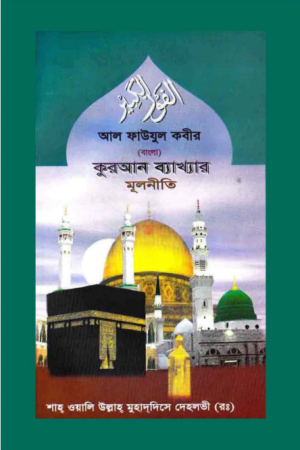
Publisher’s Note
The renowned work of Shah Waliullah Muhaddith Dehlavi (may Allah have mercy on him), “Al-Fawz al-Kabir fi Usul al-Tafsir,” needs no renewed introduction. Professor Akhtar Faruq has translated this book and named it “Principles of Quranic Exegesis.”
Its first edition had sold out long ago. Recognizing the book’s importance and necessity, Kutub Khana-e Rashidiyya, Dhaka, undertook its reprinting and first published it in 1993.
As the copies of the book have now run out, the need arose to publish it anew. While resetting the text and proofreading it, a number of errors in the translator’s work came to light. Our father, Hazrat Mawlana Muhammad Sahib, former Muhaddith of Madrasa-e Nuria, Dhaka, corrected the errors while consulting the original book and added headings, references, and other material in several places. As a result, the present edition is more polished and enriched than the previous one. We believe that, through publishing this book, we have fulfilled part of the responsibility undertaken by Kutub Khana-e Rashidiyya to publish important foundational works of research.
I hope that the translation of this immortal work by the great scholar will likewise prove beneficial and attain popularity, as has its original. May Allah, by His grace, make this humble effort of the author, translator, editor, and publisher a means of salvation. Amen!
Respectfully
Noman and Imran
12/12/1424 AH
3/2/04
The Translator’s Statement
A few words regarding the translator’s work remain to be said. Here I merely wish to express them.
Hazrat Shah Waliullah Muhaddith Dehlavi (may Allah have mercy on him) needs no introduction to the educated society of this country. Nor does his world-famous work, “Al-Fawz al-Kabir fi Usul al-Tafsir.” This book has spread throughout the Muslim world in Arabic, Persian, and Urdu. For many years it has been taught in the higher classes of Islamic educational institutions in almost every country. I translated it into Bengali and named it “Principles of Quranic Exegesis.”
This book is an ocean contained in a vessel. Therefore, churning it, retrieving pearls and gems from its depths, and presenting them to everyone is not the work of an ordinary diver. If a humble diver like me has achieved even a little success in this regard, it is nothing but the result of Allah’s grace and the powerful inspiration of the original author.
Therefore, this translator claims no credit or praise for his translation. The sole Owner and Master of praise and distinction is the Lord of all worlds. Rather, the translator expresses endless gratitude before Allah for granting him the opportunity to render this great service in the Bengali language for the first time.
If this work provides even a little opportunity or benefit for anyone in the Muslim society of Bangladesh to understand the Quran, I will consider my labor worthwhile. If Almighty Allah accepts this labor as a service in His presence, I will consider my life fulfilled.
The supplicant
Akhtar Faruq
A Brief Biography of the Author
The author’s given name was Waliullah, and his titles were Qutb al-Din and Hujjat al-Islam. He was commonly known as Shah Waliullah Muhaddith Dehlavi, and became famous throughout the world by this name. His father’s name was Shah Abd al-Rahim. On his father’s side, his lineage reached Hazrat Umar al-Faruq (may Allah be pleased with him), and on his mother’s side, Musa al-Kazim (may Allah be pleased with him). He was born in Delhi on Wednesday, 14 Shawwal 1114 AH, corresponding to 1704 CE. He passed away in Delhi at noon on 29 Muharram 1176 AH, corresponding to 1763 CE.
At the age of five, he was enrolled in a maktab to learn the Quran. At seven, he became a hafiz of the Quran. Upon completing memorization, he qualified to study Persian from the age of seven. At ten, he mastered Sharh-e Mulla Jami.
At only three years of age, he attained such proficiency in Arabic grammar and morphology that even specialists in these fields were compelled to bow their heads before him. He studied books on lexicography, rhetoric, jurisprudence, hadith, Quranic exegesis, Sufism, theology, logic, medicine, philosophy, mathematics, astronomy, and other subjects with his father, Shah Abd al-Rahim Sahib (may Allah have mercy on him). By the age of fifteen, he had attained mastery of all these subjects. After completing all the transmitted sciences, he pledged allegiance to his father to acquire spiritual knowledge. He achieved such distinction in spiritual practice that, within a short time, he became widely renowned in this field as well. When his spiritual instruction was complete, his father tied the turban of distinction on his head and granted him permission to teach spiritual wayfaring.
His father arranged Shah Sahib’s marriage when he was fourteen years old.
Shah Waliullah (may Allah have mercy on him) was the brightest star in India’s world of knowledge. Not only that, he was a Kawthar basin quenching the thirst of seekers of knowledge. Allah caused the influence, spread, and advancement of hadith and the Sunnah of the Messenger in the Indian subcontinent through Shah Waliullah (may Allah have mercy on him), his children, disciples, and students. The chains of transmission of hadith in India depend on Shah Sahib. In this subcontinent, Shah Sahib’s position is like the Tuba tree of Paradise, whose root is in Shah Sahib’s home and whose branches extend into the homes of every Muslim.
His writings cover every branch of knowledge; in particular, his works on the principles of hadith and Quranic exegesis are unrivaled in their age.
1. His Persian translation of the Quran, in the style of Arabic poetry. 2. Al-Fawz al-Kabir fi Usul al-Tafsir. 3. Al-Irshad ila Muhimmat Ilm al-Isnad. 4. Hujjat Allah al-Baligha. 5. Iqd al-Jid fi Ahkam al-Ijtihad wa al-Taqlid. 6. Al-Insaf fi Bayan Sabil al-Ikhtilaf. 7. Izalat al-Khafa an Khilafat al-Khulafa. 8. Al-Tafhimat al-Ilahiyya. 9. Al-Musaffa, a Persian commentary on the Muwatta. 10. Al-Musawwa, an Arabic commentary on the Muwatta. In addition, Shah Sahib wrote more than forty books.
Introduction
This helpless servant has received Allah’s immeasurable grace and kindness. The most important of these is the gift of being able to understand the Quran, the mighty Book. This insignificant person is also indebted to Allah’s Messenger in countless ways. The most noteworthy is the arrangement for the propagation of the Holy Quran. The Messenger of Allah (peace and blessings be upon him) himself taught the Quran to the Muslims of the first generation. They conveyed it to the people of subsequent generations. Thus the transmission of the Quran continued. Through written transmission as well as oral narration, it has reached this humble servant of the religion.
(Arabic********)
“O Allah, bestow Your grace upon our noble Prophet, the recipient of Your finest favor and beneficence, our intercessor and leader. Bestow Your grace likewise upon his Companions, descendants, and all the scholars of his community. O Most Merciful of the merciful, do so through Your boundless mercy.
After praising Allah and invoking blessings upon the Messenger, this is the statement of Waliullah, son of Abd al-Rahim: When Allah freed me through understanding His pure Word, I resolved to write a book containing several essential rules and principles, so that, by Allah’s grace, the path would be made easy for those wishing to understand the Quran by following these few principles. Although many people have devoted their lives to studying the Quran and have even sought the assistance of many learned exegetes, very few of them are likely to know these rules and principles.
I named this book “Al-Fawz al-Kabir fi Usul al-Tafsir” (Great Success in the Principles of Quranic Exegesis).
In all matters, we receive strength from Allah. Therefore, I rely upon Him alone. He is the best of guardians, and He is sufficient for me.
(Arabic********): Linguistically, tafsir means to illuminate and explain. Terminologically, tafsir is the name of the knowledge in which the intent of Allah the Exalted in the Noble Quran is discussed, according to the limits of human ability.
(Arabic********): In terms of explaining the intent of Allah the Exalted in the Speech of Allah.
(Arabic********): Following the guidance given by Allah, firmly grasping the strong rope, and attaining ultimate and everlasting success.
(Arabic********)
(1) Allah Himself has assumed responsibility for explaining His own Speech, the Noble Quran. (Arabic********) (Surah al-Qiyamah 19). According to this verse, Allah Himself is the first exegete of His own Speech, and this alone is sufficient to establish the rank of tafsir.
(2) Explaining the Quran was made the duty of the Messenger of Allah, peace and blessings be upon him.
(Arabic********) (Surah al-Nahl 44). The Messenger presented the tafsir of the Noble Quran to the community through his words and actions. Accordingly, the Prophet, peace and blessings be upon him, is the second exegete of the Noble Quran; this too is sufficient to establish the rank of tafsir.
(3) The radiant Messenger, peace and blessings be upon him, prayed for his cousin Abdullah ibn Abbas (Arabic********) (Sahih al-Bukhari). Another hadith states (Arabic********) (al-Hakim). The eminent Companion and jurist of the community, Hazrat Abdullah ibn Masud (may Allah be pleased with him), acknowledged Hazrat Ibn Abbas (may Allah be pleased with him) as the foremost exegete. (Arabic********) (al-Hakim). This too is sufficient to demonstrate the superiority of tafsir.
(4) The person who learns the Quran and the person who teaches it have been called the best of people in hadith. (Arabic********) The wording and meaning are both included within the generality of this hadith. This hadith alone is sufficient to establish the superiority of tafsir.
Legal rulings
Shah Waliullah Dehlavi
The contents of this book are confined to five chapters. Chapter One: A description of the five sciences: 1. Ilm al-Ahkam. 2. Ilm al-Jadal. 3. Ilm al-Tadhkir bi-Ala Allah. 4. Ilm al-Tadhkir bi-Ayyam Allah. 5. Ilm al-Tadhkir bil-Mawt. The Quran was revealed to explain these five sciences. Chapter Two: The causes of the obscurity of Quranic verses and their solutions. Chapter Three: The Quran’s remarkable and extraordinary style of expression. Chapter Four: A description of the methods of tafsir and reconciliation of the differences concerning tafsir among the Companions and the Followers. Chapter Five: An explanation of the obscure passages of the Quran and the amount of knowledge essential for exegetes to resolve matters such as the occasions of revelation.
Chapter One: The Five Sciences
The knowledge and instructive truths mentioned in the Quran can be divided into five categories.
(1) Ilm al-Ahkam, or knowledge of the legal ordinances:
That is, knowledge of matters that are wajib (obligatory), mandub (commendable), mubah (permissible), makruh (disliked), and haram (strictly forbidden) in any sphere, whether worship, transactions, family life, politics, or economics. Those who acquire this knowledge thoroughly and in detail are called fuqaha (jurists).
(2) Ilm al-Jadal (disputation), or knowledge of dialectics:
That is, the knowledge necessary to become proficient in debating the four misguided groups—the Jews, Christians, polytheists, and hypocrites. Those responsible for analyzing and presenting this knowledge are the mutakallimun.
(3) Ilm al-Tadhkir bi-Ala Allah, or knowledge of the doctrine of the Creator:
That is, knowledge concerning Allah’s favors and signs. It includes descriptions of the mysteries of the creation of the heavens and earth, the signs perceived by servants in daily life, and knowledge of all the attributes of the Creator.
(4) Ilm al-Tadhkir bi-Ayyam Allah, or knowledge of the doctrine of creation:
That is, knowledge concerning the conditions of the things created by Allah. It includes descriptions of the rewards of the obedient and the punishments of the disobedient.
(5) Ilm al-Tadhkir bil-Mawt, or knowledge of the Hereafter:
That is, knowledge concerning death and the conditions after it. It includes descriptions of resurrection, gathering, reckoning, Paradise, and Hell. Those who master and convey the teachings of the Quran and hadith on these matters are called waizs, or warners.
The Quran’s style of expression: In imparting this knowledge, the Noble Quran followed the style of the Arabs of that era. In later times, it bears no resemblance to the Arabs’ style of expression. In fact, when presenting verses concerning legal ordinances, emphasis was placed on brevity. The exposition was not lengthened with needless detailed analysis and resolution, as is done by legislators.
In the verses concerning Ilm al-Mukhasamah, Allah adopted a simple and straightforward method of presenting principles acceptable to all and beneficial admonition. He did not follow the broad path of advancing step by step through intricate arguments like a dialectician. Nor did He spend time, like modern essayists, weaving various statements together to explain a single point. Rather, whenever and wherever He deemed something necessary for His servants, He stated it, without even concern for chronological sequence.
The causes of revelation and exegetes: The practice of ordinary exegetes is that whenever they interpret a verse, whether concerning disputation or legal ordinances, they invariably attach some event or story to it. They assume that this story or event was the sole cause of the verse’s revelation. Yet it is universally agreed that the Quran was revealed to educate and civilize people and rescue them from superstition and evil deeds. Its various types of verses have different reasons for being revealed. For example, the verses of disputation came to refute false beliefs and superstitions, while the verses of legal ordinances were revealed to correct people’s errors in their conduct. Their purpose is to halt the flow of oppression and persecution among them. The verses concerning Tadhkir bi-Ala Allah and Tadhkir bi-Ayyam Allah were revealed because people neglected and disregarded Allah’s signs and favors. They are also ignorant of the good and evil, or right and wrong, in their own actions, and likewise ignorant of the stage after death. Thus, verses illuminating all these matters were revealed.
In fact, the attention exegetes devote to the details and analysis of minor events is unnecessary, because the Quran was not revealed on the basis of their significance. However, when verses allude to an event from the Prophet’s time or an earlier period, mentioning those events is necessary when explaining them. Listeners cannot be satisfied in understanding the meaning of a verse until they know the event to which it alludes. Therefore, the sciences under discussion must be analyzed in such a manner that there is no need to describe irrelevant details and events.
First Section: The Disputation in the Verses
The Quran describes the irrationality of the beliefs and actions of four groups: polytheists, Jews, Christians, and hypocrites. These are of two types.
1. Their false beliefs are merely presented, their consequences shown, and they are characterized as evil.
2. Their doubts are mentioned and dispelled with the help of arguments, analogies, and admonition.
The Religious Beliefs of the Polytheists:
The polytheists proclaimed themselves Hanifs (followers of the true path), and the followers of the religion of Prophet Ibrahim (peace be upon him) were called Hanifs. The injunctions of the religion of Ibrahim are given below:
1. Performing the Hajj at the Kaaba.
2. Worshipping while facing the Kaaba.
3. Considering marriage with women rendered permanently unlawful through nasab (lineage) or radaah (breastfeeding) to be forbidden.
4. Ghusl becoming obligatory after marital intercourse.
5. Circumcision.
6. Properly honoring the sacred months and the sanctity of the Kaaba.
7. Offering sacrifices.
8. Slaughtering animals and eating them.
9. Seeking closeness to Allah by offering a sacrifice during the Hajj season.
10. Performing acts consistent with human nature.
In fact, the religion of Ibrahim also prescribed ablution, prayer, fasting from sunrise, charity for orphans and the needy, helping people in hardship, and assisting relatives. They considered observing these practices honorable and praiseworthy in one respect.
The polytheists swallowed these practices so completely that it seems they had never existed in that religion. Thus, murder, theft, fornication, usury, embezzlement, and the like were forbidden in the religion of Ibrahim. Following them was condemned and disgraceful. Yet the polytheists openly engaged in them, doing whatever they desired.
The Fundamental Beliefs of the Religion of Ibrahim and the Polytheist Group:
Belief in the One Allah, along with the belief that He alone is the Creator of the heavens and earth, the primary originator and controller of major events and affairs, the sender of prophets, and the giver of the consequences of servants’ deeds; and that every change and calamity occurs by His indication. Belief that the angels are servants close to Allah and worthy of honor—these beliefs were also present in that religion. This can be understood from the signs of that religion as well.
But the polytheists had allowed doubts to corrode these fundamental beliefs—doubts born of perceiving them as impossible and incomprehensible. As a result, the confusion that arose among them manifested in the following matters:
Shirk (associating partners with Allah), tashbih (likening Allah to creation), tahrif (distortion), denial of the Hereafter, considering the prophethood of the final Prophet impossible, the spread of oppression and adultery, following superstition, abolishing worship, and so forth. These matters are analyzed below:
(1) Shirk
Shirk means regarding someone else as possessing those attributes that are exclusively reserved for Allah. For example, believing someone to have the right to do whatever he wishes in the world, as Allah does through “Kun fa-yakūn” (“Be, and it is”). Or believing someone to possess such fundamental knowledge as was not acquired through the senses, evidence and proof, dreams, ilhām, or the study of knowledge. The power to cure the sick, curse someone, make someone sick, poor, or wretched out of displeasure, and, by showing mercy to someone, cause that person to attain prosperity, health, and a good outcome—all these are attributes exclusive to Allah. To regard someone else as possessing these attributes, or to believe that anyone shares in them, is shirk.
These polytheists did not regard anyone as Allah’s partner in the act of creation or as a controller of creation. They also believed that when Allah wished to do something, no one had the power to prevent it. Rather, they committed shirk only concerning particular matters and particular persons. They thought it was like a king assigning one of his close relatives or a court amir authority over a region of the country, granting him power and independence in minor matters so that he could act according to his own judgment and decision in the king’s absence.
It is clear that a king cannot possibly attend to every small and minute matter. Therefore, in such matters he would grant authority to his appointed representatives, governors, and amirs. They would act as they deemed appropriate. In reality, by doing so he placed all the subjects of that region under the authority of that governor. Regarding the servants or subjects there, he would accept only the recommendations of the rulers. In the same way, Allah the Exalted grants some of His servants the vicegerency of His lordship. Accordingly, both the pleasure and displeasure of those servants affect the subjects. Because of this belief, they felt the need to attain their nearness and satisfaction, so that they might become worthy of acceptance at the court of the true Lord as well. They also believed that the intercession of those special servants, concerning demands and the fulfillment of needs, would be worthy of acceptance before Him.
For these reasons, they considered it lawful to bow and prostrate themselves before those special servants; to dedicate or sacrifice something in their names; to swear oaths by their names; and to seek their help in times of hardship and in particular matters. In all such ways they acknowledged them as possessing divine rights and powers. They even made idols of those special servants from stone, iron, and various metals. Gradually, these ignorant people came to regard the idols themselves as the true deities. Thus a great source of misguidance arose.
(2) Tashbīh:
Tashbīh means associating human beings or their attributes with Allah. For example, they believed that the angels were Allah’s children. They also believed that, even if Allah Himself did not approve, He was compelled to accept the intercession of certain special servants for some sinners—just as a king sometimes accepts the intercession of amirs and nobles even when it is not pleasing to him. Thus, unable to comprehend the infinity of Allah’s knowledge, vision, and other attributes, they imagined Him according to their own finite powers and sensory knowledge. As a result, they imagined a form for Allah, who is without form, like their own, and even specified a place for that body to exist.
(3) Taḥrīf
The basic account of taḥrīf is as follows: The descendants of Hadrat Ismāʿīl (peace be upon him) remained steadfast upon the religion of Hadrat Ibrāhīm (peace be upon him) for quite some time. Eventually, ʿAmr ibn Ḥayy al-Khuzāʿī emerged among them. He fashioned various kinds of idols for them and made their worship part of the religion. He introduced for them the practices of Baḥīrah, Sāʾibah, and Ḥām, as well as a lottery system using arrows. This evil practice began approximately three hundred years before the advent of the Last Prophet (peace and blessings be upon him). For all these practices, the polytheists presented as evidence the actions followed by their forefathers, regarding them as one of their decisive proofs.
(4) The Polytheists’ Position Regarding the Messenger and the Hereafter
Although earlier prophets had also spoken about resurrection and the acceptance of reckoning, they had not explained it in such detail as the Last Prophet (peace and blessings be upon him). For this reason, the polytheists were unfamiliar with such beliefs and considered resurrection and reckoning incomprehensible.
Although they also believed in Hadrat Ibrāhīm (peace be upon him), they fell into doubt and hesitation because the prophets were individual persons and their personalities seemed like separate breaks in the continuous radiance of prophethood. Since they had failed to understand the wisdom of Allah in sending different prophets from among human beings throughout the ages, and were accustomed to seeking likeness and similarity between the sender and the messenger, they were deprived of a true understanding of prophethood. They even considered it impossible for a prophet to be human. Consequently, they raised many nonsensical doubts and questions about it. For example: Why would a prophet need food and drink? Why did Allah not make the angels prophets? If revelation comes to human beings, why does it not come separately to everyone? They raised many other absurd objections of this kind, which became part of their beliefs.
Note: 1. An animal whose milk is dedicated to the names of gods and goddesses. 2. An animal set free in the name of gods and goddesses. 3. Releasing a camel that has become fit to be ridden.
Examples of the Polytheists:
If anyone still has difficulty forming a correct conception of the actual condition of the polytheists, their erroneous beliefs, and their practices, then the clear errors in the ideas and activities of the ignorant masses of the present age can also help provide a general understanding of the condition of the polytheists of that time.
Consider what beliefs they hold today concerning the saints. Although they acknowledge the existence of saints in the past, they consider the appearance of saints in the present age impossible. They visit various graves and shrines, where they engage in many polytheistic practices. Observe how tashbīh and taḥrīf have found a place among them in various ways. A sound hadith states: “You will surely follow the misguided practices of the nations before you.” Indeed, there is not a single evil practice or superstition of the misguided nations that Muslims today are not following. May Allah protect everyone from this calamity.
In short, this was the condition not only of Arabia but of the entire world. Therefore, out of sheer mercy, Allah the Exalted sent Hadrat Muhammad (peace and blessings be upon him) among the Arabs and commissioned him to establish and propagate the religion of Ibrāhīm. At the same time, the Holy Qur’an entered into a battle of argument with these polytheists. In presenting its arguments, it cited those things that still survived as acknowledged, true signs of the religion of Ibrāhīm, so that they would stand as authoritative proofs before them and they would be unable to deny them in any way.
The Response to Shirk:
In fact, the Qur’an responded to their polytheistic beliefs in four ways:
First, they were asked to produce evidence supporting their ideas and beliefs. They were accused of holding beliefs fundamentally contrary to those of their forefathers, even though they claimed to be following their forefathers.
Second, they were made to understand that there was no equality or comparison between the servants whom they had associated with Allah and Allah Himself. Rather, Allah alone possesses the highest honor; no servant does.
Third, they were told that all the prophets of the past also believed in monotheism. The Qur’an states: “O Messenger! Before you, We sent this message to every prophet: There is no deity except Me, so worship Me alone.”
Fourth, the futility of idol worship was explained to them. They were told that the pieces of stone they worshipped were, in terms of rank, far more insignificant and weaker than human beings. How, then, could they attain Allah’s rank? This argument applied only to the group that worshipped the idols believing them to be Allah, not to those who regarded them as representatives of some unseen power.
The Response to Tashbīh:
First, they too were asked to provide arguments and evidence in support of their claim. They were told that these beliefs contradicted the beliefs of their forefathers, even though they loudly claimed to follow those very forefathers and said that their forefathers also adhered to tashbīh.
Second, they were made to understand that, according to their own evidence, it would also follow that a father and son must be identical. But that is not the case. How, then, did it become necessary that Allah and His creation be alike?
Third, they were made to understand that they considered for themselves what they did not consider good or lawful for Allah. They themselves did not like daughters, regarding them as a disgrace and a misfortune. Yet they imagined daughters for Allah and said that the angels were Allah’s daughters. “How can it be that you desire sons for yourselves, while desiring daughters for your Lord?” (Qur’an) This response applied to those who were fond of imaginary notions. In fact, among the polytheists, the adherents of taḥrīf were the most numerous. Their practices were refuted in various ways.
The Response to Taḥrīf:
First, they were made to understand that there was no truth whatsoever in anything they had said. It was all fabricated by them. Nothing of this kind appears in any account of the righteous.
Second, they were told that the beliefs they held were also false and baseless, for they were merely the inventions and creations of simple-minded and ignorant people. They had no connection whatsoever with the religion.
The Response to Those Who Disbelieve in the Hereafter:
Those who considered resurrection and the raising of the dead after death impossible were also instructed in various ways. Efforts were made by different methods to remove their doubts.
First, their attention was drawn to the condition of the world around them. After the earth becomes dry and barren, it becomes alive and flourishing again.
From this transformation of the earth, it can easily be understood that the return of life is not impossible. Just as Allah gives life a second time to the dead earth, He can likewise give life a second time to dead human beings.
Second, they were told that it had been the universally accepted belief of the nations of the past that, after death, they would be brought back to life and presented before Allah for reckoning. Since all the religions of the world agreed on this matter, it was clearly proven that resurrection after death is an undeniable truth.
The Response to Doubts Regarding the Prophet:
They raised various questions about the prophethood of the Prophet. All their questions and doubts were answered separately.
Their greatest question was: How can Allah the Exalted make a human being a prophet? In response, it was said that this question was completely unfounded, because all the prophets of the past were human beings. One verse makes this clear: “O Messenger! Before you, I sent only human beings as prophets, to whom I sent revelation. Those who are faithless say that you are not Allah’s sent Messenger. Say to them: Allah Himself, the revealed Scripture, and those possessing knowledge are sufficient as witnesses between you and me concerning this matter.” (Qur’an)
The second response to their doubt was given as follows: In the Qur’an, prophethood means receiving revelation. Thus, in one verse our Messenger was instructed: “O Messenger! Say: I am only a human being like you. However, revelation comes to me.”
Then the manner in which revelation was explained cannot be considered anything impossible.
Their other questions were answered in general terms. They were made to understand that the failure to see the miracles they demanded from the prophets, the fact that the person they considered qualified was not made a prophet, the fact that angels were not made prophets, and the fact that revelation was not sent separately to every person—all this occurred for a great and beneficial purpose, which they could not understand only because of their ignorance.
Repetition of the Responses:
Since the Qur’an was addressing the polytheists, these issues were described repeatedly in different ways and fresh forms. The claims were firmly established with extremely elevated rhetorical emphasis, so there was no hesitation in repeating them. Moreover, it is only fitting that the counsel of the infinitely Wise Lord should take this form when addressing such ignorant people: the awareness of such ignorant people must be revived through repeated admonition. “This is the prescribed method of the All-Knowing, All-Victorious Lord.”
The Condition of the Jews:
The Jews claimed to believe in the Torah. Their deviation was that they altered its laws and injunctions, changing both its wording and its meaning. They erased many verses and added many others from themselves. Moreover, many of them were negligent in observing the laws and injunctions of the Torah. Yet sectarianism was extreme among them. They declared it impossible for the Messenger of Allah (peace and blessings be upon him) to be a prophet. They spread many slanders about him and behaved offensively toward him. They also made similarly offensive remarks about Allah Himself. In addition, they possessed various corrupt traits, such as miserliness, greed, and envy.
Taḥrīf in the Torah:
The verbal changes the Jews made to the Torah were not made in the original scripture but rather in the books of commentary. This is also the view of this author, and Hadrat Ibn ʿAbbās (may Allah be pleased with him) stated the same. As for the changes they made in meaning, they abandoned the true meaning of the verses and adopted arbitrary interpretations. One example of the taḥrīf or alteration they made in the Torah is that they used a statement expressed generally in a specific sense. For example, their religion explained the distinctions between the sinful and the religious, and between the unbeliever and the hypocrite. It was stated that the unbelievers would suffer severe punishment and remain forever in Hell, whereas a sinful person might attain salvation through the intercession of the prophets.
To express the distinguishing features of the followers of each religion, every religion gave its adherents a special name. In the Torah, this designation was given to the Jews and the Hebrews; in the Gospel, to the Christians; and in the Qur’an, to the Muslims. Yet in all these scriptures, these terms referred only to those who believed in Allah and the Hereafter, followed their respective prophets, observed their respective Sharīʿahs, and fulfilled the religious injunctions. They did not refer to any particular group. But the Jewish community understood that Paradise was reserved exclusively for Jews and Hebrews, that only they would receive the intercession of the prophets, and that even if they entered Hell, they would be released after spending only a short time there—whether or not they truly believed in Allah and the Messenger. Their notion was nothing but pure ignorance and foolishness.
Since the Qur’an is superior and greater than all the revealed scriptures, and contains more detailed exposition than all other scriptures, it removed all the doubts and questions found in the earlier scriptures and dispelled doubts concerning this matter as well. “Indeed, those who commit sins and are surrounded by misguidance from every side are the inhabitants of Hell; they will remain there forever.” (Qur’an)
Thus, it is also an established truth that every religion prescribed laws sufficient to meet the needs of every age. In matters of restrictions and regulations, consideration was given to the nature of a particular age or community. Instruction was given so that those laws and regulations might be known to be true and correct.
The main point here was that the validity of these rules and regulations, wherever and for whomever they were revealed, remained limited to that era. They were not permanent laws; they applied only to the communities of that time. In other words, the era of a previous prophet continued until another prophet came. Of course, there is no difference in the essential substance of any religion. Yet the Jews understood this differently. They thought that the Jewish religion and its laws could never be abrogated. The actual position is that when people are told to follow a religion, this does not mean merely following that particular religion; rather, it means faith and righteous deeds. But the Jews believed in the exclusivity of their religion and concluded that Hadrat Yaʿqūb (peace be upon him) had instructed them to follow only the Jewish religion.
So much for the distortion of the meaning of the Jews’ religious scripture. They also introduced taḥrīf into certain words and terms of the verses. For example, in every religion Allah the Exalted addressed the prophets and their followers as His own and beloved people, while declaring those who rejected the religion accursed and detested. For this purpose, words commonly used in the daily vocabulary of that community were employed. Therefore, if the word “kinsman” was used somewhere instead of “friend,” there is no reason to be surprised.
But the Jews ignored this truth. They concluded that the honor of nearness and friendship was reserved exclusively for the Jews, Hebrews, and Israelites. They failed to understand that obedience to Allah and acceptance of His laws and injunctions are the safeguard for attaining that honor.
In this way, many other erroneous interpretations became rooted in their minds. They had learned them from their forefathers and inherited them. But the Qur’an completely eradicated all these false notions.
Kitmān al-Āyāt (Concealment of Verses)
Kitmān al-āyāt means concealing from the Torah those verses that contradicted their status and interests. Their purpose was to preserve the honor they had received from time immemorial. Ordinary people trusted the religious leaders. They acted this way so that this trust would not diminish and no one would realize that they were not following the scripture. Several examples are given below:
1. The Torah contains a law requiring adulterers to be stoned to death. However, according to the unanimous view of the Jewish religious leaders, that law was changed. In its place they introduced flogging and blackening the face. If the general public had learned of this alteration, they would have lost trust in them. Therefore, fearing disgrace of any kind, they eventually concealed the verse prescribing stoning.
2. The Torah also contained verses conveying glad tidings of prophethood for the descendants of Hadrat Hājar (may Allah be pleased with her) and Hadrat Ismāʿīl (peace be upon him). Those verses also foretold a nation that would gain authority in Arabia. The mountains of ʿArafāt would resound with the cry of “Labbayk” because of them, and people from all countries would continue to come there for Hajj and ziyārah.
At first, the Jews tried to distort the interpretation of those passages. They said that these verses merely gave news of the emergence of a new community; they did not speak of obeying or following them. Indeed, this saying had become proverbial among them: “Malhamatun kutibat alayna,” meaning, “This is a war prescribed for us.” The ascendancy of the Muslims over us, they claimed, was the fulfillment of the ascendancy of the unbelievers over the Jews mentioned in the Torah. But when they saw that no one was being dissuaded by this interpretation, they had no option but to conceal the verse itself. They continued advising one another to hide it. Then they all decided that the verse would never be disclosed publicly. “Are you fabricating statements against the truth revealed by Allah in order to present an argument before Allah?”
What utter foolishness! How did they understand that Allah’s emphatic announcement of the emergence of prophets from the descendants of Hagar and Ishmael and of the rise of a new community was merely news for its own sake, and not a call to obedience or following? In reality, this was not mere stupidity; it was a great scheme of excess and of trading in lies in Allah’s name.
The Nature of Iftirā’:
Passing off one’s own invented statements in Allah’s name is iftirā’. The reason was that a particular kind of excess had taken root among the Jewish scholars and religious leaders. Considering it beneficial, they devised certain rules and regulations that were not found in the religious scripture. They regarded it as obligatory to follow those invented rules just as they followed the rules of the Divine Scripture. Moreover, they considered the unanimous decisions of their religious leaders to be conclusive proof, just like religious law. They had no evidence for denying the prophethood and messengership of Jesus except the unanimous decision of their own religious leaders. The same applied to many other rulings.
The Nature of Musāhalah:
Treating religious law lightly and proceeding carelessly regarding it is called musāhalah. They followed this very principle regarding the rulings of the Torah and were immersed in base traits such as stinginess and greed. Needless to say, all this was nothing but the machination of evil desires. Evil desires influence everyone and constantly incite them to wrongdoing. Only the one whom Allah protects can escape their tyranny.
Arbitrariness and the play of their desires gave those who had received the Divine Scripture an entirely new attitude. Taking refuge in them, they established distorted interpretations of the verses and invented rulings as though they were religious law.
The Nature of Their Doubts Regarding the Final Prophet:
The reasons for the various doubts and difficulties that arose before them regarding the Final Prophet are given below—
1. The number of wives of the prophets was not the same. Differences and distinctions among the prophets appeared in matters of this kind, such as personal conduct and customs.
2. The Sharī‘ahs of the prophets also appeared outwardly to differ in several respects. There was little agreement among them regarding detailed rules and regulations.
3. Allah’s methods and dealings differed with different prophets. Consequently, the outward circumstances of the prophets were not all the same.
4. Most of the prophets who had come until then were from the Children of Israel. Only the Prophet (peace be upon him) was from the lineage of Ishmael (peace be upon him).
There were differences in customs, conduct, and Sharī‘ah; moreover, our Messenger (peace be upon him) was from the lineage of Ishmael. For these reasons, the Jews could not place their trust in him. Various doubts arose in their minds regarding his prophethood.
The Limits of the Messenger’s Responsibility:
Yet the matters that influenced the Jews have no connection with prophethood. The Messenger’s responsibility is only to purify people’s souls from defilement and to correct their worship and habits. Creating rules concerning sin and virtue is not the Messenger’s responsibility. Customs and social practices differ among communities. A prophet comes within a particular community. He does not abolish its customs and introduce an entirely new social system; rather, he considers their good and bad aspects. He does not alter those he considers beneficial and intended by Allah. He retains the others with the necessary corrections. Thus, differences in social customs have little connection with prophethood.
The part of the prophets’ Sharī‘ah that is connected with tadhkīr bi-Allah and tadhkīr bi-ayyām Allah remains essentially the same. This is why outward variations appear in the Sharī‘ahs of the prophets. (Because of differences in place, time, and circumstances, such variation in the outward form is inevitable. Yet the fundamental message of all the Sharī‘ahs is one.)
The Essence of the Differences in Sharī‘ah:
This difference is like the different treatments an experienced doctor gives two patients. He gives one a cold medicine and a cold diet, while he gives another a hot medicine and a hot diet. Yet in both cases the doctor’s objective is the same: to remove the illness and cure the patient. Nothing else is intended. It is possible that an experienced doctor will prescribe medicines and diets according to the nature and climate of different countries. Similarly, he will change the medicine as the season and nature change. In exactly the same way, when the Supreme Physician, Allah, wished to treat people’s spiritual diseases, improve their dispositions, and make their souls strong and healthy, He naturally gave different forms of treatment in different ages, according to the customs and habits of different communities.
An Example of Jewish Scholars:
If you wish to see examples of Jewish scholars in this age, look at those scholars among us who, enslaved by worldly interests, continue to follow erroneous practices. They too follow their own ways. They are accustomed to blindly imitating their own Messenger and turn away from the clear rulings of the Qur’an and Sunnah. They follow the invented fatwas of some earlier scholars and close their eyes to the noble words of the Lord, the Creator of the sacred Sharī‘ah. They have appointed fabricated hadiths and distorted interpretations as their guiding imams.
The Religious Beliefs of the Christians:
They believed in the messengership of Jesus (peace be upon him). Their error, however, was that they regarded Allah as a combination of three persons who contradicted one another in various respects, although they also agreed in some matters. They called these three persons “Aqānīm al-Thalāthah.” One of the three hypostases is the form of the “Father,” existing as the mere foundation of creation. The second is the form of the “Son,” the first entity of creation and therefore one of its components. The third is the “Holy Spirit,” that is, the entity of knowledge or consciousness.
The Christians believed that the Messiah came in the form of the “Son.” Just as Gabriel (peace be upon him) came into the world in human form, all three persons manifested themselves in the form of Jesus (peace be upon him). In fact, they said, Jesus was Allah, the Son of Allah, and also a human being. Both divine and human qualities were present in him. In support of this claim, they cited various verses of the Jews, because those verses called him the “Son,” and he was said to have personally performed acts that are reserved exclusively for Allah.
Answer:
First, even if we accept the present Gospel as authentic and unchanged, the address “Son” found in it does not prove that he was literally the son of Allah. In ancient times, it was customary to address a beloved close person as “son.” Thus, that is what is meant here as well. This indication is found in other verses of the Jews.
Second, the fact that he performed divine acts himself and was therefore divine and the Son of Allah is not established by the acts Jesus (peace be upon him) attributed to himself; they are merely descriptions of the original acts. For example, an envoy of a king may come and announce, “We have conquered such-and-such a country and removed every brick from such-and-such a fortress.” In reality, the king is the true agent of all these acts, while the envoy’s power is merely that of a spokesman.
Moreover, it is possible that the mode of revelation to Jesus (peace be upon him) was such that all divine truths and laws manifested themselves within him. Gabriel (peace be upon him) no longer came in human form with revelation. Thus, his manner of speech would change along with the mode of revelation. He spoke all words on Allah’s behalf and expressed Allah’s acts as his own. This is an extremely simple and clear matter.
The Qur’an’s Verdict:
In short, the Qur’an came and completely refuted these erroneous Christian beliefs. The Qur’an stated that Jesus (peace be upon him) was only Allah’s special servant and His spirit. Allah placed him in the womb of Mary (peace be upon her) and brought about his appearance through the Holy Spirit, that is, Gabriel (peace be upon him). A few other distinctions were also granted to him.
If it is assumed that Allah Himself had taken on the form of a spirit that was not essentially distinct from another spirit, and that He manifested Himself before us in human form, then even a little reflection makes it clear that this is entirely contrary to reality. In that case, the relationship between servant and worshipped Lord could not be established. Rather, that truth would have to be expressed by the word “taqwīm” (establishment) or a similar term. Such a notion is degrading with regard to Allah, and He is far above it.
An Example of the Christians:
If you wish to see a true example of this community, look at the descendants of the righteous and saints of the past. See how many different titles they have given their forefathers. To tell the truth, they do not openly call them Allah. Yet the qualities and powers they claim for them do not allow them to regard them as inferior to Allah in any respect. Soon these wrongdoers will suffer the consequences.
Another erroneous Christian belief is that Jesus (peace be upon him) was crucified. In fact, they fell prey to a misconception here and took his being raised to heaven as his death. They maintained this error for generations. The Qur’an came, dispelled it, and declared: “The Jews did not kill Jesus (peace be upon him), nor did they crucify him; rather, they were confused about the matter.”
The Refutation of Another Error:
The statement attributed to Jesus (peace be upon him) in the Gospel concerning his being raised upon the cross does not mean that he was actually killed. Rather, it indicates the Jews’ vile attempt: they tried to kill him by crucifying him. It is another matter that Allah rescued him from there.
The basis of the statement attributed in this matter to the disciples of Jesus (peace be upon him) is also founded on doubt and error. They were unable to understand that someone could be taken to heaven alive, because they had never seen or heard of such a thing before. Therefore, they could not even imagine it. For this reason, they assumed that Jesus (peace be upon him) being raised to heaven meant that he had been killed.
The Christians also fell into error regarding the glad tidings in the Gospel of the coming of the Paraclete. They believed that the promised Paraclete was actually Jesus (peace be upon him). After his death, they said, he returned to meet the disciples and instructed them to remain followers of their sacred Gospel. They also claim that Jesus (peace be upon him) left this instruction: “After me, many false prophets will come. Whoever comes and speaks of me, follow his words; and whoever does not call you in my name, do not heed him.”
The Noble Qur’an clearly declares that the person foretold by Jesus (peace be upon him) was our Messenger (peace be upon him). It in no way signifies the spiritual or physical reappearance of Jesus (peace be upon him). The Gospel also states that the promised Paraclete would remain among them for some time, teach in various ways, and reform people’s souls and character. The prophecy that he would come and speak of the name of Jesus (peace be upon him) means that the coming prophet would also acknowledge the truth of Jesus’s prophethood. It does not mean that he would acknowledge Jesus (peace be upon him) as Allah or as His son.
The Hypocrites and Their Fundamental Beliefs:
Those who profess Islam verbally but are not truly Muslims are called hypocrites. They were of two kinds. One group recited the Islamic declaration of faith with their tongues, but were unbelievers in their hearts and minds. They said with their mouths exactly the opposite of what was in their hearts. The Qur’an has stated about them: “They will have their abode in the lowest level of Hell.”
Hypocrisy in Deeds:
The second group accepted Islam with a very weak nature. In belief and habit, they were essentially followers of their own community. When the entire community became Muslim, they too became Muslim. Had their community remained unbelieving, they would have remained so as well.
This group also included those who considered it preferable to remain immersed in the ordinary pleasures of worldly life. Worldly attachment had taken such hold of them that the love of Allah and His Messenger could never find a place in their hearts.
There were also people in this group whose hearts had become so deeply rooted in greed, lust, jealousy, and hatred that they had lost the ability to derive joy from worship and supplication. No relationship could develop between them and Allah.
Among the hypocrites there was another group who immersed themselves completely in worldly affairs. They remained occupied with earning and livelihood, leaving them no opportunity to think about preparing for the Hereafter. As a result, doubts and speculations arose within them regarding fundamental beliefs, particularly concerning the Messenger (peace be upon him). Yet this did not go so far that they left Islam and openly opposed it.
The Causes of the Hypocrites’ Doubts:
The hypocrites had several reasons for doubting the prophethood of the Messenger of Allah (peace be upon him). The greatest reason was that the Messenger was also a human being. Like other people, he had ordinary daily needs and activities. Therefore, it was difficult for them to distinguish him from ordinary people. Likewise, the propagation and expansion of Islam and the expansion of the Islamic state appeared to them like the territorial expansion of other kings. Thus, they could see no difference between a Messenger’s gaining authority and expanding a state and a king’s gaining a throne and expanding his kingdom. By “Messenger,” they imagined a powerful person like a king. Consequently, instead of their faith in prophethood becoming firm, their doubts continued to grow.
Among the hypocrites was a group who, despite being Muslims, could not free themselves from affection for their unbelieving relatives. This affection compelled them to help their relatives and enabled those relatives to achieve their aims. They did not care at all how much harm this caused Islam. Indeed, in helping their own tribe and close relations, they knowingly did not hesitate to harm Islam.
Thus, hypocrisy may be divided into two kinds: first, hypocrisy in fundamental belief; second, hypocrisy in conduct. After the Messenger (peace be upon him), it is difficult to identify hypocrites in fundamental belief, because belief is unseen and it is not possible to know what lies in people’s hearts. Hypocrisy in conduct, however, appears openly and widely, so it is easily recognized. In our age, especially, there are countless hypocrites of this kind.
In a hadith, the Messenger (peace be upon him) essentially pointed to hypocrites of this kind. He said: “There are three traits; whoever possesses them is certainly a hypocrite. First, when he speaks, he lies. Second, when he makes a promise, he breaks it. Third, when he argues, he resorts to abuse. Although outwardly Muslims, such people are in reality hypocrites.” There are many other hadiths to this effect.
Allah the Exalted has described in the Noble Qur’an the nature of the hypocrites’ character and conduct and has said much about these two groups of hypocrites, so that His servants may recognize them and protect themselves from them.
An Example of a Hypocrite:
If you wish to see an example of a hypocrite in this age, go to the gatherings of leaders and heads of state. Observe the antics of their flatterers. They are eager to place the leader’s pleasure above Allah’s pleasure. The truth is that there is no real difference between those today who knowingly practice hypocrisy regarding every word of Allah’s Messenger and those who became hypocrites in that age despite directly receiving the Prophet’s wishes, dislikes, commands, and instructions.
Likewise, there is a group among students of the sciences whose hearts become filled with countless kinds of doubt while they forget the Hereafter. They are no less than hypocrites.
Our Duty:
In view of these conditions of the hypocrites, your duty is this: whenever you sit down to read the Qur’an, never think that these words were addressed only to a particular community of a particular age and that community has now disappeared. Keep before you this hadith of Allah’s Messenger: “You will certainly follow the ways of the nations before you.” Be certain that there is no disorder in the world today whose example did not already exist in the past. Therefore, whatever was said yesterday remains fully true today. The real purpose of the Qur’an is to identify the fundamental causes of calamity. Otherwise, there would be no point in repeating these descriptions again and again.
In any case, brief descriptions have been given above of the four misguided groups—the polytheists, Jews, Christians, and hypocrites—and the strongest possible answers have been provided to their beliefs. As a result, God willing, it will be much easier to understand the verses of mukhāṣamah.
Chapter Two:Appendix to the Five Sciences: Tadhkīr bi-AlāAllah
It is necessary to know that the Qur’an was revealed to create civilization and spiritual purity for the entire human race. In this regard, there is no question of Arab or non-Arab, urban or rustic. Therefore, the demand of divine wisdom was that, in reminding people of Allah’s signs, only matters familiar to most people would be discussed. Thus, in the course of discussing Allah’s signs, inquiry and examination were confined within specific limits, and Allah Almighty’s names and attributes were described in a manner that even people of ordinary understanding could easily comprehend. This was so that there would be no need to study the science of kalam or the theory of divine mechanics.
Existence of Allah
In fact, the Qur’an discusses the existence of Allah very briefly. It does not attempt a detailed discussion for the sake of proof. This is because the concept of Allah’s existence is widespread among people. There is no sound and normal country or nation anywhere in the world where Allah’s existence is denied.
Of course, the question of Allah’s attributes cannot easily be understood without reflection and spiritual endeavor. Truthfully, both understanding their reality and explaining it are impossible. But the greatest difficulty is this: if no conception of Allah’s attributes can be formed, then knowing Him is also impossible. Yet that knowledge is the only path to creating civilization and spiritual refinement. Allah’s infinite wisdom resolved this difficult matter in such a way that, from among human attributes, certain qualities known to all people were selected. These qualities were presented in place of the subtle and incomprehensible attributes of God, so that weak human beings could form a general conception of them. At the same time, it was stated: “Nothing is comparable to these.”
This is so that people with limited attributes do not fall into mistaken notions and foolishness by imagining Allah’s attributes to be comparable to their own.
There are also certain human qualities that are not merely unbefitting Allah’s majesty; rather, if they are attributed to Allah, people fall prey to false notions and beliefs. Examples include having children, weeping, and becoming overwhelmed by grief. Therefore, attributing such human qualities to Allah has been prohibited. However, distinguishing between the attribution of qualities that does not cause deviation or confusion in fundamental belief and the attribution of qualities that creates false notions is such a subtle and difficult matter that human thought and intellect fail to reach it. This is a matter in which one must remain silent and refrain. Therefore, presenting personal opinions on this question has been prohibited.
The Signs of Allah:
Similarly, among the signs of Allah’s power and His favors, only those have been selected that urban and rustic people, Arabs and non-Arabs alike, can understand equally. For this reason, spiritual favors reserved only for scholars and saints have not been mentioned. Nor have the rare favors reserved only for kings and rulers been mentioned. Accordingly, among the matters selected for discussion are the creation of the heavens and the earth, rain falling from the clouds and flowing across the earth as rivers and streams, the growth of various kinds of flowers and fruits from it, and the provision of necessary instruction to people.
Likewise, in many places attention has been drawn to and warnings have been given about people’s spiritual and moral faults and lapses. Their spiritual lapse is that their conduct and character are not the same in prosperity and adversity. When calamity befalls them, they behave one way, and when the calamity is removed, they become different.
Reminding People of the Days of Allah:
In the same way, among the events that had appeared from Allah concerning the reward of obedient servants and the punishment of rebellious servants, the Qur’an selected those events that people were accustomed to hearing. In general, they had already been hearing them. For example, they had heard from generation to generation the stories of the people of Noah and the peoples of ‘Ad and Thamud. Likewise, through contact with the Jews, the Arabs had heard for ages the stories of Abraham and the Israelite prophets. Indeed, these events are repeatedly related in the Qur’an. In contrast, it contains no mention of events that the Arabs had heard little about or of historical accounts from Iran or India with which they had no connection.
Arrangement of Events in the Qur’an:
Just as the Qur’an does not assemble new and strange events, it also avoids an exhaustive discussion of every event. Rather, only the portion of an event needed to achieve the objective has been selected. The wisdom and benefit in this method of presenting events is that whenever ordinary people hear a new and strange story, or a story is presented to them in full detail, they lose themselves in the story and the primary purpose of narrating it disappears.
A famous ascetic said that from the day people learned the Qur’an’s tajwid (the science of pronunciation), they lost their absorption in prayer. And when commentators began discussing the most subtle theories of Qur’anic interpretation and far-fetched possibilities, the science of tafsir nearly disappeared. This very truth was kept in view in arranging the stories in the Qur’an. For whenever people become carried away by the pleasure of hearing a story, they lose sight of its central objective. Events and stories of this kind are mentioned repeatedly in the Qur’an in various ways.
1. The creation of Adam (peace be upon him) from clay, the angels’ prostration, Satan’s arrogant refusal, his receiving the title of the accursed, and his attempt to mislead Adam—these constitute one type of event.
2. The disputes and conflicts of Noah, Hud, Salih, Lot, and Shu‘ayb (peace be upon them) with their respective peoples concerning the proclamation of Allah’s oneness, commanding the truth, and opposing falsehood; the stories of those peoples’ various baseless doubts and rejection of the truth; the accounts of the prophets’ answers to all their doubts; the history of Allah’s wrath descending upon those wretched people; and the stories of the prophets and their followers receiving help and support from Allah—all these constitute a particular type of story.
3. The events involving Moses (peace be upon him), Pharaoh, and his companions; the matters concerning Moses and the Children of Israel; that community’s excesses and coercion toward Moses; the possibility of Allah’s wrath descending upon those wretched people; and Moses coming forward at various times on several occasions to help them—all these constitute a particular type of story.
4. The accounts of David and Solomon (peace be upon them), including mention of their rank and authority; the trials of Job and Jonah and Allah’s favor upon them afterward; the account of Zechariah’s prayer being accepted by Allah; the wondrous birth of Jesus, his being born without a father, his speaking while still in the cradle, and the various miraculous matters manifested through him—these constitute one type of story. Depending on the circumstances, they are discussed in different places and in different ways, sometimes generally and sometimes in somewhat greater detail.
The following stories are mentioned in the Qur’an only once or twice:
1. The event of Idris (peace be upon him) being raised to the heavens.
2. Abraham’s debate with Nimrod, the event of birds being brought back to life after being killed, and the account of Ishmael’s self-sacrifice.
3. The story of Joseph (peace be upon him).
4. The birth of Moses (peace be upon him); his being cast into the Nile; his killing of a Copt; his journey to Midian and marriage there; seeing a flame of fire on a tree; hearing speech from that fire; and the account of slaughtering the cow.
5. The story of Bilqis, the story of Dhul-Qarnayn, the story of the Companions of the Cave, the story of the two men engaged in conversation, the story of the people of Paradise, and the story of the Companions of the Elephant (the elephant-riding army).
The Purpose of the Stories
The purpose of relating all these stories is not to tell people the stories accurately; rather, the primary purpose is to show people what grievous consequences shirk and the polytheists face, and how Allah’s wrath descends because of them. At the same time, they may become certain that Allah Almighty always assists His sincerely obedient servants.
Reminder of Death:
This section of the Qur’an describes death and events after it: how helpless a person becomes at the time of death, how Paradise or Hell follows after death, and how the angels of punishment come, among other matters. It also contains events concerning the signs of the Resurrection, such as Jesus (peace be upon him) descending from heaven and the campaigns of the Dajjal and Gog and Magog. It also states how the trumpet will be blown, how resurrection and the complete reordering will occur, how questioning and answering will take place, how the balance of justice will be established, and how the record of deeds will be given in the right or left hand. It further states that the believers will enter Paradise and the unbelievers Hell. It mentions how the ordinary people of Hell will quarrel with their leaders there, blame one another, and insult one another; how the believers will see Allah; and what severe punishment will be inflicted upon the unbelievers.
This section describes the iron collars and chains made for punishment, and various forms of punishment such as boiling water, ghassaq, and zaqqum. It describes Paradise and its various blessings, happiness, and peace, such as houris and palaces, rivers of milk and sherbet, delicious and appetizing food, fine and attractive clothing, and beautiful women. A picture is drawn of the mutually appealing relationships and pleasant conversations among the inhabitants of Paradise. These stories are related in different surahs in different ways, sometimes sequentially and sometimes in a scattered manner. According to the form and character of the surahs, they are sometimes presented briefly and sometimes at length. A new style of narration is followed in every place.
The Science of Ahkam: Fundamental Principles of Reviewing the Legal System:
The first principle in discussing the legal system (ahkam) is that, since our Prophet (peace and blessings be upon him) was sent among the community of Abraham (peace be upon him), he properly preserved Abraham’s legal system. Where necessary, the general may have been made specific, the unrestricted restricted, and something increased or reduced in certain places.
The second principle is that Allah wished, through the Prophet (peace and blessings be upon him), to purify the Arabs and, through them, reform all other nations. Therefore, it was essential that the foundation of the Islamic legal system be established upon the customs, practices, and habits of the Arabs.
Reforming the Corrupted Millah of Abraham
Indeed, if the Islamic legal system is studied with the legal system of the Abrahamic religion and the customs of the Arabs in view, then the reason for every ruling and the benefit behind every command and prohibition of our Messenger (peace and blessings be upon him), who came to reform and alter the religion of the Arab followers of Abraham’s faith, will become clearly apparent.
In brief, major disruption had occurred in the observance of acts of worship—purity, prayer, fasting, zakat, Hajj, and remembrance. There were several causes of this disruption: (1) negligence and lack of attention in observing worship; (2) disputes over the method of worship due to ignorance; and (3) the intrusion of distortions from the Age of Ignorance. Because of all these factors, the Qur’an corrected and reformed the defects that had arisen within the Millah of Abraham, making it simple, straightforward, and firm. Thus, the ideals of the Millah of Abraham were established upon a correct and strong foundation.
In exactly the same way, various superstitions, injustices, and wrongdoings had arisen in family and social life. Therefore, the Qur’an laid down principles for their correction, imposed rules and prohibitions, and defined minor and major sins so that people would keep themselves away from all such sinful practices.
The Qur’an also dealt with the matter of prayer briefly. It issued only the command to establish prayer. Our Prophet (peace and blessings be upon him), generally following that command, built mosques and introduced the rules of congregational prayer, prayer times, and so forth. Likewise, the ruling on zakat was stated briefly. Our Messenger (peace and blessings be upon him) explained it.
In this way, different rulings concerning different matters appear in different surahs of the Qur’an. For example, the rulings on fasting and Hajj appear in Surah al-Baqarah; those on jihad in Surah al-Baqarah, Surah al-Anfal, and several other surahs; the penal code in Surah al-Ma’idah and Surah al-Nur; inheritance in Surah al-Nisa; and the rules and prohibitions concerning divorce in Surah al-Baqarah, Surah al-Nisa, and Surah al-Talaq.
Explanation of Verses Conveying Indications and Allusions:
These are universal, beneficial laws given for the entire nation. Looking a little further, the answers given when the Prophet (peace and blessings be upon him) was questioned at various times are also present. There are also accounts of the sacrifices made by believers, who gave their lives and wealth, and of the selfishness and stinginess displayed by hypocrites in that regard. In this connection, Allah praised the believers and condemned the hypocrites. It is also seen how, during the lifetime of the Prophet (peace and blessings be upon him), Allah Almighty protected the Muslims from their enemies. In mentioning these matters, Allah Almighty expressed His favor and beneficence toward the Muslims. At times, the Muslims were admonished and warned, or something was conveyed by indication and allusion. When a need arose for a prohibition concerning a particular matter, the specific event related to the verse was immediately mentioned in brief. The Qur’an also mentions particular battles fought during the time of the Messenger of Allah (peace and blessings be upon him): the Battle of Badr in Surah al-Anfal, the Battle of Uhud in Surah Al ‘Imran, the Battle of the Trench in Surah al-Ahzab, the Treaty of Hudaybiyyah in Surah al-Fath, the Battle of Banu Nadir in Surah al-Hashr, and the Conquest of Makkah and the Battle of Tabuk in Surah al-Bara’ah. It also mentions notable events, such as the Farewell Hajj in Surah al-Ma’idah; the story of Zaynab’s marriage in Surah al-Ahzab and Surah al-Tahrim; the story of the false accusation concerning A’ishah in Surah al-Nur; the Prophet’s connection with the jinn in Surah al-Jinn and Surah al-Ahqaf; the matter of the Mosque of Dirar, established for division, in Surah al-Bara’ah; and the account of the Mi‘raj in Surah Bani Isra’il.
These verses essentially belong to the Days of Allah. However, since understanding their significance depends on the related story, they have been described as a separate category. Thus, commentators should обязательно mention the relevant event when explaining verses of this kind.
Chapter Two: The Causes of the Qur’an’s Incomprehensibility and Their Resolution
It should be known that the Qur’an was revealed in pure and clear Arabic. Therefore, the Arabs could easily understand the meaning of the Qur’an’s rulings in harmony with their own faculty of understanding. This is described in the Qur’an itself—
(Arabic*************)
Moreover, since the Lawgiver (peace and blessings be upon him) wished that people would not try to investigate the meaning of the mutashabih, incomprehensible verses, that debates would not arise over the subtlest theories concerning Allah’s attributes, and that no one would demand to hear complete stories, very few questions arose concerning these matters. Consequently, few hadiths were narrated about them.
But as soon as this generation passed away, non-Arabs began crowding under the shade of Islam. Since Arabic was not their mother tongue, it naturally became difficult for them to understand the Qur’an’s correct meaning in many places. It was then that the need arose to study Arabic dictionaries and grammar.
In fact, disputes over these matters began. Works of tafsir began to be written. Thus the need arose to discuss the difficult passages of the Qur’an. Examples also needed to be presented alongside them. Then there would be no need to prolong discussion while reflecting on the main subject, and there would be no difficulty in explaining those passages.
Causes of the Incomprehensibility of the Word of Allah:
Sometimes it is difficult to understand a Qur’anic verse or one of its passages because a word or technical term used there has become nearly obsolete or is rarely used. Since the meaning of that word or term is not clear, understanding the meaning of the entire verse becomes difficult. To remedy this problem, it must be examined what the Companions, the Tabi‘un, and the scholars of the past understood that word or term to mean. In this way, its correct meaning can be understood.
Another Cause of the Qur’an’s Incomprehensibility:
The problem of abrogation, that is, not knowing which later verse annulled which earlier verse, may cause apparent contradiction in the Qur’an. As a result, there remains no way to understand the true significance.
Likewise, failure to consider the occasion of revelation—that is, the specific reason for which a verse was revealed—also makes it difficult to determine the significance and primary purpose of a verse. There are also several causes of incomprehensibility that depend on principles, grammar, the rules of exposition, and knowledge of language. The Qur’an also seems incomprehensible because these matters are unknown.
*Indeed, some verses contain an omitted annexed term (mudaf) or an omitted qualified term (mawsuf).
*Sometimes one word is used in place of another, one letter in place of another, one verb in place of another, and one agent in place of another.
*Sometimes the plural is used in place of the singular and the singular in place of the plural.
*Sometimes the third person is used in place of the second person, and sometimes the second person is used in place of the third person.
*In some places, the earlier part of a sentence is placed later and the later part earlier. In some places, a pronoun remains indefinite.
*Sometimes different nuances are created through the same word. In some places, the matter is completed through repetition and detailed discussion, while elsewhere it is conveyed briefly and by indication.
If these matters are not kept in view, it will inevitably be difficult to grasp the proper meaning.
Thus, in some places the Qur’an employs figures of speech and suggestion. Indications and allusions, incomprehensible words, and figurative expressions are used in various places. These aspects must also be taken into consideration.
Therefore, those who wish to undertake the difficult task of interpreting the Qur’an need to understand these matters from the outset. They should examine their analogies and examples. Then, in such difficult passages, they will be able to proceed through indications and allusions instead of lengthy discussion.
Chapter One: The Best Method of Exegesis
The best method for explaining the difficult passages of the Noble Qur’an is the report transmitted by Ibn Abi Talhah from the early exegete, Hazrat Abdullah ibn Abbas (may Allah be pleased with him). Imam Bukhari (may Allah have mercy on him) often followed this method in his famous Sahih al-Bukhari.
The second best method of exegesis was transmitted by al-Dahhak from Hazrat Abdullah ibn Abbas (may Allah be pleased with him).
The third method was related by Ibn Abbas (may Allah be pleased with him) in response to the questions of Nafi ibn al-Azraq. All three types of exegesis have been mentioned by Allama al-Suyuti in his famous work, al-Itqan.
In addition, Allama Bukhari (may Allah have mercy on him) transmitted another explanation of the difficult passages of the Qur’an from the exegete-imams. Another explanation has been quoted from the exegetes among the Companions, the Tabi‘in, and the followers of the Tabi‘in.
I think it would be appropriate to compile explanations of this kind, together with the occasions of revelation of those verses, in the fifth and final chapter of this book. If that chapter is written as a separate book, anyone who wishes may consult it as part of this work. And if anyone wants to treat it separately, that too will be possible. Everyone likes to work according to his own taste.
Here another point should be understood: through research into the nearest meanings and consideration of the various uses of the words, the subject has been given greater breadth and development. The purpose of this book is only to bring together the earlier tafsirs. This is not the proper place to write notes and comments upon them. Every statement applies in its appropriate place.
Chapter Two: The Problem of Nasikh and Mansukh
Among the difficult matters concerning the understanding of the Qur’an over which much debate has occurred, and concerning which there has been considerable disagreement, is the identification of nasikh and mansukh verses.
The greatest difficulty in identifying nasikh and mansukh verses lies in the difference between the terminology of the earlier and later exegetes. The Companions and the Tabi‘in used the word naskh in one sense, whereas the later exegetes did not use it in that sense.
The Meaning of Naskh According to the Earlier Authorities
An examination of all the statements of the Companions and the Tabi‘in on this matter shows that they took the lexical and original meaning of the word naskh: namely, “to eliminate one thing by means of another.” Yet using it in this sense is entirely contrary to the usage of the scholars who formulate legal principles. According to the scholars of principles, naskh means “abrogating the ruling of one verse through the ruling of another verse.”
In fact, according to the scholars of legal principles, naskh may occur in various ways. One such way is as follows.
* When a final time is set for an act, the act is automatically annulled after that appointed time. Another way is that something understood later through analysis causes the earlier matter to become mansukh, or abrogated.
They also understand naskh in this sense:
If analysis proves that a condition or obligation mentioned in a verse is unnecessary, it appears to be entirely incidental.
* Or a general ruling is made specific.
* Or a hidden matter is discovered by which a distinction becomes apparent between the original ruling and the presumed ruling, or rulings arising from ignorance or belonging to an earlier period are understood to be mansukh.
The Number of Mansukh Verses According to the Earlier Authorities
Because the earlier exegetes—the Companions and the Tabi‘in—used the word naskh in different ways in different places, this debate became quite broad. Following that approach also widened the field for testing knowledge. Its inevitable result was an increase in disagreement. Indeed, if all their views are considered, the number of mansukh verses exceeds five hundred. Rather, if those various views are examined at greater length, it will be understood that the number of mansukh verses…
The Number of Mansukh Verses According to the Later Authorities
According to the sense in which the later exegetes (the muta’akhkhirin) used the word naskh, the number of mansukh verses is, of course, much smaller. In particular, according to the interpretation we have adopted, their number is no more than a few verses. After analyzing the meaning followed by certain exegetes in his famous work al-Itqan, Shaykh Jalal al-Din al-Suyuti followed Ibn al-Arabi concerning the muta’akhkhirin’s position on the mansukh verses. In this way he cited approximately twenty verses. In my view, however, even among these are some verses that cannot readily be called mansukh.
Ibn al-Arabi’s Explanation:
Below, a portion of Ibn al-Arabi’s explanation is presented together with criticism.
(1) According to Ibn al-Arabi, the following verse of Surah al-Baqarah has become mansukh.
(Arabic*******************)
“Allah prescribes a bequest for those among you who are approaching death.” (Surah al-Baqarah 180)
According to one view, the verse of inheritance came and abrogated this. According to another, the hadith concerning bequests for heirs abrogated it. A third view is that this occurred by ijma‘, unanimous agreement. In my view, the following verse is the nasikh, the abrogating verse, of the aforementioned verse.”
(Arabic*******************)
“Allah has instituted the rule of bequests concerning your children.”
Another point is that the hadith concerning bequests did not abrogate it; rather, it clarified it.
2. Another verse of Surah al-Baqarah—(Arabic***********************0
“Those who are able to fast may instead feed a needy person….” (Surah al-Baqarah 184)
One view is that the following verse is the nasikh of the verse cited above:
(Arabic*****************)
“So whoever among you witnesses the month of fasting must fast it.” (Surah al-Baqarah 185)
But another view is that this is a muhkam verse.
In my view, there is another aspect to this. It is that, according to this verse, giving fidyah is obligatory for those who are able to provide food. Here fidyah means feeding a needy person. The pronoun is placed before the noun here to indicate precedence in rank. The masculine pronoun is used because the word fidyah is understood here to mean ta‘am, food. And ta‘am is understood to mean sadaqat al-fitr. This is because the ruling of sadaqat al-fitr was given together with the ruling of fasting. Just as the very next verse mentions the takbir of the Eid prayer—“and glorify Allah for having guided you”—the same applies here.
3. The third verse of Surah al-Baqarah: (Arabic*******************)
“Fasting has been prescribed for you as it was prescribed for those before you.” (Surah al-Baqarah 183)
This verse was made mansukh by the following verse:
(Arabic******************)
“It has been made lawful for you to have intercourse with your wives during the nights of Ramadan….” (Surah al-Baqarah 187)
This is because the verse contains an example. It indicates that, just as fasting became obligatory under the present Shariah as it had been obligatory in the earlier communities, its rules also became the same. Thus, acts that had been forbidden during the nights of fasting under the earlier Shariah—such as eating after going to sleep or having intercourse with one’s wife—were still forbidden. But the verse quoted above abrogated that ruling.
This is Ibn al-Arabi’s citation. Ibn al-Arabi also mentioned another view: that the meaning of this verse was proven abrogated by the practical Sunnah followed from the original ruling.
Of course, that is not my view. The earlier Shariah presented in the verse as an example concerning the obligation of fasting relates only to its being obligatory. Thus, the purpose was to change the practice that existed in Arabia before the Shariah was revealed. Despite extensive investigation, I found no proof that the Messenger (peace and blessings be upon him) had previously issued such a ruling. Even if he had issued such a ruling, at most it could be called Sunnah.
4. Another verse of Surah al-Baqarah:
(Arabic******************)
“They ask you about the sacred months. Say: fighting in them is a grave sin… and so on.” (Surah al-Baqarah 217)
The following verse came and abrogated this verse:
(Arabic********************)
“Kill the polytheists wherever you find them…. and so on.” (Surah al-Tawbah 36)
In my view, however, the verse proves the permissibility of killing rather than prohibiting it. Its style is like that of acknowledging a circumstance and immediately stating the difficulty that may result from accepting it. Thus, the meaning of the verse is: killing and bloodshed during the sacred months are indeed extremely grave sins. But an even graver sin is creating disorder and persecution. Therefore, to stop disorder and persecution, killing may be carried out if necessary even during the sacred months. This meaning can be understood from the style of the verse.
5. Another verse of Surah al-Baqarah: (Arabic****************)
“Those among you who are approaching death should make a bequest for their wives’ maintenance for one year.” (Surah al-Baqarah 240)
This verse was made mansukh by the later verse prescribing an ‘iddah of four months and ten days, while the ruling concerning the bequest was abrogated by the ruling of inheritance. According to one group, the ruling concerning housing arrangements was not abrogated. According to another group, the hadith “There is no housing” abrogated it. Since all exegetes agree that this verse is mansukh, I too consider it mansukh. However, it may also be said that the verse establishes the permissibility and recommendation of making a bequest for the dying, and that the woman is not obliged to follow this verse. This is the view of Hazrat Ibn Abbas (may Allah be pleased with him). Support for this interpretation is also clearly found in the verse.
6. Another verse of Surah al-Baqarah: (Arabic*****************)
“Whether you reveal what is within yourselves or conceal it, Allah will call you to account for it.” (Surah al-Baqarah 286)
But in my view, after the first verse gave a general ruling, the second verse explained one particular aspect of it. The expression “what is within yourselves” in the verse refers to the sincerity or crookedness of the heart, and not merely to a particular condition of the heart. It does not refer to thoughts that arise spontaneously from it. No one can be held accountable for something over which people have no control.
[Two] Surah Al Imran
7. The following verse of Surah Al Imran: (Arabic********************)
“Fear Allah as He ought to be feared, and so on.”
It is said that the following verse came and made it mansukh: (Surah Al Imran 102)
(Arabic*********************)
“So fear Allah as much as you are able.” (Surah al-Taghabun 16)
Another view also holds that the verse is not mansukh but muhkam.
It is another matter that, if any verse in the whole of Surah Al Imran can be called mansukh, this would be it. In my view, “as He ought to be feared” in the first verse refers to freedom from shirk, kufr, and similar false beliefs. Its meaning is that these have no place in matters of belief. As for “as much as you are able” in the second verse, it relates to actions, not belief. For example, whoever lacks the ability to perform wudu should perform tayammum; whoever is unable to pray standing should pray sitting. In support of this, we find the following verse:
(Arabic*******************)
(Do not die except as Muslims.)
Thus, both verses retain their distinct meanings in their respective places. Neither is nasikh nor mansukh.
[Three] Surah al-Nisa
8. The following verse of Surah al-Nisa: (Arabic********************)
“Give those under your authority a share in the wealth.” (Surah al-Nisa 33)
It was made mansukh by the following verse of Surah al-Anfal:
(Arabic****************)
“Blood relatives have precedence in the distribution of wealth. One group has precedence over another.” (Surah al-Anfal 75)
In my view, according to the apparent meaning of the verse, inheritance is promised only to genuine mawali. The mawali are entitled to gifts and grants instead of inheritance. Therefore, there is no question of abrogation here.
9. Another verse of this surah: (Arabic***********************)
“When the distribution is being made… and so on.” (Surah al-Nisa 8)
One view concerning this verse is that it is mansukh; another is that it is not mansukh. According to them, the person has merely shown negligence in this matter. Ibn Abbas (may Allah be pleased with him) said: This verse is not mansukh; rather, it proves recommendation in place of obligation. Ibn Abbas’s view seems correct to me.
10. Another verse of this surah:
(Arabic*********************)
“As for those women who commit adultery… and so on.” (Surah al-Nisa 25)
It is said that the above verse was abrogated by a verse of Surah al-Nur. But in my view, this verse too was not abrogated. Rather, a concession was granted in it up to a particular limit. When that limit was reached, the Messenger (peace and blessings be upon him) explained the original ruling. Therefore, it cannot be called naskh, or abrogation.
[Four] Surah al-Ma’idah:
11. The following verse of this surah: (Arabic**********************)
“Do not make bloodshed lawful during the sacred months… and so on.” (Surah al-Ma’idah 2)
It is said that the verse permitting killing during the sacred months came and abrogated this verse. But in my view, there is no verse in the Noble Qur’an by which this verse could be abrogated. Nor has any other interpretation of it been given by an authentic hadith or the Sunnah of the Messenger. Thus, the meaning of this verse is: if the killing that is prohibited occurs during the sacred months, its heinousness is increased. Just as the Prophet (peace and blessings be upon him) said in a sermon: “Your wealth and blood are as sacred as this sacred month and this sacred land.”
This does not mean that the lives and property of Muslims have no sanctity at all on other days of other months. Rather, they are sacred in every circumstance. However, their sanctity is even greater on the days of these months.
12. Verse: (Arabic*********************)
“When they come to you, either judge between them or refrain… and so on.” (Surah al-Ma’idah 42)
It was made mansukh by the following verse: (Arabic**************************)
“Judge between them according to Allah’s revelation… and so on.” (Surah al-Ma’idah 49)
But in my view, the meaning of the second verse is this: when you intend to judge in a matter involving the protected non-Muslims, you must judge according to the revealed Book. You should not be concerned with what they want. In short, when the matter concerns non-Muslims, we should leave it to their leaders so that they may settle it according to their own law; but if we ourselves settle it, we will do so according to Allah’s law. Thus, neither verse is abrogated. Rather, both have brought different rulings.
13. Verse: (Arabic************************)
“Or two others besides you, and so on.” (Surah al-Ma’idah 106)
It was made mansukh by this verse: (Arabic********************)
“Let two trustworthy men among you present testimony—and so on.” (Surah al-Talaq 2)
In my view, the essential truth is that Imam Ahmad said what he did merely by considering the apparent wording of the verse, because no one supported this view of his. According to others, the two verses explain each other. The meaning of the first verse is that the two men should not be your relatives. Thus, any other two Muslims will suffice. In the second verse, “among you” refers to the entire Muslim community. Therefore, there is no contradiction at all between the two verses. Hence, there is no question of nasikh and mansukh here.
[Five] Surah al-Anfal:
14. Verse: Arabic************************)
“If there are twenty steadfast among you, they will overcome two hundred… and so on.” (Surah al-Anfal 65)
The verse was made mansukh by the verse that follows it. What they have said concerning this verse is also my position.
[Six] Surah Bara’ah:
(Arabic*****************)
“Whether you are lightly or heavily equipped, all go forth in jihad in Allah’s way with your lives and wealth… and so on.”
Its nasikh verse is this: (Arabic*****************
That is, there is no blame upon your weak, sick, blind, and others if they do not participate in jihad. (Surah al-Fath—) (Surah al-Tawbah 91)
Thus, these two verses exempted persons unable to participate for specific reasons. Therefore, the verse above was made mansukh.
But in my opinion, it is not correct to regard this verse as abrogated. For it is connected with the means of jihad, not with individuals. In fact, the word ‘khifāfan’ means the minimum means of jihad, whether that consists of a modest means of transport, male or female servants, or any kind of weaponry. And ‘thiqālan’ means the greatest number of troops and means of transport for jihad. The two verses regarded as its abrogating verses concern incapacitated people. Therefore, these two cannot abrogate the first verse. At the very least, it may be said that the abrogating verse here is not specified.
[Seven] Surah al-Nur
16. Verse (Arabic*********************)
“The fornicator shall marry none but a fornicatress … and so on.” (Surah al-Nur 3)
According to Ibn Arabi, the following verse has abrogated it:
(Arabic*********************)
In my opinion, here too Imam Ahmad (may Allah have mercy on him) relied only on the apparent meaning of the verse. According to the others, this verse is not abrogated. For it is universally agreed that only one who commits a major sin can be the kufu’ (equal) of a fornicatress, or that it is only for such a person that marrying a fornicatress is permissible. The other verse in which this is declared unlawful concerns both fornication and polytheism. Therefore, this verse too cannot be an abrogating verse. Moreover, the verse considered abrogating is related to a general ruling. A general ruling cannot be annulled by a ruling of a particular kind. In this respect also, claiming abrogation is incorrect.
17. Verse: Surah al-Nur (Arabic*******************)
“This is because you are being permitted concerning your dependants … and so on.” (Surah al-Nur 58)
There is much disagreement concerning this verse. Some people regard it as ‘abrogated,’ while others do not. Rather, the Muslims are showing negligence in putting it into practice. Ibn Abbas (may Allah be pleased with him) does not regard this verse as abrogated; indeed, his view is the most correct. For strong arguments and reasons support it. Therefore, this view may be relied upon.
[Eight] Surah al-Ahzab
18. Verse: (Arabic**************)
“After this, no women are lawful for you … and so on.” (Al-Ahzab 52)
This verse was abrogated by the following verse. (Arabic*******************)
“Indeed, We have made lawful for you your wives … and so on.” (Surah al-Ahzab 50)
In my opinion, it is the recitation of the verse under discussion that has been abrogated. This is the true and correct view.
[Nine] Surah al-Mujadilah
19. Verse: (Arabic*********************)
“When you confer privately with the Messenger, offer a gift beforehand … and so on.”
According to Ibn Arabi (may Allah be pleased with him), the verse following it annulled it. Here too, I support Ibn Arabi’s view.
[Ten] Surah al-Mumtahanah
20. Verse: (Arabic**************)
“Pay the expenses of those whose wives became separated because of the difference between faith and disbelief … and so on.” (Surah al-Mumtahanah 11)
According to one view, this verse was abrogated by the ‘sword’ verse. According to another, this verse was abrogated by the verse concerning spoils. A third group holds that this verse was not abrogated at all; it is a decisive verse. In my view, the verse is indeed decisive, but its ruling is not general (‘amm). This verse concerns the period when the disbelievers connected with the Muslims’ weak condition were strong and powerful.
[Eleven] Surah al-Muzzammil
21. Verse: (Arabic*********************)
“Spend almost the whole night standing in prayer … and so on.”
This verse is said to have been abrogated by the final verse of this surah—that is, the command concerning the five daily prayers came and abrogated it. But in my opinion, it is not correct to say that the five daily prayers abrogated it. The truth is that the command to remain awake at night at the beginning of the surah was a confirmed recommended practice; then the later verse cancelled its emphasis and left it merely recommended.
Allamah Suyuti, while supporting the view followed by Ibn Arabi, also said that only the verse mentioned above was abrogated. Although there is disagreement concerning the abrogation of some verses within it, claiming the abrogation of any other verse besides these is entirely baseless. More accurately, even those verses are not abrogated. On this basis, the number of abrogated verses becomes still smaller.
It has become clear from the foregoing discussion that, in my view, no more than five verses are abrogated. Thus, only five—and only the abrogation of the verses under discussion—may be claimed.
Third Chapter: The Circumstances of Revelation
The second difficult matter in understanding and interpreting the Qur’an is knowledge of the ‘circumstances of revelation’ (shan al-nuzul)—that is, knowing precisely when and concerning what matter each verse was revealed. Here too, there is a problem: disagreement arose between the early scholars (mutaqaddimin) and later scholars (muta’akhkhirin) concerning the terminology used in describing the circumstances of revelation.
In describing the circumstances of revelation, the expression ‘nuzilat fi kadha’—‘it was revealed concerning this matter’—is used. But examination of all the statements of the Companions and the Tabi‘in shows that they used such wording in other contexts as well. In other words, they did not use this terminology only to indicate the occasion on which the verse was revealed during the lifetime of the Messenger (peace and blessings be upon him). Rather, in that era they used it for everything explained by the verse, whether it concerned the time of the Messenger (peace and blessings be upon him) or a later period. In such usage, they did not consider it essential that the matter correspond to all the conditions of the verse. Rather, they used it wherever the ruling of the verse applied.
It also happened that someone asked the Messenger (peace and blessings be upon him) a question, or that a particular event occurred during his blessed life, and he derived a ruling from a Qur’anic verse concerning it and immediately recited that verse. The Companions used the same terminology in such cases. When speaking about the verse, they would describe the event and then say, ‘nuzilat fi kadha.’
In such situations they also used expressions other than ‘nuzilat fi kadha,’ such as, ‘fa-anzalallahu ta‘ala qawluhu’—‘then Allah Most High revealed His word’—or ‘fa-nazalat’—‘then it was revealed.’ By this they meant that the Messenger (peace and blessings be upon him) had derived the relevant ruling from that verse.
It is also possible that whenever they used such expressions, they used them in their literal sense. For the Messenger’s deriving a ruling from a verse, or his attention being directed toward a verse concerning a matter, occurred fundamentally through Allah’s indication. Allah’s indication is also a kind of revelation. Thus, in such cases, the use of similar language was appropriate in every respect.
In such a case, if someone says that the verses recited by the Messenger (peace and blessings be upon him) concerning those matters were in fact revealed by Allah Himself, that too must be accepted as correct. Whatever reason may be offered, it is true that the Companions used the expression ‘nuzilat fi kadha’ in contexts other than the original event of revelation.
The Method of the Hadith Scholars:
The hadith scholars, while discussing Qur’anic verses, relate many matters that do not form part of the circumstances of revelation. For example, at times the Companions presented a Qur’anic verse as evidence in their disputes with one another. Sometimes they mentioned a verse by way of example, or stated their own claim. At other times they mentioned it together with a hadith related to that verse. The hadith scholars report all these things while interpreting the verse. Sometimes they then mention the place of revelation; sometimes they refer vaguely to those concerning whom the verse was revealed. At other times they establish the correct pronunciation of Qur’anic words, explain the relationship between a surah and a verse, or describe how the Messenger (peace and blessings be upon him) acted regarding a Qur’anic ruling.
The Responsibility of the Qur’an Commentators:
What the hadith scholars relate concerning a verse does not necessarily bear any relation to its circumstances of revelation, nor is it necessary for Qur’an commentators to discuss all of it. Qur’an commentators need knowledge of only two matters. The first is the event to which the verse refers, because without knowing it, the correct meaning of the verse cannot be understood. The second is knowing the event because of which a general ruling assumed a particular form—in other words, the event that caused the apparent meaning of the verse to convey another meaning. Without knowing it, determining the true purport of the verse is impossible. Apart from these two kinds of events, knowledge of other matters is not necessary for the commentator.
This includes the stories and events of earlier prophets, for most of these stories are obscure and unnecessary. For this reason, their stories are reported only rarely in hadith. The long and elaborate stories related by commentators have generally been obtained not from hadith but from the scholars of the People of the Book. Regarding these, a report in Sahih al-Bukhari instructs us: we should neither affirm them as true nor declare them false. This clearly shows that we should not attach importance to them.
In addition, many minor events were related to present the beliefs and customs arising from the ignorance of the polytheists and Jews of the periods of the Companions and the Tabi‘in. In relating these events too, they used the expression ‘nuzilat fi kadha.’ Their purpose, however, was to say that the verse had been revealed concerning an event of this type.
The events concerning the beliefs and customs of the polytheists and Jews that the Companions and Tabi‘in mentioned were not introduced merely to tell stories. Rather, they mentioned them to present an accurate picture of the kind of event on the occasion of which the verse had been revealed. For this reason, contradictions and disagreements are found in their reports. Each statement points to a different path, although their underlying purpose was the same. The renowned Companion Abu al-Darda (may Allah be pleased with him) said: ‘A person who cannot apply the same verse to different matters cannot be a jurist.’ Here too, he was indicating the same subtle point described above.
There are many passages in the Qur’an from which different conditions appear at the same time. One condition is that of virtue and good fortune, while another is that of sin and misfortune. The fortunate condition is accompanied by certain praiseworthy qualities, while the unfortunate condition is described with certain blameworthy faults. Yet the purpose is to state the rulings related to the faults and qualities. For example:
(Arabic***************)
‘I instructed man to treat his parents well, who bore him with hardship and raised him.’ (Surah al-Ahqaf 15)
After this verse, the conditions of both the good and the bad are described. For example: (Arabic*****************)
‘When the revelation sent down from your Lord was recited to them, they said, “These are merely ancient and rotten tales.”’ (Surah al-Nahl 24)
(Arabic*****************)
‘When the revelation from your Lord is recited to those who fear Allah, they say, “An excellent message.”’ (Surah al-Nahl 30)
After this verse too, the conditions of both the virtuous and the sinful are mentioned. The following verses should also be included among verses of this kind:
(Arabic***************)
‘Allah presented the example of a town that was safe and secure.’ (Surah al-Nahl 112)
(Arabic*******************)
‘That exalted Lord created you from a single being and from it produced its mate, so that it might find comfort in her … and so on.’
(Arabic****************)
‘Certainly, the believers have succeeded—those who are humble and attentive in their prayer.’ (Surah al-Mu’minun 1–2)
(Arabic***************)
‘Do not obey every habitual swearer and reviler … and so on.’ (Surah al-Qalam 10)
In all these cases, it is not necessary that all the characteristics mentioned in the verse correspond exactly to a particular individual. For example, the following verse says: (Arabic**********************)
‘The example of charity is like a grain that produces seven ears, and each ear produces a hundred grains.’
The verse gives, by way of example, a seed from which seven ears grow and from each ear a hundred grains emerge. This does not mean that such a seed must actually be found. Its purpose is only to present an image of the abundance of recompense and reward. In such passages, the presence of all, or even most, of the characteristics is not an essential condition.
Another style of expression can also be observed in the Qur’an. When a description of a legal ruling reaches a point that could give rise to doubt, that doubt is removed there. Or, if a spontaneous question arises concerning the stated ruling, its answer is given in the course of the discussion. The purpose of this style is simply to establish and substantiate what has been said; it does not mean that someone actually raised a question after hearing such a verse or that anyone truly expressed a doubt.
The Companions, however, had the practice that whenever they debated such verses, they first formulated a question. They would then explain the meaning of the verse in the form of a question and answer. If these passages are examined closely, it becomes clear that the whole statement is a complete sentence. There is no opening for moving any part forward or backward while preserving the sequence of revelation. It is a well-ordered sentence; changing its position or breaking its structure is contrary to proper usage.
The Companions also had the practice of presenting the parts of a verse in a different order when explaining its meaning. This does not mean that they believed that to be the actual sequence of revelation. In arranging it in that way, they considered the importance of the verse.
(Arabic******************)
‘Those who hoard gold and silver … and so on.’ (Surah al-Tawbah 34)
Abdullah ibn Umar (may Allah be pleased with him) said concerning the verse above that it was revealed before the verse concerning zakat. Until then, hoarding gold and silver had been prohibited. The verse concerning zakat then established a means of purifying wealth, after which hoarding it became permissible.
Yet everyone knows that Surah Bara’ah was revealed at the very end, and this verse is part of it, whereas the verse concerning zakat came much earlier. Nevertheless, Ibn Umar claimed a prior-and-later order here on the basis of a specific ruling taking precedence over a general ruling.
In short, the responsibility of the commentator is limited to observing two matters amid all these different circumstances. First, he should mention the wars and events to which the verse refers and without which its meaning cannot be understood. Second, if the verse contains any particular condition or subtlety that cannot be understood without mentioning its circumstances of revelation, he should mention those circumstances.
Although the second condition concerns explanation (tawjih), not interpretation (tafsir), it is also needed in the science of tafsir. Therefore, commentators must provide it as well. The science of tawjih is a separate subject. It contains such meticulous analyses of a sentence that every question concerning it is resolved.
Summary:
The conclusion of all the preceding discussion is that a verse may sometimes appear obscure, making it difficult to establish what its apparent meaning seems to prove. At other times, an apparent lack of connection may occur within the verse, making its meaning difficult for a beginner to understand. Or a particular feature or condition of the verse may not occur to him. When the commentator discusses such passages, he removes all their difficulties. This is called tawjih (analysis). For example, consider this verse: (Arabic**************)
By the address ‘O sister of Aaron,’ the people of Palestine called Maryam (may Allah be pleased with her) after the birth of Jesus (peace be upon him). Naturally, the question was raised that there were several thousand years between Jesus (peace be upon him) and Moses (peace be upon him); how, then, could Aaron have been Mary’s brother?
The source of this confusion was the assumption that Aaron, the brother of Moses (peace be upon him), was Mary’s brother. The Prophet (peace and blessings be upon him) explained in response that this was another Aaron, who was Mary’s brother, and that he had been given this name because of the blessing associated with the name of Aaron (peace be upon him). It was the custom of the Israelites to name people after pious elders.
Similarly, the Prophet (peace and blessings be upon him) was once asked about a verse: how will people walk on the Day of Resurrection, lifting their feet into the air in fear? He replied that the Pure Being who enabled people to walk on their feet in this world would give them the power to walk there on their heads.
Once, the early exegete Abdullah ibn Abbas (may Allah be pleased with him) was asked about an apparent contradiction between two verses. One verse says, ‘They will not question one another,’ while the second says, ‘They will dispute with one another.’ How can the two be reconciled? He replied: the first verse concerns the Day of Judgment, and the second concerns Paradise. On the Day of Judgment, no one will have the awareness to speak, but after reaching Paradise they will have leisure for conversation. Then they will dispute with one another.
Aishah (may Allah be pleased with her) was once asked: if running between Safa and Marwah is obligatory, why does the Qur’an say that there is ‘no sin’ in it? She replied: despite its being obligatory, some people used to avoid it. It was concerning them that this was said: since you are performing the pilgrimage, there is no harm in fulfilling this obligation.
Once Umar (may Allah be pleased with him) asked the Prophet (peace and blessings be upon him) why the condition ‘in khiftum’ (‘if you fear’) was attached to the ruling concerning charity. He replied: donors do not suffer from giving; rather, they take pleasure in it. Thus Allah did not attach this condition here for a particular purpose; it was simply stated in this way.
In short, countless examples can be found concerning tawjih. My purpose here is only to give a correct understanding of tawjih.
In this connection, I think it appropriate to present briefly in the fifth chapter what Bukhari, Tirmidhi, and Hakim have written about the circumstances of revelation and tawjih, while preserving the chain of transmission back to the Prophet (peace and blessings be upon him) or the Companions. This will have two benefits. First, this much knowledge is essential for every Qur’an commentator, just as it is essential to know the matters I have mentioned for explaining the difficult passages of the Qur’an. Second, it will become clear that knowledge of the circumstances of revelation is not necessary for understanding most verses. In fact, only a small number of events need to be mentioned for this purpose.
For this reason, the two most reliable and authentic works of tafsir contain relatively few such reports. In contrast, Muhammad ibn Ishaq, Waqidi, and Kalbi were excessively liberal in this matter. They related some story in connection with almost every verse. Most of these have been deemed unsound by the hadith scholars, or their chains are doubtful. To make such doubtful and erroneous stories a condition of tafsir works is sheer error. Making such reports the basis for understanding the Qur’an ultimately does nothing but deprive oneself of Qur’anic knowledge.
Fourth Chapter: Appendix to the Chapter
This chapter contains several further topics that are needed for understanding the Qur’an. One of them is hazf (ellipsis), that is, leaving out a part of a sentence and thereby making its meaning uncertain. The second is ibdal (substitution), that is, replacing one thing with another. The third is taqdim-ta’khir (advancement and postponement), that is, placing what was mentioned first later and what was mentioned later first. The fourth is the use of mutashabihat (figurative) and ta‘ridat or kinayat (allusive) sentences—that is, presenting a realistic and intelligible picture of the meaning, essence, and principal objective while retaining a connection with the actual subject. In Arabic terminology this is called isti‘arah bil-kinayah or majaz ‘aqli. These matters can sometimes make it difficult to understand the intended subject. Separate examples of all of them are presented below, so that the difficulty may be removed and the Qur’an become easy to understand.
1. Hazf
(a) The omission of the mudaf (the annexed term).
(b) The omission of the mawsuf (the thing whose qualities are described).
(c) The omission of the muta‘allaqat (related parts of the sentence).
(d) The omission of other things of this kind.
Consider these examples:
[One] Verse
“But true righteousness is to believe…” and so on. (Surah al-Baqarah 117)
Here the word birr is omitted before man amana. The complete sentence is as follows:
[Two] Verse
“And We gave the people of Thamud the she-camel as a visible sign…” and so on. (Surah Bani Isra’il 59)
In this verse, the word ayatan is omitted before mubsiratan. Mubsiratan is connected with that word, not with the word naqat. Therefore, the young camel is not itself capable of seeing here; rather, it is merely a sign that opens the eyes of others.
[Three] Verse
“The love of the calf was caused to enter their hearts…” and so on. (Surah al-Baqarah 93)
In this verse, the word hubb (love) is omitted before al-‘ijl (the calf). Thus, the meaning is that love of the calf took root in their hearts.
[Four] Verse
“Have you killed an innocent person…” and so on.
A word is omitted in this verse: the word qatl (killing) before nafs (person).
[Five] Verse
In this verse, the word bighayri is omitted before fasada. The meaning is: he neither killed anyone nor caused corruption, yet you killed that innocent man?
[Six] Verse
“Whatever is in the heavens and the earth…” and so on.
The meaning here would be “whatever is in the heaven and also in the earth.” Yet there is nothing that exists in both places simultaneously. Therefore, the phrase wa man fi is omitted before wal-ard. The meaning then is: “Whatever is in the heaven and whatever is in the earth—all of it.”
[Seven] Verse
In this verse, the word ‘adhab is omitted before the two words hayat and mamat. The meaning is: “The punishment of the period of life will increase, and the punishment of the period of death will also increase.”
[Eight] Verse
“Ask the town.” (Surah Yusuf 82)
But a town cannot itself be asked. Therefore, the word ahl (inhabitants) is omitted before qaryah (town). The meaning is: “Ask the inhabitants of the town.”
[Nine] Verse
“They exchanged Allah’s blessing for disbelief.” (Surah Ibrahim 28)
The original expression would be: “They replaced gratitude for Allah’s blessing with disbelief.”
[Ten] Verse
That is, “It guides toward what is more beneficial and better.” (Surah Bani Isra’il 9) Here the word khaslatan is omitted before allati. The meaning is: “It guides toward the quality that is more beneficial and better.”
[Eleven] Verse
Here, khaslatan is omitted before allati. The meaning is: “By the quality that is better.” (Surah Fussilat 34)
[Twelve] Verse
Here, the word al-kalimah or al-i‘dah is omitted before al-husna. The complete expression would be al-kalimah al-husna or i‘dah husna.
[Thirteen] Verse
In this verse, the word ‘ahd is omitted before mulk. The sentence would be ‘ala ‘ahdi mulki Sulayman, meaning “during the reign of Solomon.”
[Fourteen] Verse
“You made a promise concerning Your messengers.”
Here, the word alsinah is omitted before rusulika. The meaning is: “You made a promise through Your messengers.”
[Fifteen] Verse
Here, the noun al-Qur’an is omitted before the pronoun hu, because no noun has been mentioned earlier.
[Sixteen] Verse
“It hid itself behind the curtain.” (Surah Sad 32)
Here, the word ash-shams is omitted before bil-hijab. The meaning is: “The sun hid itself behind the curtain.”
[Seventeen] Verse
In this verse, the pronoun ha is used in place of the expression qaslat as-sabr.
[Eighteen] Verse
Here, the phrase ja‘ala minhum is omitted before it.
[Nineteen] Verse
Here, the expression should be faja‘ala lahu instead of faja‘alahu.
[Twenty] Verse
“Moses chose his people.” (Surah al-A‘raf 150)
Here, the preposition min is omitted before qawmahu. The meaning is: “Moses chose some people from his community.”
[Twenty-one] Verse
“The people of ‘Ad denied their Lord.”
Here, the word ni‘mah is omitted before rabbahum. The meaning is: “They denied the blessing of their Lord.”
[Twenty-two] Verse
In place of this expression, the other expression is used, meaning “always.”
[Twenty-three] Verse
In this verse, the word yaqulun is omitted before ma na‘buduhum—that is, before the beginning of the verse. The meaning is: “They used to say, ‘We worship idols only so that they may bring us nearer to Allah.’”
[Twenty-four] Verse
“Indeed, those who fashioned the calf as a lord…”
Here, ilahan is omitted after the word ittakhadha.
[Twenty-five] Verse
In this verse, an ash-shimal is omitted after ‘anil-yamin. The meaning is: “From both the right and the left.”
[Twenty-six] Verse
In this verse, taqulun is omitted before inna lamughramun. The meaning is: “You are saying…”
[Twenty-seven] Verse
“If We had wished, We could have appointed angels in your place.” (Surah az-Zukhruf 60)
Here, badalan is omitted before minkum.
[Twenty-eight] Verse
“Just as your Lord brought you out…” and so on. (Surah al-Anfal)
Here, one expression has been used in place of another.
Other kinds of hazf:
Various parts of a sentence—such as the predicate of inna, the apodosis of a conditional sentence, the object of a verb, or the subject of a sentence—are sometimes left unmentioned on the condition that the omitted part can be understood from a subsequent word or phrase. This practice is widespread in the Qur’an. For example:
1. Verse:
“If We had wished, We could have guided all of you…” and so on.
Here, hidayatukum is omitted after falaw sha’a.
2. Verse:
“The truth is whatever comes from your Lord.”
The word hadha is omitted at the beginning of this verse.
3. Verse:
“Those among you who spent their wealth and fought before the conquest of Makkah are not equal to those who spent and fought afterward.”
After man min qabli fathin wa qital, the phrase wa man anfaqa ba‘dal-fathi wa qatal should have been repeated. But its meaning is expressed in the concluding phrase ula’ika a‘zamu darajatan min alladhina. That is, those who spent and fought before the conquest cannot be equal in rank to those who did so afterward.
4. Verse:
“And when they are told, ‘Beware of what is around you, so that you may become worthy of Allah’s mercy,’ and whenever a sign from Allah came to them, they turned away.”
In this verse, the word a‘radhu is omitted after khalfakum.
Where searching for the omitted part is unnecessary
The Qur’an has another closely related style that should also be remembered. Some verses begin with the word idh. For example:
“And when your Lord said to the angels…” and so on.
Or: “And when Moses said…” and so on.
In such places, idh functions as an adverbial element and conveys the meaning of the verb. But where idh is intended to express suddenness or fear, the word itself can be considered sufficient to convey a terrifying or sudden event without using any phrase describing it. The word idh alone affects thought and reflection. Therefore, in such places there is no need to search for an governing element.
The omission of the particle preceding anna is also widespread. Arabs generally omitted the preposition that governs the genitive before a certain root and used it in the corresponding sense. This practice has also been followed in some places in the Qur’an.
Sometimes the apodosis of a conditional sentence is omitted in the Qur’an. For example, the omission of the apodosis after the conditional particle law is widespread:
“And if you could see when the wrongdoers are in the agonies of death…” and so on.
“If the wrongdoers could see the punishment of their wrongdoing!…” and so on.
The apodosis is omitted in verses of this kind. But the expression is not used to convey its original meaning; rather, it is used to express astonishment. Therefore, there is no need to search for the omitted part here either.
2. Ibdal:
Ibdal means placing one word in place of another. It is used extensively in the Qur’an. Its forms vary: sometimes a verb is replaced by a verb, a noun by a noun, a particle by a particle, or a complete sentence by a complete sentence. In addition, the definite may be changed to the indefinite, the masculine to the feminine, and the singular to the plural. A detailed discussion follows.
Replacing one verb with another:
This style is very widespread. Its purposes are numerous and varied, but they are not discussed in this book. An example of its use in the Qur’an is as follows:
1. Verse:
“Was this the one who used to mention your lords?” (Surah al-Anbiya 36)
The verb used here was originally another verb, but because the verb meaning “to insult” is not refined, the verb “to mention” has been used instead.
This type of expressive style occurs frequently in daily life. For example, when someone is ill, people say, “So-and-so is not well.” They also say, “We are honored by the arrival of the venerable one” and “His Excellency knows everything,” intending by these expressions, “You have come” and “You know everything.” The Qur’an also uses this kind of expression. For example:
2. Verse:
“I will not be accompanied by help.” (Surah al-Anbiya 43)
Here, the word “companionship” is used in place of “help.” Since companionship is essential for assistance, the word “companionship” has replaced the word “help.”
3. Verse:
“Whatever is hidden in the heavens and the earth.” (Surah al-A‘raf 187)
Here, one word has been used instead of another. The reason is that something unknown to the inhabitants of the heavens and the earth seems burdensome to them. Thus this substitution was made. It is a change in which an indication of the original word remains.
4. Verse:
“Whatever is agreeable to your inclinations.” (Surah an-Nisa 4)
The original expression was different.
Sometimes a noun is replaced by another noun. For example:
1. Verse:
“Their heads will bow before him in fear.” (Surah ash-Shu‘ara 4)
Here, one expression is used in place of another.
2. Verse:
“And they were firm in faith.” (Surah at-Tahrim 12)
Originally, the feminine subject would have required a feminine form here.
3. Verse:
“Then they will have no helper.” (Surah Al ‘Imran 22)
In this verse, the singular form would originally have been used.
4. Verse:
“Then no one among you will be able to prevent it.” (Surah al-Haqqah 47)
Here too, the singular would originally have been used.
5. Verse:
“By the declining day! Indeed, humankind is engaged in loss.” (Surah al-‘Asr 1–2)
The singular is used here for the whole human race because it is a generic noun.
6. Verse:
“O human being! You are striving laboriously toward your Lord.” (Surah al-Inshiqaq 6)
For the same reason, the singular word insan is used for all the descendants of Adam.
7. Verse:
“And the human being carried it.” (Surah al-Ahzab 72)
For the same reason, all the descendants of Adam are referred to by the singular word insan.
8. Verse:
“The people of Noah denied the messengers.” (Surah ash-Shu‘ara 105)
One expression is used here in place of another, because although all the messengers are mentioned, only Noah is intended.
9. Verse:
“Indeed, We have granted you a clear victory.” (Surah al-Fath 1)
The singular form would have been expected here, but the plural form is used.
10. Verse:
“Indeed, I am powerful.” (Surah al-Ma‘arij 40)
The plural is used here instead of the singular.
11. Verse:
“And Allah grants victory to His messengers.” (Surah al-Hashr 6)
Here too, the plural “messengers” is used, although only the Prophet Muhammad is intended.
12. Verse:
“Those concerning whom everyone said…” (Surah Al ‘Imran 173)
Here, a particular expression is used regarding the group of ‘Urwah ath-Thaqafi.
13. Verse:
“So Allah made him taste the garment of hunger.” (Surah an-Nahl 112)
Here too, one word has replaced another. The reason is that the two share a special similarity: hunger weakens the body and envelops the whole body like a garment.
14. Verse:
“The color of Allah.” (Surah al-Baqarah 138)
Here, the word sibghah is used in place of din. One reason is that just as color permeates cloth, the color of religion permeates the heart. The second reason is its connection with a special Christian term.
15. Verse
Here, the plural sinin is used instead of the singular.
16. Verse
In this verse, Ilyasin is used in place of Ilyas. The reason is the correspondence between the substituted term and the term it replaces. Secondly, this creates rhythm in the expression.
Replacing one particle with another:
1. Verse:
“Then when his Lord illuminated the mountain.” (Surah al-A‘raf 143)
In this verse, a genitive-governing preposition is used with one expression and has replaced another preposition. The meaning is: “Just as light appeared upon the first tree.”
2. Verse:
“They hastened toward it.” (Surah al-Mu’minun 61)
Here, one preposition is used in place of another.
3. Verse:
“I have no fear of the messengers, except one who wrongs himself.” (Surah an-Naml 10–11)
Here, one particle is used instead of another.
4. Verse:
“I will surely crucify you on the trunks of palm trees.” (Surah Ta-Ha 71)
One particle is used here in place of another.
5. Verse:
“Do they have ladders by which they can listen?” (Surah at-Tur 38)
Here, one particle is used instead of another.
6. Verse:
“The sky will be split apart because of it.” (Surah al-Muzzammil 18)
Here, one particle is used in place of another.
7. Verse:
“They boast about it.” (Surah al-Mu’minun 67)
Here, one particle is used instead of another.
8. Verse:
“His pride led him into sin.” (Surah al-Baqarah 206)
Here, one expression is used in place of another, and another particle replaces a further particle. The meaning is: “Honor and power prompted him toward sin.”
9. Verse:
“Ask someone knowledgeable about it.” (Surah al-Furqan 59)
Here too, one particle is used instead of another.
10. Verse:
“Do not consume their property along with your own.” (Surah an-Nisa 2)
Here too, one particle is used in place of another.
11. Verse:
The original expression was another one; the meaning is “including the elbows.” (Surah al-Ma’idah 6)
12. Verse:
“The servant of Allah drinks from it.” (Surah al-Insan 6)
The original wording was: “The servant of Allah drinks from it.”
13. Verse:
“When they say, ‘Allah has revealed nothing to any human being,’ they have not esteemed Allah as He deserves to be esteemed.” (Surah al-An‘am 91)
Here, one particle is used in place of another.
Using one sentence in place of another::
Sometimes an entire sentence is left unmentioned and another sentence is used in its place. This is done when the second sentence expresses the meaning of the first and indicates its existence. The meaning remains intact, but the structure of the sentence is shortened. For example:
1. Verse:
“If you associate with them, they will become your brothers.” (Surah al-Baqarah 220)
The original wording was:
2. Verse:
“The reward received from Allah is certainly better than this.” (Surah al-Baqarah 103)
The sentence would originally have been:
3. Verse:
“If he has stolen, his brother also stole before him.” (Surah Yusuf 77)
The sentence originally was:
“If he has stolen, there is no reason to be surprised, because his brother is a thief.”
4. Verse:
“Whoever regards Gabriel as an enemy should remember that Allah Himself sent him down into your heart.” (Surah al-Baqarah 97)
The original form of the sentence:
“Whoever is an enemy of Gabriel is an enemy of Allah—an enemy of Allah—because He sent him to you. Therefore, whoever shows enmity toward him seeks enmity toward Allah.”
Changing an indefinite word into a definite word:
Sometimes idiomatic usage requires an indefinite word to be used in a definite form. In that case, the markers and conventions of definiteness are used, but the meaning remains indefinite. For example:
1. Here, one form was originally another. This change shortened the sentence.
3. Originally, one form was used. But another element was added solely for ease of pronunciation.
Change of gender and number::
Sometimes, according to the natural demands of idiomatic usage, a pronoun is made feminine and sometimes masculine. At times, the singular is required. The basis of these changes is maintaining consistency with the original meaning in the sentence. For example:
1. Verse:
“When he saw the sun shining, he said, ‘This is my greatest lord.’” (Surah al-An‘am 78)
In this verse, the feminine pronoun in baziyatan is used in place of the masculine form associated with shams (sun).
2. Verse:
“Their example is that of a group who kindled a fire, and when it illuminated everything around them, Allah took away their sight.” (Surah al-Baqarah 17)
In this verse, a singular pronoun is used instead of a plural pronoun in relation to adawat. For example:
1. Verse:
In this verse, the verb is singular, although its subjects are Allah and the Messenger—two persons. The pronoun has the same status. Since Allah and the Messenger share the same action, the singular is used in place of the dual.
2. Verse:
“If I possess a clear proof from my Lord and He has granted me mercy from Himself…” and so on. (Surah Hud 28)
Here, the expression is related to both of the preceding elements. Therefore, the dual form should have been used. But since both have the same status, the singular is used.
Change of a phrase:
According to the demands of idiomatic usage, the conditional clause and the oath clause of a conditional or oath sentence, as well as the response, sometimes need to remain properly connected. Even then, one part may be made into an independent sentence, because the change is made while preserving its connection with the meaning. There must, however, be some indication that points in some way to the change. For example:
1. Verse:
“By those angels who forcibly extract, who swiftly move through the air, racing ahead, and who manage various affairs; on the day when the convulsion will convulse.” (Surah an-Nazi‘at 1–6)
This verse contains an oath from beginning to end, but the statement following the oath is not mentioned. That statement is that the resurrection is true. Instead, it says, “On the day when the convulsion will convulse,” and this sentence expresses the intended meaning.
2. Verse:
“By the sky with its constellations! By the promised day! By the witness and the witnessed! Destroyed were the people of the trench.” (Surah al-Buruj 1–4)
This verse also has no statement following the oath. That statement is that recompense for deeds is true.
3. Verse:
“When the sky is split apart by the command of its Lord—and it is bound to do so; when the earth is flattened and casts out all that is within it by the command of its Lord—and it is bound to do so; O human being, surely you are laboring arduously.” (Surah al-Inshiqaq 1–6)
The meaning of this verse is that the granting of recompense and the taking of account are true. Here too, only the condition is stated; nothing is said in response to it.
Change of descriptive style::
Sometimes the descriptive style of a sentence changes. A sentence may call for an address in the second person, but an address in the third person is presented instead. For example:
Verse:
“Until, when you are aboard ships and they sail gently with a favorable breeze.” (Surah Yunus 22)
Here (***) is in the second-person plural. The complete sentence should be phrased in this manner. But the style was changed. It was put in the third person by using (***).
In this way, the sentence form is sometimes changed, making an inshāʾ expression into a declarative statement and a declarative statement into an inshāʾ expression. Likewise, a verb-based sentence is changed into an inshāʾ sentence, and an inshāʾ sentence into a verb-based sentence. For example:
1. Verse: (Arabic***************)
Here, the demonstrative term belongs to an inshāʾ sentence. Yet, in meaning, it was a verb-based sentence. The form of that term was (***), which was a continuous verb. (Sūrah al-Mulk 15)
2. Verse: (Arabic*********************)
‘If you are believers.’ (Sūrah al-Baqarah 93)
Since the sentence begins with a conditional word, it too became an inshāʾ sentence. Yet the original sentence was declarative, or verb-based. It was: (Arabic*************)
That is, this is what your faith requires.
3. Verse: (Arabic*********************)
‘For this reason I prescribed it for the Children of Israel.’ (Sūrah al-Māʾidah 32)
The sentence was: ‘On the basis of the condition of the Children of Adam, or following that example, I prescribed this for the Children of Israel.’ Yet the phrase ‘on the basis of the condition of the Children of Adam, or following the example of the Children of Adam’ was replaced by the phrase ‘for this reason’ (min ajali dhālik). Qiyās is generally based on a cause. Stating it explicitly would only provide an analysis. To avoid that and condense the sentence, it was phrased this way.
4. (**) is an interrogative term. It was formed from the word ‘to see.’ Here, however, it was converted into an interrogative term as a warning. This is done to draw attention to the following sentence. We use such expressions in everyday life, for example: Have you seen? Have you heard?
Inversion within a sentence::
Sometimes, in the structure of a sentence, the earlier part of a phrase is placed later and the later part earlier. As a result, understanding the original meaning becomes difficult. This can be understood from the following two famous Arabic lines: (Arabic*****************)
Remote grammatical relation::
Sometimes a word is connected to a distant word or idea. This too can make the sentence difficult to understand.
There are many other such situations, as a result of which understanding the meaning of a verse becomes difficult. One example is the successive use of ‘illā’ (except).
1. Verse: (Arabic*********************)
‘We rescued everyone except the family of Lot, except his wife.’ (Sūrah al-Ḥijr 59)
Here, the meaning became obscure because one exception was introduced after another exception.
2. Verse: (Arabic*********************)
‘What, then, has made you deny the Hereafter?’ (Sūrah al-Tīn 7)
In this verse, it is directly connected with: (Arabic*******************)
‘Indeed, Allah fashioned the human being in the finest form.’ (Sūrah al-Tīn 4)
Yet, outwardly, there is no connection at all between the meanings of these two verses. Hence it became difficult to understand.
3. Verse: (Arabic*********************)
The apparent meaning is that he calls upon the one whose harm has become nearer than benefit. In reality, the meaning is that he calls upon the one whose harm is nearer than his benefit. Here, the use of (**) instead of (***) has made the meaning difficult to understand. (Sūrah al-Ḥajj 13)
4. Verse: (Arabic*********************)
The original form of the verse was: (Arabic************)
But because the style of expression changed, the wording also changed somewhat; this is why the meaning became difficult to understand. (Sūrah al-Qaṣaṣ 26)
5. Verse: (Arabic*********************)
‘And wipe your heads and your feet… Its final part should have been: (Arabic***********)
Here, the difficulty arose from a remote grammatical relation. (Sūrah al-Māʾidah 6)
6. Verse: (Arabic*********************)
‘Had your destiny not already been decreed and a specified term not been fixed, you would have been seized.’ (Sūrah Ṭā Hā 129)
Here, it should have been: (Arabic***********)
This difficulty arose from an unusual word arrangement.
7. Verse: (Arabic*********************)
‘Otherwise, you will fall into mischief.’ (Sūrah al-Anfāl 73)
Along with it: (Arabic*********)
‘Then helping you becomes obligatory upon them.’ (Sūrah al-Anfāl 72)
Here, the difficulty arose from the absence of a mutual connection.
8. Verse: (Arabic***************)
‘Except for the statement of Abraham.’ (Sūrah al-Mumtaḥanah 4)
The verse connected with this verse is: ((Arabic***************)
‘You have an excellent example in Abraham.’
The difficulty arose because the connection between the two is unclear.
9. Verse: (Arabic***************) (Sūrah al-Aʿrāf 187)
In this verse, the difficulty arose because of an unusual word arrangement. In the verse, ‘anhā’ should have come immediately after ‘yasʾalūnaka.’ But because it came after (***) ‘ḥafiyyan’ in the sentence, it became difficult to understand the relationship between the words, and this caused the obscurity.
The verse would have been phrased as follows:
Because of an additional word in the sentence:
Sometimes the difficulty in a verse arises for several reasons besides idiomatic usage or unusual sentence arrangement. For example:
1. Because of the use of an adjective (ṣifah)—
(a) Verse: (Arabic***************)
‘There is no bird that flies with its two wings.’ (Sūrah al-Anʿām 38)
(b) Verse: (Arabic***************)
‘Indeed, the human being was created impatient: when misfortune touches him, he becomes distressed, and when good fortune reaches him, he becomes exuberant.’ (Sūrah al-Maʿārij 19–21)
2. Because of the repetition of a phrase (badal): (Arabic***************)
‘They were considered weak, and they believed.’ (Sūrah al-Aʿrāf 75)
3. When, in a conjunctive explanatory compound sentence, one part explains the other: (Arabic***************)
‘Until he reached full maturity and reached the age of forty.’ (Sūrah al-Aḥqāf 15)
4. When a letter is repeated or a word is repeated—
(a) Verse: (Arabic***************)
‘Those who follow partners besides Allah follow nothing but conjecture.’ (Sūrah Yūnus 66)
The original form of the sentence is: (Arabic***************)
(b) Verse: (Arabic***************)
‘And when a Book came to them confirming the Book they already had—although previously they used it to triumph over the disbelievers—when what they recognized came to them, they did not recognize it and rejected it.’ (Sūrah al-Baqarah 89)
In this verse, the meaning became difficult because (***) was repeated.
(c) Verse: (Arabic***************)
‘And those who fear leaving behind weak offspring should fear Allah and speak rightly. So they should fear Allah.’ (Sūrah al-Nisāʾ 9)
Here too, the meaning became unclear because ‘fear of Allah’ was mentioned twice.
5. Verse: (Arabic***************)
‘They ask you about the new moons. Say: they are markers of time for people and for the pilgrimage.’ (Sūrah al-Baqarah 189)
Here it could have been abbreviated as: (Arabic***************)
‘The new moons are markers of the time of pilgrimage for people.’ But although (**) makes it somewhat longer, it provides greater benefit. That is, the moon is not only for indicating the time of pilgrimage; it is also for regulating the human calendar.’
6. Verse: (Arabic***************)
‘Warn the people of Makkah and those around it, and warn them about the Day of Resurrection.’ (Sūrah al-Shūrā 7)
The original form would be: (Arabic***************)
Here, (**) has caused confusion.
7. Verse: (Arabic***************)
‘You will see the mountains and think them firmly fixed.’ (Sūrah al-Naml 88)
Here, (**) is extra. Among the various meanings of (**), it has been used here to convey the meaning of (**). As a result, the sentence has become complex.
8. Verse: (Arabic***************)
‘Humanity was one community. Then Allah sent the prophets bearing good news and warnings, and sent down with them the true Book so that it might judge between people concerning their disputes. No one disputed it except those who had previously received the Scripture; even after the new Book came, they opposed it out of sheer jealousy. Allah guides whoever He wills to a straight path.’ (Sūrah al-Baqarah 213)
Every sentence in the verse above is well arranged and coherent. Nevertheless, the phrase (*****) has been inserted in the middle. This was done so that the pronoun in the (****) portion would be clear. That is, it should be clear that the disagreement and dispute mentioned among those who had received the earlier divine Scripture arose as soon as they received the Book. They followed some of its rulings and rejected others.
Because of adding a preposition within the sentence:
In some places, the Qur’an uses a preposition with the subject or object, making it govern the verb. This strengthens the meaning of connection and following. For example:
1. Verse: (Arabic***************)
It should actually have been: (***)
2. Verse: (Arabic***************)
‘And We sent Jesus, son of Mary, following in their footsteps.’ (Sūrah al-Māʾidah 46)
It should actually have been: (Arabic***************)
‘After them, We sent Jesus.’
Because of adding the wāw in ‘wa-yatlu’:
Another subtle point needs to be explained here. The letter wāw generally connects two sentences. But in many cases it is also used to strengthen the sense of following. For example:
(a) From the verse (Arabic***************)
(b) Up to (Arabic***************)
(c) Verse: (Arabic***************)
(d) Verse: (Arabic***************)
Because of the added connectedness of the fa:
In this way, fa is sometimes used without having an independent meaning. It merely enhances the beauty of the sentence.
In his commentary on Kitāb al-Ḥajj, while discussing whether the farewell ṭawāf is necessary when someone makes the intention for ʿumrah, performs ʿumrah, and then leaves Makkah, ʿAllāmah Qusṭalānī wrote in passing: ‘If the purpose is to strengthen the relationship between the adjective and the noun it qualifies, it is permissible to use a conjunction between them. For example:
Verse: (Arabic***********)
‘When the hypocrites and those whose hearts are diseased said.’ (Sūrah al-Anfāl 49)
Here, ‘the hypocrites’ and ‘those whose hearts are diseased’ refer to the same people—the noun and its qualifying description. The wāw is used only to create emphasis in the sentence.
The famous grammarian Sībawayh wrote, in explaining this verse, that it is exactly like the following sentence: (Arabic***********)
‘I went with Zayd and your friend.’
If ‘your friend’ here means Zayd, then ‘Zayd’ is the qualified noun and ‘your friend’ is its qualifying description. Yet a conjunction appears between the two.
ʿAllāmah Zamakhsharī says concerning the following verse: (Arabic***********)
‘We did not destroy any town whose inhabitants did not have a particular Scripture.’ (Sūrah al-Ḥijr 4)
Here, the conjunction between (****), the qualifying description, and (**), the qualified noun, is used only to emphasize the description. The same construction is followed in the verse below.
‘We did not destroy any town without a warner for it.’ (Sūrah al-Shuʿarāʾ 208)
Here, the conjunction has been used to establish the relationship between the qualifying description and the qualified noun; here too, the purpose is to emphasize the description. This verse is exactly like the following sentence: (Arabic***********)
Instead of: ‘Zayd came, with clothing on his body.’
There is merely a conjunction between the two parts of the sentence. It creates no difference in meaning. The sentence would work without the conjunction.
Dispersed pronouns:
Sometimes a verse becomes difficult to understand because the pronoun is not specified. At other times, difficulty arises because the same word expresses two meanings. For example:
1. Verse: (Arabic***********)
‘Indeed, they turn them away from the right path, while they think that they are rightly guided.’ (Sūrah al-Zukhruf 37)
Three pronouns are used in this verse, and all three are unspecified. Thus, it cannot be understood who turns them away from the straight path, nor who, despite following a misguided path, considers themselves rightly guided. If the pronouns were specified, the verse would read as follows:’
(Arabic***********)
‘Indeed, the devils turn people away from the right path, while people think that they are certainly following the right path.’
And in (***) it means Satan in one place and angels in another.
2. Verse: (Arabic***********)
‘They ask you what they should give. Say: whatever you give is good.’ (Sūrah al-Baqarah 215)
3. Verse: (Arabic***********)
‘They ask you what they should give. Say: whatever is surplus, give it.’ (Sūrah al-Baqarah 219)
The answer in the first verse is correct because they were asking about the recipients of charity. Thus it was said: ‘Whatever they give, wherever they give it, is good.’ In the second verse, however, the form of the answer shows that they were asking about the amount to give. Therefore, the correct answer for them was: ‘Give the surplus wealth.’
In this way, a verse can also become difficult to understand because words such as “(***)” and “(**)” express different meanings in different places. For example: (a) the word (**) is used in the meaning of (***), as in: (*****) ‘Allah created darkness and light.’ (Sūrah al-Anʿām 1)
(b) Sometimes it is used in the meaning of (***), that is, creed. For example: (Arabic******************)
‘Their belief concerning Allah is that He is something like whatever they see.’ (Sūrah al-Anʿām 136)
‘In this way, the word (**) is sometimes used as the subject, sometimes as the object, and so on. For example:
1. Verse: (Arabic******************)
That is, were they created without anything, spontaneously? (Sūrah al-Ṭūr 35)
Here, (***) is understood in the sense of (***), meaning Creator.
2. Verse: (Arabic******************)
‘Do not ask me about such a matter.’ (Sūrah al-Kahf 70)
Here, (***) refers to something beyond one’s capacity.
Sometimes, by “khabar” (predicate), the event related to the “khabar” is meant. For example: (*****) (the great event). Here, (***) refers to the dreadful event related to it, for which the word is used.
Thus, (***) and (***) or their synonyms are assigned different meanings in different places. Therefore, here too, as with the other matters, it becomes difficult to determine which meaning is intended when.
Disjointed Verses:
Even when the verses are disjointed, obscurity arises. Sometimes a verse, judging by its meaning, should come at the end as the conclusion of a story, yet it appears earlier. Then the narration of the story begins anew.
Sometimes a verse, though given precedence in terms of revelation, comes later when recited. As a result, its meaning becomes difficult to grasp. For example:
(Arabic******************)
Indeed, I have noticed your repeated turning of your face toward the sky. (Surah al-Baqarah 143)
This passage was revealed earlier.
And soon the foolish will say. (Surah al-Baqarah 142)
It was revealed later.
Yet the order is reversed at the time of recitation.
Sometimes it is seen that the reply to the disbelievers’ statement is given intermittently amid its narration. In this way, the verse ends in a confused mixture of question and answer. This too creates obscurity. For example:
(Arabic******************)
“Do not place your trust in anyone except those who follow your religion. Say: Surely, guidance is only Allah’s guidance. If someone is given it, it will be given to you just as it was given to you.” (Surah Āl ʿImrān 73)
In this verse, (*****) is the reply to the disbelievers’ statement. The statements before and after it belong to the disbelievers.
In short, this discussion is very lengthy. Explaining these obstacles and complexities one by one would take considerable time. The discussion presented above is sufficient to remove the difficulties. If an intelligent reader can remember these points, then, by giving some thought to any difficulty, they will be able to find its solution. From what has been said and from the examples given, it is not very difficult to understand what has not been said and the examples that have not been given.
Chapter Five: Verses of Muhkam, Mutashabih, Kinayah, Ta’rid, and Majaz ʿAqli
There are two kinds of verses in the Qur’an: muhkam and mutashabih. Muhkam refers to those verses whose meaning presents no ambiguity to anyone well versed in Arabic. They can mean nothing other than the simple and clear meaning conveyed by them. The standard of linguistic expertise and experience is, of course, the ancient Arabs—not those modern fault-finders who, in the pride of their research, make muhkam verses mutashabih and simple, straightforward verses obscure, pushing the nearer meaning away.
Mutashabih verses are those from which two meanings can be taken at the same time. Outwardly, there is no indication by which one of the meanings can be specified. Both possibilities are equal. There can be many reasons for creating such ambiguity. Sometimes a pronoun is brought into a sentence whose referent applies equally to two people. For example, someone said:
(Arabic******************)
The amir instructed me to curse so-and-so. May Allah curse him.
Whom was I told to curse here—so-and-so or the amir? The pronoun “hu” is equally related to both of them. Here, everything depends on the intention; no one else has anything to say.
Sometimes an ambiguous word is used in a verse, with both of its meanings being equally applicable. For example, (**) meaning, “you touched him.” (Surah al-Nisa 43)
** It can also mean sexual intercourse. These two meanings are so equally strong that neither can be preferred without an indication.
** Sometimes a word is used in a verse that could be connected with either of two different sentences. Yet there is no indication by which it can be definitively connected with either the nearer or the more distant sentence. For example:
(Arabic******************)
And wipe your heads and your feet. (Surah al-Ma’idah 6)
That is, if (***) is read with a kasrah on the letter lam, it may be connected with (***); if read with a fathah, it may be connected with the more distant (****). Thus a disagreement arises over the meaning: must the feet be washed, or is merely wiping them sufficient?
** Likewise, when it cannot be determined whether a sentence or phrase is connected with what came before or is a new beginning, one falls into doubt if no indication is found. For example:
(Arabic******************)
No one knows its interpretation except Allah and those firmly grounded in knowledge. (Surah Āl ʿImrān 7)
Here, the status of the sentence (*******) remains indeterminate. It is just as capable of being connected with the preceding words as it is of beginning a new statement.
Kinayah:
Kinayah means saying something without intending its apparent meaning, but rather intending the necessary consequence of that meaning.
This necessity may be of two kinds: natural and rational. If the consequence of a statement is understood by nature, it is natural. If the consequence must be derived with the help of reasoning, it is rational. For example: smoke always comes out of his kitchen. He has many guests. That is, he invites everyone he meets. Since cooking is always taking place, the stove in the kitchen is always burning. A kinayah expression of this kind is: (Arabic******************)
That is, “His hand is very open”—meaning that he is extremely generous. (Surah al-Ma’idah 64)
Similarly, when an imagined thing is conveyed with the help of something real, it is called istiʿarah, which is like kinayah.
The use of such expressions is widespread among the Arabs. There are also many examples of it in the Qur’an and Hadith. For example:
(Arabic******************)
That is, send foot soldiers and cavalry against them. (Surah al-Isra 64)
This verse refers to a leader of bandits instructing his companions: one group of you attack the travelers from that direction and another group from this direction.
(Arabic******************)
“I have built a wall before them and a wall behind them.” (Surah Ya-Sin 9)
(Arabic******************)
And I have placed shackles around their necks. (Surah Ya-Sin 8)
Here, the helplessness and narrowness of the disbelievers’ state of mind and purpose are expressed. It is as though walls surround them on all sides and shackles are around their necks. Therefore, they cannot move even a hair’s breadth from their condition, nor can they see anything good or bad.
(Arabic******************)
“And, out of fear, sit crouched with your hands and feet drawn together.” (Surah al-Qasas 32)
That is, steady your mind and cast away confusion and impurity of thought.
Many such examples are found in the speech of the Arabs. For example, when they express someone’s bravery, they point toward their own sword and say, “Sometimes he strikes this way, sometimes that way.” By this they mean that no one in the world equals him in bravery, although he may never have held a sword in his life. Sometimes they say, “So-and-so says that there is no one in the world who can stand before him.” Sometimes, saying “So-and-so was doing this,” they act as though a great warrior had overcome an enemy on the battlefield and was doing something heroic. Perhaps the poor man neither did nor said anything of the sort. Sometimes they say, “So-and-so seized me by the throat.” Sometimes they say, “So-and-so put his finger in my throat and pulled out the morsel.”
It is clear that such expressions are not intended in their ordinary meaning. Many similar expressions are also current in our language and idiom.
Taʿrid
It means indirect discourse: saying something in general terms while hinting at a particular person. For this reason, only one or two of that person’s characteristics are mentioned, allowing the listener to understand by implication.
When this style of expression occurs in the Qur’an, it is necessary to know the related story or incident in order to understand it.
When our Prophet (peace be upon him) expressed displeasure with someone, he would say, without mentioning the person’s name:
(Arabic******************) What is wrong with them? Why are they doing all this?
Or it says in the Qur’an: (Arabic******************)
“After Allah and His Messenger have decided a matter, believing men and women have no choice in it.” (Surah al-Ahzab 36)
Here, although believing men and believing women are mentioned generally, the reference is essentially to Zaynab (may Allah be pleased with her) and her brother. And:
(Arabic******************)
In this verse, by mentioning those who possess virtue and bounty, the Qur’an essentially refers to Abu Bakr (may Allah be pleased with him). (Surah al-Nur 22)
In all these cases, understanding becomes impossible without knowing the actual incident.
Majaz ʿAqli
That is, attributing an action to someone other than its actual doer, or attributing an object other than the actual object of an action as its object.
This is done when there is some resemblance between the action and its figurative doer or object, or when the person about whom the speaker says this is not the actual doer or object but is connected with it. For example, it is commonly said: (Arabic******************) (The amir built the building.)
Yet the amir did not build it himself. Similarly, it is said: (Arabic******************)
Spring produced vegetables.
Here, spring did not actually produce them.
This style of expression is found in most places in the Qur’an.
Chapter Three: The Qur’an’s Subtle Sentence Construction and Astonishing, Wonderful Style of Expression
Section One: Sentence Structure and Features of Expression
The Qur’an was not composed in chapters and sections according to the method of other books, arranged by subject matter or its classification. Therefore, it does not provide a way to find whatever one wants on a given subject by consulting a table of chapters and sections. The Qur’an may be called a book of letters, or a collection of decrees. It is as though a king issued particular decrees to his subjects under particular circumstances, then issued new decrees as circumstances changed. After many decrees had accumulated over a long period, someone compiled them into a book. In the same way, the King of all creation sent different verses and surahs to His beloved Messenger at different times and according to varying circumstances, to guide His servants. During the lifetime of the Prophet (peace be upon him), those surahs were arranged and preserved, though they were not publicized. In the time of Abu Bakr (may Allah be pleased with him) and Umar (may Allah be pleased with him), those surahs were compiled into book form in a particular sequence. It was named the Mushaf.
The Companions of the Messenger (peace be upon him) arranged the surahs into four divisions and gave them four names.
1. Saʿa Tiwal: The seven longest surahs are included in it.
2. Mi’un: Surahs containing one hundred or more verses are included in it.
3. Mathani: A collection of surahs containing fewer than one hundred verses.
4. Mufassal: All the remaining surahs apart from the three categories above.
The Qur’an in the Era of Uthman:
This sequence and division remained correct until the Qur’an was arranged in its present order. However, when it was compiled in the proper order, considerable changes took place. According to the meaning and implication of the verses, two-thirds of the Mathani became part of the Mi’un section. In this way, other sections also underwent some changes. During his caliphate, Uthman (may Allah be pleased with him) had several copies of the Mushaf made and sent them to different parts of the country, so that everyone would follow it and not attempt to give it another form.
The Beginning and End of the Qur’an in the Form of Royal Decrees
Since the surahs of the Qur’an were composed in the manner of royal decrees, their beginnings and endings are exactly like those of official documents. Just as some documents begin with praise of Allah, some with the purpose of writing, some with the names of the writer and recipient, and some without a heading, some letters are long and others brief. Likewise, Allah Most High began some surahs with praise and others by highlighting their purpose. For example:
(Arabic*****************)
“This is the unparalleled Book; there is no doubt in it, a guide for the straightforward.” (Surah al-Baqarah 2)
Or: (Arabic*****************)
This is a surah that We have revealed, and We have made its obligations binding. (Surah al-Nur 1)
This is exactly the ordinary style of correspondence, such as: (Arabic*****************)
This is the letter on which so-and-so and so-and-so agree.
Or: (Arabic*****************)
This is the document bequeathed by so-and-so.
The oath and treaty of Hudaybiyyah that our Master (peace be upon him) recorded also began in this way: (Arabic*****************)
This is the treaty concluded by Muhammad (peace be upon him).
Some surahs begin exactly like letters, with the names of the writer and recipient. For example:
(Arabic*****************)
“This is a Book revealed from Allah, the Mighty, the Wise, the Most Noble and Glorious.” (Surah al-Jathiyah 2)
(Arabic*****************)
This is a Book whose verses were made firm and then explained in detail. (Surah Hud 1)
Or: (Arabic*****************)
This has come from the Lord who is All-Wise and All-Knowing.
The style followed at the beginning of all these verses corresponds to a decree or a letter from a superior. Such a letter also begins in this way:
“The decree of His Excellency the Caliph has been issued.” Or, “The decree of His Excellency the Caliph has been conveyed to the inhabitants of such-and-such a city.”
The letter that the Prophet (peace be upon him) wrote to Heraclius, the Roman emperor, also began in this way:
(Arabic*****************)
From Muhammad (peace be upon him), the Messenger of Allah, to Heraclius, the emperor of Rome.
Some surahs were revealed in the style of letters, without any heading. For example:
(Arabic*****************)
Allah has heard the words of the woman who argued with her husband. (Surah al-Mujadilah 1)
(Arabic*****************)
O Messenger! Why do you declare unlawful what Allah has made lawful? (Surah al-Tahrim 1)
The purest expressions of the Arabs were recorded in the form of qasidas. In a qasida, a tashbib is written as an introduction before the main subject. Mentioning strange and rare imagery and wondrous and terrifying events in the tashbib is a very ancient practice. This practice is also followed in some surahs of the Qur’an.
(Arabic*****************)
When the sun is wrapped in darkness and the stars become dim… and so on. (Surah al-Takwir 1–2)
(Arabic*****************)
By those lined up in ranks and those who drive away the devils… (Surah al-Saffat 1–2)
By those scattering forcefully and those carrying heavy clouds… and so on. (Surah al-Dhariyat 1–2)
The End of the Surah in the Form of a Decree:
Just as a letter ends with a summary, sometimes containing valuable advice and an injunction, sometimes emphasizing in conclusion what was said earlier, and sometimes warning those who wish to oppose the rules and prohibitions stated in the letter, so some surahs of the Qur’an end with verses that firmly emphasize a matter. Sometimes a surah also begins in exactly this way.
Among the surahs begun in this manner, there are passages that are immensely beneficial. In them, Allah is praised in an exceptionally excellent and ornate manner. Likewise, some passages discuss Allah’s gifts and favors.
For example, one surah begins by discussing the difference and distinction between the Creator and creation. In the middle appears this verse:
(Arabic*****************)
Say: All praise belongs solely to Allah. And there is punishment from Allah upon those servants whom He has honored. He is better than those whom they have appointed as partners with Him. (Surah al-Naml 59)
Thereafter, this very subject is described in five consecutive verses in an exceptionally excellent and ornate manner. The same method is followed in Surah al-Baqarah where an argument is presented against the Children of Israel. The debate begins as follows: (Arabic*****************)
O Children of Israel, remember My favors upon you. (Surah al-Baqarah 48/122) and so on. The debate is also concluded with this verse. To conclude a debate with precisely the words with which it began depends upon the highest degree of eloquence.
Likewise, in Surah Al ‘Imran, the debate with the People of the Book is opened with this verse:
(Arabic*****************)
Indeed, the religion with Allah is Islam alone. (Surah Al ‘Imran 19)
Since the subject under discussion was obtaining the People of the Book’s acknowledgment of Islam, the debate begins by presenting the central claim, so that its essential point remains alive in the mind. Thus the debate proceeds in its light, and this objective also remains before the participants when giving their replies.
Chapter Two: The Division of the Quranic Surahs into Various Verses and Their Compositional Style
A notable feature of the style and form of the Holy Word is that, just as a qasida, a panegyric poem, is divided into a number of different kinds of lines, the surahs of the Quran are likewise divided into a number of different kinds of verses. At most, one may say that there is some difference between Quranic verses and the lines of a qasida. In terms of purpose, however, it is equally important in both cases that readers or listeners should not read or hear them merely for enjoyment and entertainment.
The Difference Between Quranic Verses and Lines of Poetry:
One clear difference between lines of poetry and Quranic verses is that poetry must follow the principles, meters, and figures of speech that Khalil al-Nahwi, the grammarian, prescribed for it. Later poets learned these matters from him. In contrast, the measure and rhythm established in Quranic verses are entirely different from the constraints of poetic meter and cadence, and are more in accordance with nature. They have no connection with the artificial and rigid conventions of poets. Whatever points of harmony exist between poetry and verses are only of a general nature. Examining or discussing them is futile. What does require discussion and analysis, however, are the features that create the difference between the two.
Points of Harmony Between the Quran and Poetry
I shall now analyze the brief discussion above. Every person with an appreciation of beauty can derive enjoyment from metrical and ornate poetry. It contains a particular kind of aesthetic feeling and attraction. If one investigates their causes, one finds that every sentence whose parts are mutually harmonious and interconnected exerts an influence on the listener. At the same time, it increases the desire to hear more. When, in that moment of eagerness and anticipation, another similarly well-arranged sentence appears, the listener surges with delight. If the line is equally successful in ornamentation as in meter, there is nothing more to say. Thus, the secret of finding attraction and pleasure in poetry is rooted in human nature. Indeed, there is no nation in any country whose refined and appreciative people are not influenced by poetry.
Despite this natural and universal relationship between meter and rhythm, people’s ideas about them are not the same everywhere. Rather, every nation has different ideas and theories concerning the conditions of meter and rhythm. Consequently, the rules for composing poetry have developed differently in each language. The Arabs follow the principles laid down by the famous grammarian Khalil. The people of India have formulated separate rules in this matter according to their own customs and traditions. Not only that, the rules of meter and rhythm also change as eras change. When all the rules of meter and rhythm are set out and one searches for a common thread among them, one finds nothing in common except imaginary and relative principles.
Arab and Persian Principles:
For example, the Arabs allow as much freedom in meter and rhythm as the Persians adopt strictness. In the matter of poetic meter, a slight deviation is not considered wrong by the Arabs. Thus, they permit the poetic meters “Mafāʿīlun” (***) and “Muftaʿilun” (****) to be used in place of “Mustafʿilun” (***), and follow this practice without hesitation. They even have no hesitation in treating “Fāʿilātun” (***) and “Fuʿūlatun” (***) as equal meters. They regard many other minor deviations of this kind as permissible in poetry and freely employ them.
The Persians, on the other hand, do not regard such deviations in meter as acceptable and consider no error or variation in this matter tolerable. The same applies to rhyme. For the Arabs, rhyming the word ‘kabūr’ (****) with ‘munīr’ (***) does not spoil the rhyme, whereas it does for the Persians. Arab poets consider words such as ḥāṣil (***) and nāzil (****) to have the same rhyme, but the Persians do not agree. Among the Arabs, it is permissible for half the meaning of a word to be used in one line and the remaining half in another; the Persians consider the use of words in this manner entirely impermissible.
In short, considering the extent of disagreement between the Arabs and Persians regarding the conventions of poetry, one must say that the common basis of meter and rhythm in these two countries is nothing but imaginary and relative.
Indian Poetic Style
Indian poetic style is distinct from that of the Persians and Arabs. The meter they established for poetry is based on the number of letters, whether they bear a vowelless sign or a vowel mark. Nevertheless, this system of meter continues to generate aesthetic pleasure and attraction. I have seen many uneducated villagers compose poetry. They string together rhymes based on melody, with a short line for matching a chorus of one or more words. They too do not deviate from the meter and rhythm they establish. In reciting their poetry, they follow precisely the manner in which the Arabs recite a qasida. Everyone finds pleasure and delight in this. Thus every community and nation follows a different poetic style. Outwardly, they differ greatly, yet they all contain a fundamental common thread.
Musical Style
As with poetry, people naturally find songs attractive. People in every part of the world take pleasure in song. But here too, differences appear among nations regarding conventions. The Greeks introduced a system for musical practice and established its scales, naming it maqamat. Taking the maqamat as a complete system, they created various melodies and modes from it. Advancing in this way, musical style developed into an independent and extensive discipline.
The Indians, on the other hand, established six fundamental principles for their musical practice. They called them raga. Various ragini melodies emerged from these ragas. Through this gradual development, they too transformed it into an extensive and independent discipline, distinct from Greek musical style. But from observing the villagers, we understand that they rejected both Greek and Indian ragas and followed an independent musical method according to their own taste and dignity. Breaking all rules and regulations, they create a chaotic commotion. Yet even so, they derive no less pleasure than the followers of Greek and Indian musical theory.
When we consider these matters and search for the common thread among the various disciplines of musical practice, we discover that, as with poetry, the unity of song is purely imaginary and relative.
In summary, whether it is the science of music or the discipline of poetry, the common thread among their various styles is the creation of melody. It is connected with the meter or mode that we find consistently in all styles of poetry and song. In reality, that basic melody of song and poetry is the only common thread among all these disciplines. Taste and aesthetic appreciation are connected to the resonance of that melody, and it certainly cannot be captured by any set of conventions.
The Selection of Eternal Beauty in the Quran’s Descriptive Style:
Indeed, when Allah wished to speak to human beings of this earth, He chose the eternal beauty that is the fundamental unifying melody of all poetry and music, and rejected the various customs and conventions of different lands, which are always changing. In reality, the styles that people develop from their limited knowledge in each age continually reveal their ignorance. Therefore, leaving those aside, He employed the total beauty of language and music in such a way that every aspect of the description became appropriate and harmoniously composed. That is undoubtedly a wondrous and magnificent descriptive style.
The Compositional Style of the Verses:
Although the system of meter in Quranic verses differs from all established systems, it is not without rules and conventions. It has its own particular principles.
In fact, a new compositional style can be determined by identifying the essential characteristics underlying the various styles followed in the different surahs of the Quran. Breath and voice form the basis of Quranic meter. It does not rely on fixed meters such as the “baḥr ṭawīl” (****) and “baḥr madīd” (****). Nor does it follow for rhyme the method found in poetry. Rather, the word at which one breath comes to an end appears as the rhythmic joint in a Quranic verse, even if it conflicts with our planned rhythmic systems. This is the briefest description of the Quran’s system of meter and rhythm, though it requires explanation.
The Natural Movement of Breathing Is the Rhythmic System of Quranic Verses:
Basically, the movement of breath in the chest is an eternal and natural phenomenon. Although lengthening or shortening the breath depends on a person’s will, if breathing is left in its natural state, its coming and going follows a specified period. When a person inhales once, a particular breathing process begins within him. It gradually comes to an end, and then the person needs to inhale a second time. A definite period passes during this coming and going of breath. Although it is not an exact period and varies slightly, this variation remains within limits.
Therefore, if a sentence or line is based on this breathing, there is no variation of more than two or three words among different lines. More precisely, variation of more than a quarter or a third of a word is rarely found. This slight difference is not serious enough to cause the line to exceed the limits of the style or lose its meter.
In fact, this causes no significant harm; rather, it provides freedom to expand or shorten a composition and to advance or postpone elements. As a result, even within rules and conventions, the beauty of a sentence can be preserved and even enhanced. (Needless to say, fourteen hundred years ago the Quran introduced modern free verse.)
The Measure or Meter of the Verses
Needless to say, this duration of breath has been made the standard for the Quran’s meter. It has in turn been divided into three categories: long (****), medium (**), and short (***). An example of the long meter is Surah al-Nisa; examples of the medium meter are Surah al-A’raf and al-An’am; and examples of the short meter are Surah al-Shura and Surah al-Dukhan.
Qafiyah, or the Rhythmic System of the Verses:
Like the meter of a verse, the basis of its rhythmic system is also the duration of the breath. The word at which the breath comes to an end determines the qafiyah in the verse. Only subtle perception can clearly understand this. Whether the breath ends at an alif or at a ya, and whether the final letter of the sentence is ba or jim, it will nevertheless produce aesthetic feeling by serving as the qafiyah.
By this measure, ‘ya’lamun,’ ‘mu’minin,’ and ‘mustaqim,’ although three different kinds of words, maintain a relationship with one another and become each other’s qafiyah. Likewise, however different ‘khuruj,’ ‘maraj,’ ‘tawhid,’ ‘tibar,’ ‘firaq,’ and ‘ijab’ may be from one another, they still fall within the prescribed system.
Rhythm Created by the Alif:
The addition of an alif at the end creates the rhythm of the qafiyah. Similarly, adding an alif at the end of a sentence creates a qafiyah, even when the preceding letters differ, as in ‘karima,’ ‘hadisa,’ and ‘basira.’ According to the principles established by the Quran, these can create a qafiyah despite being so far apart.
Equality of the Preceding Letters Is Also More Euphonic:
In such cases, if similarity of the preceding letters is also made a condition, it will certainly be more melodious, even though it is unnecessary from the standpoint of principle. Surah Maryam and Surah al-Furqan bear witness to this. Likewise, if every verse is required to end with the same letter—as the verses of Surah Qaf end with the letter mim and those of Surah al-Rahman with the letter nun—the degree of aesthetic pleasure will also increase.
In this way, a special kind of aesthetic pleasure is also created when a verse is repeated after a particular group of verses, as in the descriptive style of Surah al-Shura, al-Rahman, al-Qamar, and al-Mursalat.
Changes in the Qafiyah Rhythm at the Beginning and End of a Surah Changes in the Qafiyah Rhythm:
Sometimes the style of the qafiyah in the first and final verses is changed with the listener’s taste in mind or to create a sense of beauty in the sentence. For example, at the end of Surah Maryam come ‘idda’ and ‘hadda’; at the end of Surah al-Furqan, ‘salama’ and ‘kirama’; and at the end of Surah Sad, ‘tin,’ ‘sajidin,’ and ‘munzirin.’ Yet it is universally known that the rhythmic style, or qafiyah, in the earlier part of all these verses is entirely different.
The Quran’s Qafiyah (Rhythmic) Style
Most of the Quran’s surahs are composed on the basis of the standards of meter and qafiyah described above. If, exceptionally, no qafiyah appears at the final letter of a verse, it is joined to a sentence whose ending contains a qafiyah. The sentence added, however, is not subject to any special restrictions. It merely contains one of Allah’s signs or a general warning. The following kinds of sentences are generally added to match the qafiyah:
(Arabic***************) (And He is the Most Wise, the All-Knowing.)
(Arabic***************) And Allah is unrivaled in knowledge and wisdom.
(Arabic***************) And Allah is fully aware of everything you do.
(Arabic***************) So that you may fear.
(Arabic***************)
Indeed, within it is a clear sign for those who possess knowledge. In this way, wherever the Quran adopts the principle of expansion instead of contraction, it follows the same method.
(Arabic***************) And ask those who possess knowledge about it.
In this way, the sequence of verses has sometimes been rearranged. At times, elements have been moved forward or backward. Sometimes letters have been added, as in (***) instead of (****).
(***) instead of (****)
The Secret of Bringing Short Verses to the Same Measure as Long Verses:
By this standard, there are some verses in the Quran that appear to lack measure. One verse may be short, while right beside it is a long verse. In reality, however, even the short verse is not without meter. In such places, either a particular mode of poetic composition has been followed, a proverbial expression has been adopted, or a repetition of the same phrase has occurred. Thus the short verse ultimately reaches the same measure as the long verse.
Sometimes the opening phrase is made shorter in comparison with the closing phrase. As a result, the beauty and aesthetic pleasure of the sentence increase many times over. For example:
(Arabic***************)
In all such verses, the first two parts are short and the third, or final, part is long. Without realizing it, the listener takes the first two parts as one verse and places the final part on the other side of the scale, thereby making the measure equal.
Three-caesura verse:
Sometimes a sentence is composed with three caesuras in this way. That is, if three combine to form one complete line and the fourth verse itself forms one line. For example:
(Arabic***************)
In this verse, the three parts together create one complete meter, and the verse that follows comes in an equal meter:
(Arabic***************)
But those who do not understand its mystery regard these not as two verses in this manner, but as several consecutive verses. Thus, they do not perceive this beautiful correspondence.
Two-caesura verse:
Sometimes a verse has two caesuras or rhymes, as is generally found in poetry. For example:
(Arabic***************)
The secret of using a long verse on the same scale as a short verse::
Sometimes, of two adjacent verses, one is long and the other short. Even so, their meter remains balanced. The secret of this balance lies essentially in the style of expression of the two verses. The central secret is this: when a beautiful, metrical sentence with rhyme is placed on one side of the scale, and a simple, fluent, attractive sentence on the other, refined taste gives greater value, in terms of significance, to the more important sentence. In such a situation, there is room to disregard one rhyme and complete the meter with another. A person of sound taste will then feel no discrepancy between the two.
Some surahs do not use the aforementioned rhyme and meter:
At the very beginning of this discussion, an analysis was given showing that this style was followed in some surahs. But this was stated because another style was followed in some verses. The same rhyme and meter were not followed there. In fact, certain verses were composed in the distinctive style of effective speeches or proverbs uttered by learned men. Perhaps you have heard the story of the women narrated by Hazrat Aisha (may Allah be pleased with her). You have also understood the importance of its rhyme. It certainly does not have the meter and rhyme discussed above.
In some surahs, the style of letter writing was followed instead of the style of speeches. It is entirely simple and clear. No ornamental flourish was intended there. Just as people freely converse with one another and carry on plain, easy conversation, so the speech was ended wherever its natural flow came to an end. The secret of creating flavor and appeal in this style of expression is that the Arabs naturally stopped where their breath ran out. Needless to say, the sentence stopped at the final sound of their breath. Thus, a special kind of natural harmony and correspondence arose in the sentence. Even though it was free of all formal conditions and conventions, there was no difficulty in making it attractive.
This very style was followed in some surahs of the Qur’an. Those verses were extended in accordance with this style. In any case, I have said everything I have understood. The ultimate truth is known only to Allah.
Chapter Three: The beneficial aspects of repeating the verses of the five themes
A notable feature of the Qur’anic style is that verses with the same meaning are repeated in different places. This has not occurred only in some particular matters; it has occurred in almost every matter. It is natural for most people to ask: Why was this done? Why was a matter not stated once in one place and finished?
In reality, great artistry and benefit lie within this. For example, if we wish to teach or explain something to someone, there can be two ways of doing so. If my sole purpose is to give the listener some new information, I will tell it to him only once and finish. But if my purpose is to impress a matter upon the listener’s mind so that he understands its essence and beauty, his entire way of thinking becomes colored by it, and all his actions are governed by it, then there is no way except to explain it repeatedly.
Consider a good poem. We hear the poem once, learn its meaning, and derive pleasure from it. Yet we want to hear it repeatedly, and each time we find a new flavor in it. This shows that repetition also gives pleasure. It builds a home for it in the mind and heart. The Qur’an has achieved this objective through repetition as well.
Essentially, the Qur’an was revealed with two objectives. Some matters were considered sufficiently served by merely informing people of them. There were also matters whose purpose was to implant them in the heart and mind. Thus, the former matters were stated once and finished, while the latter were stated repeatedly in different ways. The verses containing rules and regulations that were not repeated were intended merely to inform people. The purpose was not to engrave them permanently in their hearts and minds. Of course, that is a separate matter: the Shariah does not consider it sufficient to read and understand even these just once. Rather, it commands repeated recitation.
Although the same matter is repeated in the Qur’an, great care has been taken not to repeat the same sentence. In fact, each time it has been presented in a new sentence and a new style, so that its appeal increases and human nature does not feel bored. If the same sentence had been repeated again and again, nature would have become so accustomed to it that it would have found no attraction in it. But because the form and manner of the sentence change, nature finds a new attraction each time. Consequently, the mind turns to it repeatedly, and the matter finds its full place in the heart.
Dispersal of meanings
Another question may arise here: Why have all the matters within the same surah been scattered about? Why were they not described consecutively? That is, why were Allah’s signs and praises not described at the beginning, followed by mention of the events, and then arguments and debates with the unbelievers? Why were they not arranged one after another in this way?
This is indeed a valid question. It is also true that this would not have been difficult for Allah. Had He wished, He could have stated everything consecutively. Yet it is also true that some artistry and beneficial purpose lie within everything Allah does. Those who receive a Messenger and those to whom this message is sent can understand it. Since the Qur’an was revealed to the Messenger Muhammad (peace be upon him) and conveyed to the Arabs, it was composed with their language and style of expression in mind, so that it would fully accord with their nature, hearts, and minds. The Qur’anic verse, ‘Why were its verses not explained in detail in Arabic and a foreign language?’ points precisely to this truth.
The main point is that, at the time the Qur’an was revealed, the Arabs had no divine or human book at all. The continuity and conventions that Arab litterateurs emphasize today were unknown to the Arabs of that age. If one studies the writings of those who lived before the Islamic era, or the letters of the Prophet (peace be upon him) and Hazrat Umar (may Allah be pleased with him), this truth becomes evident by itself.
Therefore, if an unfamiliar method had been followed in arranging the events of the Qur’an, the Arabs of that time would have been bewildered on hearing it. Their minds would have become so confused that they would have had difficulty understanding even simple speech. Yet the Qur’an was not meant merely to inform them of something and stop there; rather, its purpose was to implant its words in their hearts and minds. That purpose was more likely to be achieved through sudden transitions than through orderly, systematically arranged speech. Since dramatic narration attracts the listener’s mind more powerfully, the Qur’an chose that path.
Chapter Four: The Uniqueness and Wonderful Aspects of the Qur’an
If it is asked: Since meter and rhyme were followed in the Qur’an, why did it not follow the style prevalent in Arab poetry? That style was more attractive than the Qur’anic style of expression. The answer is that attractiveness is relative. Differences also arise from differences between countries and peoples. Even while accepting the questioner’s point, it may be said that the Prophet (peace be upon him) was known to be illiterate. Introducing an entirely new style into Arabic literature was as astonishing for him as it was a brilliant proof of his prophethood. Conversely, if the Qur’an had imitated Arab poets, the Arabs would not have distinguished between the poets’ work and the Qur’an. Consequently, lacking an attractive distinctive quality, the Qur’an would not have influenced them.
Thus we find that a great literary figure creates an entirely new path in order to establish authority and dominance over his eloquent contemporaries. He claims that no one can write in this style. In fact, everyone acknowledges its uniqueness and readily accepts its superiority. Conversely, if someone writes in an old, established style and makes such a claim, no one except one or two subtle critics readily grasps the substance of his claim. Therefore, they do not readily accept his superiority either. It is precisely this secret that guided the Qur’an. Thus, the Qur’an discovered an entirely new path and compelled everyone to bow before its superiority.
The Wonderful Aspects of the Qur’an
If it is asked how the Qur’an is wondrous, I would answer: for various reasons.
1. One reason is the Qur’an’s unique and distinctive mode of composition. The Arabs displayed their talent with particular force in a few fields, and competed for superiority in those very fields. These were poetry, speeches, letters, and forms of prose expression. Apart from these four, they had no other path, nor the power to create a new one. In precisely that situation, Hazrat Muhammad (peace be upon him), known in Arabia as illiterate, certainly produced a marvel by discovering an entirely new mode of composition.
2. Moreover, is it not astonishing to describe accurately the laws and regulations of past nations, and their universally acknowledged circumstances, without education or prior knowledge?
3. Likewise, is it not wondrous to give letter-for-letter accurate information about what will or will not happen in the future? It is not merely wondrous; rather, it is a continuing series of wonders, through which people, age after age, continue to marvel as they witness the fulfillment of those prophecies.
4. In addition, the Qur’an’s rhetorical excellence is itself an absolute wonder. It is such an excellence that no human can attain it. Since we came long after the earliest period of the Arabic language and literature, our understanding of the beauty of Arabic is limited. Consequently, we cannot reach its depths, nor can we fully assess it. It may nevertheless be said that only those versed in ancient and modern Arabic literature can appreciate the extraordinary refinement and captivating arrangement of words in the Qur’an, and its spontaneous and unrestricted use of language. The subtle literary perception and sound judgment required for this are found in no one except eminent poets and literary figures.
Another wondrous aspect of the Qur’an is that although its style of narration and mode of expression are dynamic and changing from moment to moment, no variation can be observed in its established and prescribed style. In fact, whether the Qur’an’s meaning concerns signs and favors, or events and arguments, conventional narration is never used in more than one place. However many times a matter is mentioned, it is expressed in a different form and a new manner. In every place, the unique beauty of the narration remains intact. The idea of anyone being able to alter it is inconceivable.
If this discussion does not help someone perceive the truth, let him examine the passages in Surah al-A’raf, Surah Hud, and Surah al-Shura where the conditions and events of earlier prophets are described. He should then read the stories in Surah al-Saffat and Surah al-Dhariyat. When he sees one matter presented in different forms in different places, the essential truth will become clear to him.
Likewise, wherever the punishment of sinners and the reward of the righteous are mentioned, they too are described in entirely new forms. Wherever debates and disputes with the inhabitants of Hell are mentioned, new styles of narration are also followed. In any case, such examples are not merely one or two; the entire Qur’an is filled with them. Discussing them all would take considerable time.
Use of Rhetorical Devices:
Both plain and ornate forms of expression are present in the Qur’an. Wherever a particular form was needed, it was used. To learn the detailed nature of such usage, one must study rhetoric. This is also necessary for understanding figurative and allusive expressions. Although the Qur’an was aware of the inadequacy of its listeners and their ignorance of rhetoric, it followed these devices with such remarkable care that people of every kind could receive them equally. Creating such an incomparable composition while preserving every aspect equally is truly wondrous.
(Arabic***************)
Conclusion
In short, apart from these aspects, there is another wondrous aspect that is not easy for those unfamiliar with the deeper secrets of the Shariah to understand. It is the Qur’an’s overall form itself and the meanings it conveys. Its breadth, depth, universality, and conclusiveness—all are powerful proofs of its superiority. These prove that the Qur’an is none other than a Book revealed by Allah to guide His servants.
When a learned scholar and skilled physician studies a famous work on medical science, sees in it learned analyses of the causes and symptoms of diseases, and examines its discussions of medicines and their properties, he is compelled to conclude that the author of the book is a discerning physician and medical scientist. An ordinary person, by contrast, can infer nothing from it.
The situation regarding understanding the Qur’an’s superiority is exactly the same. A person of ordinary ability, lacking the capacity for theoretical insight, can never understand the Qur’an’s superiority. Conversely, a person experienced in the secrets of the Shariah and its laws knows what is needed, and how much of it, for reforming individuals and society. Thus, when he studies the Qur’an, he immediately understands that its meanings are established at the highest summit of knowledge, to which human beings have no access at all. Therefore, he is compelled to accept spontaneously the Qur’an’s wondrous power and its being the word of Allah.
(Arabic***************)
Chapter Four: The Methodology of Tafsir and Resolving the Differences of the Companions and Tabi’un
In explaining the meaning and interpretation of the Qur’an, the mufassirs have divided into several groups according to their methods.
One group consists of the “Hadith-exegete mufassirs.” In seeking the meaning and significance of a verse, they consider it necessary to gather without discrimination every report that might be relevant—whether a hadith with or without a chain of transmission, an irrelevant report narrated by a Tabi’i, or an account narrated by a Jew whose truth or falsehood has no basis for determination.
2. The second group consists of the “theologian-exegete mufassirs.” They consider it necessary to explain Allah’s names and attributes. However, they are unwilling to go as far as the underlying reality, fearing that it would dishonor Allah. They have maintained this principle in tafsir as well. That is, when they considered the ordinary meaning of a verse dishonoring to Allah, they altered its interpretation and criticized those who adopted its straightforward meaning.
3. The third group consists of the “jurist-exegete mufassirs.” Their method of interpretation is to derive legal rulings from the verses. Once each of them reaches a conclusion on a matter, they continue gathering arguments and proofs in its favor and against whatever others have done or might do concerning it.
4. The fourth group consists of the “linguist-exegete mufassirs.” Their method is to discuss the Qur’an’s grammar and linguistics. In support of whatever view they adopt concerning a verse, they gather every possible example from Arabic language and literature, whether or not it is actually necessary.
5. The fifth group consists of the “literary-exegete mufassirs.” Their task is to discover where hidden subtleties lie in the Qur’an according to the standards of rhetoric and literary criticism. They devote themselves tirelessly to revealing, unfolding, and forcefully presenting these in every possible way and to whatever extent possible.
6. The sixth group consists of the “recitation-exegete mufassirs.” Their principal concern is the Qur’an’s various qira’at, or methods of recitation. In fact, they cite only the qira’at transmitted from the various teachers in this field. However, they do not consider it permissible to create turmoil over the most subtle details of the various reading methods.
7. The seventh group consists of the “Sufi-exegete mufassirs.” The Sufis remain occupied with searching for the Qur’an’s spiritual and moral principles. Wherever they find something of this kind, they consider explaining that portion to be the exegete’s sole responsibility.
In short, the field of exegesis is extremely broad. Every Muslim considers understanding the Qur’an and researching it obligatory. Thus, the number of exegetes could hardly be small. Yet instead of understanding or attempting to understand the Qur’an in one way, each of them chose a separate path according to his own inclination. They also sought to publicize their talent and learning to the utmost, considering support for their own views and their followers one of their principal duties. In this way, this field has attained an indescribable breadth. Even if all the tafsir works were counted, it would have to be admitted that counting them to the end would be difficult.
Comprehensive Tafsir:
Some people have tried to compile these tafsir works. Some wrote them in Arabic, while others wrote them in Persian. Some wrote concise works, while others wrote in greater detail. This has further increased the number of tafsir works. Allah has granted me a deep understanding of Qur’an exegesis.
All these works are before me. Not only that, I also know their principles and methods. I have independently studied and researched them. The study and research of all these tafsirs has given me the status of a researcher and specialist in this discipline.
What I have discussed so far about the exegetes has reached me through chains of transmission. In addition, I have also acquired knowledge of some tafsirs directly. Indeed, I have received inspiration in this discipline from its very source. This is such a fortunate matter that expressing sufficient gratitude for it is beyond human capacity. Therefore, I consider it necessary to discuss in this book the various types of tafsir and related matters.
Chapter One: Discussion of Hadith-scholar exegetes
The most important subject in the discipline of tafsir is the issue of the occasion of revelation, that is, examining and analyzing the event on account of which a verse was revealed. The discussion is quite extensive and requires analysis.
The occasions of revelation are of two types:
The occasions of revelation are essentially of two kinds. One kind consists of those events without knowledge of which the true meaning of a verse is impossible to understand. For example, during the time of the Prophet (peace be upon him), an event occurred that revealed the faith of the believers and the hypocrisy of the hypocrites. Thus, the identities of both groups became distinct. A similar situation arose in the battles of Uhud and the Confederates. Consequently, in the verses revealed by Allah Most High, the believers were praised and the hypocrites condemned, so that the conduct of both groups would become clear to everyone and the two groups could be recognized separately. Such verses contain many indications connected with various sources concerning the relevant event. In such circumstances, the meaning of the verse cannot be understood without knowing that event.
In such cases, it becomes the exegete’s essential duty to mention the event briefly, so that readers can easily understand the meaning of the verse by knowing its context.
The second concept of the occasion of revelation includes events on account of which a verse was revealed, even though the event had no connection whatsoever with the meaning of the verse. Events associated with verses containing general rulings and commands fall within this category. Therefore, it is not necessary to narrate the occasion of revelation for such verses. Nevertheless, earlier exegetes considered it useful and necessary to mention such events. They probably did so to explain the kinds of circumstances in which the ruling applies.
The method of the Companions:
In my view, misunderstandings concerning the occasions of revelation arose because of differences in the narrative methods of the Companions and the Followers. When narrating an occasion of revelation, they commonly used the phrase ‘nazalat al-āyatu fī kadha’ (the verse was revealed concerning this matter). The difficulty is that they did not use this phrase only for the specific event related to the verse. Rather, they used it also for all events to which the verse applied. Their aim was to mention everything that could be understood from the verse. They did not consider whether the event occurred before or after the verse, whether it belonged to the narratives of the Children of Israel, or whether it belonged to the pre-Islamic or Islamic period. They did not even consider whether the event fully corresponded to the conditions mentioned in the verse.
These discussions have shown that the subject currently being examined in tafsir is not limited to the Prophet’s (peace be upon him) hadiths and the reports of the Companions; it also includes the personal opinions and research of the Companions and Followers. Second, several events of different kinds have been narrated concerning the same verse, and there is no question that all of them are fully related to the ruling of the verse. Once these two points are kept in view, no matter how many questions arise concerning the occasion of revelation, they can be resolved with a little reflection.
This also brings up the issue of discussing events in detail. The Qur’an leaves aside detailed discussion of an event and merely alludes to it. When an exegete writes about such a verse, he searches for the entire story. He then rummages through Jewish narratives or their history books to reconstruct the whole event. Yet not every allusion in the Qur’an requires analysis. When the meaning of many verses cannot be understood without analyzing the related event, it is indeed the exegete’s duty to mention that event. But matters that are not like this—such as whether the cow of the Children of Israel was a heifer or a bull, or whether the dog of the Companions of the Cave was red or black—are entirely pointless discussions. The Companions regarded such needless discussions as wrongful and a waste of time.
Two questions should be kept in view here. First, one should not resort to conjecture regarding events mentioned in the Qur’an. They should be stated exactly as they have been transmitted. However, a group of earlier exegetes followed an entirely new method. Using the Qur’anic allusions as their basis, they would roughly conjecture the event and state it with reservations. The result of this method was that later exegetes took the thread of their reservation and treated the event as certain.
Since no separate narrative method had yet been established for different kinds of statements, uncertain and certain reports became mixed together. Consequently, the uncertain was sometimes treated as certain, and the certain as uncertain.
In reality, this method of recording events is undetermined. Just as the method of transmission can indicate doubt concerning a fact, this part of tafsir is also not free from personal research and the application of conjecture. Therefore, there is considerable scope here for reflection and debate. Those who remember this will understand the nature of the exegetes’ disagreements and will not regard the Companions’ position as a final resolution leading to a correct conclusion. Rather, that too requires research. The entire matter is merely a combination of the Companions’ debates, doubts, and conjectures.
In my view, Ibn Abbas’s position concerning ablution was of the same nature.
(Arabic****************)
And wipe your heads and your feet up to the ankles.
Regarding this verse, he said: “From the Book of Allah, I have found only the instruction to wipe. Yet some people acknowledge nothing except washing.”
What I understand from Ibn Abbas’s statement is that he did not hold the view that the feet should be wiped, nor did he regard wiping them as a condition of ablution. In his view too, the feet must be washed. Here, he merely pointed to a problem that ordinarily arises from the arrangement of the verse. Through this statement, he wanted to know what solution contemporary exegetes wished to offer concerning this problem. However, those who were unaware of his purpose and unfamiliar with their method of narration took this statement as his conclusion and established that his school held wiping, rather than washing, to be required for the feet. This is completely contrary to the truth.
Jewish narratives:
In this connection, Jewish narratives attract our attention. Many Qur’anic events have been analyzed on the basis of their narratives. Yet we have had to remain silent concerning whether those narratives are true or false. Therefore, two points must be observed regarding the relevant events. For Qur’anic events alluded to for which we have no hadith from the Messenger (peace be upon him), we should not extract narratives from the People of the Book and use them to analyze those events at all. Any material found in hadith should be considered sufficient. For example: (Arabic****************)
And surely We tested Solomon, and placed a body upon his throne; then he turned back. (Surah Sad 38:34)
Regarding this verse, it is narrated from the Prophet (peace be upon him) that once Solomon (peace be upon him) intended to do something but forgot to say ‘if Allah wills.’ For this reason, Allah Most High took him to account. Yet the Jews narrate a story about a stone and a serpent concerning this matter. In such a case, what validity can that narrative have in comparison with the Prophet’s (peace be upon him) narration?
Second, when narrating an event, one should remember the famous saying: ‘One should have only as much as is necessary.’ That is, one should narrate exactly as much of the event as is related to the Qur’anic allusion. Then what is stated will find support in the Qur’an as well. Excessive analysis should be avoided.
The Qur’an explains itself:
There is another very interesting matter here: the Qur’an sometimes relates the same event briefly and sometimes in comparatively greater detail. For example, regarding the angels’ objection, it says in one place:
(Arabic************)
Allah says, ‘I know well what you do not know.’ (Surah al-Baqarah 2:30)
Then it is stated in another verse:
(Arabic************)
I did not tell you that I know all that you reveal and conceal in the heavens and the earth? (Surah al-Baqarah 2:33)
This is exactly the preceding statement. The only difference is that it was stated briefly the first time and explained somewhat more fully this time. Thus, what required analysis in the first verse was completed in the second. In this way, the second verse became an explanation of the first.
Similarly, the story of Jesus (peace be upon him) is stated briefly in Surah Maryam. For example:
(Arabic************)
And We made him a sign and a mercy for mankind. This was a matter decreed by Me. (Surah Maryam 19:21)
This same event is explained in detail in Surah Al Imran: (Arabic************)
And We sent him as a messenger to the Children of Israel. He said, ‘I have come to you with a sign from your Lord.’ (Surah Al Imran 3:49)
In this verse, the glad tidings are explained in detail. Since the first verse mentioned these tidings briefly, I have concluded from it that … The meaning of the second verse is:
(Arabic************)
I have sent a messenger to the Children of Israel to convey this news, who will say, ‘I have come to you with Allah’s sign and grace.’
This meaning is indeed included among the glad tidings. Allamah al-Suyuti, however, connected these words to another implicit action and explained them as follows: (Arabic************)
When Allah Most High sent him to the Children of Israel, he said, ‘I am the man sent by your Lord, for I have brought you Allah’s sign and grace.’
In my view, Allamah al-Suyuti’s opinion is not correct. Allah alone knows which is true.
The cause of the Salaf’s disagreement in explaining obscure words and the means of resolving it
Explaining obscure words:
The matter of explaining the Qur’an’s ‘gharib’ words—relatively unfamiliar and obscure terms—is also worthy of attention. It rests on two foundations. First, searching for their meanings in Arabic dictionaries. Second, attempting to determine their meanings from the form and indications of the sentence and from their relationship with other words. Both matters depend on the application of one’s personal opinion and intellectual capacity. Thus, reason also intervenes here. This is where the possibility of disagreement arises.
Two facts must be remembered in this regard. First, the same Arabic word can be used with different meanings. Second, people do not possess equal intellectual ability. Thus, when different people determine one of a word’s various meanings by considering the form and indications of the sentence and its relationship with other words, they naturally reach different conclusions because of differences in their levels of knowledge. This is why disagreement arises.
This is why disagreement arose among the Companions and Followers in this matter. Each offered a new opinion. Therefore, when explaining an obscure word, an impartial exegete must examine it from two directions. First, all the meanings in which the Arabs used the word should be considered, and one should reflect on which meaning is most applicable here. Second, the form and indications of the sentence should be examined to determine which meaning seems most suitable here. After that, the correct and appropriate meaning should be selected.
My conclusion:
I have worked on this matter after considerable thought and reflection. After giving deep attention to all the prerequisites, examining every relevant matter with full consideration at the point of application, I reached a new conclusion. It is so subtle and precise that no one without a biased attitude can deny it. I give several examples below; they will make its validity easier to understand. (Arabic************)
Retaliation for the slain has been prescribed for you. (Surah al-Baqarah 2:178)
The essential point behind the ruling of qisas in this verse is that correspondence must be established between the slain person and the retaliation. The condition explained in this verse concerning the harm and its recompense must also be regarded as included in the ruling of qisas. Even the condition of gender present in (****) must not be lost. There is no need to make such an alteration merely to eliminate this gender condition or render the general meaning of the word unnecessary—an alteration that would appear meaningless upon slight reflection.
(Arabic************)
People ask you about the new moons. (Surah al-Baqarah 2:189)
According to my research, the word ‘ahillah’ (moons) here means ‘ashhur’ (months). Since mention of pilgrimage follows immediately afterward, the question here concerns the months of pilgrimage. In response, it is said:
(Arabic************)
They are means for people to determine time and for pilgrimage.
The specific mention of pilgrimage here points to the meaning I have adopted. Otherwise, saying only that they are indicators of time would have been sufficient.
(Arabic************)
It is He who expelled the disbelievers among the People of the Book from their homes for the first gathering. (Surah al-Hashr 59:2)
In my view, (***) here means ‘the first dispatched army.’ Although there does not appear to be much similarity between the two, further examination shows that in some places the word ‘hashr’ has been used to mean an army. For example:
(Arabic************)
And send an army to the cities. (Surah al-Shu‘ara 26:36)
Elsewhere, it is said concerning Solomon (peace be upon him): (Arabic************)
In this sentence, the word ‘hashr’ is used to mean the mustering of soldiers.
The verse under discussion speaks of the disbelievers among the People of the Book and is essentially connected with the event of Banu Nadir. Therefore, I believe that the meaning I have stated is more applicable here.
The disagreement between earlier and later scholars in explaining abrogation
The question of abrogation in verses is also among the most difficult problems in Qur’an interpretation. For without correct knowledge of it, it is inevitably difficult to derive the meaning of a verse. Therefore, it is necessary to understand the complexities involved in this matter.
It must first be remembered here that different groups have used the word ‘naskh’ in different senses. The Companions and Followers used it in one sense, the hadith scholars in another, and the scholars of usul, who establish principles, in yet another. The fact that the same word had three meanings was bound to create confusion; and it did.
The Companions’ usage:
The Companions and Followers often used the word ‘naskh’ in its lexical sense, meaning the removal or effacement of something. According to their usage, ‘naskh’ means that a ruling in an earlier verse is abrogated by a later verse, and this may occur in various ways. A later verse may explain and state that the period of the earlier verse’s ruling has ended. Or a later verse may contain something that redirects the line of thought from the earlier verse’s general ruling. As a result, the ruling of the first verse is automatically abrogated. Sometimes abrogation also takes the form of a later verse emphasizing a particular condition, thereby restricting the broad ruling of the earlier verse. In this case, the general ruling is considered abrogated. At other times, a later verse contains information that makes an obscure meaning of the earlier verse clear. Consequently, the earlier meaning is considered abrogated.
This is one of those matters in which there is ample opportunity to apply human reasoning, and consequently much disagreement has arisen. As a result, the number of abrogated verses has reached five hundred.
The second point worth remembering regarding abrogated verses is that everything depends on knowing history. For the usage of “naskh” among the Companions has given it various meanings, making it difficult to determine which verses are truly abrogated and which are not. Therefore, one must examine the history of the past in order to identify abrogated verses. Sometimes the unanimously held view of the pious predecessors is taken as evidence. Let us set aside the common people—even the great jurists have followed this path. Yet relying on such consensus, or ijma, is a mistake, because there remains the possibility that the meaning of the verse was misunderstood. In that case, where is the basis for trusting its being abrogated? In short, the dispute over abrogated verses is an extremely intricate matter. It is difficult to reach its final point.
The Method of the Hadith Scholars:
The hadith scholars developed a separate method of their own. In this matter, they did not consider only the categories under discussion sufficient. They also introduced other materials. For example, if a matter was disputed among the Companions, and one of them cited a verse as proof or as an example, or the Messenger himself (peace be upon him) recited a ruling from that verse, the hadith scholars cited all such instances. Moreover, if there was a hadith that shed light on a verse, or if the Messenger (peace be upon him) or one of his Companions had mentioned a particular mode of recitation or meaning of the verse, they also brought that into the discussion.
Chapter Two: Discussion of the Remaining Important Subjects of This Chapter: Istinbat, Tawjih, and Ta’wil
Istinbat:
Among the important subjects discussed in this chapter, one of the foremost is deriving legal issues from the Qur’anic verses, or istinbat. This is a matter requiring extensive analysis. For, to learn a particular ruling from a verse, one must examine and understand its meaning, indications, and implications. Thus, it is a broad field for intellectual reasoning and maneuvering, and it provides ample scope for disagreement. The result is that reaching the correct conclusion or attaining certainty becomes difficult. I have divided the methods followed in deriving legal rulings into ten categories. I recorded them in a booklet, arranging them according to a particular method. That booklet of mine is an extremely important standard for evaluating the rules and regulations of istinbat.
Tawjih, or Analysis:
Another important matter in Qur’anic exegesis is tawjih. It is an independent subject, with many branches and forms. When commentators begin writing a book, they follow one or another of these forms; the manner in which they perform tawjih, or explanation, reveals the measure of their minds and understanding and determines their rank as commentators. This shows that not everyone explains matters in the same way, nor do they reach the same conclusions. Hence disagreement arises in determining meanings and deriving rulings. During the era of the Companions, tawjih had not developed into a distinct discipline, and its methods and principles had therefore not been defined. Even so, that esteemed generation provided extensive explanations of the Qur’anic verses.
Tawjih essentially means resolving a difficulty. For example, when a difficult passage occurs in an author’s writing, the commentator pauses and unfolds it in such a way that everyone can easily understand the matter. In Arabic terminology, this is called tawjih.
But since all readers are not of the same level and their powers of understanding are not equal, the same explanation is not sufficient for everyone. In fact, the approach to explanation for beginners must necessarily differ. Conversely, the approach for specialists will be different. A hint is sufficient for them in this matter. On the other hand, a beginner cannot even imagine such subtle complexities. It is obvious that what is difficult for a novice is nothing to a specialist, while what is difficult for a specialist is beyond a novice’s ability even to consider.
The Best Form of Analysis:
Specialists present their statements with the intellectual development of beginners in mind. In fact, regarding verses in which different schools of thought are disputed, the best method of analysis is first to explain those views. Then the allegations made against them should be fully examined. As for verses relating to legal rulings, the method of analysis is to mention every possible form of the rulings and discuss all the conditions and impediments involved. One should see what consequences result when those conditions and impediments are present or absent. In this way, each matter should be discussed one by one so as to illuminate the central legal issue.
Regarding verses about Allah’s favors, the method of analysis is to portray those favors and explain all their related aspects. Regarding verses about events or incidents, the method is to narrate all such events in sequence and uncover all the mysteries and indications contained within them.
Verses relating to death and the conditions after it should be analyzed by clearly portraying all the conditions said to occur and providing a complete explanation of each of them.
So far, only one form of analysis has been discussed. There are many others. For example, if the meaning of a verse appears inconsistent because of some difficulty, the method of analysis is to present similar examples and bring it closer to the reader’s understanding. If two proofs make it difficult to understand, analysis should reconcile the contradiction between them. If two meanings appear contradictory, or if the apparent meaning conflicts with reason and knowledge, an analysis is likewise needed to remove the contradiction. Similarly, when two separate matters become confused and form a muddle, analysis is needed to eliminate the cause of error. If the same verse appears to prove two different rulings, an effort should be made to reconcile those two rulings. In some places, analysis may also mean clearly demonstrating the truth and validity of the promises mentioned in the verse. Another form of analysis is to collect examples from the life of the Messenger of Allah (peace be upon him) and thereby establish the matter conclusively.
In short, there are many examples of analysis in the tafsir of the Companions. Indeed, this subject cannot be properly understood without explaining in detail the chief causes of all such difficulties. A complete discussion of the subject can succeed only when solutions are provided through analysis for all matters requiring analysis.
Ta’wil, or Esoteric Meaning
Ta’wil is generally applied to mutashabih verses. Ta’wil means assigning to a sentence a meaning that conflicts with its apparent meaning. The theologians went to considerable excess in this matter. They attempted to perform ta’wil on nearly all mutashabih verses. I do not approve of ta’wil, however, because most mutashabih verses are connected with Allah Himself and His attributes. I do not consider it appropriate to discuss the reality of Allah and His attributes. My view is the same as that of Imam Malik, Sufyan al-Thawri, Ibn al-Mubarak, and all the earlier scholars: to follow the apparent meaning of mutashabih verses and not indulge in research and ta’wil concerning them. For, in my view, it is not permissible to dispute over rulings derived from such verses, to establish one’s own doctrine by defeating that of others, or to alter the clear proofs of the Qur’an. The proper approach is to accept the meaning that the verse plainly conveys and regard that as one’s doctrine. One should not care what others say or do not say.
I have already explained the causes that give rise to doubt and inconsistency in verses. Here, the different methods to be followed for each cause will be discussed.
(****) The Language of the Qur’an
If the cause of uncertainty (tashabuh) is a word, the method is to determine the meaning in which the ancient Arabs used that word. Then the usage of the Companions and the Followers should be examined. The meaning on which they agreed should be adopted.
(*****) The Grammar of the Qur’an
Some difficulty has also arisen from discussions of Qur’anic grammar. One group followed the grammatical system of Sibawayh and, whenever they found anything contrary to it, established their own view by resorting to every kind of possible and impossible alteration. In my view, this is wrong. One should follow whatever appears most appropriate to the form and indication of the verse, whether it accords with al-Farra’s grammatical principles or with Sibawayh’s. For example: (Arabic***************)
and those who establish prayer and pay zakat
Regarding this verse, Hazrat Uthman (may Allah be pleased with him) said—(Arabic***************)
In my view, although this phrase and style of expression may outwardly appear contrary to the idioms used by Arabs in everyday speech, in reality they are not. For the Arabs themselves are the originators of the Arabic language. Whatever comes from their mouths becomes evidence. It is nothing new for Arabs to violate established conventions in everyday conversation, and no one considers that wrong.
The Qur’an too was revealed in the language of the ancient Arabs. Therefore, there is nothing surprising if, in some place, one form is used instead of another, or if the singular is used for the dual, or the feminine for the masculine. Thus it is unanimously accepted that (***) in fact carries the meaning of (***).
The Science of Ma’‘ani and Bayan
The sciences of ma‘ani and bayan, the sciences of language and rhetoric, are entirely new matters. They took shape after the Companions and the Followers. Therefore, they have no particular importance regarding the Qur’an’s mode of expression. We shall accept what Arabs generally understand with ease and focus on that. But we do not accept that the Qur’an contains the most subtle secrets of an artificial discipline that no one except a specialist can understand. Such things are neither necessary for understanding the Qur’an’s meaning nor should one needlessly entangle oneself in them.
The Sufis’ Indications:
The situation is the same with the difficulties created by Sufi commentators and adherents of tasawwuf. The subtle mysteries to which they allude have no connection whatsoever with the science of tafsir. The actual matter is that, when listening to the Qur’an, special feelings arise in the hearts of Sufis. The Qur’an’s arrangement, together with the Sufis’ thoughts and spirituality, produces a special state within them. Only they can derive pleasure from it; it has no value for others. For example, when a true lover reads the story of Layla and Majnun, he remembers his beloved and, immersed in imagining everything that happened between the two, experiences profound delight. What is that to anyone else? Thus the Sufis’ mystical experiences are also unrelated to the science of tafsir.
The Science of I’ ‘tibar, or the Science of Analogy:
In connection with this discussion, another important matter should be remembered. The Prophet (peace be upon him) permitted ‘ilm al-i‘tibar, or the science of analogy. He himself followed it so that it might become a sunnah and an example for the Ummah. In this way, it provides a means to understand the store of knowledge Allah has bestowed and to reach its innermost meaning. For example: (Arabic***************)
As for the one who gives and fears Allah. (Surah al-Layl 5)
This verse is cited as an example in the discussion of predestination. Yet its general significance is that those who perform such deeds will have Paradise and its blessings, while those who follow the opposite path will have Hell and its torments. According to the science of analogy, however, the meaning of the verse may also be that each person has been created for a particular condition. Whether willing or unwilling, knowingly or unknowingly, he will remain in that condition.
Likewise, the following verse: (Arabic***************)
Allah has made known sin and righteousness. (Surah al-Shams 7)
Yet it is true that there is harmony between the essential nature of sin and righteousness and the sin and righteousness embedded in man at the time his fundamental nature was infused with life. Thus, on the basis of the science of analogy, this is another proof concerning the matter of predestination.
Chapter Three: The Rare Passages of the Qur’an
The rare passages of the Qur’an are also an important subject. In books of hadith, separate chapters have been written under different headings to describe the importance and merit of these surahs and verses. They are of several types.
1. Rare Passages in Verses Mentioning Allah’s Signs
In verses concerning Allah’s great signs, the rare passage is the discussion of Allah’s eternal attributes, such as Ayat al-Kursi, Surah al-Ikhlas, the concluding part of Surah al-Hashr, and the opening part of Surah al-Mu’min.
2. Rare Passages in Verses Mentioning Allah’s Days
Among verses containing stories and events, a rare passage is one that discusses something previously mentioned, gives only the necessary details of a known event, or contains a substantial beneficial lesson. For example, regarding the story of Moses and Khidr, the Prophet (peace be upon him) said: “I wish that Moses had been able to remain patient with Khidr for some more time, and that Allah had told us more of his story.”
3. Rare Passages in Verses Mentioning Death
Among the verses connected with death and the Hereafter, those that contain detailed descriptions of the Day of Resurrection are considered rare passages. Indeed, a hadith states that whoever wishes to know the state of the Resurrection as though seeing it with his own eyes should recite the surahs “When the sun is wrapped up,” “When the sky is cleft asunder,” and “When the sky is split open.”
4. Rare Passages in the Science of Legal Rulings
In matters of law, rare verses are those in which Allah has prescribed a ruling of ((******) or established a special provision for it. Examples include the punishment for adultery—one hundred lashes—the waiting of a divorced woman for three menstrual periods or three periods of purity, and the rules for distributing inheritance.
5. Rare Passages in the Science of Debate
Among the verses that present the objections of adherents of other views and their answers in an innovative manner, rare passages are those in which every question is answered in an exceptionally beautiful and astonishing way, or in which their complete nature is laid bare. For example:
(Arabic***************)
Their example is like that of one who kindled a fire and it gave light. (Surah al-Baqarah 17)
This verse portrays the true condition of the disbelievers in an exceedingly fine manner. Likewise, the faults of idol worship, the distinction between Creator and creation, and the difference between Lord and servant, when illustrated through beautiful new examples, are also rare verses. The rhetorical description of how ostentatious deeds are rendered futile is likewise included among the rare verses.
The rare and remarkable qualities of the Qur’an mentioned above are not limited to these alone. There are many other passages in which it attains the highest perfection. Sometimes a verse becomes remarkable merely because of its rhetorical form or manner of expression. Every verse of Surah al-Rahman is rare and remarkable in this way. Hence, a hadith calls it “the bride of the Qur’an.” At other times, a verse becomes rare by portraying an attractive image of the sinful and the righteous.
The Inner and Outer Aspects of the Qur’an
A hadith says the following about the Qur’an.
(Arabic***************)
Every verse of the Qur’an has an outward aspect and another aspect that is inward.
Indeed, five sciences relating to the outward aspect of the Qur’an have been discussed above. By zahir, or outward aspect, is meant what a sentence generally proves and the meaning that everyone understands from it. As for the batin of the verses, it is as follows:
** The batin of tadhkir bi-ayatillah is contemplation and research—in other words, reflecting on Allah’s state and investigating His essence.
** The batin of tadhkir bi-ayyamillah is the mystery of the events described in the verses: reflecting on the reasons for which they were praised or condemned, and deriving instruction from the knowledge and purposes contained in their batin.
** The inner meaning of reminding people of Paradise and Hell is to create hope and aspiration in their hearts—such a feeling that they seem to see Paradise and Hell with their own eyes.
*** The inner aspect of verses concerning legal rulings is to learn the implicit rules and regulations of the verse from its form and indications.
*** The inner meaning of verses concerning disputation is to recognize the fundamental deviations and injustices and, on that basis, bring under control every injustice that may arise.
The second part of the aforementioned hadith says, “Every boundary has a watchman” (****). Here, in the outward meaning of the verse, ‘muttaliʿ’ means understanding the Arabic language. It also refers to the ancillary matters necessary for understanding the meaning of the Qur’an.
(***) In the inner meaning of the verse, muttaliʿ means sharpness of intellect, soundness of conscience, radiance of the heart, and tranquility of the soul.
Fourth Chapter: ʿIlm-e Ladunni–God-Given Knowledge and the Significance of the Stories of the Prophets
One of the branches of God-given knowledge connected with the science of tafsir is knowledge concerning the taʾwil of the stories of the prophets. I wrote a separate book on this subject and named it ‘Taʾwil al-Ahadith’.
*** It should be remembered that everything that occurred in the age of the prophets necessarily has an underlying basis connected with the capacity of that prophet and his community. At the same time, it indicates the course of action pleasing to God in that age. The story rests on three foundations: the prophet’s capacity, the community’s suitability, and the needs of the age. Thus, the taʾwil of a story means determining its purpose in light of these three things. This is not easy. It cannot be accomplished without a gift from God. As though it is stated in the following verse: (Arabic***************)
And I taught you the taʾwil of ahadith.
*** The five sciences, which are the Qur’an’s principal subjects of discussion and whose explanation and analysis I presented at the beginning of this booklet, are God-given knowledge connected with the science of tafsir. Therefore, I wish to refer to them there.
*** While producing my Persian translation of the Qur’an and ʿilm-e Ladunni in the Persian language, modeled on Arabic, I made it resemble the Qur’an in the measure of its words and sentences, the breadth of its sentences, and its particular form. I named it “Fath al-Rahman fi Tarjuma al-Qur’an.” I refrained from discussing several matters of this subject in detail because readers would not be able to comprehend them.
The Qur’an’s Special Matters::
The fourth branch of knowledge connected with the science of tafsir is knowledge of the Qur’an’s special matters. Although a group of people before this took up their pens on the subject, it would have been a thousand times better had they written nothing about it. This is because they struck at the very foundation of the Qur’an’s special matters. Some reduced them to supplications, while others turned them almost into magic and talismans.
But God Most High led me away from the previously followed path in this matter and showed me a new path. He enabled me to master together the sacred Names, the magnificent verses, and the blessed supplications. God has granted this gift only to me. Therefore, what I have learned in this matter is entirely distinct, unique, and superior.
The truth is that every verse of the Qur’an, every Name among God’s sacred Names, and every supplication found in the Holy Word has certain conditions. Yet no set of laws or rules can be formulated for them. If anything is to be done, it is this: “Wait and see whether something is disclosed from the unseen.” Just as, in istikhara, one waits to see whether an indication comes from God concerning a verse or a Name, so it is here. However, if anything is to be said about verses and the beautiful Names according to established practices, it should be said only by following an expert.
I do not think it proper to say anything more about this subject in this book. I have said as much as I had to say.
Fifth Chapter: The Resolution of the Muqatta’ʿat Verses
Among the forms of knowledge bestowed by God upon the insignificant mind of His servant is the ability to resolve and comprehend the meaning of the muqattaʿat verses. But before discussing the main subject, some introduction is necessary.
Introduction: Every letter of the alphabet on which sentences and words depend has an extremely broad meaning. That meaning is also so valuable that it cannot be explained in one or two words. Therefore, even briefly, something should be said about it.
One of the characteristics of the Arabic alphabet is that the roots of all the letters are close and similar to one another, and their meanings are alike. Even if they are not exactly identical, they will certainly be close. Esteemed and learned writers have discussed this mystery at length. According to their explanation, whenever nun and fa occur together in a word, they express, in one way or another, the meaning of ‘emerging.’ For example, nafar, nafs, nafḥ, nafkh, nafaq, nafd, and nafaj all indicate ‘coming out from within’ something or other—whether from a tree or from a hand. In short, the basis of all these words is emergence.
Similarly, when fa and lam occur together in a word, they convey the meaning of splitting or breaking. For example, the words falaq, falah, and falaj each convey the meaning of something splitting or breaking in one way or another—whether the breaking of a leg, the rending of darkness, or a seed splitting open to produce a sprout.
One conclusion reached by thoughtful writers concerning the Arabic alphabet is that if all the letters of a word are rearranged one by one, and their origins and pronunciations are close to one another, the same word may be used with countless meanings. The Arabs have demonstrated such usage extensively. By rearranging the letters of words one by one, they used the same word with various meanings. For example, changing (**) of (**) into (**), and changing (**) of (**) into (**), and using (**), is widespread in Arabic. Many such examples could be given. But since my purpose is merely to draw attention to this characteristic of the alphabet, and that purpose is fulfilled by this much, there is no need for an extensive discussion.
Although this characteristic of the alphabet is related to the Arabic language and lexicography, it is nevertheless true that the ancient Arabs did not know these things—at least, they did not know them in detail. Not to speak of ordinary Arabs, even great linguists were unable to understand them. In fact, if they were asked about the definition or essence of jins, or about the peculiarities of various sentence constructions and asked to explain them, they would fail. It would be even more difficult for them to state the underlying principles. Yet they used these things naturally, without feeling any need to consider their underlying theory.
Moreover, the depth of thought was not equal among those who analyzed Arabic linguistics in minute detail. Some of them were such profound scholars that many people did not even know of their work. Although this science is connected with the Arabic language, many were unable to reach this level.
Main Discussion:
After giving this much introduction, we have reached the point of beginning the discussion of the huruf al-muqattaʿat. First of all, it should be remembered that their significance is connected with the surah at whose beginning they occur. In fact, everything discussed in detail in the surah is, in general, contained in its initial letters. For example, a book is written and given a name, and that name has a connection with the book’s contents, so that merely hearing the name gives one a general idea of the subject. Thus, Allama Bukhari named his compilation of hadith ‘Jamiʿ al-Sahih al-Musnad fi Ahadith Rasul Allah (peace be upon him),’ and as soon as we hear this name, we understand that the book contains the sahih hadiths of the Messenger (peace be upon him).
(***) (Alif, Lam, Mim): In fact, this is the title of the surah. Its meaning is: ‘That hidden truth of the unseen world which, although determined in its proper place, was indeterminate in the visible world has now become determinate.’ The basis of the meaning given for (**) is that hamzah and ha, these two letters, express the meaning of unseen things. The difference between them is only that ha is related to the unseen things of this world, whereas hamzah is related to things unseen from the created world.
(***) (Hamzah): Among the other letters, hamzah is related to an unseen thing that is indeterminate. The proof is that in ordinary speech, when a question is asked about something that is still undetermined, hamzah is used. Thus am, meaning hamzah, is used at the beginning of interrogative sentences. When such an interrogative sentence is connected to another sentence, am is also used. Its first letter is hamzah. This connection proves that the unseen thing about which the question was asked remains undetermined.
In fact, these interrogative and conjunctive letters or combinations of letters prove that the thing being asked about is still beyond our knowledge. It is unseen and unknown. They awaken this uncertainty in our minds. At that point, ‘। ’ is used at the beginning of the sentence. It proves that the questioner has a vague idea of the unseen matter being asked about and that it concerns a certain thing.
(Ha): It is like the pronoun and interrogation. Both are connected with the unseen or invisible thing. Interrogation is used for an unknown thing. A pronoun likewise replaces a thing or word that is unseen, meaning absent from the sentence. Ha is used for the pronoun. This means that ha’s relation to the unseen is a relation to a specific unseen thing. A pronoun is definite, whether explicitly or implicitly. The result is that hamzah is related to an indeterminate thing unseen from the world, whereas ha is related to a specific unseen thing within the world.
(Lam): Just as hamzah and ha indicate the unseen, lam specifies that to which it is connected. Therefore, when an indeterminate thing must be made definite, (**) must be attached to that word.
(**) (Mim): When hamzah and lam combine with mim, they indicate a real entity within which various material entities come together and are bound. It leaves the empty world and takes refuge in this visible, real world.
In short, in light of the characteristics discussed for these three letters, together (**) (Alif Lam Mim) means that infinite inspiration which had until then been confined to the empty world has now left that world, taken refuge in this visible world, and become determinate according to this world’s customs and human knowledge. It has been engaged in removing humanity’s hardness and crookedness. It seeks to drive away their unlawful deeds and wrongful words by warning them of punishment.
If the entire surah is understood, it will be seen that it is filled from beginning to end with an explanation and analysis of the meaning given for ‘Alif-Lam-Mim’.
(***) (Alif-Lam-Ra): In the two verses, the only difference is ra and mim. Thus, this too is almost an analysis of ‘Alif-Lam-Mim.’ The only difference is that ‘Alif-Lam-Ra’ also expresses repetition and recurrence. Accordingly, its meaning is that the unseen, once made certain in this world, returned to the world with another group and became certain anew.
The Qur’an (***) refers to the knowledge that exists to remove the wrongdoing and sinful behavior of the children of Adam. Everything that successive prophets followed in the way of teaching and practice for guidance and reform in this matter is included within this knowledge.
(****) Ta and Sad: These two letters also have closely related meanings: taking a step toward advancement—that is, ascending from this material world to the higher world. The difference is that ta denotes ascending to the higher world with human qualities, together with greatness and superiority, whereas the advancement signified by sad is accompanied by purity and subtlety, that is, nearness to God.
(**) (Sin): This letter proves that the unseen power of the immaterial world, which had taken form and become determinate in the material world, has now spread throughout the entire created world.
(**) (Ta-Ha): ‘Ta-Ha’ is among the muqattaʿat verses. Of the characteristics of the letters discussed above, ta and ha prove worldly advancement and distinction. Together they indicate a station reserved for the prophets. That is, through the prophets’ attraction toward and connection with the immaterial world, an unseen state comes into being in which the knowledge of all entities is present in a general way. In other words, ‘Ta-Ha’ denotes the status by which the prophets establish a connection with the immaterial world and learn many unknown things. Those sciences are recorded in the books they receive from God.
(***) (Ta-Sin-Mim): Among these three letters, ta signifies worldly advancement and distinction, sin signifies spreading through the created world, and mim signifies definiteness. Together they indicate a special rank of the prophets. That is, through their movement from the material toward the immaterial world, they acquire knowledge whose truths are then manifested and spread in the material world. Thus, Ta-Sin-Mim means that the knowledge acquired by the prophets became manifest and spread throughout the world.
(**) The meaning of (Ha) is an unseen thing, like that of ‘**’. The difference is that the unseen thing indicated by (**) remains entirely unseen. In contrast, (**) points to an unseen thing in which a flash of light, a hint of manifestation, and distinction are present. Therefore, wherever ‘**’ occurs, it will indicate manifestation and distinction.
(***) (Ha-Mim): These two letters have almost related meanings. Mim indicates contraction and inquiry. Although ha points toward the unseen, it also contains the radiance of light and a desire for manifestation. Therefore, (***) points to an unseen reality possessing the glory of luminous manifestation. It has acquired the characteristics of the material world so that it may correct human misconceptions and wrongful deeds. This points to that reality of the Qur’an in which the words of the misguided are refuted, their customs and practices—and their greatest doubts and uncertainties—are criticized, and the light of truth is revealed.
(**) (Ayn): This letter proves the manifestation of brilliant radiance and its assumption of a definite form.
(**) (Qaf): In meaning, this letter resembles mim. It too proves distinction and definiteness. The difference is that it signifies the utmost degree of distinction and definiteness; all its forms are contained within it. Accordingly, the full meaning of (***) is that the love of God, which had been appearing drop by drop, spread completely throughout the material world.
(***) (Nun): This letter denotes the diffusion of light through darkness. That is, nun expresses the state of light and darkness seen at dawn or dusk. Even if it is not exactly the same, it conveys something close to it.
(**): Ya and nun have the same meaning. The difference is that the manifestation of light conveyed by nun is stronger, whereas here it is not quite so strong. At the same time, it resembles the meaning of (**). The difference there is that ha conveys greater definiteness. Ya indicates comparatively less light and definiteness.
(***) (Ya-Sin): Ya and sin together indicate the spreading of a certain degree of definite light. Accordingly, they point to that reality and meaning which spreads throughout the entire creation.
(**) (Sad): This letter expresses the special condition and activity of whatever has been created up to this point. When the prophets are drawn toward the Lord of all creation—whether by nature or through acquisition—their station at that time is also expressed by this letter.
(Qaf): The similarity and difference between the two letters (**) and (**) are likewise reflected in their meanings. The pronunciation of (**) is comparatively light and soft. Therefore, it expresses the meaning of (**) with some limitation and weakness—that is, with less strength and less hardness.
(***) (Ka-Ha-Ya-Ayn-Sad): This verse is composed of five letters in which general strength and hardness, two specific unseen things, radiance, manifestation, subtlety, and purity are all combined. Thus, this verse indicates a real world of darkness in which some knowledge has appeared clearly and brightly, while some knowledge remains obscure and dim.
In summary, a vast world of realities and knowledge is hidden within the muqattaʿat verses. Only eagerness and the power of perception can help attain it. If there is any way to express that condensed meaning through writing or discussion, that way has been followed in this book. To say or describe more than this is beyond human capacity.
It is also true that what has been said is not entirely consistent with the meanings of those words and sentences. Their true meaning has not been fully expressed. In some respects, it has even been contrary to the original meaning. But it was acknowledged from the outset that saying more than this is beyond human capacity. I have said only what could be said, and God Most High knows best what is correct.
— End —